‘I’m sitting down after a quite busy though fairly enjoyable day – didn’t get up till 10.40 ogh ogh, then, it being a fine sunny morning, I got on my bike and went out eastwards: had a drink at Paull, a village on the Humber, & round through Hedon & home. About 30 miles in all. On the wall of the Paull pub there was a notice saying ‘old golfers never die, they simply lose their balls.’ Bucolic humour. A dull ride on the whole, but I felt in better shape – isn’t it odd that on Friday I was so feeble, just going to town tired me, yet today I could cycle a long way without feeling exhausted.’
Philip Larkin, letter to Monica Jones, 8 October 1961.
*
7 August 2023
I take the train from Rotherham Central – misnamed now, as there’s no other station in the town anymore – to Doncaster for the connection to Hull. To my surprise, the Hull train’s already sitting there. It’s a lovely summer day. I arrive in the city just after noon, and walk the mile or two to the hotel where I’m staying, a former flour mill built in 1838, at a crossroads on Holderness Road.
The walk takes me past the vast Victorian City Hall and across the Drypool Bridge over the River Hull. The bridge, dating from 1961, is in the ‘Scherzer Rolling Bascule’ design – a drawbridge essentially, though I can’t imagine the liftable section is lifted very often, if at all – and is decorated with circles in honour of John Venn, he of the now ubiquitous diagrams, born nearby.
Once I’ve unpacked, I walk back into town, primarily to visit the Ferens Art Gallery. I love what were formerly called ‘provincial’ (and are now called the marginally less patronising ‘regional’) art collections, because even the smallest of them have unexpected treasures. The Ferens includes a beautiful Hals portrait, of a young, smiling woman, face-on to the painter and viewer; two Canalettos (one on loan); Atkinson Grimshaw’s extraordinary, green-tinged view of Whitby by moonlight; and Stanley Spencer’s gratuitously meaty nude of his second wife, Patricia Preece.
Preece tempted randy Stanley away from his first wife, Hilda Carline, by always being barely clothed whenever he visited her and then, once they were married, went on ‘honeymoon’ with her partner Dorothy Hepworth and refused ever to sleep with Spencer. Hepworth was a talented painter whose output Preece passed off as her own. Preece later talked Spencer into signing his house into her name. She’d long been a bit of a wrong’un, having inadvertently caused the drowning of W.S. Gilbert in a small lake in Harrow when she was 17 and known by her birth-name of Ruby. The other witness to the incident was Winifred Emery, who later became an actor and the mother of Britain’s finest Surrealist poet, David Gascoyne. Some time in the late 1980s, my mother and I visited the Royal Academy’s ‘British Art in the 20th Century’ exhibition: she, a doyenne of the Mothers’ Union, was less than enamoured by Spencer’s ‘Double Nude Portrait’ of 1937, also known as the ‘Leg of Mutton Nude’ in which said piece of meat foregrounds full frontals of both Spencer and Preece. Mum’s full ire, though, was turned on a Gilbert and George picture on which the word ‘wanker’ was emblazoned in huge capitals.
Returning to the hotel, I detour past Hull Minster.
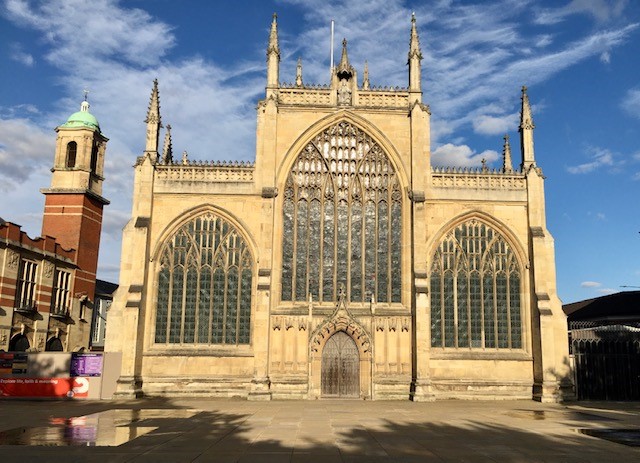
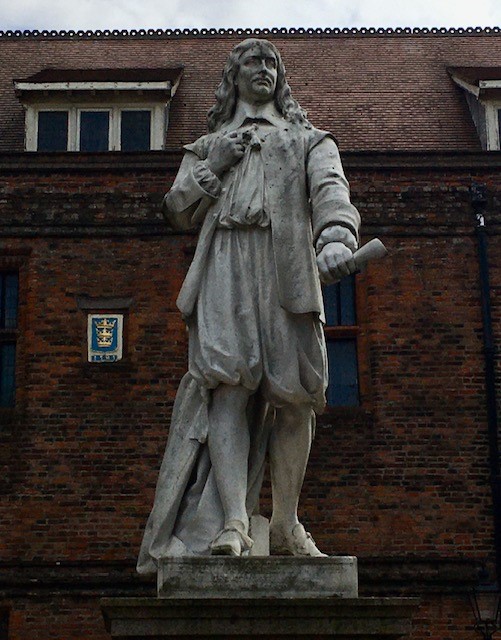
The six-o’clock sun fills its sandy-coloured facade such that its grandeur, and setting on Trinity Square, reminds me of John Wharlton Bunney’s crepuscular painting of St Mark’s, Venice, in the collection of Ruskin’s Guild of St George in Sheffield. On a plinth in the square stands a life-size statue of Andrew Marvell, whose father was a ‘lecturer’ in the church until he drowned when crossing the Humber.
Later, I plod down Holderness Road into East Hull, and pass Rank House, birthplace, in 1888, of J[oseph]. Arthur Rank, founder in 1937 of the Rank Organisation, famous for the strongman striking a gong at the start of all their films.
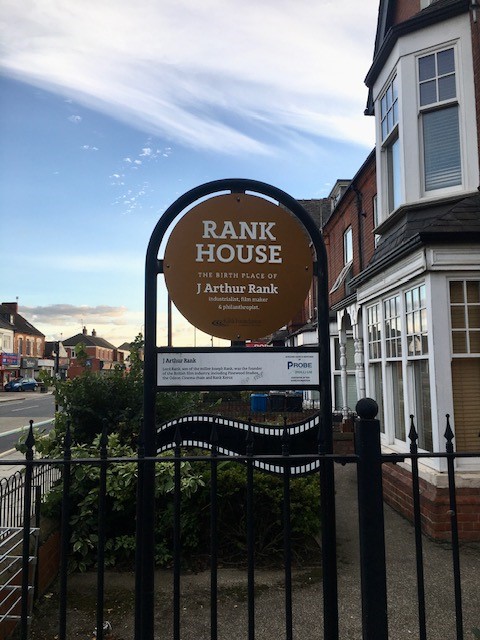
Rank was a staunch Methodist, but profit came before faith so the company’s films weren’t always ‘family-friendly’. He was also a governor of the Peckham Experiment, a pre-war exercise in advanced social living, in which 950 families were encouraged to organise themselves as one community in a generally creative manner. Efforts were made to revive it after the war, when Lady Mountbatten was also a governor. It still exists, of sorts, as the Pioneer Health Foundation. Unlike most interwar do-gooding social studies, it seems not to have been a hotbed of fascists rounded up under Regulation 18B. (When, incidentally, The Times printed the news of Mosley’s internment, a keen-eyed reader wrote in to remark gleefully that the report had appeared in the particular page’s fifth column.)
*
8 August 2023
Instead of taking one of the many buses going in the right direction, I rashly decide to walk to Paull. From a new pedestrian path, I spot Hull Prison, dating from 1870; its mint-green roof complementing the Hampton-Court-like brickwork. If there’s one place where lead roofwork ought to be safe from thieves it’s here.
All along Hedon Road, large Port of Hull signs inform drivers that they’re ‘Keeping Britain trading’ – or as well as they can post-Brexit.
The village of Paull is round the bend at the end of a long, straight road and is largely strung out in parallel to the estuary.
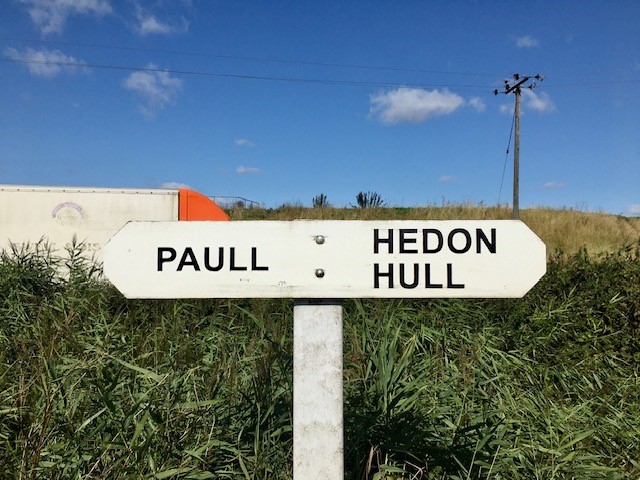
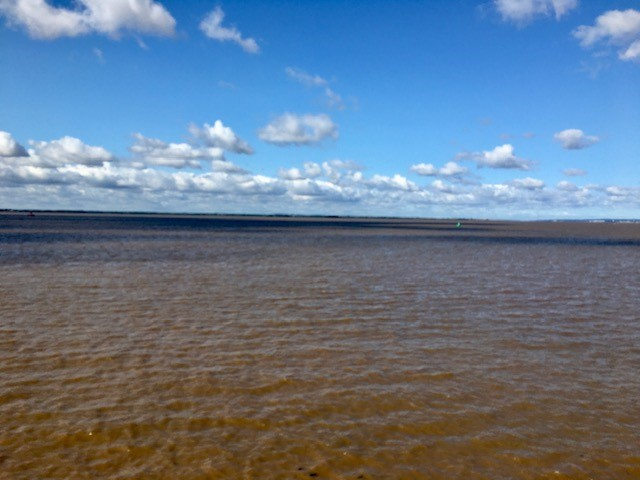
Long grass, ragwort and ice-cream-coloured sea bindweed sway in the shoreline breeze. The river’s browns churn into blues with the movement of the clouds: ‘Here silence stands / like heat’.
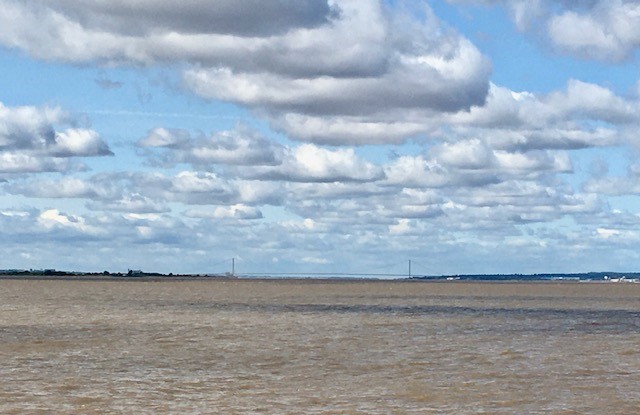
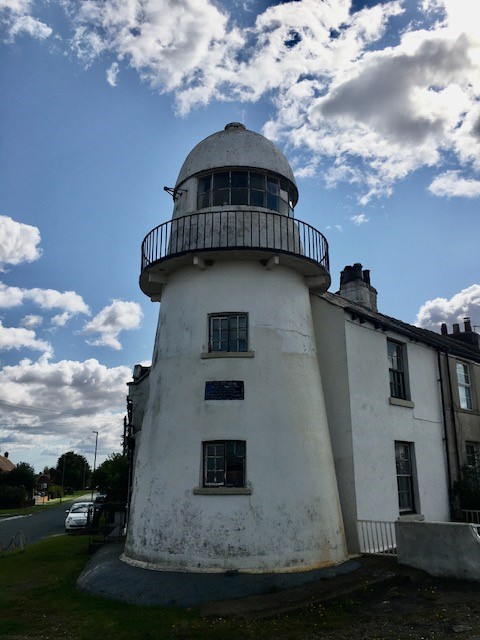
White paint is peeling off the Old Lighthouse, one of the earliest built by Trinity House, in 1826. With full late-morning sun on it, it’s a gorgeous building. The view, across to the Humber Bridge, must be fine from its balcony.

I know in advance that it’s no longer open to the public as an attraction, but I can’t resist vising Fort Paull, a battery, originally built in 1542 and a century later used by Royalist forces, though the parliamentary ships easily evaded its guns in the great width of the Humber.

It saw service in both world wars and was decommissioned in 1960. Today, it’s overgrown and is occupied solely by house martins that swoop low over the adjacent field.
All the walking has whetted my appetite for a beer. It’s unclear which of the two pubs in Paull Larkin patronised, yet only one, the Humber Tavern, survives.
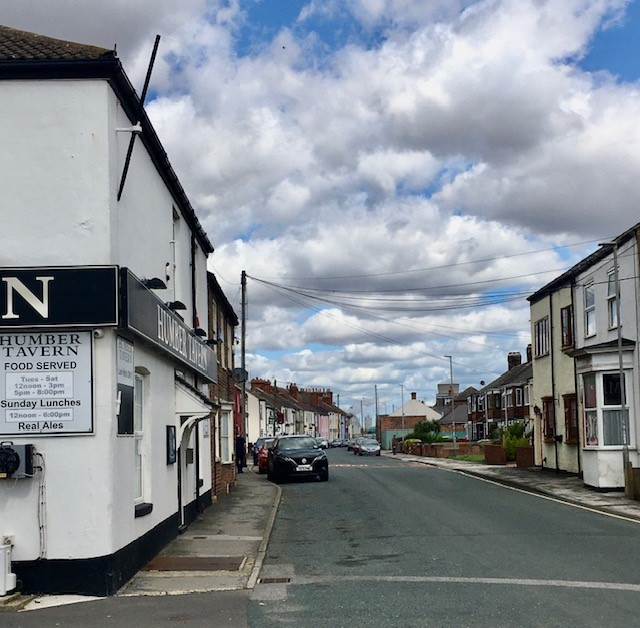
I tip up at 11 to find the door shut and no lights on. After much sulking, I notice the small piece of paper in the window saying that it opens at 5pm on a Tuesday, which today happens to be. My disappointment mutates into happiness at the thought of the imminent arrival of the 79 bus to Hedon, where surely a pint can be had.
The driver’s a Cockney, wearing a West Ham lanyard. I’m the sole passenger and I climb the stairs to obtain some long views of countryside which could easily be mistaken as French, Belgian or Dutch.
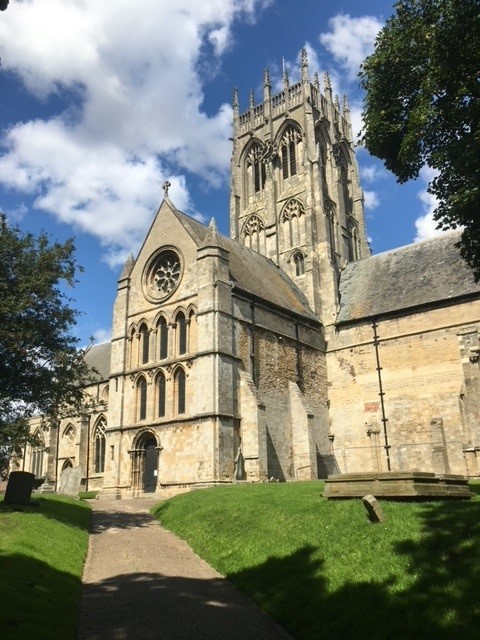
In Hedon, I waste no time in heading up the town’s high street, St Augustine’s Gate, named after the impressive church, the ‘King of Holderness’ (St Patrick’s in Patrington, where I once took shelter in the porch from a torrential downpour, is the ‘Queen’) and which Pevsner described as ‘a reminder of Hedon’s former importance’. In his 10-quatrain poem, ‘A Bridge for the Living’, commissioned for the cantata celebrating the opening of the Humber Bridge in 1981 and written seven years since his previous poem, Larkin wrote, ‘Tall church-towers parley, airily audible / Howden and Beverley, Hedon and Patrington’.
My choice is between the Queen’s Head or the King’s Head further on. Two sips into a terrible pint in the latter and I wish I’d gone to the former. In the beer garden, I sing along to ‘Up the Junction’.
I mosey off for a circular wander which takes me to the ‘Shakey’, the Shakespeare Inn. Here, an old, bearded fella calls across to two other old boys, ‘I’m sixty-six, you know. Just qualified for my state pension.’ The reply is lightning-quick, ‘I’d’ve put you older than that.’ To which the first replies, ‘Would you? Well, if I shave this off . . .’
In the garden out the back, I tuck into a pint of locally-brewed Sleck Dust, a ‘straw-coloured’ blonde beer that hits a spot the King’s head beer could never reach. A wasp takes a liking to it too, repeatedly returning to the glass-lip. Another oldish man, carrying two pints, looks lost. His partner has not appeared. Ten minutes later, after much banter at his expense, she still hasn’t. ‘It’s like when you lose a dog,’ I venture. ‘You’re best off staying in one place and waiting for it to come to you.’ Turns out she’s helped a really old chap with a walking trolley make it to his front door up the road. Cheers all round.
I take the 75 bus, the service from Withernsea, back to Hull. The automated announcer says, ‘Next stop: Hull Prison.’ Do not pass go. The delightful 1932 East Hull Fire station has a motto painted above each of its three arched vehicle doors: ‘Ready Aye Ready’.
I get off at the interchange, next to Hull Paragon Station, location of both the well-known statue of Larkin and the Royal Hotel featured in his Symbolist-ish poem ‘Friday Night at the Royal Station Hotel’, completed in May 1966. In his biography of Larkin, James Booth claims that the atmosphere of the hotel is largely unchanged since the poem was penned, despite a major fire in 1990 and subsequent restoration.
It’s a sonnet, of course, with the turn coming after the ninth line. Although far from being the only poem in his oeuvre to prominently feature light, it starts with ‘Light’ and includes the word ‘lights’ twice, as though hammering the point that this hotel is, and maybe hotels per se are, very brightly lit: ‘In shoeless corridors, the lights burn.’ I love hotels, and I love poems, novels (e.g. Troubles by J.G. Farrell) and films (e.g. The Consequences of Love, Some Like It Hot and The Grand Budapest Hotel) which are at least partially set within them.
A curious part of ‘Friday Night’ is ‘all the salesmen have gone back to Leeds, / Leaving full ashtrays in the Conference Room.’ Few of Larkin’s mature poems mention smoking – is ‘Essential Beauty’ the only other? – even though he smoked throughout adulthood. In a dissection of ‘Cut Grass’, in which ‘Mown stalks exhale’, Tom Paulin conjured the perfect phrase, ‘the anxieties smokers know’; not all smokers are necessarily anxious (do Mick Jagger and Keith Richards ever get anxious?), but the overlap in a diagram by Mr Venn must be very considerable. All of this is a roundabout way of declaring my surprise that Larkin didn’t touch on smoking in his poetry more often.
The part of the poem which is undoubtedly the most intriguing is Larkin’s pressing-home of the point about the hotel being a bastion of ‘loneliness’ by adding the curiosity ‘How / Isolated, like a fort, it is’. Was he thinking of Fort Paull here? Or maybe Bull Sand, one of two Great War forts built in the Humber Estuary, visible from the end of Spurn Point, which is implicitly featured in ‘Here’ .
 Matthew Paul: Poetry & Stuff
Leave a comment