With thanks to editor David Cooke, I have two poems, available to read here, in the latest issue of The High Window: the first is a hybrid poem of sorts; the second is more in keeping with my usual style, I think.
It’s great to be in the same issue alongside, inter alia, friends Kathy Pimlott and Michael Loveday. David always does a terrific job in pulling the journal together.
-
Poems in The High Window – ‘The Postcard’ and ‘Record Breaker’
-
Review of Andrew Neilson’s Summers Are Other
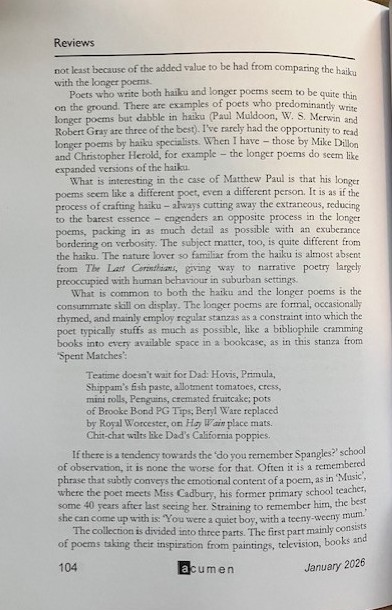
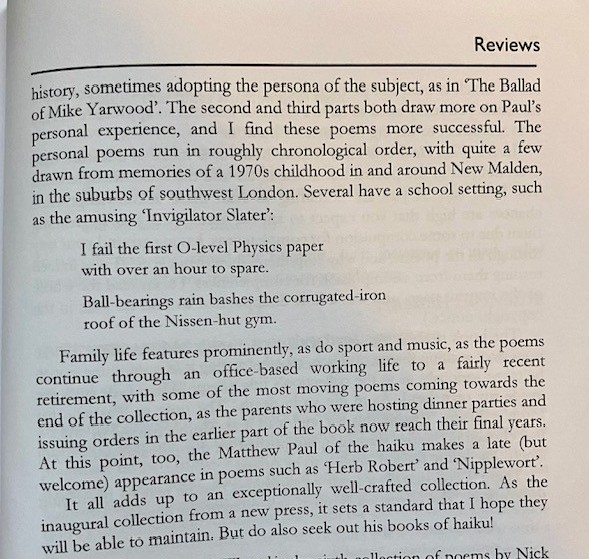
My last review of the year, of Andrew Neilson’s fine Rack Press pamphlet, Summers Are Other, has been published today, over at The Friday Poem, here. My thanks, as ever, to Hilary Menos and Andy Brodie.
This week also saw the excellent news that Blue Diode Publishing will be publishing Andrew’s long-overdue first full collection, Little Griefs, in 2026.
I should also mention that I very much enjoyed Andrew’s essay on Seamus Heaney in the latest issue of The Dark Horse, which is available to buy here.
-
Recent readings and reading
The evening in York was a memorable one: Janet Dean and Ian Parks, whose new collection we were celebrating, read beautifully, and Jane Stockdale’s songs and tunes were delightful. I stuck to my usual set of poems from The Last Corinthians, tempting though it was to read different ones and even some from my previous collection and/or some new ones.
Five days after York, having been invited by Katie Griffiths to read in Walton-on-Thames alongside Sophie Herxheimer, I skedaddled down south for what was perhaps the most enjoyable gig for me since the one in Nottingham in September. Sophie is a force of nature, an artist as well as a poet, whom I could’ve listened to all evening. She got everyone making zines during the interval. Katie herself read a poem; it’s excellent news that Nine Arches will be publishing her second collection next year. There was also a short open mic, the readers including marvellous Jill Abram.
Photo by Cris Fells of Sophie Herxheimer, Katie Griffiths and me. As Walton is only a few miles west of Kingston, I tailored my set accordingly, with more locally-set poems than I would normally read, though I decided – wisely, I think – against reading one, ‘The Blue Bridge’, which features Sham 69, who came from the neighbouring town of Hersham. In all, it was a joyful evening, and a good way to end this year of readings, which has seen me appear in eight cities and towns in England within the space of six months. It’s been more of a meander than a tour, and two of them were serendipitous invitations at fairly short notice; nonetheless, it’s been lovely to read my poems out loud in front of attentive listeners, not all of whom are poets themselves. I’m thankful to everyone who’s come along, whether because of me, my co-readers or both. I’ll start again in 2026, with a trip to Wells in March.
Meanwhile, my friend and fellow native-Kingstonian poet Greg Freeman, wrote a kind review, available here, of The Last Corinthians for the Write Out Loud site, for which he is the news editor. I am especially grateful to Greg for this, for he not only also reviewed the first launch event at Doncaster back in June but was also the first person to review my first collection. Many congratulations are due to Greg for graduating yesterday from the Newcastle University / Poetry School MA in Poetry.
This last week has seen me join up with poet–friends for a residential in Cloughton, four miles north of Scarborough and just under a mile from the North Sea. Due east from there, there’s no landfall until Schleswig Holstein.
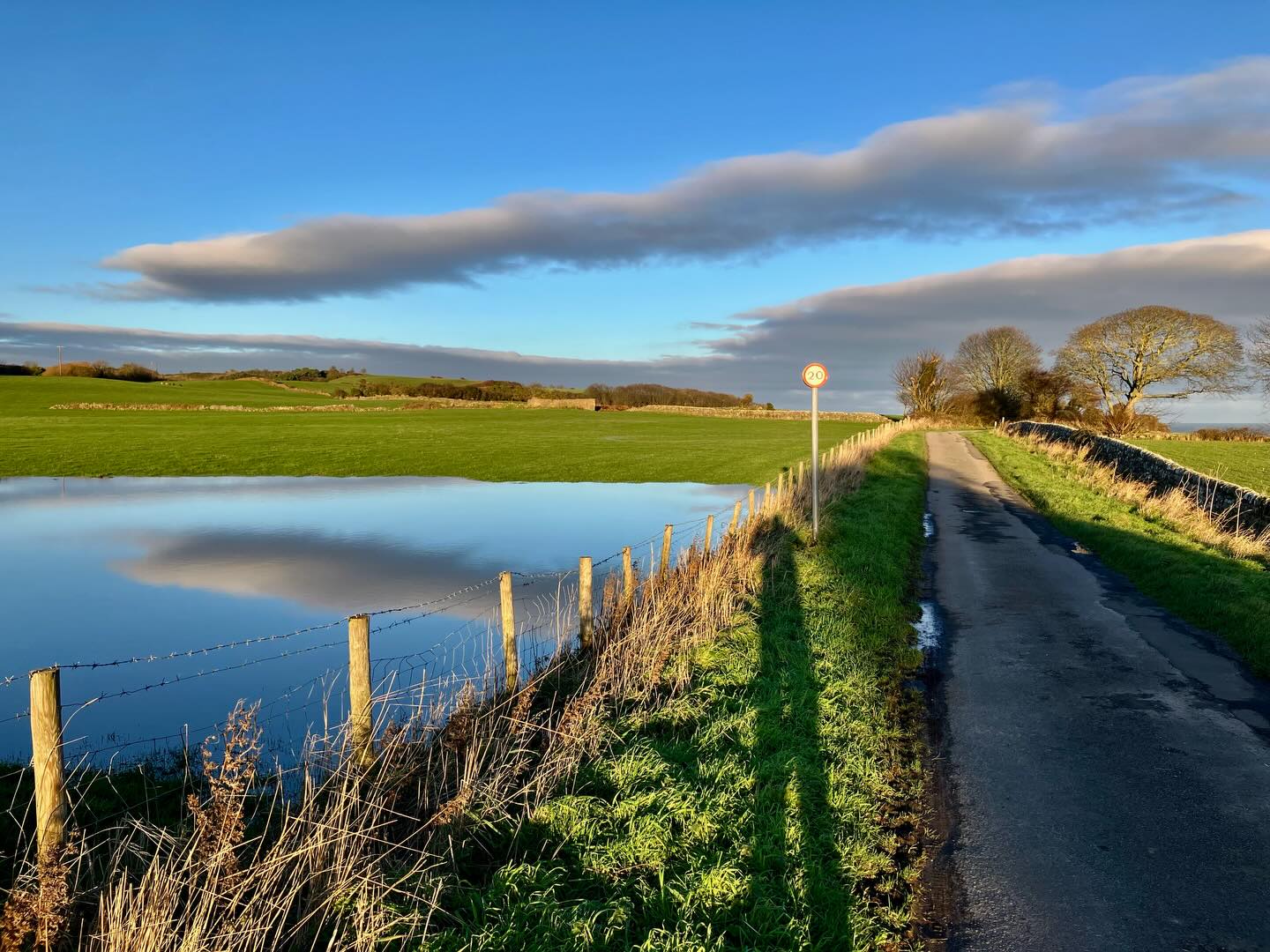
The track to Cloughton Wyke. Although there were intense mornings of drafting poems using prompts, there were also lots of laughs and games, including guess-the-mystery-poets, pool and table tennis, despite the games room (a big shed) being a bit flooded. There was also lots of that great British delicacy, fried bread, at breakfast, which was right up my strasse. I can’t say that I wrote especially well, and sometimes in such weeks the real pleasure to be had is in hearing how well others can draft fully-formed poems in under 10 minutes, and in the conversations at meal-times and in small workshop groups. I very rarely write well from prompts, and usually only if I go off on a tangent, but that’s not necessarily the point; it’s more about getting words down on a page and seeing what might emerge, either immediately or much later when the words are revisited. It is invariably amazing to discover what memories, thoughts and word salads appear.
In between times, I’ve been reading books and journals in a rather unsystematic manner. Here are my thoughts on some of them.
I very much enjoyed Amanda Dalton’s third full collection, Fantastic Voyage (Bloodaxe, 2024, available here), which riffs on the wacky 1966 film of the same name and also includes her moving meditation on grief, the two long poems which make up ‘Notes on Water’ (which I briefly reviewed, here, when it appeared as a Smith | Doorstop pamphlet in 2022), as well as a series of tremendous prose poems which are as funny as they are affecting, as in the opening and ending of this one:
Auntie Irene says that cousin John got a tapeworm from stroking the sheep. [. . .] Every time I see my cousin John I want to ask him if the tapeworm is still growing in his insides and every time he speaks to me I wonder will it come out of his mouth like words he didn’t mean to say.
Alan Buckley’s Still (Blue Diode Publishing, 2025, available here) was for me rather a disappointment after his sublime 2020 debut full collection, Touched (HappenStance Press): every (single-word title) poem consists of six couplets with seven syllables per line, a form which Buckley calls the ‘douzaine’, and most of them are about nature and were written during Covid times, though too many of them seemed like nature notes, inhibited rather than helped by the form, in which the thoughts he conveys aren’t quite brought sufficiently into focus and sometimes lapse into cliché, such as ‘May you burn brightly as long as you can’ (‘Glow’), or the obvious – a magpie described as having ‘piebald simplicity, / disturbed by metalline blue’). The paring-back dictated by the form, which he talks about in the book’s end-matter, lacks the powerful concision of haiku and doesn’t quite leave enough room to develop the plethora of ideas that he evidently has. However, I do, admire Buckley’s determination to try something different and at their best, these poems have a fine simplicity, as one would expect from such a talented poet: ‘As the final transport plane / leaves Kabul, here in Marsh Park // the Afghan boys play cricket. / They made their journeys on foot, // in trucks. Some don’t know if those / they left behind are alive.’ (‘Cricket’) Maybe a re-reading will prove more profitable.
At the age of 80, Peter Jay has collected his poems 1962–2024, as The Last Bright Apple, published by Anthony Howell’s Grey Suit Editions and available here. Jay was the founder and chief editor of Anvil Press Poetry from 1968 until it ceased in 2016, when some of its poets and back-catalogue were taken on by Carcanet. Jay had impeccable taste; as well as perhaps his most lucrative (!) asset, Carol Ann Duffy, I have on my shelves Anvil books by real favourites of mine, like Martina Evans, Michael Hamburger, Anthony Howell himself, Peter Levi, E.A. Markham, Dennis O’Driscoll and Greta Stoddart, and Edmund Keeley and Philip Sherrard’s translations of Elytis, Seferis and others. As is often the case, Jay is better-known as an editor than he is as a poet, and this nicely-titled and beautifully-produced book will go some way to restoring his reputation as a poet. I say some way, because it’s not the most substantial of outputs and includes many translations from a variety of poets and languages. At his best, though, Jay’s poems are warm, attractive and cerebrally ruminative without being esoteric, as in the opening half of ‘Thoughts’:
There are days when the mind grazes,
Circling itself like an answer
Lazily guessing its question.
How fragile they are, thoughts,
How delicately to be hoarded!
When a white thought runs away,
It takes on the colour of air,
Of water. Unguarded thought,
Home thought in search of a heart,
Heartless though in search of a home,
Desert thought thirsting for an oasis,
Pale fractured thought, let me catch you,
Name you and give you a colour.
These lines, perhaps unsurprisingly, remind me of Levi and of the late collections of Hamburger. Elsewhere, Jay is a pleasing observer of what passes for natural wonder in nature-depleted England, e.g. ‘Swans on the tarn / move with the weather, / rain, wind or sun, / drifting together.’ (‘Little Langdale’), and is wryly reflective on his life’s work: ‘What can be done with poets? / Such awkward people. We know / They don’t matter at all; why then / Do they concern us?’ (‘Ars Politica’). In all, this is a collected poems which, despite being comparatively slender at 150 or so pages, contains the sort of fine, philosophising poems which are sadly out of fashion these days.
I’ve also spent time revisiting the metaphysical rococo wordscapes of Lucie Brock-Broido. The four collections published by Alred A. Knopf before her death in 2016 at the age of just 61were and are magnificent. It amazes me that, although Carcanet published a fine selected, Soul Keeping Company, in 2010, the individual collections are yet to be published over here. Maybe they’re waiting for Knopf to publish a definitive collected.
I have more reviews to write before Christmas, and one appearing next week. It has without doubt been my busiest year of poetry, and for that I am very grateful.
-
Reading in York tomorrow evening
I’ll be reading tomorrow evening as one of the guests at the York launch of Ian Parks’s terrific new collection, The Sons of Darkness and the Sons of Light (Crooked Spire Press). As well as Ian and me, there will be more poetry from Janet Dean, music from Jane Stockdale, and an interview with Ian by Tim Fellows, Crooked Spire supremo.

Poster for the event in York 
Another poster for the event in York
-
Reviews of Annie Fisher, Kath McKay and Claire Crowther
Annie Fisher, Missing the Man Next Door, Mariscat Press, £9
Kath McKay, Moving the Elephant, The Garlic Press, £10
Claire Crowther, Real Lear: New & Selected Poems, Shearsman Books, £12.95
Fans of Annie Fisher know that her poetry of the everyday – serious, entertaining, sometimes bordering on outlandish – is handsomely crafted. Even on a first breeze through the 24 poems of her new pamphlet, the variety is evident: of form, length, type and subject matter. There are couplets, tercets, blocks, prose-poems, list-poems, an unrhymed sonnet and more, encompassing, as before, high seriousness, nonsense verse and fantasy. What is constant throughout is Fisher’s voice: droll, mischievously cynical and worldly-wise.
The title-theme is introduced cleverly in a poem entitled ‘The New Neighbour’, whose anonymous character has succeeded ‘John / who died in the pandemic at the age of ninety-four — // John, to whom I never said goodbye, / who’ll always be, for me, the man next door.’ John is elegised at fuller length in the title poem, a list-poem full of delightful closely-observed memories:
I liked that he was there.
I liked the way he sang Italian arias off-key.
I liked how every time he tottered to the corner shop
for bread and beans, he’d ping our metal gate post
with his stick, then nod and smile to hear the note it made
as if was his tuning fork.
Fisher’s use of anaphora here surely bestows extra poignancy to her moving recollections.
Another, pleasurable list-poem, this time verging on nonsense verse (to which it states its debt), itemises what the title, ‘A Few Favourite Things’, indicates, including ‘naked swimming, hugging trees, / Seamus Heaney, Scotsmen’s knees’.
A handful of nature-themed poems include one about the critically-endangered shoebill and a lovely short poem, ‘The Old Beech by the Lychgate’, which deserves to be in every anthology of tree poetry: ‘It’s unembarrassed if we talk out loud. / It’s just as fine with nothing being said.’ That half-rhyme adds to the poem’s four full rhymes. Full rhyme is seemingly scarce nowadays but Fisher is adept at using it to winning effect in light verse which bears comparison to Lear or Nash:
The Parson’s goldfish is godlier than God,
His piranha is pious as well,
But the Parson himself is a wicked old sod,
Who’s probably going to hell.
(‘The Improbable Perfections of the Parson’s Pets’)
The clerical theme continues overleaf (and not, alas, opposite) in one of the pamphlet’s two highpoints, ‘Priests’. Its eight tercets reflectively address the good and the bad in what might be the definitive poem on the subject:
Some were demons. Some were saints.
One (dear Father Clement) was an angel.
They starved for lack of ordinary love.
Here, as throughout, Fisher turns skilfully on a sixpence from the generic to the specific and back again.
The pamphlet ends with the other highpoint, ‘The Old Dancing Woman of Bridgwater Town’, a luscious, celebratory whirl, using ballad meter, of Fisher’s own Somerset roots:
and she’s dancing through Northfield and Springfield and Oakfield,
she’s dancing down East Quay and Westover Green
and on through the back streets, the dark streets, the drunk streets
where only Houdini the alley cat’s been.
Occasionally, Fisher’s flights of fancy – ones involving R.S. Thomas and Jesus for example – feel like filler, but on the whole this is another rich assortment from a poet whose mastery of comic verse shouldn’t blind readers to her ability to write, additionally, and at times simultaneously, profound, re-readable poetry.
Kath McKay’s third full collection, like its predecessors, reflects her life story: a working-class Liverpool-Irish childhood, university in Belfast at the height of the ‘Troubles’, and adulthood, teaching in London, Leeds and Hull, parenting and grandparenting. It runs chronologically, right up to the pandemic and beyond, and the poems are almost always comprised of personal vignettes.
McKay’s style doesn’t set off fireworks; at their best, though, the poems in Moving the Elephant are, well, moving. The staccato clauses of an elegy for her mother, ‘I Know that the Science of Genetics’, say much with little:
[. . .] I fifth in your belly,
one dead at a year, three more to come, and youlapped milk and fed me potatoes and bread, so that
when women go on about chocolate, I say, Give me
potatoes and bread.’
Two successive poems deftly celebrate the optimism of McKay and her Sixties cohort’s aspirations:
In spring, Harold Wilson told our sixth form, ‘You will go far.’
A lad asked about the White Heat of Technology. Next Day
over the law on the conservation of mass, the chemistry teacher
we felt sorry for, in her glasses and bun, curbed our giggles:
‘In the modern world, everyone will need a knowledge of chemistry.’
The Physics teacher had ‘Leaving the Tao’ written on his door.
(‘Leaving the Tao’)
‘Youse girls, says Nelly. ‘Get yourselves an education. Get out of here.’(‘Saturday Job’)
The range of subject matter is diverse, covering: learning Spanish, Catholicism, political activism, working in a jam factory (‘How to switch my mind off, but keep enough residual attention / in case something untoward like a dead spider or a decapitated mouse / ended up in the jam’), secondhand clothing, Captain Webb, moving house (the title poem), a 77-year-old milkman, a visit to a chiropodist, soup-making, strong women and much else; but it is the poems about family which are arguably the most captivating. ‘The Other Room’, second-person tercets presumably about the death of McKay’s mother, contains the tenderest of moments, ‘you note / that your mother is growing colder, but still, you want to cuddle her / in case something of her is still floating round, lost.’ Somehow, the punctuating repetition of ‘still’, albeit used in differing ways, heightens the emotion.
The collection feels over-stuffed; 61 poems is excessive, given their lack of formal variety. In particular, six successive travelogues (set in Russia, Australia x 2, Italy and Spain x 2) midway through the book feels like a few too many, like that old trope of the neighbours showing you their holiday snaps with an implicit ‘you had to be there’ hanging in the air. The best is ‘Black Tea and Lemon’, because its tale is the quirkiest: ‘All night on the train between Moscow and Krasnodar, / Michael cracked the shells of boiled eggs and popped in thirteen.’
Heartfelt though all the poems in the book are, they don’t quite often enough include surprising lines or metaphors/similes, or portray incidents out of leftfield – a poem resulting from donation of her late brother’s eyes is a notable exception and shows exactly what McKay is capable of.
I was left with an abiding memory of two consecutive poems, both of which stand out precise because of their formal difference and (appear to) concern the death of McKay’s partner at just 56: ‘Unremarkable’, a very much remarkable list poem in which the condition of his body parts is itemised – ‘Liver shows evidence of nutmeg congestion’ – and ‘The Other Side’, seven couplets, but not a sonnet, which unflashily and touchingly convey the zombie-like autopilot nature of bereavement – ‘I boiled a kettle I’d forgotten to fill. Left the toast // to burn. Told the kids, their faces stricken, I was going shopping.’
Claire Crowther’s poetry is considerably more complex than Fisher’s or McKay’s. This retrospective drawn from her five collections from 2007 to 2022, plus 23 new poems, therefore demands patience on the reader’s part. In a 2009 interview, in response to the question of how closely Crowther drew on her own experiences, she said:
In a way I always do but only as a starting point. I have always felt what I write about – that’s the genesis of a poem. But the detail varies from my own experience – it could be that I observe other families interacting and freely bring in their details. I never feel I have to stick to any one set of facts – I mingle and match facts I’ve observed to serve the poem which becomes something different. In the end, there is rarely any autobiography at all – the poem has taken over completely.[1]The innate questions of this mix’n’match approach are whether the effort required to try to locate the emotional heart, and the point, of each poem justifies the time spent. I confess that my first read-through was challenging and that the poems – or, rather, some of them – only came alive on a second reading. Perhaps that is a good thing – like music whose depths only reveal themselves over several listenings.
The first poem, has a forbidding, if not off-putting, title, ‘Reconstructive Fortress’, but concerns one of those life-changing events: the process of selling a property, a flat in central London, and the feelings it evokes. The short sentences of the poem’s middle stanza follow each other in an almost disassociative, dark-humoured manner:
I’ve been wearing this flat for too long.
It’s dark though I’ve accessorised it in turquoise.
It works best when my skin is palest in winter.
In summer, it makes me look tacky. I am ready
to invest in a house as well-fitted as a bra.
None of that faux leopard skin, no balconettes.
A later, charming companion piece of sorts, ‘Fennel’ takes a strange turn: ‘The new owners may scrape the taste of my house / off its surface, but her fennel seeds cranny in fissures / and plan a dynasty of yellow tang.’
The subject-matter of the early poems is as happily varied as Crowther’s syntax is elegant. ‘Lost Child’, one of several poems set in Solihull, unspools its curious tale over six couplets, ending beautifully: ‘Pearl was playing quietly alone. / My ear is like a shell the wind swept.’ ‘Nudists’ opens with a killer line, ‘In the home of the naked, glass is queen’; as does ‘Foreigners in Lecce’: ‘Home is rind-hard’. The 23 five-line stanzas of ‘Against the Evidence’ unfold a short story largely also set in and around Lecce, and the phrases of which needs to be slowly savoured:
Saturday. Lemon of winter. Damp charcoal
bramble. Grey quilts of cloud. Wind tumbles
the wrapping from our ciabatta as if future
is the rim of a beaten country
and we’ve reached it. [. . .]
‘Once Troublesome’ begins as a fine Twixmas poem – ‘It isn’t New Year yet so Happy What? / Till then, it’s Boxing Day every morning.’ – then veers off with Crowther’s trademark odd turns. ‘Live Grenade in Sack of Potatoes Story’ is weighed down by its title’s promise.
A number of poems revolve around ‘thikes’, creatures imagined by Crowther, again in Hob’s Moat, Solihull: ‘The number of thikes / casually shot is high. / Celebrities on Channel Five News / have endorsed the policing of thike-baiters.’ (‘The Thike). Whether it’s a metaphor for marginalised groups, or even the position of women, within British society isn’t entirely clear, but it gives Crowther licence to play:It’s not because I’m dirty
It’s not because I’m clean
It’s not because I kissed a thike
inside a space machine
(‘Sleeping on a Trampoline’)
That playfulness is evident elsewhere, such as a punning riff on her forename in the whackily entitled ‘Self-Portrait as Windscreen’:
Do you think I’m clear on every issue
just because I’m glass?
Have you heard yourself calling ‘Claire,
Claire, Claire, Claire’ when you’re confused?
A name is lulling
when you aren’t clear on every issue.
It’s tempting to intuit that that last line is a knowing, self-aware thought that her poetry is not of the transparent kind.
The difficulty quotient is ratcheted up further in Crowther’s fourth collection, Solar Cruise, which explores, via the metaphor of a cruise ship, the world of solar physics inhabited by her partner, Keith Barnham. Yet, among the scientific jargon, these poems are among the book’s most enjoyable, largely because we find Crowther at play again: ‘A sheen of fog curtains our balcony / and into that the captain sends a throaty // ohhhhm // ohhhhm // ohhhhm’ (‘Foghorn with Solar Harvester’). She satirises the domineering men of that world and celebrates the women whose achievements ought to be better known. One poem, ‘Electricity Generation in Germany in a Typical April week’, incorporates a graph showing the relative amounts of solar, wind and conventional power generated. There are further physics-related poems in her fifth collection, and curious others, including a love poem and a (cod?) metaphysical one:
Now we are over, death
has nuanced our model of dead worlds.
Indeed, as some poet mentioned,
pearl is mere pavement here
and no one dead mourns.
(‘Heaven is Nothing If Not Resolution’)
The final section, Real Lear, reimagines Lear as a woman, and includes some delicious gobbledygook, in particular in the nature poem, ‘Gabbery’:
every dry battletwig
scuttles under tubbans
a dunnock in the hedgeskips
sings to her nestling:
cuculus cuculus
gowk in my hidland
gabber in my hidland
o fierce cuculus
This intriguing seam has also recently been mined to great effect by Geraldine Clarkson, in her collection Medlars. Poetry to be enjoyed purely for its soundscape reaches an apogee for Crowther in the book’s final poem, ‘Soundsunder’:
[. . .] I hear inside my silence
that it is the sussuround of us
we other:
sounds that shushhush the our of self
In reading such a generous selection of Crowther’s poetry, it becomes a struggle to know when she is making serious points and what they are. The density of her writing, albeit often exquisitely crafted in musical lines, inhibits simple, or simplistic, exegesis and therefore prohibits much in the way of an emotional reaction other than a degree of frustration and, inasmuch as one can judge the tone, a wry smile at the fun Crowther appears to be having, as if one isn’t quite allowed in on the joke. Surely, though, kernels of clarity are gradually revealed over multiple re-readings.
[1] Interview with Andrew Philip, https://tonguefire.blogspot.com/2009/07/open-plan-otherness-interview-with.html, accessed 23 November 2024.
-
November readings
As well as the event in York on Friday 21st November – when I’ll be one for the supporting acts for Ian Parks at another launch event for his new collection, The Sons of Darkness and the Sons of Light – I’ll be reading in Walton-on-Thames on Wednesday 26th, 7.30pm, at the Riverhouse Arts Centre. My fellow reader, multi-talented Sophie Herxheimer, and I will both also be in conversation with Katie Griffiths, whom I know from my days as a Red Door Poet. Details are available here. That’s as near to a hometown gig as I’ve had yet.
-
On the last while
It’s been a bit of a poetry whirl of a month for me. The National Poetry Day readings at Rotherham Civic Theatre were well-attended, and not just by the readers, for the launch of Ourselves Reflected Back, the anthology of local voices, edited by Vicky Morris. The quality of the poetry was unsurprisingly variable, but the passion and commitment were exemplary and never in doubt. Many poems were poignant or funny, or both. (The event also reminded me never to have an alcoholic drink before reading – in this case a pint of Guinness I walloped down in a couple of minutes in the theatre’s bar – because it always impairs my diction, even after, as in this case, just one drink.)
On Tuesday 7th, I read at the Dusty Miller, in Mytholmroyd, West Yorkshire. Before the reading, I made the obligatory pilgrimage to the house where Ted Hughes was born and lived, before he and his family moved to Mexborough when he was seven. The readings were co-hosted by the lovely duo of fine poets Carola Luther and Ian Humphreys, who set the tone for the evening with very thoughtful, perceptive and generous introductions for my co-readers, Molly Prosser and Kim Moore, and me. As I often do, I learnt a lot by listening and watching the other readers, especially Kim, who worked the room in as natural and engaging a manner as Peter Sansom had at Five Leaves bookshop, Nottingham, back in September.
The following Saturday saw the launch in Doncaster Unitarian Church of Ian Parks’s new collection The Sons of Darkness and the Sons of Light, published by Tim Fellows’s Crooked Spire Press. As with my collection, Tim did a great job in producing the book. There was a supporting trio of readers – Susan Darlington, Steve Ely and Laura Strickland – each of whom read their excellent poems with gusto. Liam Wilkinson sung some terrific songs, accompanying himself on guitar. Ian himself read beautifully from his tremendous collection. Most notably, to end proceedings, Ian read the long and moving title-poem of his book, gradually building up the pace and power of his pitch. It was a highly memorable experience, up there with any long-poem reading I’ve ever heard, including Allen Ginsberg reading ‘Kaddish’ at the Albert Hall. There’s an account of the day, by Tim, plus plenty of photos, on the Crooked Spire Press website, here.
I then watched Ian’s online reading on Tuesday 21st. There was music again, by Liam’s dad, Allan Wilkinson, who is also a very talented singer and guitarist, and guest readings by Bob Beagrie, Gaia Holmes, Vanessa Lampert and Charlotte Wetton, a diverse array of distinctive poets, with different styles and subject-matter, all of whom read exceptionally well, as did Ian himself. As anyone who’s tried knows, reading online is trickier than reading in person, because you can’t see everyone and therefore can’t gauge their reactions as easily; nor can you really tell how loudly you’re speaking. On this occasion, though, all the readers coped very well and MC Tim Fellows ran things very efficiently and effectively.
This Thursday just gone, I travelled down to Stroud, in Gloucestershire, to read at the Museum in the Park, at an evening organised under the aegis of Yew Tree Press run by Philip Rush, who was on the second Poetry Business Writing School programme I attended in 2019–2021, which was curtailed by Covid. The other two readers, Mark Corcoran and Polly Howell, were/are both local poets who deserve to be better-known. I changed my set a bit from the Mytholmroyd reading, which was easy to do because my slot at both was (up to) 20 minutes – however, well a poet knows and can therefore remember the words of their poems, it does, I think, get a bit wearying always reading the same ones. Of course, some poems in collections, in mine at least, just don’t work particularly well when read to an audience; this can be because of: words which might be heard as their homonyms; obscure references (a speciality of mine!) which necessitate explicatory preambles; are too short or too long; or page layouts which are an intrinsic part of the poems’ effectiveness and so can’t be orally conveyed. Philip and the Stroud audience were really warm and responsive, and I enjoyed the evening immensely. It was great also to meet the poet JLM (Juliette) Morton, whose Broken Sleep Books collection Red Handed I enjoyed reading last year, and to see in person again David Hale, my fellow member of the workshop group, the Collective, whom I first met when he and I were on my first Poetry Business Writing School programme back in 2017–2018. (Nice though it is to see David and everyone else in the Collective over Zoom every other Sunday, seeing them in person is even better – though we’re yet to meet together in person; in fact, there are two members, Ben McGuire and Lydia Harris, whom I’ve never met in person.)
On Friday, I was one of six readers at an Off the Shelf Festival event in the University of Sheffield Drama Studio’s theatre, as a celebration of forty years of my and every other UK poet’s favourite poetry journal, The North. Hosted by the co-editor (and co-director of the Poetry Business), Peter Sansom, it consisted of a delightful 20-minute reading by the Sheffield Poet Laureate, Beth Davies, whose pamphlet The Pretence of Understanding won the New Poets’ Prize 2022, and then short readings – by Peter, Alan Payne, James (Jim) Caruth, Kate Rutter and me – each of three poems which had appeared in The North. I read Stephen Payne’s superb villanelle, ‘Dai’, Victoria Gatehouse’s brilliant, and brilliantly-titled, ‘Reservoir Gods’, and my own ‘The Prang’. It was another very memorable event, and a fitting tribute to Ann and Peter Sansom’s work over the years to cement The North as a hugely important pillar of the poetry scene in the UK and beyond.
And then yesterday, I went to my third poetry event in as many days. I have to say that by this point I was feeling as though I was permanently living in a bubble of poetry. But the quality of the event was such that I had another great time. It was the launch, at the amazing Leeds Library, a venerable and beautiful subscription library founded in 1768, of Ian Harker’s Smith | Doorstop pamphlet, Gain Access, which Kim Moore chose as the winner of last year’s Poetry Business International Book and Pamphlet Competition. Gain Access is available at the bargain price of £6 here. The event was MC-ed by the poet Joe Williams, who read and recited two poems of his own, and Ian had two guest readers, Melanie Banim and Tom Weir, both of whom read their fine poems very well indeed. Tom and Ian were also on the Poetry Business Writing School programme alongside me, in my first and second ones respectively. It was great to see Tom read some old favourites, plus some new, heartrending poems. Ian’s pamphlet, which I haven’t had time to read in full yet, consists of poems about his days as a housing officer for Leeds City Council. Everyone in the room was privileged to hear Ian read a selection of them yesterday. As a former local authority officer myself, and with my daughter having recently moved roles in the council she works for (from Customer Services) into Housing, as a homelessness officer, the poems resonated very strongly with me. As we all know, public servants in general in the last 15 years have, alas, had to get used to doing more with less funding, as a result of Cameron and Osborne’s Austerity, May’s ‘hostile environment’ and failure to control the roguest elements of her party as it went hell for leather towards the national economic suicide that was Brexit, Johnson’s plumping for Brexit purely as a way of self-aggrandisement and his incompetence and lies at the helm throughout the pandemic, Truss’s crashing of the economy for entirely ideological reasons, Sunak’s failure to effect any improvement to people’s wellbeing, and the huge disappointment, so far, of Starmer’s government to effect the positive change they were elected to. Hearing Ian’s poems about the day-to-day impacts of all that on ‘ordinary’ people’s lives was intensely moving; they are extraordinarily well-crafted poems, which impart their message and import without preaching or hammering.
What I learn from watching and listening to other poets read isn’t just how they make their poems engaging, but where they pause, what they emphasise, how they vary their pace and all manner of tricks which make reading poems to an audience into a proper performance. Inevitably, I also get inspired to write new poems, because memories and ideas get triggered.
Much though I loved all those events, I’m glad to have a bit of a break before the next one, another 20-minute reading I’ll be doing in support of Ian Parks (and with Janet Dan and musician Jane Stockdale) in York on the evening of 21st November – details and (£5) tickets are available here.
This month’s Poetry Book Club book is Ash Keys, the ‘New Selected Poems’ of Michael Longley, published by Cape not long before he died. Of his generation of poets from the north of Ireland, he’s not, to my mind, up there with either Heaney or Mahon (or for that matter, with the younger generation of Carson, McGuckian and Muldoon). I do, though, like some of his poems, especially his short ones on the flora of the Burren, in the west of Ireland. My chosen poem to talk about at the meeting is a section of his elegiac sequence on Peter, his twin.
The poetry collection I enjoyed reading the most in the last month was Gunpowder by Bernard O’Donoghue, another Irish poet, published by Chatto & Windus back in 1995. It pulled off that rare hat-trick of making me laugh, swoon at his skill and admire how it seemingly effortlessly moved me. I shall have to find and read more of his collections. On my shelves, Gunpowder sits happily between collections by Sean O’Brien and Dennis O’Driscoll, which is surely a fine place to be.
-
National Poetry Day
I’ve never been asked to take part in any National Poetry Day events before, so I’m very pleased to be reading a poem or two this Thursday evening. It’s the launch event for an anthology of poetry written by poets from and/or living in or near Rotherham (including me). It’s published by Flux Rotherham and Spread the Word, who do so much to encourage poetry and other literary writing and art projects in the area, and it’s edited by the very fine poet Vicky Morris, who has herself done a great deal of good working with young people aged 14–25 through the Hive South Yorkshire programme, here. I’m looking forward to hearing the rich array of local voices.
The event is at Rotherham Civic Theatre and details are available here.
-
September reading and other news
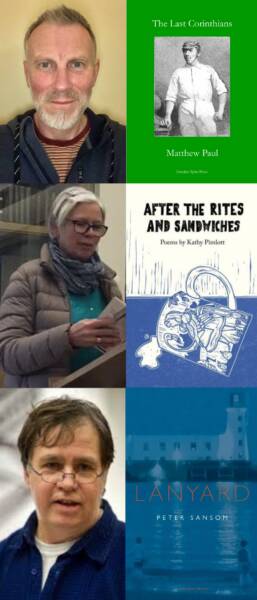
On Tuesday, I had the great pleasure of reading at Five Leaves bookshop in Nottingham, alongside two lovely poets whose poetry I love: Kathy Pimlott and Peter Sansom. As Kathy mentioned during her reading, she and I met because we were both participants in the Poetry Business Writing School run by Peter and Ann Sansom. I think our sets of poems complemented one another’s. I’m very grateful to Ross Bradshaw of Five Leaves and Tim Fellows of Crooked Spire Press for introducing our readings. Here’s a photo taken afterwards:

Photo of Kathy Pimlott, Matthew Paul and Peter Sansom I have two readings coming up in October, at the Dusty Miller, Mytholmroyd, on the 7th, and at the Museum in the Park, Stroud, on the 23rd. Both are free events, with no ticketing. Details are available here.
I’ve been reading Peatlands (Arc Publications, 2014), written by Pedro Serrano, the Mexican poet, and translated by Anna Crowe, both of whom I was due to be reading alongside in Mytholmroyd. (They have been replaced by Kim Moore and Molly Prosser.) In his poem ‘El Arte de Fecar’ / ‘The Liminating Art’, he writes, ‘Shitting is like the art of writing: / you have to give it thought and just so long / for everything to come out good and strong.’ I can’t argue with that.
I’ve also been (re-)reading Us (Faber, 2018) by Zaffar Kunial, as it’s the chosen book for this month’s Poetry Book Club. In these days when the media are encouraging the open racism of far-right fuckwits, his poems exploring what it means to belong have taken on added importance. I’ve also re-worked my way through the poetry oeuvre of Seamus Heaney, accompanied again by Stepping Stones (Faber, 2008), Dennis O’Driscoll’s seminal interviews with him. For me, Heaney remains a paragon of how a poet can negotiate the politics and events of their time.
I’m also savouring Flint Country (Saraband, 2025, available here) by Laurence Mitchell, whose East of Elveden blog (here) I have long enjoyed. It’s a lovely, heartfelt meditation on the character, history and importance of flint in Norfolk, Suffolk, Sussex and beyond.
Finally, I’m very grateful to Jonathan Taylor, who featured two poems from The Last Corinthians on the Creative Writing at Leicester site, here. I should mention again that Jonathan’s short-story collection Scablands (Salt, 2023), available here, is one of my reading highlights of the year.
-
Poem at Atrium – ‘Highlights of the Yorkshire Branch of Butterfly Conservation’s Members’ Day’
I’m very pleased to have another poem published at Atrium, here. My thanks go to the co-editors, Holly Magill and Claire Walker.
-
Three poems from The Last Corinthians
I am very grateful to my fellow Collectivite Fokkina McDonnell for featuring three poems from The Last Corinthians over on her blog, here.
If you haven’t got copies of Fokina’s poetry collections, they are all tremendous; details are available here. I wrote about a poem from her most recent collection here.
-
Review by Philip Rush of The Last Corinthians
I am greatly heartened by the very kind review written by Philip Rush on his blog, here.
Philip is a tremendous poet, whom I’ve written about here. His collection entitled Camera Obscura was published by Michael Laskey’s The Garlic Press in 2023 and is a fantastically rich and rewarding read.
-
On Mary Mulholland’s ‘Stilling Time’
Mary Mulholland has been steadily building up an impressive body of work over the last decade and more: her latest publication, the elimination game, published by Broken Sleep Books and available here, is her second solo pamphlet, following her 2022 Live Canon debut What the sheep taught me, in addition to her two Nine Pens collaborations with Vasiliki Albedo and Simon Maddrell. Mary is also the founder of the Red Door Poets (details here), of whom I was an original member; I can testify to Mary’s deep poetic intuition and generosity.
With intelligence, humour and carefully contained ire, the elimination game tackles the stereotypes, pitfalls and apparent invisibility of older women in contemporary British society. As a late-middle-aged man in the same society, I can’t, and don’t, pretend to know what it feels like to be an older woman in Britain today, but Mary’s poems provide a good idea.
The content contains a plethora of memorable lines and images, such as the eponymous hero of ‘The General’s Widow’ who, once ‘The funeral’s over’ finds ‘it’s such a relief, / she’ll spend the night making paper planes, / hurl them at his eyes, nose and brains’, and the title-poem in which a litany of misogynist and agist insulting terms for older women are rebuffed in no uncertain terms (‘kindly wait while i /find a bucket to list & puke in’) and then refuted by another, much more positive litany of achievements: ‘last year I swam in the / arctic trekked the sahara then / mastered roller-blading next up / i’m starting classes in mandarin’.
There are heartfelt poems from the perspective of both motherhood and grandmotherhood (both subjective and objective, and in ‘The Grandmothers, both), celebrating the passing on of the torch of female fearlessness; and of the incredible family memories and history which need to be handed down through the generations before it’s too late (the vivid ‘Fallen Tree’); and, in ‘Reading the Silence’, the quiet, uneasy moments of a later-years (heterosexual) relationship, in which the man’s apparently dominant voice and ‘exploits’ are quietly undercut by the woman’s unsaid response:
Once in Africa, with rain like steel drums
on the tin roof, he said whisky was saferthan water, and the grey parrot, once owned
by a bronchial old man, coughed.
She pauses her knitting, replays her thoughts,
plain, purl, clacketing needles, perhaps time,
to cast off. She glances. He raises an eyebrow,
she half-smiles.
There are poems, too, about the perils of older sexual attraction and perfunctory, unfulfilling sex, surely underexplored topics in contemporary British poetry, and, most poignant of all, a rueful list-poem, ‘The Regretting Room’.
There is a degree of interplay and echoing between the poems, not in a way which duplicates ideas, but, rather, augments them with different facets of the same sub-themes. This helps to make this pamphlet unusually well unified. I, for one, would like to see a full collection from Mary, in which she can bring her skills and life-experience to bear on the larger canvas.
The 25 poems in the pamphlet are varied in form: blocks, 5; bullet-points, 1; columns, 1; couplets, 6; haiku, 1; irregular stanzas, 4; quatrains, 2; sestets, 1; tercets, 4. Such variety remains, I think, an under-rated aspect of collecting poems into a coherent whole. Unless a collection is themed by form (e.g. a collection of sonnets), reading poem after poem in the same or similar forms, whether block poems or in couplets, will never be the most enjoyable experience, however excellent the content maybe.
11 of the poems are in standard upper- and lower-case; the others, though, are in lower-case only – first-person singular, names, other proper nouns and all. I presume the decision as which case to use when was made on an intuitive, poem-by-poem basis, rather than with any preconception. I can’t be the only reader who finds the lower-case-for-everything format to be unnerving to the point of mild irritation, because I can’t quite see the point of it, other than as a needless layer of further variety, but I’m endeavouring to get over myself. (For years, there has been a sizeable minority of English-language haiku poets who have deployed the lower-case for each and every word, and within three lines – or just one – that approach looks a trifle pretentious. Often the ‘i’ instead of ‘I’ was/is used to indicate an absence of ego by Zen-infused poets, but to my mind it has had the opposite, self-defeating effect on the reader, of drawing attention to itself.)
You may wonder, then, why I’ve chosen the poem below rather than one of those in standard upper- and lower-case. The answer is simply that I like the content very much. So it seems that I’m succeeding in getting over myself, which must be a good thing.
Mary has kindly given me permission to quote the whole of the following poem.
*
Stilling Time
when she turned eighty my aunt refused to go
to bed, because that’s where most people die.
at eighty eleanor of aquitaine rode on horseback
like a man when she went to visit the king of spain.
a woman even older circumnavigated the world,
another ran marathons, one wrote racy books.
when i’m eighty i’m going to retrace my steps
to the grand canyon, breathe again the air
where i first encountered the majesty of creation.
i will touch a black stone ninety million years old
and feel young. i’ll bump into a family elk
at dawn, we will hold each other’s gaze.
I’ll tell them I come in peace, leave my shadow
falling over the canyon edge, sinking into earth.
*
I’ll be straightforward for once and start with the title. A play-on-words on ‘stealing time’ is intentional, I assume; at least, that allusion came immediately to mind. The idea of stilling time is attractive: of enabling a pausing, even a thwarting, of its sly progress. It’s a fine title with which to end the pamphlet, because the passage of time is the underlying stratum of all the poems within it.
Do seven couplets always make a sonnet? Not necessarily, but there’s a definite turn in this one, after the third couplet, so it’s fair to call ‘Stilling Time’ a reversed sonnet, like Elizabeth Bishop’s ‘Sonnet’ (the 1979 one).
The opening line contains arguably the pamphlet’s finest line-break: I admire how it leads the reader to think that ‘to go’ indicates that death was imminent for her aunt, and then the second line, showing her resilience, intelligence and wit, reveals that she wasn’t quite near the brink yet. Poets nowadays seem more adept at that kind of double-meaning line-break in which the reader is lulled into one interpretation before being directed elsewhere. Here it is all about how much time the reprieve will provide.
That opening couplet leads very nicely into the second, with the precise age of eighty neatly linking the two verses. Eleanor of Aquitaine lived one of the most remarkable lives of anyone of ‘high’ birth in the early Middle Ages: married three times, including to King Louis VII of France and Henry II of England, with both of whom she ruled jointly, she outlived each of them, and even survived imprisonment by Henry. She also outlived her son Richard the Lionheart, for whom she acted as regent during his almost perpetual absences from England, and enabled the succession of her younger son, John, in face of much baronial and other resistance. I’m scarcely doing justice to her full biography here. Suffice it to say that in the cut and thrust of male-dominated diplomatic shenanigans between England and France, she was a central figure for well over half a century. Eleanor’s journey which this couplet refers to was across the Pyrenees to fetch her granddaughter Blanche of Castile to marry Louis VIII of France and in so doing consolidate John’s shaky hold on the English throne. She was, and is, an example of a hugely successful and important long-lived woman, indomitably defied her advanced years. She’s an excellent example in another way too: being equally at home in England and France, like Mary and her family, as shown in several of the poems.
The third couplet, in almost throwaway style, is less specific in its old-age-resistant examples but is precisely-worded to sound salubrious to the ear.Although they link and shift like the verses of a renga, each of the first three stanzas is discrete, content-wise. From the fourth couplet onwards, however, they flow into one another, despite the full stops in the fifth and sixth, thereby giving the heart of the poem a lovely impetus after the somewhat stately, though no less well-made, opening trio of couplets.
At this point, the defiantly adventurous tone becomes reminiscent of Jenny Joseph’s very well-known poem ‘Warning’, available to read here, with its much-quoted opening,
When I am an old woman I shall wear purple
With a red hat which doesn’t go, and doesn’t suit me.
And I shall spend my pension on brandy and summer gloves
And satin sandals, and say we’ve no money for butter.
I shall sit down on the pavement when I’m tired
And gobble up samples in shops and press alarm bells
And run my stick along the public railings
And make up for the sobriety of my youth.
I shall go out in my slippers in the rain
And pick the flowers in other people’s gardens
And learn to spit.
There the comparison ends, though: the ambition in Mary’s poem is much bolder and more outlandish (in a good way). Note that it’s not ‘retrace my steps at the grand canyon’ but ‘to’, as if the poet–persona will take a longer and slower route, like Eleanor of Aquitaine. The segue into the fifth couplet is elegantly managed, with that pause on ‘breathe again that air’. To make the syntax here work to its optimum maybe either a semi-colon is needed after ‘creation’ or ‘touching’ should replace ‘i will touch’, but that’s quibbling. The elk encounter in the sixth couplet is utterly delightful and reminiscent, for me, of the similarly close encounter with elks in Dorianne Laux’s superb poem ‘The Crossing’. The unravelling of the clauses towards the void at the end is beautifully achieved and delivers a delicate and most noteworthy note on which to close the pamphlet.
-
On the Walker Mausoleum, Rotherham
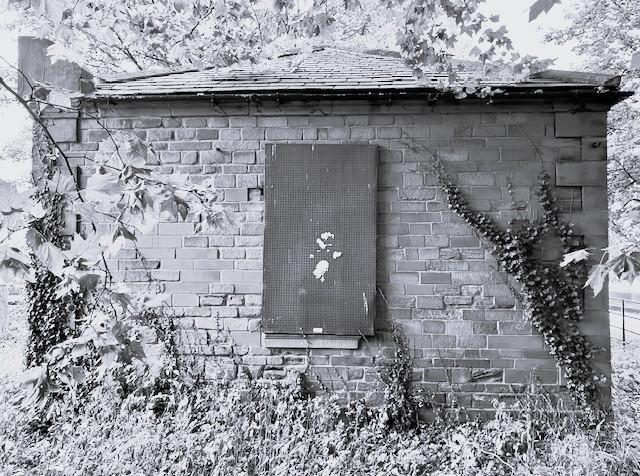
On my usual Sunday run – along the canal, the Sheffield and South Yorkshire Navigation, to Meadowhall, then up the long steep hill to Kimberworth church and back down, and up again and down, to Rotherham – on a rare cooler day, a cloudy August morning, in the third heatwave of an endless summer, I stop briefly in Masbrough, beside Rotherham’s ring road, to part the head-high branches of a water-deprived London plane, and find the unassuming brick box that is the Walker Mausoleum.
Resembling in its size the Hampton Court ice house in Home Park, it was made of red bricks in the Flemish bond pattern, with quoins of ashlar sandstone, though not of the local soft-pink Rotherham Red variety out of which many of the town’s finest buildings, including its forbidding minster, were built. It contains the remains of 23 members of Samuel Walker’s family, including the man himself who died in 1782, with the last internment dated to 1855. With his customary certainty, Pevsner wrote that Samuel ‘died in 1783 [sic], but the architecture of the austere little building is too Grecian for so early a date’.

The Walker Mausoleum, from College Road The Walker brothers – Jonathan, Samuel and Aaron – were sons of a nail-maker from Grenoside, a village whose curious name means ‘quarried hill’ in Anglo-Saxon, six miles to the west in what is now north-east Sheffield. As they surfed the waves of the Industrial Revolution, they made their fortunes as ironmasters. A schoolmaster who moonlighted as a surveyor and sundial maker, Samuel gave up teaching and threw in his lot with his brothers to manufacture furnaces and other premises and equipment for the iron and steel industry, including, in 1746, a major works, powered by the Don, a little upstream at Holmes.
Hand in glove with their moneymaking enterprise went their Methodism. Samuel and Aaron were early converts to the Great Awakening of the 1730s and ’40s, the Christian revival promoted by, inter alia, the Wesleys and George Whitfield. Whitfield’s more Calvinist branch of Methodism was more to their taste than the Wesleys’ Arminianism: predestination rather than free will. In 1763, they built the now vanished Masborough Independent Chapel in whose grounds the mausoleum stands. Functioning as a place of worship until almost the end of the last millennium, it became a carpet warehouse before fire damage led to its demolition in 2012. It had a close connection with Rotherham Independent Academy, a Congregationalist seminary founded in 1795, which moved in 1876 to the Gothic fort-like building on Moorgate Road that now houses a well-regarded sixth-form and adult education centre, Thomas Rotherham College, named after a late-15th Century Archbishop of York and Lord Chancellor of England.
At the top of one of the many hills overlooking the town, Samuel’s son Joshua built Clifton House – designed by John Carr, architect of Buxton Crescent, Harewood House, racecourse grandstands, prisons and much else – in the year his father died. Within this modest Georgian pile Rotherham’s excellent museum, gallery and archival study room are accommodated. Pevsner called it the ‘most ambitious’ of several such houses built locally in that period. The grounds which surround the house are a fine example of civic park landscaping, designed by upstanding Victorian aldermen to provide leisure activity for the town’s workers and their families as an alternative to drinking. It still admirably fulfils that function, with a recently upgraded watersplash play area, a magnet for children throughout this drought summer, plus crazy golf, rides, a sandpit and a splendid 1928 bandstand that is criminally underused. In three weeks’ time, the annual Rotherham Show will fill the park for a weekend celebrating the diversity and identity of the town through music, circus, other performance, stalls aplenty and, best of all, the fruit and veg produce display, prizes awarded in categories galore.

A ruined grave in the burial ground The mausoleum has been rendered even less prepossessing than Pevsner’s description, by the covering-up of the windows with boards painted racing-green, which, despite the building’s listed status, lend it an air not so much of abandonment as wilful apathy on the part of its supposèd protectors. What’s left of the adjacent burial ground of the erstwhile chapel is more desperate still: gravestones are overgrown, illegible and, in some cases, smashed. On the pedestal of the last remaining obelisk these words from the King James version of 1 Corinthians 15:52 are written in capitals, ‘for the trumpet shall sound and the dead shall be raised incorruptible and we shall be changed’. Among such waste land, it is the dead who will more likely be changed; turned to despondency, if not justifiable fury, at the rack and ruin into which their graves have fallen.
I take a few photos with my phone and resume my run, the overcast skies as sombre as the plight of the mausoleum and burial ground.
Later, on typing into the search engine, here, of the UCL database of British slavers and investors in slavery the names of the Walker clan, I find, to my pleasant surprise and relief, that none of them are listed there.
-
Readings in Nottingham on 16 September and elsewhere
Over on the Readings page, here, are details of readings from The Last Corinthians which I will be doing this autumn and next year. The first of them is a ticketed event (£5 admission) in a month’s time, at the very fine Five Leaves bookshop in Nottingham, with Kathy Pimlott and Peter Sansom, both of whom are not only brilliant poets but also have local(ish) connections.

As you’ll see, later readings are in Mytholmroyd, Stroud, York (ticketed) and Wells. It would be lovely to see you at any of them.
-
July reading
You might think it invidious at the moment to be reading books by anyone called Donald, so it’s strangely coincidental that I’ve just read two in a row. I’ve mentioned before that Lyn and I have read several books recommended by the excellent Jacqui’s Wine Journal website, and Mr Bowling Buys a Newspaper by Donald Henderson is the latest of them. Jacqui reviewed it here, and her verdict is as dependably spot-on as ever. It’s very much a period piece as many older crime novels are, but that’s its joy.
Toy Fights, Faber 2023, Don Paterson’s memoir of the first 20 years of his life, is full of the rich details and meta-commentary that readers of his poetry would expect. His recall of memories is phenomenal, as if he’s channelling Ray Bradbury, who said, on Wogan in the Eighties, that he could remember everything that had happened in his life, even back into the womb. Paterson says, though, that, after three years of age,
the memories are vivid, but they still can’t be trusted. I am wont to confuse memory and photographs, other folks’ memories with my own, and things I saw on television with things that happened to me.
Paterson writes well about his jobbing musician father, at whose club gigs Paterson joined him as a side guitarist from the age of 15, though his mother, still alive at the time the book was written, is less of a presence. The biggest character, aside from Paterson himself, is the city of his birth and upbringing, Dundee. As a fan of the joyously daft BBC4 sitcom Bob Servant – written by Neil Forsyth who also wrote the fantastically well-plotted The Gold among other things – I was pre-programmed to like the colourful characters, community spirit and language of Dundee which Paterson brilliantly and often hilariously conjures. He’s very good, too, about the painful years of his adolescence, including two or so years as a devout Christian in a cult-like group, and his subsequent musical education, as listener, player and part of the local music scene, which at that time encompassed The Associates, led by much-missed Billy Mackenzie. The most memorable section concerns a breakdown he had aged 19, chiefly caused by drugs, and his subsequent four-month stay in Ninewells (psychiatric) Hospital. The book ends with Paterson setting off for a job in a band in London. Poetry barely gets a mention. Paterson’s ability to self-analyse with candour and honesty is extraordinary and provides many of the book’s funniest moments.
I’ve written before, here and here, of my admiration for the writing and performing of Philip Hoare, and it was about time that I got stuck into his book Spike Island (Fourth Estate, 2001), subtitled ‘The Memory of a Military Hospital’. Ostensibly, it’s concerned with the history of the humungous hospital built from 1856, opened in 1863 and mostly demolished in 1966, at Netley, near Southampton; but it’s much more than that, suffused as it is with Hoare’s memories of growing up a stone’s throw away in Sholing, his family history in general, aspects of British social history from mid-Victorian times and much else. It’s the most Sebaldian of his books, I think, with photographs interspersed throughout, and was in fact one of the last books which Sebald himself endorsed, in the Sunday Telegraph books of the year, before his death in December 2001: ‘A book that has everything a passionate reader could want – a subject that far transcends the trivial pursuits of contemporary writing, concerns both public and private, astonishing details, stylistic precision, a unique sense of time and place, and a great depth of vision.’ Hardly unique, though, as those words could’ve been applied to any of Sebald’s own books. Thanks to its proximity to the port of Southampton where the troopships docked, all British soldiers injured in the nation’s colonial wars were initially treated there, including those suffering from shell-shock inflicted on the Western Front, who were sectioned off in ‘D Block’, where the dreadful treatment was very much based on the notion of using military discipline to bully the inmates back to some kind of ‘normality’. I thought of James Goose, my great-grandfather, who was sent to South Africa in 1899 as part of a Norfolk militia regiment, got shot in the face by a Boer sniper (the wound turned cancerous and killed him years later) and came home on a ship named Roslin Castle, pictured here: he was so relieved to be home that he and my great-grandmother Agnes (née Riches) named their son Roslin, though maybe sensibly he was known as Rossie.
On the poetry front, I much admired Richard Scott’s second collection, That Broke into Shining Crystals, Faber, published earlier this year. As in several of Pascale Petit’s collections, this contains work which very skilfully, and with a marvellous ear for musical cadence , transforms the pain of sexual abuse into beautiful poetry. Each of the 21 poems in the first section, Still Lifes, responds to a different still life painting by painters from the 1600s onwards to Bonnard. The second part, a response to Marvell’s ‘To his Coy Mistress’ felt less successful, as it employs Seventeenth Century language in a manner verging on parody. The third section contains 22 poems after types of crystals and gemstones, as refracted through Rimbaud’s Illuminations as translated by Wyatt Mason, and are, for me, the most successful in the book, because the prose-poem form allows Scott to give fuller vent to his gift for articulating emotion through vivid and sensuous imagery and language, as in this extract from ‘Emerald’:
The field is a body. Wild grass rippling over breasts and muscles, the jut of a hipbone. Some of the grass is trampled down into mud like a battlefield – screams catch the air. Some of the grass is spread over little hillocks like shallow graves. Some of the grass is cut into a bit, desire lines and goat paths, leading to all the places you ever dreamed of going but didn’t.
As I discovered from listening to his interview with Peter Kenny in Series 5, Episode 10 of the ever-excellent Planet Poetry podcast, here, Scott talks very thoughtfully and eloquently about his craft.
I’ve also been knee-deep in the poems of Wisława Szymborska, as translated by Clare Cavanagh and collected in Map, Houghton Miflin Harcourt, 2015, for the poetry book club I’m part of. My jury is still out thus far, but then it’s a heftily daunting tome.
I’m also about halfway through Diane Seuss’s Modern Poetry, published last year in the USA by Graywolf and in the UK by Fitzcarraldo Editions. Her telling-it-as-it-is style might not be everyone’s cup of tea, but I really like the way she throws it all in and takes disjunctive leaps in her poems. I adore her poem ‘An Aria’, 23 irregular quatrains which are propelled with a fearsome energy. I found myself getting funny looks on the Tram Train to Sheffield last Thursday as I read out sotto voce. If poetry can make me do that, it has to be good.
-
On revising poems
How many times have I tinkered with a poem before realising that I’ve overcooked it, so then had to undo the change? It’s a good job I’m not a builder. Sure, no one wants to read the obvious word every time, but poets can of course overdo the tweaking by replacing the early-draft choices with alternatives whose other connotations are so far from being synonymous that they blur the original meaning and/or unbalance the syntax to an unbearable degree.
In his Paris Review interview with Frederick Seidel, Robert Lowell said this:
You think three times before you put a word down, and ten times about taking it out. And that’s related to boldness; if you put words down, they must do something, you’re not going to put clichés.
And this:
Almost the whole problem of writing poetry is to bring it back to what you really feel, and that takes an awful lot of maneuvring.
By that, I infer that he means how the emotional kernel of the poem is conveyed and encased by the rest of it. The best advice I ever received from another poet was to ensure that every poem, like the Tin Man, had a heart.
When Seidel asked him if he revised a great deal, Lowell’s answer was emphatic: ‘Endlessly.’
Time is the poet’s greatest ally in revision: each and every poem needs to be set aside for a long enough period before the poet comes back to it and decides whether or not it needs more work. If there is a niggle at the back of your mind that some aspect of the poem isn’t quite right, then you can bet that an editor would spot it straight away, so that niggle can’t just be ignored before the poem is released into the wild.
But I’m as guilty as anyone of having, many times, sent off in a bout of unfounded enthusiasm a recently- or even just-written poem which hasn’t been allowed to settle into its best form. Wherever you are, I expect you could hear my sighing earlier today while I spent three hours rejigging a poem, which, thinking it was well and truly finished, I submitted to a journal only last week.
All of which begs the question as to when a poem is actually finished, if at all. In my case, it certainly wouldn’t, by any means, be finished if it were published in a journal or in a pamphlet, although I would do my level best to try and resist tinkering with it before including it in a full collection. Even then, perhaps only the reader can complete it, though that cliché sounds as trite as any other cliché.
-
On Rod Whitworth again
I’ve written about Rod Whitworth on this blog before, here. Rod is a very fine poet and one of my fellow members of the fortnightly workshopping group, the Collective.
Rod has four outstanding poems in the latest issue – #97 – of the ever excellent Pennine Platform, which is one of my very favourite poetry journals, and I’m very pleased to see that over on the journal’s website, you can now have the treat of hearing Rod reading one of them, the beautifully tender ‘Still Growing’, and see a lovely artwork by Rod’s wife, Ange. The poem and image are here.