Not that I’m suddenly verse-averse, but my reading so far this year – Hamburger, James Tate and Mike Barlow aside – has been largely dominated by prose books.
Two were Sebald-related: The Emergence of Memory, a collection of interviews with and writings about him, edited by Lynne Sharon Schwartz, and Philippa Comber’s extraordinary memoir, Ariadne’s Thread. As with all Sebald literature, there are many quotable lines and astonishing moments.
I’ve frequently had the same experience when reading Claudio Magris’s 1986 masterpiece, Danube, as translated by Patrick Creagh, a book I was alerted to because it was mentioned in Comber’s.
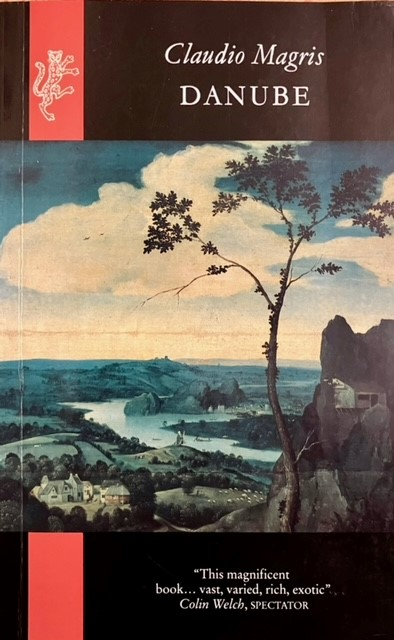
While it’s superficially a journey from the Danube’s several contesting sources to its delta entry into the Black Sea, it’s far more than that: Magris’s knowledge of Mitteleuropa history and literature is remarkable. Here are two short, separate extracts which I noted down:
Perhaps writing is really filling in the blank spaces in existence, that nullity which suddenly yawns wide open in the hours and the days, and appears between the objects in the room, engulfing them in unending desolation and insignificance.
Time is not a single train, moving in one direction at a constant speed. Every so often it meets another train coming in the opposite direction, from the past, and for a short while that past is with us, by our side, in our present.
I gather that it was brought back into print a couple of years ago – and I should think so, because its digressions, even when addressing some of the worst of Nazi horrors, are always remarkable. Sebald must’ve read him, for they are surely kindred spirits and stylists and they share an obsession with Kafka, though Magris is much the funnier.
Another writer mentioned in the Comber book was Sara Maitland, whose books I had long been meaning to start reading. Start I did, with her lovely book on the woodland roots of fairy tales, Gossip from the Forest. Like Danube, it’s full of erudition, with the bonus of the chapters being separated by her own retellings of classic fairy tales.
Among novels, I very much enjoyed the twists and turns of Case Study by Grahame Macrae Burnet and Katherine Carlyle by Rupert Thomson – two brilliantly written and absorbing tales. (I know I’m late to the party, but I’ve just started the latter’s The Insult.) I also read Here We Are by Graham Swift, but it really dragged.
Lastly, there’s Patrick Barkham’s The Swimmer, subtitled ‘The Wild Life of Roger Deakin’, an unconventional biography of a very unconventional man. I’ve written about Deakin before – here and here – because I’ve been a fan since Waterlog was first published. Like all the best biographies of writers, it’s made me want to re-read its subject’s oeuvre. I enjoyed it so much I read it in one day.


 Matthew Paul: Poetry & Stuff
Leave a comment