It’s been a while since I read Chris Edgoose’s admirable and enticing review for The Friday Poem, here, of Geraldine Clarkson’s second full collection, Medlars, available to buy from its publisher Shearsman Books here (with free p&p, might I add); and therefore about time I bought and read a copy. That I have now done, and what a deferred pleasure it was and is!
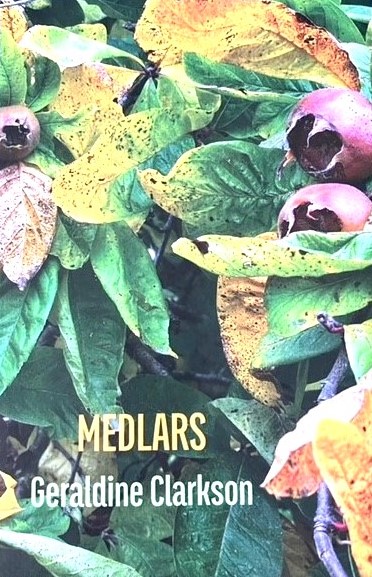
Mystifyingly overlooked for the major prize shortlists, Medlars is simultaneously both a state-of-England-post-Brexit collection and one which explores the nation’s folklore and psychogeography. It does so in rich, often tongue-twisting language; the wordsmithery of Shakespeare by way of Raymond Queneau and even, perhaps, ‘Professor’ Stanley Unwin. Consider, for example the second part (‘oulipo yew engenders TT strop’), a sonnet of sorts, of ‘golden opportunity, wet streets’, which I find it difficult not to read in Unwin’s voice:
oily graveside glove shunted. Motto pops.
Cone shape sings, mining tissue
of hay – vie
a dapple, a coin, a thorny no.
In pop tryout, a doter overeaten (why?)
a hotdog mound, phone nite,
curdle of slow – nearer – eyes, hoof, nose;
glib moon, dew nines; anatomy hefted.
And, if egoists speak no cot, they
hover, chattered, or – alembic wren-rug –
retrain tweets: the raw iota dots,
forced sons, idle lies. Faeces pour
canapé sighs, gene-slimy, semi-nosing.
Limned owls will leach, ruin Midi sow’s icy tit.
Yes, poetry like this is demanding for the reader, but it isn’t just ‘nonsense poetry’; it’s hugely satisfying, on the ear, the eye and in how it forces the reader to savour each clause and think deeply.
A three-part sequence of ‘Rivariations’ concerning three rivers, the Leam, Ouse and Derwent, begins thus:
Lovely the Leam and her sisters
milling through Midlands
watermeadows. Broadbacked
and elegant, halving the Spa town.
There was a story in childhood
of three daughters of one family,
adrift in a boat, lost. Leam lowered
her gaze and mourned. Hypocrite river.
For me, this is delightful, magical writing by a poet not content merely to write anecdotal poetry, but to stretch herself by extending the limits of her language and control, and to follow her own vision. Her poem on the Derwent and its ‘brown surge’ is one I can easily relate to, having walked many miles alongside it in Derbyshire one extraordinarily muddy Christmas Eve a few years ago, as illustrated here.
I much enjoyed Clarkson’s first collection Monica’s Overcoat of Flesh (Nine Arches, 2020) also, and I’m eagerly anticipating her third collection, due from Verve Poetry soon.
 Matthew Paul: Poetry & Stuff
Leave a comment