With thanks to Chris Boultwood and Judy Kendall, my essay on the haiku of Caroline Gourlay, published in Presence #73 in July, is now on the journal’s website, here.
I owe a personal debt to Caroline, for a good deal of encouragement and friendly advice when I was starting out as a haiku poet 30 years ago or so.
Author: Matthew Paul
-
On the haiku of Caroline Gourlay
-
On (Eavan Boland and Colm Tóibín, again, on) Elizabeth Bishop
Having savoured Colm Tóibín’s book On Elizabeth Bishop, I then re-read words on Bishop by another great Irish writer, Eavan Boland: the chapter ‘Elizabeth Bishop: an unromantic American’ in her wonderful book A Journey with Two Maps (Carcanet, 2011), available here.
The focus of that book is on Boland’s own poetic journey and how women poets helped her shape her ideas about how she could relate in poems her own experience as a woman, wife, and mother; therefore, her thoughts on Bishop are somewhat subsumed to that purpose. Nonetheless, Boland’s discussion of Bishop’s ‘tone’, as distinct from her ‘voice’, is illuminating. As is her dissection of ‘At the Fishhouses’, from Cold Spring (1955), available to read here: rightly, she notes that, in amongst Bishop’s usual litany of precise visual perceptions, there lurks a “superb meditation on water as an emblem of tragic knowledge”, interrupted by the lighthearted, cameo appearance of a seal: ‘He was curious about me. He was interested in music; / like me a believer in total immersion, / so I used to sing him Baptist hymns’.
While Tóibín highlights Bishop’s paradoxical observation, ‘as if the water were a transmutation of fire’, Boland’s commentary oddly stops short of addressing the last 19 lines of the poem, in which Bishop’s description of the sea reaches a tidal crescendo, culminating in the poem’s brilliant, six-line final sentence:
It is like what we imagine knowledge to be:
dark, salt, clear, moving, utterly free,
drawn from the cold hard mouth
of the world, derived from the rocky breasts
forever, flowing and drawn, and since
our knowledge is historical, flowing, and flown.
If a poet took lines like these to a workshop nowadays, the response, more’s the pity, would no doubt be that the poet should axe at least half the adjectives and re-consider the purpose of writing about an abstract noun.
What’s especially intriguing to me in those lines is how Bishop separated the adjectives with commas in the second and last of them, but didn’t in the third. Strict grammarians may say that in a string of adjectives qualifying the same noun, there should always be commas between them; in poems, though that often looks fussy, if not off-putting to the reader. It could be, too, that by not separating adjectives with commas, one can enable them to have a pleasing and surprising compound quality. In this instance, Bishop used commas where she wanted to slow down the reader’s attention. Judging when to do this in poetry isn’t necessarily straightforward. Pacing, though, is a key component of a poem’s efficacy – and it isn’t just a case of deciding which overall form suits the words, and the speed at which the poet wants the reader to absorb them, but also how the pace of the words in each line looks and, moreover, sounds.
I could witter on about how Bishop brilliantly and repeatedly shifted the focus within the poem as a whole without it ever seeming as through its coherence was slipping; however, Tóibín is a much better guide to that than I’d be.
-
On a haiku by Sheila Butterworth
all day
the drop and roll of acorns
on a tin roof
The benefit of having the Haiku Calendar on my work desk is that the monthly selections quickly seep into my consciousness. This one, one of the three runners-up for October in this year’s calendar, must’ve been written, probably twenty-five or so miles to the north-west of where I am, on a day just like today here in Yorkshire: dominated by a keen south-westerly/southerly breeze; warmish, but fierce enough to shake the trees, specifically to loosen acorns from at least one mighty oak.
It’s a highly sensory haiku. The wind is implicit, as is the sound of the acorns hitting the roof, but the movement of the acorns and the surface of the roof – a tin roof – are clearly outlined, with an engagingly direct simplicity.
Underneath it all, and what makes this haiku really stand out, are the multiple timelines. The reader is told, first, that the action within the haiku has been happening ‘all day’ and, presumably, is still happening now. Yet set against that constant movement is the forensic focus on the journey of the acorns: they ‘drop’ onto the tin roof and then ‘roll’ along it, perhaps along its corrugations – and then almost certainly straight onto the ground, because a tin roof is unlikely to be a flat roof. Once on the ground, there is, of course, the possibility that some of the acorns will, over a much longer timeframe, furnish forth new oaks, in the great cycle of life, and all the biodiversity which oaks support.
It should be noted that the way in which Butterworth uses ‘drop’ as a noun makes the acorns’ movement seem more fluid, and, crucially, more incessant, than if she had used it as a verb – compare her haiku with this possible alternative:
all day
acorns drop and roll
on a tin roof
This version is passable, but Butterworth’s one is much preferable, because it shifts the emphasis of the poem from the all-day nature of the activity squarely onto the acorns’ journey from the tree; it is that ‘the’ which confers the central importance. We know that the acorns’ fall will not last forever, but it is as noticeable as all-day rain, with a similar, though more intermittent and therefore different, drumming sound.
A deeper reading could be, as it is for many autumnal haiku, a metaphorical one: that we too, as readers, will, if we reach that age, experience our own physical change, a slowing-down that leads inexorably in one direction. Whether, like the falling of acorns does, it will eventually lead to rebirth is, naturally, for the individual reader to decide or not.
-
On (Colm Tóibín on) Elizabeth Bishop
There’s a good case to be made for October being the loveliest month, in England at any rate; though only really when the sun shines and the plentiful golden yellows are at their best, like Samuel Palmer landscapes before your eyes.
It’s also a month of melancholy, too, which suits me just fine. The ideal time to get stuck into some serious reading, which, in turn, will feed into writing. Over the years, early autumn has traditionally been a time when I will make a concentrated study of a favourite poet’s oeuvre, to see how the quality of their output, and the clarity of their thinking, deepened over time. Poets who, either by choice or premature death (yes, I realise that most deaths are premature in some respect), published in a disciplined and selective manner are ideal for this, Elizabeth Bishop for one.
Like everyone and anyone who loves poetry, I’ve long liked Bishop’s poems. Curiously, though, real, devoted love for them has been awakened in me through an apparently unlikely source, Colm Tóibín. His book On Elizabeth Bishop, published by Princeton University Press, is as fine a critical reader’s study of another writer as any I’ve ever read. I find it interesting that it should be a writer known until recently solely for his novels, albeit wonderful ones at that, who has really opened my eyes. I won’t spoil the book for anyone who might be tempted to buy a copy, save to quote just the first sentence of the opening section (‘No Detail too small’), which alone was enough to make me sit up and reflect:
She began with the idea that little is known and that much is puzzling.
Tóibín continues:
The effort, then, to make a true statement in poetry—to claim that something is something, or does something—required a hushed, solitary concentration.
Much more than, say, his late compatriot Eavan Boland did, he gets to the heart of Bishop’s statement-making, her restraint – what’s unsaid in her poetry as much as what is said, especially in comparison to her close friend Robert Lowell – and the exactness of her writing. In so doing, he quotes extensively from Bishop’s stories and correspondence (primarily with Lowell, naturally), but also from another great poet, Thom Gunn, who, like Bishop, chose not to take the ‘confessional’ path blazed by Lowell in Life Studies.
On the strength of just a few pages of the book, I couldn’t resist buying Tóibín’s poetry collection, Vinegar Hill, published by Carcanet. It could’ve been a dreadful vanity project, but, as any of the recent online readings he’s undertaken attests (there are several on YouTube), Tóibín’s humility about his poetry appears genuine and heartwarming. By and large, it’s a very good collection, albeit rather bloated – thinning out by a third, maybe almost a half, could’ve made it brilliant. All the same, I enjoyed and admired it.
-
Haiku Society of America Haiku Award
Thanks to Chuck Brickley, I’ve recently had the great honour of co-judging, with Kat Lehmann, the Haiku Society of America’s annual haiku competition, named in memory of Harold G. Henderson, who played a pivotal role in helping to popularise haiku in English.
I’ve been reflecting on why it’s such a great honour. The answer is complex. First off, that the HSA should ask me, some schmuck from England, when the easiest thing would be to ask two (North) American haiku poets – I find that immensely open-minded, especially at this time when globalism seems to be in retreat. Secondly, that so many of the English-language haiku poets whom I admire are American. Thirdly, that much of the rich culture which has influenced me as a person, and as a writer, is American – not just the obvious poets like Bishop, Brock-Broido, Kerouac, Lowell, Snyder and Williams, but art film, music and all, right up to yesterday, when I had Jake Xerxes Fussell’s interpretations of old folk tunes from the South on repeat. So, much gratitude again to Chuck.
I hugely enjoyed the process through which Kat and I progressed from our two separate longish shortlists to having a combined shortlist, and agreeing which poems would be the top three (or four in our case) and then which would be awarded hono(u)rable mentions.
Thanks to Kat, it was an altogether much easier and better process than being a sole judge, as I was for the Martin Lucas Haiku Award for 2019. When you are flying solo, you have nobody with whom you can air your thoughts and doubts about particular haiku; moreover, the chances are that, however meticulously you undertake the initial sifting, you will overlook some perfectly excellent poems which might have otherwise grown on you had you given them the chance to do so.
I like to think that the seven haiku which we selected are all excellent and resonant in their individual ways, and that the pleasure we took from reading and discussing them is evident in the commentaries which Kat and I co-wrote.
You can read the winning haiku and our commentaries here.
-
On Simon Chard
I’ve written about the clarity and excellence of Simon Chard’s haiku before, here, and I make no apology for doing so again. Over the last few years, his haiku have been as consistently good as those of any English-language haiku poet and it’s no wonder that he’s won several competitions, including the Haiku Presence Award for 2014 and the BHS’s David Cobb Award for 2021, here.
Snapshot Press published an ebook – A Fence Without Wire, available here – of 20 of Chard’s haiku in 2017. Many of his poems reflect the flora and fauna of Dumfries and Galloway where he lives. Since then, Chard has continued to develop his craft and take more risks.
In the latest issue of Presence, #73, one of his three haiku takes what many readers and, I suspect, most editors would deem to be a highly fanciful turn:
bracket fungus
we take the same path
as the goblins
One could criticise the first line for using the generic ‘bracket fungus’ rather than a specific identification, but many bracket fungi look similar to one another so, unless the reader is a mycologist, the wording is totally understandable. One sees the tree or stump to which the fungus is clinging, and senses that the setting is fairly deep inside a wood or forest. The word ‘goblin’, deriving from Norman, came into English in the 13th Century it seems, so one can conclude that belief in goblins is ancient, as ancient as the woodland into which Chard’s haiku leads us. The surprise of the line is softened sonically by ending, like the first line, in an ‘s’. More power to Ian Storr’s elbow for publishing this poem, and good on Simon for writing it.
I was also intrigued by another of Chard’s trio, mainly, but not only, because he includes a place-name and does so prominently:
Burnswark
tinged with pink
first snow
Burnswark was new to me, and a quick search said that it’s a hill near Lockerbie with a rich and fascinating history: evidence of Bronze Age occupation; an Iron Age hillfort; and site of a battle between the Romans and locals in the 2nd Century. To my mind, not enough English-language writers are willing to use the power and associations of place-names in their poems. Does it matter if the reader is initially unfamiliar with the reference? Well, the answer is surely that if they are interested, they will look it up. In this haiku, Chard has the confidence to let the hill’s name stand alone as the first line. Its first syllable has an assonance with ‘first’ in the third line and a pararhyme with the ‘n’ of ‘tinged’. Its second syllable has a near-rhyme with ‘pink’. The three ‘w’s in the haiku, happily positioned on a diagonal add a visual rhyme. The picture painted is of a hill towering over a broad landscape at a crepuscular hour – I see a spectacular sunset rather than dawn, but either is possible – as late-autumn gives way to the harshness of winter. With a syllable count of 2-3-2, it’s a short haiku by any standard. The passive adjectival verb, ‘tinged’, is inspired; it suggests the sunset is either working up to a full multi-red glow or is fading from one towards darkness. However one reads it, the elemental sense is intensely vivid.
-
On Ted Hughes
On Saturday, fellow poets Ian Parks, Simon Beech, Tracy Day Dawson and I walked the route of Ted Hughes’s paper round up from Mexborough to Old Denaby, as described here. Ian, born and brought up in Mexborough, led us on the route which took in the former newsagent’s where Hughes and his family lived from 1938.

The former Hughes newsagent, Main Street, Mexborough 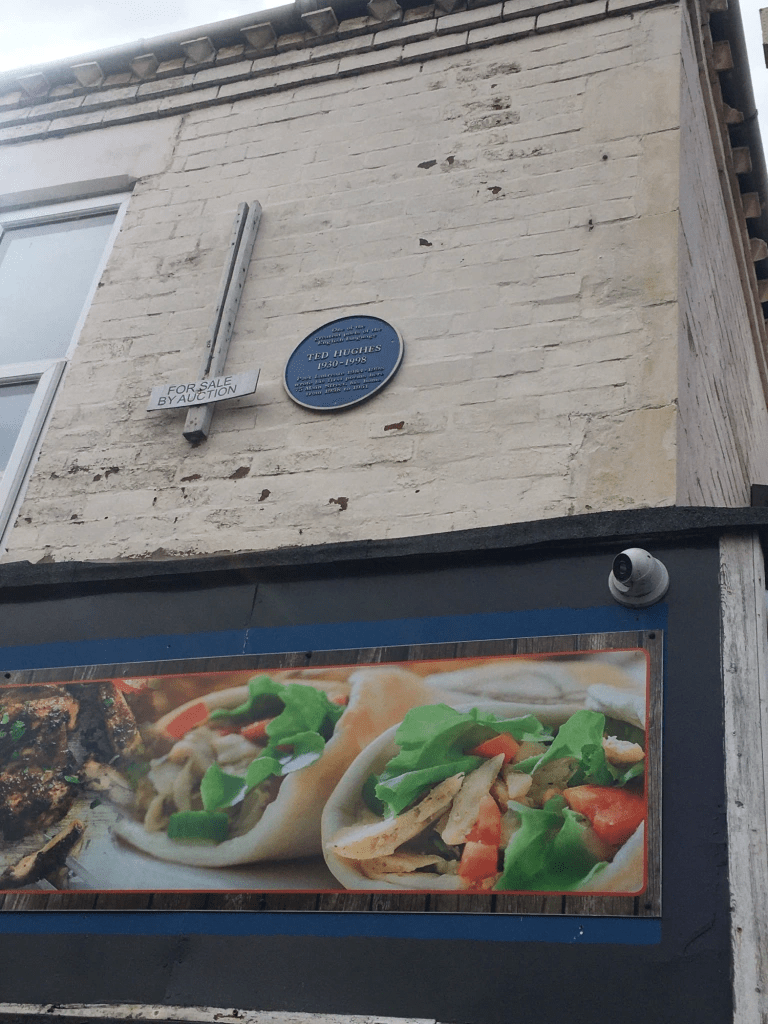
Blue plaque to Hughes on the former newsagent’s 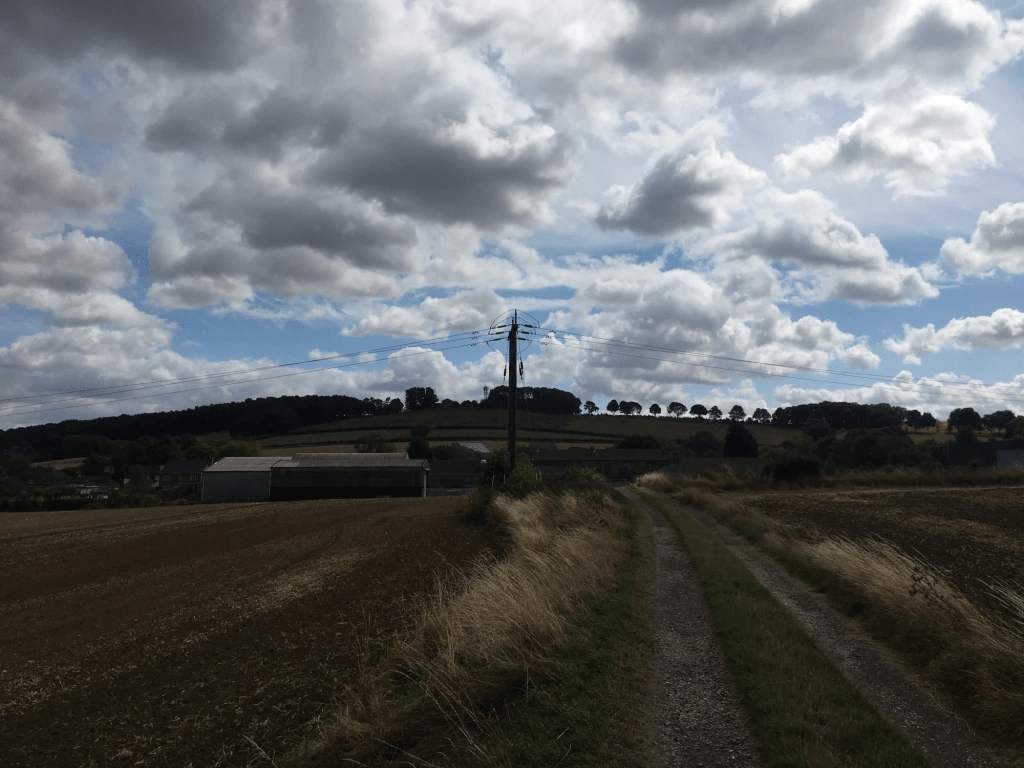
Manor Farm, Old Denaby At the right-hand-side of the shop is Hughes’s bedroom window overlooking what was a slaughter-yard back then. It inspired his gruesome poem ‘View of a Pig’, published in his second collection, Lupercal (1960). Like most, if not all, English children of my generation, I studied the poems of Hughes more than anyone else’s, except perhaps Owen and Sassoon, and it was the earthier, meatier poems like this one, and ‘Pike’, also from Lupercal, which we read the most. The poem’s last two lines – with the perfectly-judged anaphora, alliteration and simile – ring across the years from an England long-gone:
I stared at it a long time. They were going to scald it,
Scald it and scour it like a doorstep.
The route took in the possible setting of ‘Pike’:
A pond I fished, fifty yards across,
Whose lilies and muscular tench
Had outlasted every visible stone
Of the monastery that planted them—
Stilled legendary depths:
It was as deep as England. It held
Pike too immense to stir, so immense and old
The route took in Manor Farm, where Hughes went trapping and shooting with his brother. It’s the setting of his poem, ‘Sunstroke’, again in Lupercal:
Reek of paraffin oil and creosote
Swabbing my lungs doctored me back
Laid on a sack in the great-beamed engine-shed.
I drank at stone, at iron of plough and harrow [. . .]
I should add that Ian has a wonderful poem published today over at Black Nore Review, here, and I’m looking forward to hearing Ian read at Mexborough Library this Wednesday.
*
On looking into Lupercal again, I came across that odd poem ‘Mayday on Holderness’, such a contrast to Larkin’s ‘Here’ covering the same terrain, which I trod recently. The last three stanzas travel a vast distance:
The crow sleeps glutted and the stoat begins.
There are eye-guarded eggs in these hedgerows,
Hot haynests under the roots in burrows.
Couples at their pursuits are laughing in the lanes.
The North Sea lies soundless. Beneath it
Smoulder the wars: to heart-beats, bomb, bayonet.
“Mother, Mother!” cries the pierced helmet.
Cordite oozings of Gallipoli,
Curded to beastings, broached my palate,
The expressionless gaze of the leopard,
The coils of the sleeping anaconda,
The nightlong frenzy of shrews.
-
In Larkin Country
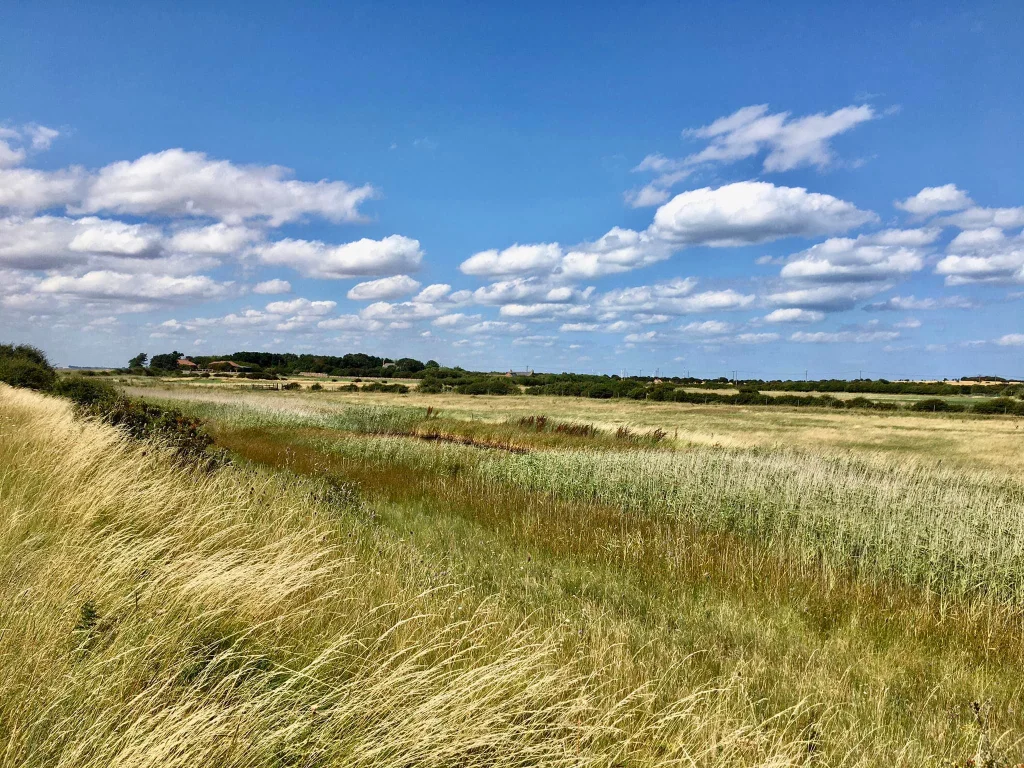
I can’t really not mention Larkin, since yesterday was the 100th anniversary of his birth. Last week, I spent a few days in deepest Holderness, the flatlands of East Yorkshire between Hull and the North Sea.
It’s the area celebrated in ‘Here’, the opening poem of The Whitsun Weddings, and which ends in one of trademark, secular-mystical epiphanies:
Here silence stands
Like heat. Here leaves unnoticed thicken,
Hidden weeds flower, neglected waters quicken,
Luminously-peopled air ascends;
And past the poppies bluish neutral distance
Ends the land suddenly beyond a beach
Of shapes and shingle. Here is unfenced existence:
Facing the sun, untalkative, out of reach.
Nowhere is that sense of ‘unfenced existence’ more apparent than along the spit of Spurn, which protrudes three miles into the last knockings of the Humber estuary, much in the same way that Southend Pier does at the end of the Thames.
A field near Spurn 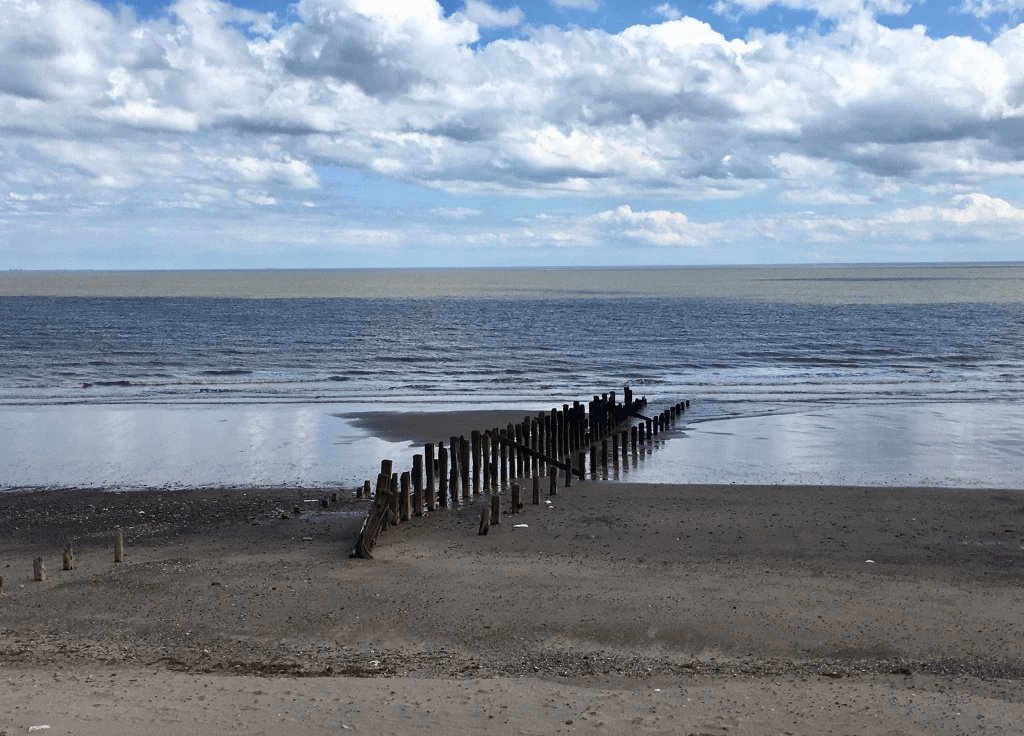
The North Sea from Spurn 
The lighthouse at Spurn From the end of Spurn Point you can see Bull Sand Fort, a derelict First World War fort guarding the approaches to the Humber. I wonder if it’s what inspired the strange phrase in Larkin’s ‘Friday Night at the Royal Station Hotel’: ‘How / Isolated, like a fort, it is’.
What’s for sure is that Holderness is little changed from Larkin’s time. Since he was still alive when I first became interested in poetry, I somehow think of him as being more contemporary than he is. It seems hard to credit that he was born in the same year as another great writer who inspired me to pick up a pencil, Jack Kerouac, though he, of course, had died long before (in 1969) I came of age. They both inclined to melancholy, and both loved jazz, though Kerouac’s hero Charlie Parker was a figure of hate for Larkin. But I digress. Neither has remained a great, direct influence, but bear repeated, pleasurable re-readings.
-
On Sickert
I’ve been to see the Sickert exhibition at Tate Britain, having meant to go and see it in Liverpool when it was on show there.

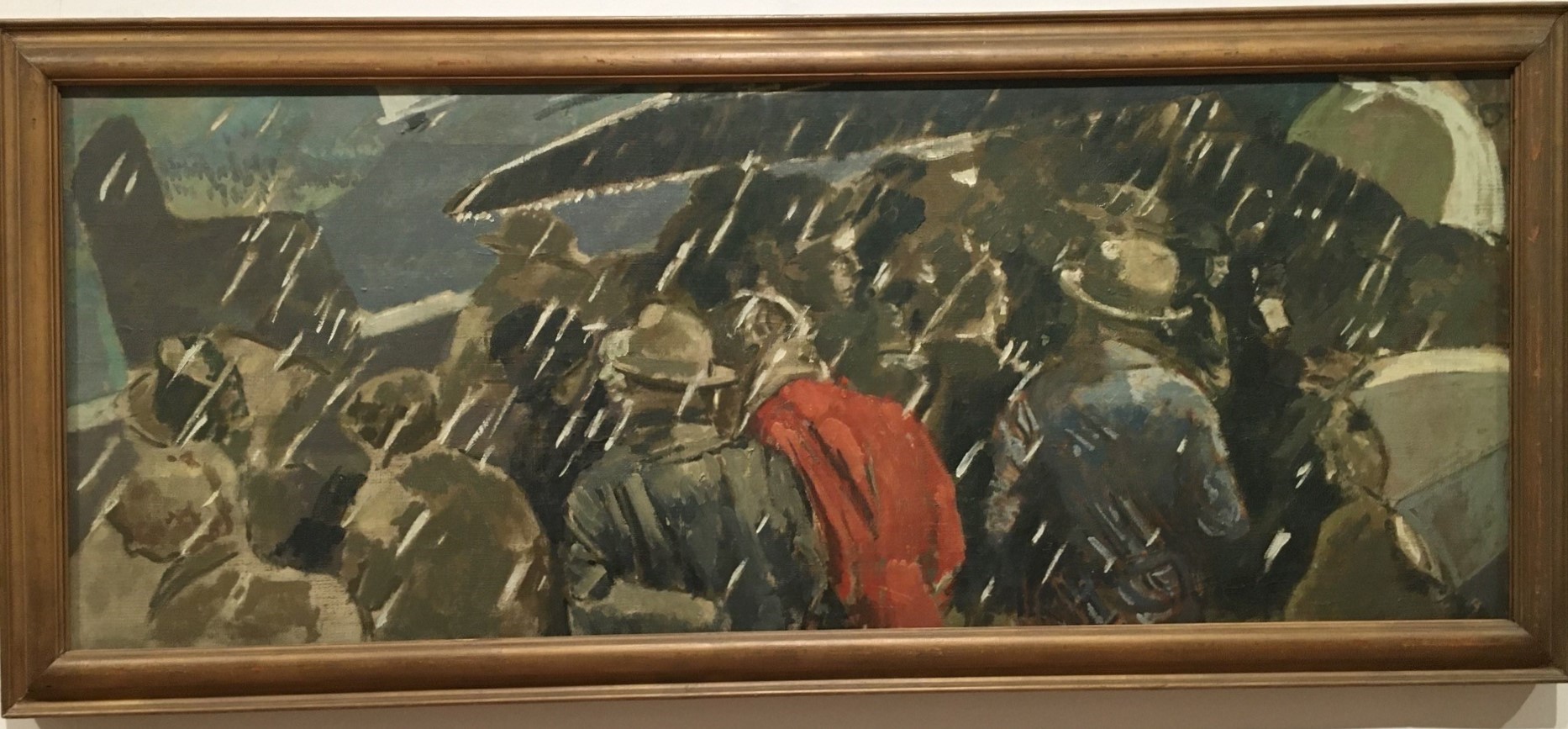
Poster for Sickert exhibition at Tate Britain Sickert’s long been among my favourite British artists – and artists per se. The exhibition traces his development from his beginnings as Whistler’s protégé in the 1880s to becoming the grand old man of British art as Europe descended into war for the second time during his life. The curators haven’t flinched from questioning the ethics of Sickert’s nudes or his interest in the infamous Camden Town Murder, and outline how his pioneering usage of photographs paved the way for Pop Art. For me, it was especially good to see many of his Degas-influenced music-hall and theatre pictures assembled together; likewise with the ‘conversation pieces’, narrative paintings in shades of brown and muted ochre, which could have illustrated the novels of Bennett or Wells.
Here’s a poem of mine, written six or seven years ago, which focuses on three fine Sickert paintings in the Tate collection, all of which feature in the exhibition, two of them hung side-by-side.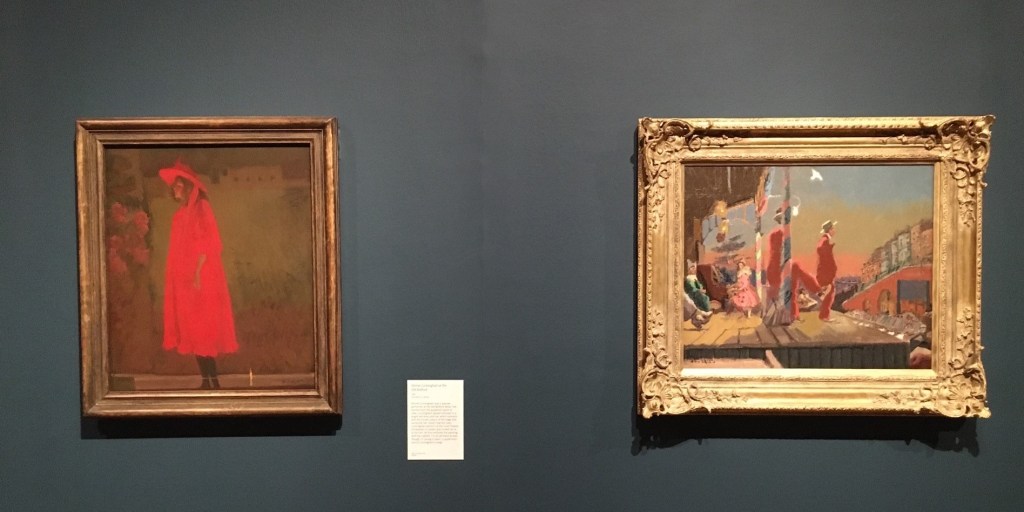
Sickert: Minnie Cunningham at the Old Bedford, 1892, and Brighton Pierrots, 1915 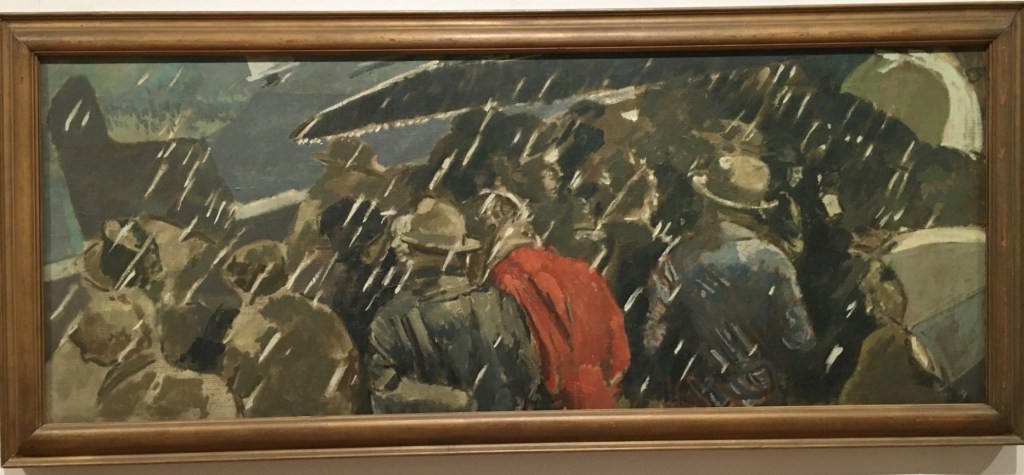
Sickert: Miss Earhart’s Arrival, 1932 Sickertian Reds
Vermilion: the dress and hat of Minnie Cunningham,
vamping, for the Bedford Music Hall’s Friday-night delight,
‘I’m an Old Hand at Love, Though I’m Young in Years’.
Venetian: the suits worn by Brighton Pierrots, trotting out
patter to rows of vacant deckchairs, while poison-gas drifts
and chokes the No Man’s Land beyond Sickert’s Dieppe.
Scarlet: the mac defining a news reporter’s back, hunched
at the front of a vast crowd flailed by rain, waiting hours
for Amelia Earhart’s arrival at Hanworth Air Park, May ’32;
conception month of my parents, who grew up to nurture
such tasty Moneymaker tomatoes, lining them up to redden
on the south-facing window-sill, behind the kitchen sink.
-
OPOI reviews of Amanda Dalton and Greg Freeman
My reviews of these two fine pamphlets are up on the Sphinx website, where, as always, there are many other reviews to read. Thanks to Nell Nelson for her encouragement and skilfully editing of my chunter.
The review of Amanda Dalton’s Notes on Water is here.
The review of Greg Freeman’s The Fall of Singapore is here.
-
Toad Lane
Who knew legs could hallucinate,
mistaking uphill for the flat?
a windmill’s arms
as still as the roadkill
ox-eye daisies
Toad Lane road sign
-
On Ted Walker
Today is an exciting day for me because my essay on the poet (and writer per se) Ted Walker has been published on The Friday Poem, here. I’m very grateful to editor Hilary Menos for finding space for my rambling observations and, moreover, for Ted himself.
The essay took a good deal of reading and research, including a trip down to Lancing back in February (thus the photos); it was, and is, a labour of love. The more I’ve read by and about Ted, the more I’ve grown to like him and respect his considerable achievements. As you’ll see from the essay, he was critically acclaimed throughout his career, yet hardly anyone seems to remember him. My intention was to bring Ted back into the light, so that, with any luck, he might acquire some new readers. If that happens, then I will be very glad.
-
Hiatus
The summer is invariably a quiet time for me, writing-wise. There are too many distractions for one thing, but, in any case, I rarely get in the mood to write when it’s warm and pleasant outside.
Reading, though, is a different matter. Sitting out in the sunshine with a good book is, of course, one of life’s great pleasures. In the last three months or so, I’ve enjoyed new and old collections by David Cooke, Jonathan Davidson, Tim Dooley, John Foggin, Ishion Hutchinson, Simon Jenner, Anita Pati, Peter Sansom, Anne Stevenson and Sarah Westcott, as well as pamphlets by Amanda Dalton and Greg Freeman which I’ve reviewed.
On my to-read pile, are new collections by Cahal Dallat, Richie McCaffrey, Dino Mahoney, Helena Nelson and some old ones by Ken Smith, plus the Collected Poems of Lorine Niedecker. All of those should keep me busy when I’m off soon, in four of the six school holiday weeks. A few days in Marvell country, Holderness, will also be good for the soul.
It’s been lovely to see the excellent news lately that some of my favourite poets have new collections forthcoming, including Ramona Herdman, Marion McCready, Pete Raynard, Emma Simon and Matthew Stewart.
Meanwhile, the understandably long waits to hear back about various submissions go on and on, so in amongst my fretting about resilience and recalling of Eliot’s words about poetry being a mug’s game, I was chuffed to see, today, that Live Canon posted on YouTube the reading I did for them last year in their still-thriving Friday Lunchtime readings series. It can be watched here.
-
On Kathy Pimlott
I’ve written before on this blog about the excellence of Kathy Pimlott’s poetry – a review, here, of her first Emma Press pamphlet Goose Fair Night (2016). Kathy’s second pamphlet, Elastic Glue (2019), was just as good, and contained several poems concerning the gentrification of her neighbourhood of Covent Garden and Seven Dials in central London.
I was therefore delighted to be able to attend the launch, on Wednesday at the lovely setting of Phoenix Garden, of Kathy’s first full collection, The Small Manoeuvres, published by Verve Poetry Press and available to buy here. It was a very enjoyable evening, which included Kathy reading some of the fine poems in the book.
Like the two pamphlets, the poems in The Small Manoeuvres are full of Kathy’s clear-eyed perceptions, a palpable sense of social justice, deep respect for family, friendship (especially amongst women), history and memory, and finely-drawn character studies. They are, in the best way, very readable poems, without any irritating tricksy-bollock nonsense. For these reasons, Kathy is among my very favourite contemporary poets.
The first of the five stanzas which make up the poem ‘Weathers in the City’ exemplifies Kathy’s bravura, but also concise, tell-it-as-it-is style:
Our lead-laced down draughts gust
between high-rises, blow sex cards
from phone kiosks, shake plane trees
to sneezes. Not true winds as such.
The poem’s concept is an original one. It carries on to end as wonderfully as it began:
Without
oceans, rippling cornfields, crags,
we must find the sublime where we can.
Once, from the Lyric Hammersmith bar,
disappointed with the play, I looked out
and saw a triple rainbow, so clear it made
anything possible. And sometimes grubby air
rests on our cheeks as if we are loveable.
Aside from the incidental resonance for me of the mention of the Lyric bar, where I spent many lunchtimes with my friend James when we both worked for Hammersmith and Fulham Council in the late Nineties, this passage begs the questions of who ‘we’ might be and, intriguingly, why that ‘we’ might not usually be ‘loveable’. Is ‘we’ the city-residents, or does it also include all those who are just passing through as tourists or even as day-trippers? The idea of community is a key theme, sometimes more latent than explicit, in Kathy’s poetry.
‘Weathers in the City’ is one of several superb poems set in Kathy’s locale which form a core sequence at the centre of the collection, touching on Theatreland, West End pubs and all, but the book also encompasses jam-making, sloe gin and much else besides.
Here’s a picture of the poet herself at the launch.
Kathy Pimlott
-
Friday Poem review of Sarah Mnatzaganian
With thanks to editor Hilary Menos, I have another piece on The Friday Poem today: a review, available here, of Sarah Mnatzaganian’s marvellous Lemonade in the Armenian Quarter, published by the estimable Against the Grain Poetry Press. As ever, though, there’s plenty of other, excellent stuff on there.
-
On a haiku by Simon Chard
set fair the pop of the dubbin tin
The haiku above, one of the April contingent in The Haiku Calendar 2022, still very much worth buying from the incomparable Snapshot Press, here, has been talking to me for the past week and a half. Few haiku as short as this – just nine syllables – do as much work.
I picture the poet/protagonist, having consulted the weather forecast, down on his haunches to polish his faithful pair of sturdy black boots, for a walk into the countryside, maybe, or out to the coast.
The familiar sound as the tin-lid’s catch releases is immensely satisfying. Chard is as observant and excellent a haiku poet as anyone writing today, so he knows that the ‘pop’ needs no qualifying adjective, and his choice of the rather old-school ‘dubbin‘ is inspired.
It’s also pertinent to note that Chard didn’t write ‘set fair the dubbin tin’s pop’. His wording enables a double surprise: of the pop itself, and then that what causes the pop is something as apparently trivial as opening a tin of shoe polish.
Except that it isn’t trivial, and it shifts the focus: what we see is an act born of tradition; of someone with standards to maintain, standards no doubt instilled in him as a boy. The day is ‘set fair’, so boots need to be looking their best.
-
Essay on bowls poems
Over on The Friday Poem, I have another essay, here, entitled Considering the Effects; on three poems about bowls (yes, really) by Stephen Payne, Pauline Stainer and Ted Walker. My thanks to editor Hilary Menos, and to HappenStance, Bloodaxe and London Magazine Editions for permissions to quote the poems in full.
-
On leaving dos and public service
Last Friday, April Fool’s Day perhaps appropriately, marked thirty years to the day since I started working in local government. I joined Kingston Council all those years ago thinking that it would do me for a few months while I thought about what I really wanted to do with my life. I’ve moved local authorities a few times since then and returned; for 10 years now I’ve worked for both Kingston and Richmond. In 2014, also on 1st April, along with everyone else in children’s services in Kingston and Richmond, I TUPE-transferred out into our own new not-for-profit community interest company, to be owned and commissioned by the two councils. So whenever I’m in Kingston for work, I end up sitting at a desk which is about five metres away from where I sat back in 1992. That’s progress. But still, I remain glad that the only paid work I’ve undertaken in the last 30 years has been public service, which is much maligned nowadays, in no small part thanks to this utterly contemptible government of ours.
Friday was also the retirement day – therefore her leaving do in the evening – of a colleague whom I like(d) very much, for her dry wit as much as anything. You can’t survive for years in local government unless you have a penchant for drollery. I love leaving dos, because they are a chance to celebrate a working life well served, but also because they invariably draw old faces who haven’t been seen for some while. A bit like funerals but not quite as sad. Then there’s the booze, of course, as you can see from the picture of some eejit below. The poem below, which was published in Butcher’s Dog 8 in 2016 and then in The Evening Entertainment, was my attempt to make sense of such occasions.The Leaving Do
You’re already ancient history:
for months you’ve been demob-happy
and senior management have less and less often
invited you to meetings or solicited your view;
so here you are yet again—though this time
unexpectedly for your turn—in the Fox and Hounds,
where your deputy reserved an area from 5pm:
you emailed every name in the corporate address book,
plus a few old faces who managed to escape before you;
anyone, basically, who might give a toss. After three jolly
Happy Hours, on an unknown but quaffable brand of fizz,
there’s a fair-sized turn-out considering it’s a school night.
Your team are patently delighted to be seeing you off,
though most dissemble from politeness. Some folk say
you’re going because you don’t think they’re good enough;
pronounce at the bar that you’ve been over-promoted.
One or two seem genuinely pleased to see you succeed.
Thus the evening develops into This is Your Life:
each vodka brings retirees looking so much chirpier
than before they left, and colleagues you’ve not seen
for yonks, fully reminding you why. That’s when
Vivienne from Finance appears at your elbow
and wells up unstoppably, as she’ll miss you ‘like mad’,
and you never, ever, even guessed.
-
OPOI reviews of Alan Brownjohn and Martin Figura
My latest ‘one point of interest’ (OPOI) reviews are on the Sphinx website: of Alan Brownjohn’s The Ship of Endurance, here, and Martin Figura’s My Name is Mercy, here. As ever, though, there are lots of other reviews to read.
-
The Bidding
Wednesday marked seven years since my dad died. So here’s a sonnet about him, concerning an important aspect of his retirement years, which Richard Skinner kindly published in his annual journal 14 in 2020.
The Bidding
We never saw our father bidding in stuffy,
Crockery-cluttered auction rooms across Surrey—
Dorking, Shere, Reigate, Haslemere—for late-Georgian
Toby jugs; even so, we can all imagine
His tried and tested method of signalling a bid
Was the same as when oncoming vehicles slid
Politely into passing places and relinquished
Right of way to his Fiesta: he acknowledged
Such sensible behaviour not by disclosing
A palm, a thumbs-up or peace sign, but raising
His trigger finger an inch; like a Sunday-outing
Farmer in a new black Mercedes, visiting
Beachy Head, who listens to Country and Western
To snuff out an upsurge of untold depression.






 Matthew Paul: Poetry & Stuff