I’ve written before, here, about the debt I owe to Sarah Maguire, for the inspiration her poetry gave me to pick up my own pencil again. Moreover, she remains one of my favourite poets – possibly my very favourite contemporary poet despite the curtailing of her career by her tragic early death. Her lyrical, economical style was suited perfectly to her big themes: her adoption; London life; gender inequality; sex; flowers, gardening and, by extension, ecological catastrophe; migration; and the injustices suffered by the Palestinians and other peoples across the Arab lands.
The Pomegranates of Kandahar, her final (Chatto & Windus, 2007) collection, contained all those themes and more, with, as its title implies, a larger focus on the last of them. If any one poem in the collection stands out it is ‘From Dublin to Ramallah’, dedicated and directly addressed to the Palestinian poet and novelist, Ghassan Zaqtan, a small selection of whose poems, translated into English by Fady Joudah, is available here. The first of the 15 rolling, irregular quatrains in Maguire’s poem opens with the message that she is writing a (poetic) postcard to him because he had been denied a visa to travel to Ireland, presumably to attend the Dublin Book Festival:
Because they would not let you ford the River Jordan
and travel here to Dublin, I stop this postcard in its tracks –
before it reaches your sealed-up letterbox, before yet another checkpoint,
before the next interrogation even begins.
What purpose does the anaphora of ‘before’ serve here? Primarily to underline the oppression suffered by Zaqtan and his compatriots, but also to reinforce the comparative liberty which we in the UK, Ireland and other countries take for granted?
That Maguire is writing from Ireland – and from ‘the underwater backroom / of Bewley’s Oriental Café’ on Grafton Street at that – has two other significances: that it is the home country of her adoptive and blood relatives; and because of an unstated historical parallel between the situation of the Irish and Palestinian peoples, both subject to violent subjugation and colonisation.
The Orientalist setting of Bewley’s and its Far- and faux Middle-Eastern fare, provides another curious parallel of sorts, carefully and precisely observed by Maguire:
I ship you the smoked astringency of Formosa Lapsang Souchong
and a bun with a tunnel of sweet almond paste
set out on a chipped pink marble-topped table
from the berth of a high-backed red-plush settle.
The delicate, yet pointed beauty of that ‘smoked astringency’ is remarkable: ‘smoked’ with its connotation, maybe, of burnings-out; and ‘astringency’ with its multiple meanings, including bitterness, and curious etymology; and its apparent conflation of ‘stringent agency’ – an agency stringent in its suppression of individual and collective freedoms. The choice of a tea from Formosa, i.e. Taiwan, an island nation under perpetual threat of invasion by its much more powerful neighbour can’t be coincidental.
Outside the Liffey and the city itself are being inundated, such that ‘the cream double-decker buses steam up and stink // of wet coats and wet shopping’. From here, the complexity of Maguire’s concerns, ‘Closer to home and to exile’, become further entwined with Zaqtan’s plight, by blurring geographies in language which feels far from typically English:
I ask for a liquid dissolution:
let borders dissolve, let words dissolve,
let English absorb the fluency of Arabic, with ease,
let us speak in wet tongues.
Look, the Liffey is full of itself. So I post it
to Ramallah, to meet up with the Jordan,
as the Irish Sea swells into the Mediterranean,
letting the Liffey
dive down beneath bedrock
swelling the limestone aquifer from Hebron to Jenin,
plumping each cool porous cell with good Irish rain.
If you answer the phone, the sea at Killiney
will sound throughout Palestine.
If you put your head out the window (avoiding the snipers please)
a cloud will rain rain from the Liffey
and drench all Ramallah, drowning the curfew.
There is a measured but desperate urgency here, enhanced by the rolling rhythm, repetitions, musicality (all those ‘l’s) and acute line-breaks.
In Beyond the Lyric (Chatto & Windus, 2012), her brilliant, though at times (understandably) eccentric ‘map of contemporary British poetry’, Fiona Sampson a little bafflingly lumped Maguire with Gillian Clarke and Michael Longley as what she called ‘touchstone lyricists’. Sampson perceptively noted, on page 87, that this poem,
is almost cavalier in it refusal to sound ‘crafted’: ‘rain rain’? Could Maguire really find no synonym for this kind of weather? Of course she could. The micro-pause that the repetition introduces allows us to glimpse the ghost of a half-line break, which moves throughout this poem – a trace of the parallelism of some Arabic verse. The pattern is broken only by that disobedient ‘throughout’ unfolding its long vowels in a deft piece of mimesis.
It’s a pity, perhaps, that Sampson didn’t pursue that ‘trace’. And her last observation seems a bit of a stretch – no pun intended – to my eyes and ears – I get what she means; albeit that there is so much to the poem which Sampson could have glossed.
Zaqtan, still in Ramallah, in the West Bank, remains on X/Twitter, here; his latest post, yesterday, loosely translates as:
I was born in the homes of Christians in Beit Jala
In the stone houses above the olive presses
Where heavy stones roll in the fall
Where Arab women draw the sign of the cross whenever oil flows into the gutter
Born among women
In the course of hymns, when Sunday had the smell of tea and mint
On the balconies of Muslim women.
-
On Sarah Maguire’s ‘From Dublin to Ramallah’ and Ghassan Zaqtan
-
Some of my favourite poetry books of the year
What follows is a canter through a baker’s dozen of poetry books I read and enjoyed this year that I haven’t already written about on this blog or reviewed elsewhere (including one for which my review is due to appear in 2024).
My best present last Christmas was Jane Kenyon’s Collected Poems (Graywolf Press), which occupied a good deal of my poetry head for a few months at this year’s outset. Her poems are so much more than just her celebrated ‘Let Evening Come’. Re-opening the book at random, I find ‘Year Day’ and its extraordinary opening stanza, with enough going on to keep my mind busy for ages before advancing any further:
We are living together on the earth.
The clock’s heart
beats in its wooden chest.
The cats follow the sun through the house.
We lie down together at night.Having previously read and loved a couple of Jane Hirshfield’s collections, it was high time I read more of her poems, so I got her selected poems, Each Happiness Ringed by Lions (Carcanet), which, despite being annoyingly ordered in reverse chronology, has almost as much treasure within as the Kenyon book.
Sarah Wimbush’s Shelling Peas with my Grandmother in the Giorgiolands occupies much of the same cultural space as Jo Clement’s Outlandish (both published by Bloodaxe): Gypsy, Roma and Traveller communities in the north of England. Wimbush’s greater formal variety made it for me the marginally more compelling read, but it’s not a competition and they are both rich, important collections.
Paul Stephenson’s Hard Drive (Carcanet) saw him bring to bear all his repertoire of poetic skills upon grief at the loss of his partner. I can’t think of another contemporary poet who deploys such a large variety of forms to such devastatingly fine effect. It’s a big, unmissable collection.
Luke Samuel Yates is another playful poet, who spins language with an artfulness which is both inherited and very much his own, and his first collection, Dynamo, was, like Stephenson’s, long overdue but well worth the wait. Like his dad, Yates has the driest wit but always with an underlying serious look at life, as befitting a professional sociologist – as demonstrated by a post-Dynamo poem here.
The 19 poems in Josephine Corcoran’s Live Canon pamphlet, Love and Stones, are all big ones, addressing meaty themes, not least the tricks of time and the joys of, and worries about, family and nature. Take, for example, the opening stanza of ‘Parenting book’:
I wrote it down when you woke me at 3am
to tell me you didn’t like ham anymore.
Only jam. And cheese. How the shower cubicle
was where a murderer would lurk.
Appearing a whopping 19 years after his debut collection, Matthew Hollis’s second, Earth House (Bloodaxe), is chock-full of his majestic, measured poems in which time and place are delicately explored. Carol Rumens discussed one as ‘Poem of the Week’ in the Guardian, here.
Vanessa Lampert’s Say It with Me (Seren) contains a lifetime of wit and wonder, as profound in dealing with the minutiae of life as with all the heavy stuff.
Tiffany Atkinson’s fourth collection, Lumen (Bloodaxe) is a book of two halves: 19 poems she wrote on a residency in a hospital in Aberystwyth and a miscellaneous mash-up including a wonderful prose-poem sequence, ‘You Can’t Go There’. I especially loved ‘The Smokers Outside Bronglais Hospital’ in which,
The nurse in her peppermint uniform
throws them a sneeze and her ponytail swings
I’d never read John Birtwistle before his Partial Shade: New & Selected Poems (Carcanet) appeared, but I very much enjoyed his subtle, quite observational style. In ‘On a Pebbly Beach’, he writes,
it struck me that grownups tend to select
those that the sea had spent her centuries of energy
smoothing and buffing
from rock until perfectly formal, the ovoid, the oval
but our youngsters go for the grotesque,
the knobbly ones with fractured faces and funny holes
that can have fingers poked in and out of them
or look like puppies or gulls
Alexandra Corrin-Tachibana’s Sing Me Down from the Dark (Salt) recounts memories of a decade of living and loving in Japan, and its aftermath back in England; a warm, honest collection of skilfully crafted poems.
Lastly, the unshowy, but deeply beautiful poetry in Marion McCready’s third collection, Look to the Crocus (Shoestring), is as fine as anything I’ve read in 2023, and would win awards in the parallel world where justice prevails. As the title implies, one of McCready’s concerns is flowers, and I would go so far as saying that she writes as well about them as the late great Sarah Maguire did. Here is the start of ‘Pink Rhododendrons’, with similes as arresting as Plath’s or Thomas James’s:
They are opening toward me
like a gang of babies, or puppies,
or wedding bouquets;
creatures from another world.
But McCready writes equally well about family and place, most notably perhaps, in the magnificent ‘Ballad of the Clyde’s Water’, which first appeared in Poetry (Chicago). It’s an absolute corker of a book.
-
My favourite prose books of the year
What follows is a small selection of prose books I read this year that I haven’t already written about on this blog.
I seldom read novels these days, but I’ve enjoyed a few this year. Foremost among them was one I bought in a charity shop in Worksop: J.G. Farrell’s Troubles (1970). How I’d hitherto never read anything by him, I don’t know. It was like a cross between Henry Green’s equally magnificent Loving, Tom Barry’s Guerrilla Days in Ireland and, maybe, Brideshead Revisited – in how the house, or hotel in this case, out-stars any of the characters.
I also adored Jeremy Worman’s ‘autobiographical novel’ The Way to Hornsey Rise (Holland Park Press, 2023), a superb evocation of his upper-middle-class upbringing in Surrey in the Fifties and Sixties, in which his mother played such a dominating and unforgettable role. It’s available here.
Jeremy Cooper’s word-of-mouth success, Brian (Fitzcarraldo Editions, 2023), a tale of a Camden Council housing officer who joins the BFI and consequently becomes an obsessive cinephile, had more than a few memorable moments; but not quite enough about his day-job for my liking. (The definitive novel about local government is yet to be written. Maybe I should have a go!) It’s available here.
I’ve got through a fair number of books by or about Larkin this year. The most enjoyable by far was Jean Hartley’s undeservedly out-of-print Philip Larkin, The Marvell Press and Me (Carcanet, 1989), though, to my pleasant surprise, not because of its Larkin material, but Hartley’s superb account of her working-class childhood (in Hull) and evacuations, which, in passing, reminded me of my mother’s similar experiences at the same age.
The first, and so far only, biography of Peter Levi, subtitled ‘Oxford Romantic’, by Brigid Allen (Signal Books, 2014) was intended not to be a critical one, but Allen’s prose style and shrewd comments on Levi’s unjustly neglected poetry make for an engaging account of a writer whose reputation will surely be restored in time. It’s still in print, here.
The best prose book I read this year was Kid Gloves (Penguin, 2016), Adam Mars-Jones’s really quite beautiful memoir of his father and their sometimes fraught relationship. Mars-Jones is, of course, an outstanding novelist so it’s unsurprising that his writing in this book is so exquisite. It’s available here.
-
Owen Bullock on editing haiku
There’s a really good, instructive piece by Owen Bullock on editing haiku over at the New Zealand Poetry Society haiku pages, here, with particular attention to the best form for the content and to the deployment (or not) of articles.
Owen is a Cornishman who’s lived in NZ and Australia for many years and writes long(er)-form poetry as well as haiku. There are two haiku by Owen in the latest issue of The Heron’s Nest at this page here.
-
Review of Geoff Hattersley’s Instead of an Alibi
I’ve been lucky this year to have been asked to review some excellent books by very fine poets and this is no exception: with thanks, once again, to Hilary Menos and Andy Brodie, my review, available here, of Geoff Hattersley’s Instead of an Alibi (Broken Sleep Books) is up at The Friday Poem, alongside the now-monthly cornucopia of poems, reviews and features.
-
New poem – ‘Half Board at the Alum Sands Hotel Again’
I’m very happy, and grateful to editor Michael Bartholomew-Biggs, to have a poem in the latest, landmark (i.e. fiftieth) edition of London Grip, available here, in good company. It’s a follow-up to my poem ‘Half Board at the Alum Sands Hotel’, which was published in The Evening Entertainment and subsequently also at The Beach Hut, here.
I like the idea of threading themes and the ongoing adventures of characters through collections, as if the reader is greeting old friends. If and when my second collection ever appears, it will include two poems which feature characters (other than my family) who appeared in poems in The Evening Entertainment.
-
New poems – ‘Music’ and ‘Spurn’
With thanks to editor David Cooke, I have two poems in the latest issue of The High Window, here, alongside lots of good stuff by 36 other poets.
-
On Mat Riches’s ‘Half Term at Longleat Safari Park’
Last week, I attended the launch of Matthew Stewart’s collection, Whatever You Do, Just Don’t (HappenStance Press) and Mat Riches’s Collecting the Data. The latter, available here from Red Squirrel Press, is Mat’s long-awaited and excellent debut pamphlet. The launch itself was a joyous and merrily raucous occasion, with readings not only from the two launchers, but also some mighty fine guest readers – Eleanor Livingstone, Hilary Menos and Maria Taylor.
There was a lot of love and affection in the room for Mat and his warm, witty and well-crafted poems.
Mat has kindly given me permission to quote the whole of the following poem.
*
Half Term at Longleat Safari Park
We could only watch the rhesus macaque
tear off our dusty windscreen wiper blades.
His partner and kid appeared from nowhere
in the rearview mirror in what I now
know to have been a planned pincer movement
or David Blaine-esque sleight of hand.
And we thought getting in was expensive!
Just think, if they’d had the slightest sniff
of the homemade sandwiches at Mum’s feet
we wouldn’t have left alive, let alone
bought a thing in the café or gift shop.
I think, my child, you learned a few new words
you won’t be taking back to your teacher.
Your What-I-did-on-holiday might raise
some eyebrows. I want to blame the monkey
but it’s not his fault we crossed his domain
—he was trying to amuse his kid.
I can recognise myself in that.
*
You might be asking yourself this: How is he going to analyse a poem which speaks for itself so clearly and eloquently without killing it? My answer is that it will be useful to scrutinise Mat’s ability to write poems which combine his natural gift for comedy with an underlying seriousness; essentially, it demonstrates that Mat, as Matthew Stewart puts it in his endorsement of Collecting the Data, ‘is a specialist in the humorous use of the serious and the serious use of the humorous, channelled through a playful but yoked relish for language.’
The title of the poem helpfully tells the reader where and when the poem is set, with the implication that this is a probably-much-anticipated family visit; but it also assists the poet because the title does enough scene-setting to allow him to dispense with preliminaries in the poem itself and instead open it with two lines of description which plunge the reader straight in. The passive understatement and economy of the opening make it even more frightening: we can immediately sense the family’s helplessness while the macaque sets to work, with an unspoken dread of what might come next. And what does come next provides a clever mirroring of the mother, father and child trapped in the car: three monkeys matching three humans. That the mother and child macaques are glimpsed ‘in the rearview mirror’ serves to augment the feelings of claustrophobia and terror at being surrounded by wild creatures seemingly intent on violence.
It’s interesting and a little disconcerting (for me at least) that the word ‘know’ is not placed at the end of the fourth line, which might have been the obvious choice, but at the start of the fifth. I did wonder whether that was dictated by syllabics, in that the first five lines each have ten syllables. Whatever the reason, it bestows additional emphasis on ‘now’, as if to say ‘we can laugh about it now’. The over-precise ‘to have been’ – as opposed to the duller alternative of ‘was’ – polishes the comical exaggeration of the stanza’s final two lines, and also gives a pleasing half rhyme between ‘been’ and ‘Blaine’ (which is echoed later in the poem by the full rhyme with ‘domain’). That the magician reference is to the preposterous David Blaine adds a certain something. Note, too, the shift from the first-person-plural to the singular in order to supply the hindsight commentary.
The middle stanza begins as boldly as the first, with that rhetorical statement ended by an exclamation-mark’s flourish. The pronoun returns to the familial ‘we’ so as to resume the sense of being besieged. That sense, though, is nicely undercut by the punchline-like bathos of the last line. The word ‘slightest’ echoes the earlier ‘sleight’. Perhaps the fact that their (of course) ‘homemade’ lunch is ‘at Mum’s feet’ is a consequence of trying to hide the food from the macaques’ view.
The naming of the mother as ‘Mum’ at this point belatedly, but neatly, indicates that the address of the poem is either towards the poet-persona’s child or the family trio as a whole. This enables the poem to widen out in its third stanza into a subtle and delightful first-person-singular meditation on the family unit and, more specifically, the father–child relationship. The reader is further entertained by the implicit swearing and the extension of the comedy into the hypothetical. It’s noteworthy that the verb construction in the second line is in the future tense and not the past; compounded by using ‘might’ in the third line. Does this mean that this reminiscing about the trip is happening during the same half-term holiday?
The poem closes, as it must and beautifully, with a more explicit delineation of the mirroring. In the last line, as with its predecessors, any reader could step into the poet’s shoes and empathise or sympathise. (I can remember, incidentally, similar happenings involving large-bottomed baboons at Windsor Safari Park when I was young, c.1971.)
For me, the three meaty stanzas of irregular lengths seem well-suited to the content. The syntax is measured throughout, with no verbiage. Is there also, as in most zoo poems, an implied questioning of why wild animals have been brought thousands of miles from their native habitats to be kept for human entertainment? The events in the poem provoke complex emotions, all of which the poem elicits to some degree or other. There is a fine art to writing narrative poems and this one succeeds in telling its story with wit, charm and intelligence.
-
Review of Cliff Yates’s New and Selected Poems
With thanks again to Hilary Menos and Andy Brodie, my latest review is at The Friday Poem, here.
-
On Emma Simon’s ‘White Blancmange Rabbit’
Over the last decade, Emma Simon has quietly but impressively built up a reputation as a gifted exponent of quirky, well-honed poetry, good enough to grace many well-known journals and to win or be placed in several prestigious competitions. Her two pamphlets – Dragonish (The Emma Press, 2017) and The Odds (SmithǀDoorstop, 2020; a winner, chosen by Neil Astley no less, in The Poetry Business’s annual pamphlet competition) – showcased her poems’ qualities. Notably, as well as containing first-class content, a number (but not too many) of the poems have ostentatious titles, e.g. ‘A Pindaric Ode to Robert Smith of The Cure’. Emma has completed both the Poetry Business School Writing School programme and the Poetry School / Newcastle University MA programme and thereby been fortunate to receive the tutelage of some of the UK’s finest poet–teachers.
When Emma announced that Salt would be publishing Shapeshifting for Beginners, available here, I was very glad, and keen to see how she would work across the broader canvas of a whole collection. For me, Emma’s poems, though distinctively her own, remind me of Vicki Feaver in how she draws, often playfully, upon memories, reveries, a wide range of cultural references and a generally wry viewpoint, to consider the place of women and girls in, and the occasional accepting befuddlement at the weirdness of, our contemporary world. Her tone throughout is commanding: the reader follows her train of thought without question. Glyn Maxwell’s blurb says that the ‘poems are shaped by lockdown’, but they are largely far from being about the pandemic, even, it seems, at a subconscious level. It’s a very witty, clever and enjoyable collection.
Emma has kindly given me permission to quote the whole of what is my favourite of the book’s many highlights, a poem first published in Spelt Magazine.
*
White Blancmange Rabbit
A neighbour brought it round
the day after grandma died.
It sat, ears back, on a green plate
faintly quivering
the way a rabbit might
among the grass, crouched low
waiting for the shadow of a cat
or fox to pass.
A kindness of sugar, set milk
and glossy arrowroot. My sister
spooned a mouthful from its flank,
and retched.
After a week where it sat
in the fridge, slowly yellowing.
After the funeral, when it was
slid into the bin
with the uneaten sandwiches
and casseroles. After the plate
was cleaned so you could see
its fancy edging.
After Margaret called round
I watched Mum thank her,
saying how much the girls
enjoyed it,
as though, after all this, she was free
to say anything, anything at all,
was making it up from here
with no-one watching.
*
Who wouldn’t be drawn in by a title like that? The lack of a definite article adds to its intrigue, almost like it’s a what3words location. Two minutes of online research shows that the history of blancmange is much older and more international than I knew. I suspect that almost everyone who grew up in the UK between Victorian times and the 1990s (and maybe later) would have their own recollections of eating blancmange; I certainly do. (There was also an unaccountably successful 1980s British synth-pop band called Blancmange, but that’s by the by.) This poem encapsulates what one might describe as ‘extreme blancmange’. Albeit incidentally, the ‘white rabbit’ aspects might, for some readers, recall Alice’s Adventures in Wonderland and even Jefferson Airplane.
The first two lines of the opening stanza plant the reader straight back in time, perhaps to the early 1980s, and reveal a reason for the titular rabbit’s appearance: the compassion of a neighbour who evidently felt that the rabbit would cheer up the family, the girls especially, in their grief. The precise, yet economical description of the rabbit – ‘ears back’ in particular – is splendidly and surprisingly rendered, such that we can see it vividly. (Initially, I envisioned the plate as sage-coloured Beryl Ware, which my family used throughout my childhood, but the poem goes on to dispel that notion.) The lovely ‘faintly quivering’ is cleverly enhanced by its isolation as a short line on its own and then by the stanza-break pause.
The extraordinary extended simile of the second stanza cannot fail to unsettle the reader. Too often, poets use throwaway similes which they, let alone their readers, scarcely believe in, but this one adds a layer of complexity to the poem, underscoring the raw oddity of bereavement. The ear hears the subtle rhymes of ‘might’ and ‘cat’ and the more obvious ‘grass’/‘pass’, plus a smidgen of alliteration; all of which help to animate the simile. The last clause – ‘waiting for the shadow of a cat / or fox to pass’ – is so sinister that the rabbit becomes supra-natural.
That spell is immediately broken by the first of what could easily be, but isn’t, a dry list of ingredients: ‘A kindness of sugar’ is an arresting phrase; like ‘set milk’ it seems to belong to the era of wartime and post-war austerity when sugar was more generally considered to be beneficial. Here, of course, it underlines the kindness of the neighbour in investing the time and effort required to make the wobbly beast. The second syllable of ‘kindness’ links sonically to ‘grass’ and pass’.
The mention of ‘arrowroot’ also provides a throwback. From more cursory online enquiry, I can see that it’s been cultivated for over 7,000 years. The spare and careful deployment of adjectives in this poem is nowhere bettered than with that marvellous ‘glossy’. Then comes another surprise, delivered with excellent observation and brevity, and with natural (dark) comic timing. It could’ve been something less effective like ‘My sister took a mouthful’, but the accuracy of the actual words are just-so, with ‘flank’ being not just pinpoint but also off-rhyming with ‘milk’. The use of ‘retched’, its first syllable foreshadowing the poem’s penultimate one, is so converse to ‘kindness’ that the reader is instinctively amused.
The poem then hits its full stride with the anaphora at the beginning of each of the poem’s final four sentences, the first three of which disconcert through their syntactical ‘wrongness’ until the fourth provides the context. The bold performance of this device here is deftly executed: perfectly paced to condense a period of several weeks, that strange time between the death of a loved one and their funeral. The skill involved in pulling off this trick should not be underestimated.
As for tone, the poet simultaneously revels in and is revolted by what she is describing: ‘slowly yellowing’ is delicious, as is the assonant ‘slid into the bin’, which sounds grammatically incorrect but isn’t. The word ‘casseroles’ needs to be highlighted, even though it plays a small part in the poem – again, it’s a word so evocative of its time. The inclusion of the almost incidental plate-cleaning revealing the ‘fancy edging’ – another excellent adjective use – is inspired.
The shift which follows in the last two stanzas gives the poem another twist and adds to the poignancy. How it treads the delicate line between the comedy, horror and gravity of the events constitutes the poem’s finest achievement. The naming of the neighbour is another nice detail. The emphatic repetition in ‘anything at all’, and how it segues into ‘making it up from here’ is also admirable. The conflicting emotions of the mother, apparently unshackled from a presumably loved but also implicitly domineering mother or mother-in-law, are captured with beautiful restraint. I did briefly wonder whether the last line was necessary, i.e. whether ‘she was free / to say anything’ had sufficiently implied the point, but I concluded that it would’ve been a weaker ending without it, because ‘watching’ has connotations which, despite (and possibly because of) the understatement, emotionally affect the reader even further.
What of the form? The loose quatrains, each with a shorter fourth line, let the story unfold at a gentle, relaxed pace, in line with the comparative slowness of its times. It reminds me of Kathleen Jamie’s many equally loose and brilliant quatrain poems, particularly in The Tree House and The Overhaul.
As a model of what details to include and what to omit in telling a complex tale in a relatively short poem, it ought to be anthologised, used in workshops and widely shared per se.
-
New poem – ‘The Dogger Bank Earthquake of 1931’
With thanks to editor Ben Banyard, I have a poem up at the Black Nore Review site today, here.
-
The Ballad of Mike Yarwood
Although I’m sad at his death, I’m glad to see that Mike Yarwood’s end-of-life time was spent at Brinsworth House, the retirement home for actors and other entertainers, in Twickenham. He was a huge star throughout my formative years. My poem below was published in Poetry Salzburg Review 36, in 2020.
The Ballad of Mike Yarwood
The King of Impersonation:
both the Steptoes, Larry Grayson,
Robin Day and Harold Wilson;
Doddy, Frostie and Brian Clough;
Jimmy Carter against Ted Heath
in a battle between their teeth;
Prince Charles, Columbo, Michael Caine,
Tommy Cooper and Hughie Green,
Kung Fu’s David Carradine—
I took them all off to a tee;
breaking to grin, ‘And this is me’,
to introduce Peters and Lee.
I spawned the nation’s mimicry:
‘Who loves ya, baby?’; ‘Ooh, Betty!’;
‘Up and under’; ‘Silly Billy’.
What’s said about imitation
is cobblers—it’s pure impression,
neither flattery nor flirtation.
John Major was too wet to be,
then Spitting Image did for me:
nobody wanted my Brucie.
A coronary made me give up
the booze. My Tony Blair was crap.
God forfend my Forrest Gump.
Within this high-security,
Weybridge gated community,
with other stars as broke as me,
I do the ex-wife, my caddy,
lawyers, shrinks and Raj the Taxi.
Only drink reveals the real me,
the dubious and the evil:
Barrymore, Garnett, Enoch Powell,
both the Johnsons, Jimmy Savile—
a random mix of shameful blokes
and misremembered painful jokes.
I mean that most sincerely, folks.
-
On the haiku of Annie Bachini
I’ve known Annie Bachini since I first attended a British Haiku Society AGM at Daiwa House, in the mid-’90s, and admired her haiku before then. Annie, along with Alan Summers, was very friendly and welcoming, and dispelled my nervousness. Both were also very encouraging of my haiku writing.
Being a resident of inner-city London, Annie’s haiku are rare in how they often address urban themes. Annie’s oeuvre also contains many fine haiku concerning the fault-lines of relationships.
Three years ago, Annie asked me if I would be one of what turned out to be four poets – the others were Dee Evetts, Steve Mason and Dick Pettit – to look at the draft of a manuscript which ended up being accepted for publication by Iron Press, though as a dual-collection with another fine, longstanding British haiku poet, Helen Buckingham.
Here are a couple of Annie’s haiku in the book which I especially like:
faint breeze rolling a scrunched paper bag
waiting room
the rhythmic squeaks
of the cleaner’s shoes
The one-liner is a concrete haiku of sorts, in that the bag is rolled horizontally with the text. What I especially like about it, though, are that the word ‘rolling’ is used transitively, rather than the much more common intransitively, and that the movement is engendered by a faint breeze. Yes, it’s a fairly straightforward ‘cause-and-effect’ poem, but it’s subtly done. The highlighting of an item of litter may or may not be seen as an incidental comment on today’s selfish society. And which reader wouldn’t enjoy the sound of that ‘scrunched’? The way in which the wind is interacting with a thrown-away item reminds me of that strangely captivating scene in American Beauty in which the camera follows a plastic bag through the air. The haiku is very neatly done.
The three-liner is equally fine, not least in how it makes art out of what, in lesser hands, could be a mundane observation. The waiting room might be at the doctor’s, dentist, train station or wherever – though probably one of the first two – but it’s the attentiveness of the second element of the poem which beautifully commands the reader’s attention. It’s an exemplar of how a well-chosen adjective can add so much: as well as providing visual and sonic balance, ‘rhythmic’ implies so much. The cleaner, it seems, is doing a thoroughly professional job, as perhaps they’ve been shown how to do. We might intuit, too, that the cleaner is taking pride in their work, but earns very considerably less than the professional in the consulting room. That it’s the shoes which the poet draws our eyes and ears towards makes this, for me, a real masterpiece.
The book, rather prosaically entitled Two Haiku Poets, is available from Iron here.
-
New poem – ‘The Semi-Fast Service to 1969’
With thanks to Helen Ivory and her colleagues, I was delighted today to see my poem ‘The Semi-Fast Service to 1969’ published over on Ink, Sweat & Tears, here.
-
On Bruce Chatwin
I’ve been steadily reading another library book, Under the Sun, Bruce Chatwin’s letters, edited by Elizabeth, his wife, and Nicholas Shakespeare, author of the excellent first biography of him. I like collections of writer’s letters: as well as the fact that letter-writing is a dying art and will, presumably, never be replaced by anyone’s collected emails, they often give a less guarded picture of a writer’s thought processes. For me, they’re also ideal for reading when there’s a few minutes to fill. The flavour of Chatwin’s letters can be gauged from this extract from a letter, dated 26 July 1978 and posted from Malaga, to his friend, Sunil Sethi, an Indian journalist:
Don’t give a thought to your self-doubt: mine is in full flood. The last month has been a wearisome frittering away of time, unenjoyable, expensive, unproductive. I have at last found a place to hole up in, an exquisite neo-Classical pavilion restored by an Argentine architect who has run out of money. BUT I FRY. I feel hotter here than in Benares. Five hours of work and I’m exhausted. I will the words to come, but they won’t; don’t like what I’ve already done: feel like burning the manuscript [of what became The Viceroy of Ouidah].
Chatwin was a superb prose writer. Getting on for 20 years ago, I binge-read all six of his books published during his sadly short life. Of them, I especially loved two of his books: On the Black Hill and Utz. I suspect that those which can be more easily classified as novels will endure in a way more than the others. Like WG Sebald’s output, some of Chatwin’s books – In Patagonia and The Songlines particularly – defy easy categorisation. Shortly before his own premature death, Sebald summarised Chatwin, in Campo Santo (tr. Anthea Bell, 2005), in words which can, of course, equally apply to Sebald:
Just as Chatwin himself ultimately remains an enigma, one never knows how to classify his books. All that is obvious is that their structure and intentions place them in no known genre. Inspired by a kind of avidity for the undiscovered, they move along a line where the points of demarcation are those strange manifestations and objects of which one cannot say whether they are real, or whether they are among the phantasms generated in our minds from time immemorial.
I read that biography by Shakespeare five or so years ago and marvelled at how much Chatwin packed into his life, and the range and depth of his knowledge. He was, as his books make plain, restlessly nomadic. But I’d forgotten that he was born in Sheffield, in a nursing-home in Shearwood Road, adjacent to the former Glossop Road Baptist Church which now houses the University of Sheffield’s drama studio. His mother was the daughter of a clerk to one of the city’s many cutlery makers, and had returned home after the outbreak of war – Chatwin was born in 1940 – while Chatwin’s father was away with the navy.
I went to have a look yesterday. I’m not sure what the nursing-home building is used for now, though it’s probably a private residence.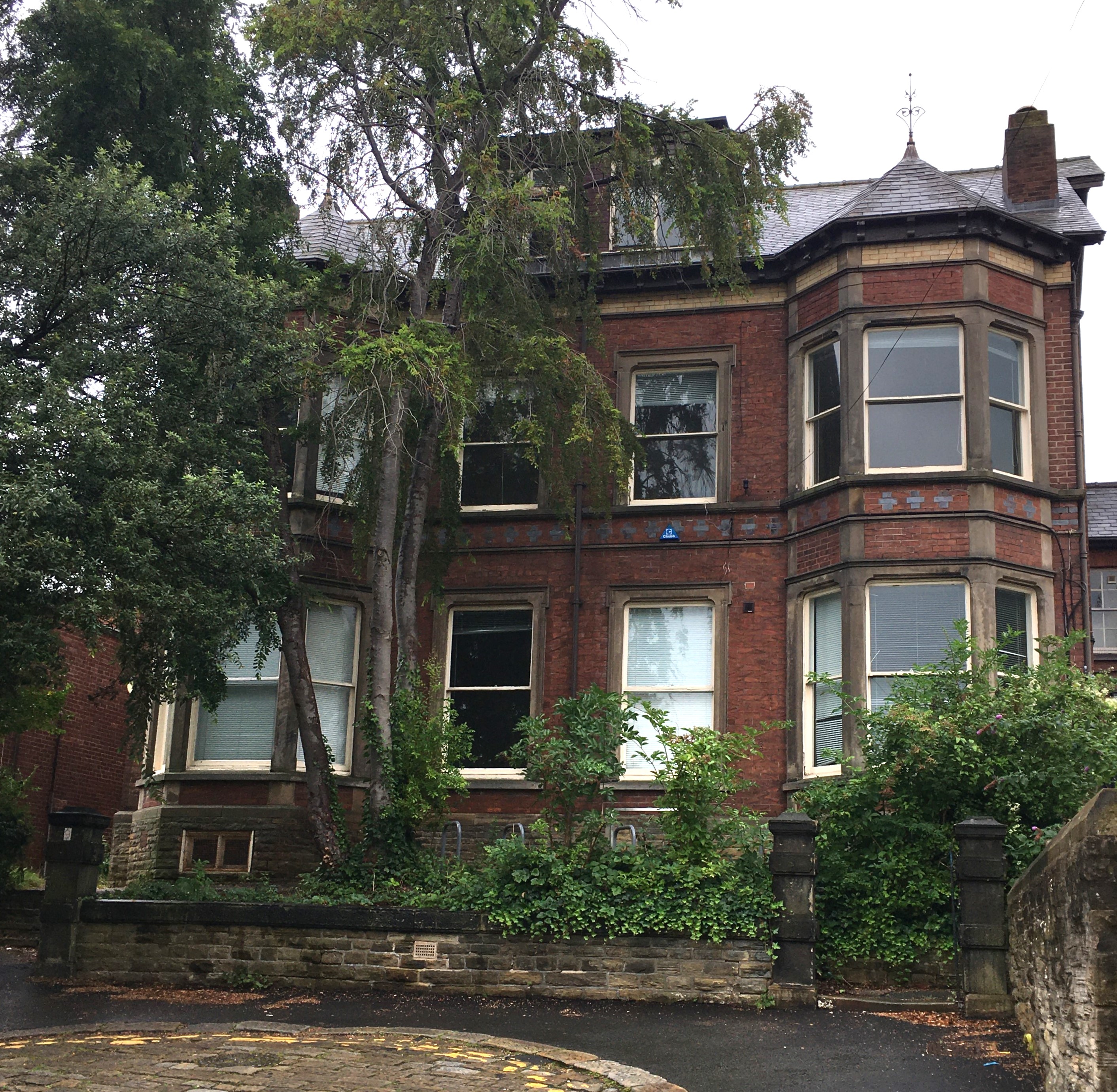
Chatwin’s birthplace in Shearwood Road, Sheffield, S10 He was such an elegant wordsmith that it’s a wonder that he didn’t become a poet as well as a prose-writer. His friends included several well-known and wildly different poets: Charles Tomlinson, his neighbour in Gloucestershire; Peter Levi, with whom he travelled to Afghanistan, as recounted in Levi’s The Light Garden of the Angel King; and George Oppen, the arch Objectivist.
-
On Martin Amis’s Inside Story
Over the years, I’ve probably read half of Martin Amis’s novels and liked them in parts, but I’ve never been a great fan, though more so than I was of Barnes (crushingly dull in my experience) and Rushdie, and less so than McEwan. What made me take Amis’s final novel, Inside Story (Vintage, 2020), off my local library shelf and borrow it the other week, I don’t quite know; I’m jolly glad that I did though, because I enjoyed it from start to finish, all 500+ pages of it.
That Amis called it a novel, rather than a slightly or partly fictionalised memoir, must be due to his disdain for ‘life writing’. Regardless, it interweaves reminiscences about his best friend (Christopher Hitchens), his father’s best friend (Larkin), and his other, literary father (Saul Bellow), with the story of a relationship he apparently had in the late ’70s with a woman whom he calls Phoebe Phelps. Among other things, he’s very good, and moving, on death, or, rather, dying. (He himself died, in May this year, at the same age, 73, as his father; and Hitchens died at 62, a year younger than Larkin, but from the same cause, oesophageal cancer. Bellow outstripped them all, by living to 90.) I found myself chortling frequently too, which can’t be a bad thing.
Curiously, he also throws in top tips for prose writers – and writers of any kind really, none of which is hugely original; even so, the following paragraphs contain sound advice, particularly for those haiku poets who imagine they are the world’s only true Existentialists:
Writers take nothing for granted. See the world with ‘your original eyes’, ‘your first heart’, but don’t play the child, don’t play the innocent – don’t examine an orange like a caveman toying with an iPhone. You know more than that, you know better than that. The world you see out there is ulterior: it is other than what is obvious or admitted.
So never take a single speck of it for granted. Don’t trust anything, don’t even dare to get used to anything. Be continuously surprised. Those who accept the face value of things are the true innocents, endearingly and in a way enviably rational: far too rational to attempt a novel or a poem. They are unsuspecting – yes, that’s it. They are the unsuspecting.
The book also includes a concise verdict on Larkin’s poetry which I’ve never seen bettered elsewhere, but more of that another time.
-
On Tom Paulin’s The Secret Life of Poems
I’ve been reading another gem of a book I found in Rotherham Library: Tom Paulin’s The Secret Life of Poems, Faber, 2008.
Having once been omnipresent, not least because of his trenchant opinion-giving on Late Review, Paulin appears to be a neglected poet these days; maybe he’s been quietly ostracised because of his views on Israel and Zionism.
Subtitled ‘A poetry primer’, The Secret Life of Poems analyses 46 poems (plus an excerpt from Macbeth), from the anonymous Elizabethan ‘The Unquiet Grave’ to Jamie McKendrick’s ‘Apotheosis’ from 2003.
Regrettably, none of the poets featured are black and/or minoritised, only two are women (Dickinson and Rossetti), and only two (Frost and Zbigniew Herbert) aren’t British or Irish.
Aside from those major flaws, though, I very much enjoyed Paulin’s takes on very familiar poems – such as ‘A Nocturnall Upon St Lucies Day’, ‘Frost at Midnight’, ‘Sailing to Byzantium’ and ‘A Disused Shed in Co. Wexford’ – and the odd one new to me, e.g. Thomas Given’s ‘ Song for February’.
He’s brilliant at pointing out the layered, otherwise hidden foreshadowings and secondary meanings. Crucially, though, he stresses the fundamental importance of the sounds, the rhythms, the music, the emphases that poems make. In that vein, he quotes Frost, without stating the source, as follows:
The ear does it. The ear is the only true writer and the only true reader. I have known people who could read without hearing the sentence sounds and they were the fastest readers. Eye readers we call them. They can get the meaning by glances. But they are bad readers because they miss the best part of what a good writer puts into his work.
Remember that the sentence sound often says more than the words. It may even as in irony convey a meaning opposite to the words.
I must bear all that in mind more consciously than I usually do.
-
On Gaia Holmes
I’ve been a fan of Gaia Holmes’s poetry since the publication of her third (and most recent) collection, Where the Road Runs Out, available from Comma Press here, which is among my very favourites of the last five years, if not all time. I’m pretty sure that it I bought on the recommendation of a typically warm-hearted review by John Foggin on his blog, here. I subsequently bought Gaia’s two earlier collections, which are both very good too. To paraphrase Orwell, all poets’ voices are unique, but some, like Gaia’s, are more unique than others’.
So I was really pleased to see today from Gaia’s blog that she’s uploaded a recording of her short story, ‘Below the Thunders of the Upper Deep’, to her Soundcloud page, here. It’s a terrific listen.
Even better is the fact that there are also loads of other atmospheric recordings, interspersed by music, which she made two/three years ago, of her (and other poets’) poems. I particularly like how, each time, Gaia paired one of her own lovely poems with somebody else’s to provide intriguing comparisons and contrasts.
-
Review of Ian Parks’s Selected Poems 1983–2023
With thanks to Hilary Menos and Andy Brodie, I have another review at The Friday Poem, here.
-
On Jill Abram’s ‘Inheritance’
Through her erstwhile directorship of Malika’s Kitchen, staging of the highly successful ‘Stablemates’ series of readings and ever-supportive presence at many poets’ launch events and other readings, Jill Abram, as much as anyone in the UK poetry community, has championed, and continues to champion, its happily increasing diversity of outstanding voices.
As an exceptional poet in her own right, Jill’s poems have been appearing with increasing frequency in high-quality journals in the last few years. It’s therefore excellent news that Jill’s debut publication, Forgetting my Father, has recently appeared from Broken Sleep Books. It’s available here, with an attractive cover designed by Broken Sleep’s owner and principal editor, Aaron Kent. It consists of 23 tremendous poems about family, Jewishness, bereavement, the passage of time and much besides; above all, how memories, and their jewel-like details, still colour the present.
Jill has kindly given me permission to quote the whole of what is possibly my favourite of the pamphlet’s many highlights.
*
Inheritance
A coat, a jacket, five pairs of knickers and Alfred —
my grandmother’s legacy to me; the bronze tortoise
which I still see hiding in the hairs of the hearthrug
at Woodlea, opposite the park on Wythenshawe Road.
My sister has silver grape scissors, an eternity ring
and the canteen of cutlery. There’s a red pyrex bowl
in Mum’s cupboard filled with memories of custard.
My aunt liked the ugly paintings, she got them all.
Grandma didn’t leave a will with lawyers. She left
a locked deed box in her flat and dozens of keys
which didn’t fit. We broke it open. It was stuffed
with letters: My dearest Bessie . . . forever your Sim.
*
Here we have a single, abstract noun as the title, with an etymology derived from Old French and Latin. It’s a heavy word, but it does the job, because it summarises exactly what the poem is about, and no other word would suffice.
The shape of the poem is a traditional one, which is somehow appropriate because the content of the poem harks back to times which were weighed down with more convention than today. Throughout the pamphlet as a whole, the forms are mostly stanzaic and, crucially, organic, in that they are driven by the content, as befits a sequence of poems concerned with family and how it shapes our understanding of our place in the world. ‘Inheritance’ looks orderly on the page, allowing the poet to subvert that neatness. It consists of only three quatrains but, in an implicit mirroring of the clearance following a relative’s death, they are crammed full of objects.
That the first stanza starts with a list of objects which the poet-persona has inherited, rather than with the summarising statement of ‘my grandmother’s legacy to me’ plunges the reader straight into the scene, as if surrounded by the objects. As an opening line, it is estimable both for what it reveals and how it sounds on the ear. Are the coat and jacket too old-fashioned to be unwearable now, or are they stylish enough to transcend the years of fashion? Are they from when the grandmother was young, middle-aged or elderly? Wisely, we’re not told – sometimes the reader doesn’t need to know everything and should be left to fill in the gaps. Neither do we know precisely when the grandmother lived and died.
The ‘five pairs of knickers’ has a surprising and rueful comedy to it; not just innately, but also in the augmenting specificity of ‘five’ and, as the reader soon discovers, in relation to the comparative riches bequeathed to the poet’s sister.
The line ends with another surprise: the very Victorian-sounding forename, maybe named after Lord Tennyson. The dash gives the reader a slight pause, like a comedian would bestow on their audience before a punchline, before the two revelations of the second line.
The fine detail, and spaced alliteration, of the third line flows beautifully from the second into the fourth, where we find more rich detail. ‘Woodlea’ could be the name of a house, perhaps built in the mid- to late-1800s, a Victorian villa in estate-agent parlance; or it could be the name of a block of flats; either way, it was a home, located, it seems, in south-west Manchester. (I’m no expert on the geography of Manchester!)
Reading the stanza out loud brings out its almost iambic rhythm and sound, but also that air of resigned comedy which the word ‘legacy’ conveys, as though the grandmother was having a last laugh.
Maintaining, or upping, the momentum after such a lively and exemplary first stanza would not be easy, but the poem accelerates through the second stanza, in a succession of three sentences (as opposed to the first stanza’s one). Immediately, we find out that the poet’s sister received a rather better legacy, but, again wisely, there is no overt mention of any sibling rivalry which that might have caused. (Incidentally, the pamphlet includes a beautiful, bittersweet elegy called ‘My Sister Is’.)
That the second stanza also starts with a list surely adds to the poem’s unity. I had to look up ‘grape scissors’ to see exactly what they look like. It seems, they were a Victorian invention, in the days when it would’ve been deemed extremely bad form to pluck grapes with one’s fingers in front of guests. The ‘eternity ring’ neatly foreshadows the poem’s ending. That gloriously sonorous phrase ‘canteen of cutlery’, can’t fail, whether intentionally or not, to remind some readers of the prizes on The Generation Game and Sale of the Century.
The next sentence provides more comical pathos, verging on bathos, with that superb ‘filled with memories of custard’. I have no doubt that I’ll be hard-pressed to read a more striking – and chuckle-inducing – phrase than ‘memories of custard’ any time soon. By not attempting to describe the paintings other than by the catch-all ‘ugly’, the poet lets the reader use their imagination. Knowing when, and when not, to employ that technique is a fine art, and in this poem the balance is perfectly stuck.
With its unobtrusive but effective alliteration and its concise story-telling, the last stanza is as taut as the first two, despite its sobering opening. Until the Married Women’s Property Act of 1882, Englishwomen were not allowed to draw up a will without their husband’s permission. Perhaps the lingering misogyny of English society or a distrust of officialdom influenced the grandmother’s decision not to ‘leave a will with lawyers’, or maybe it was simply more pragmatic to leave the ‘locked deed box’. Is the ‘flat’ part of ‘Woodlea’, or a scaled-down dwelling elsewhere following the grandfather’s death some years before? The information that there were ‘dozens of keys / which didn’t fit’ – the enjambment nicely delaying the humorous pathos here – and that the box had to be opened by force afford the poem’s final droll images. The use of ‘we’ is subtle: the plural pronoun provides a female unity: all the inheritors are female and some or all of them are assembled with one purpose, but hitherto they have been referred to as individuals.
And so to the poem’s surprise ending. Like earlier enjambments, the pause on ‘stuffed’ enriches what follows. The opening and closing snippets of what are presumably love-letters are tantalising – the reader has to fill in the ellipsis in between. The use of the names is just right here, especially that we learn that the grandmother is ‘Bessie’. Presuming that ‘Sim’ is a diminutive of ‘Simeon’, ‘Simon’ or something similar, is he the grandfather, or a pre- or extra-marital paramour? It’s brave and admirable of the poet not to spill the beans; moreover, it’s a poignant ending to a poem which is chock-full of life in the midst of death.
The various clues which are laid out before us in the poem prompt deeper thoughts of other matters: what the grandmother’s relationships with her daughters and granddaughters were like, hinted at – in one direction only – by her bequests; whether or not she was much-mourned; and what she was like as an individual.
‘Inheritance’, like other poems in this magical pamphlet, is a treasure which needs to be widely known and anthologised.
 Matthew Paul: Poetry & Stuff