Two days running, I’ve had serendipitous, marvellous encounters with sand martins.
On Wednesday, I intended to, and still did, walk up the Sheffield and South Yorkshire Navigation – i.e. the canal parallel to the Don – towards Swinton, but first I got distracted by the sand martins whizzing and falling, u-turning and tumbling, their white bellies skimming the river in one seamless, incessant movement on a riffled stretch downstream of Chantry Bridge, below the bus station in Rotherham town centre.
I’d been periodically looking out for them in May, but it took until its final day for me to get the chance to watch stand there, mesmerised, watching them from the railings at the back of a car park. As I said to a 4×4 driver, it’s mindboggling to think that sand martins (and those other acrobats, house martins, swallows and swifts) come all the way from sub-Saharan Africa to sub-Arctic Yorkshire, where there was spit in the air – while half the country’s enjoyed temperatures above 20 degrees, here it’s struggled to get above 10 all week.
Yesterday, Lyn and I walked along the canal in the other direction, towards Sheffield, because we wanted to have a wander round Attercliffe, where she was born. It was that sort of day when it was too cold to go without a jacket, but you felt too hot wearing one – it was, and is, June, for pity’s sake. Anyhow, having looked in the beautiful former Banner’s department store building, now used for not a great deal other than a greasy caff, we ended up trotting through Attercliffe Cemetery and down to the Don again, where we had a fantastic view of sand martins flying in and out of pipe outlets.
That reminded me of seeing them somewhere near Skipton, along the Skirfare, a lovely tributary of the Wharfe, about 20 years ago, with other British Haiku Society poets, in, I think, May 2006. From that experience I produced this haiku, published in Presence 30, then Wing Beats and The Lammas Lands:
river loop—
a sand martin squirms
into its nest hole
It seems like a lifetime ago. Those few days there were notable, among other things, for a renku session run by John Carley, who did as much as anyone in the UK to promote the creation of haikai linked forms not just as a literary exercise, but as an enjoyable, collaborative social event. He was a very erudite man, and absolutely passionate about renku. I think that was the only time I was involved in a renku session in person. I took part in several by email with Ferris Gilli, Paul MacNeil – who took the ‘conductor’ role and very much kept us focused – and Ron Moss, across three continents; but it would have been amazing if we’d been able to write them face to face. Like John, Paul was very exacting and knowledgeable about the subtleties of ‘link and shift’, i.e. how each verse was connected to, and simultaneously moved away from, the previous one. Sadly, both John and Paul are no longer with us.
-
On sand martins and renku
-
On ‘The Red Wheelbarrow’ and what Donald Davie had to say
When, in 1982, I first encountered William Carlos Williams’s now-famous 1923 poem ‘The Red Wheelbarrow’, readable here, it was instantly inspirational and probably the first poem that I really loved. Like my devouring of the works of Kerouac, Ginsberg and the other Beats, this came about because my brother Adrian, four years older than me, had undertaken a poetry module as part of his American studies degree at Essex University. We both loved WCW’s poem for its directness, immediacy, exactness, brevity, shape upon the page, and absence of punctuation and upper-case lettering; so much so that Adrian, with no little pretension, asked our mum to knit him a jumper which featured a red wheelbarrow against a grey background. I don’t think anyone ever ‘got’ the image without prompting, but we knew – and somehow that sufficed. To us, ‘The Red Wheelbarrow’ seemed a significant advance on Ezra Pound’s 1913 poem ‘In a Station of the Metro’, which rather clumsily attempted to transmit the spirit of haiku into English poetry.
Over the years, my admiration for ‘The Red Wheelbarrow’ has reduced, partly because my tastes have broadened to include poetry far more florid than Imagism and perhaps because, like WCW’s ‘This is Just to Say’ (which, due to the abundance of social media parodies it has spawned, has become more well-known than ‘The Red Wheelbarrow’), the poem has, within the poetry world, become famous to the point of infamy. In my own poetry, whatever concision and specificity they contain are qualities I first grasped from WCW’s poem. But by 1983, I’d discovered the Penguin Book of Japanese Verse and its translations of Bashō, Buson, Issa, Shiki and other haiku poets and retrospectively found Imagism to be verbose in comparison. Nevertheless, I retain a certain nostalgic fondness for my first love.
I’ve just read The Movement Reconsidered, edited by Zachary Leader and published by OUP in 2009, subtitled ‘Essays on Larkin, Amis, Gunn, Davie and Their Contemporaries’. It had a brief review in the Guardian, here. It’s a brilliant book, not least because of the range and quality of the contributors, including: Robert Conquest, the then last survivor of whatever collegiality the Movement possessed; Blake Morrison; Alan Jenkins; Anthony Thwaite (who had co-edited the Penguin Book of Japanese Verse); James Fenton; Craig Raine; Clive Wilmer; and the rather more leftfield Terry Castle, with her essay ‘The Lesbianism of Philip Larkin’ (about his soft-porn ‘Brunette Coleman’ stories). My interest in it was much more about Donald Davie and, above all, Thom Gunn than in their far more insular ‘colleagues’. In relation to Davie, what comes across so strongly is his critical acumen. This wasn’t news to me, because I’ve cherished his last main essay collection, Under Briggflatts, since I first read it 30 years ago; but some of his assessments quoted in The Movement Reconsidered jumped out at me. (Davie was, incidentally, the founding Professor of English at Essex, from 1964 until the sit-ins of 1968 drove him to the States. Not long after, Robert Lowell pitched up at Essex, where one of his students, albeit unofficially, was the haiku bard of Halifax, Keith J. Coleman, perhaps a distant cousin of Brunette.)
In particular, this throwaway remark, in an essay – ‘Donald Davie, The Movement, and Modernism’ – by William H. Pritchard, grabbed my attention: ‘Davie treated Williams as Modernism’s Dumb Ox, calling his most famous poem, ‘The Red Wheelbarrow’, a ‘trivial and self-preening squib’ – something that surely needed saying.’ It’s a devastating verdict, and Pritchard’s enthusiastic agreement, unqualified by any reasoning, further damns the poem. But the poem was published the year after Davie’s birth, a year after Modernism’s high-water marks, so it seems odd to dismiss the poem’s worth without any historical context and/or acknowledgement of how ground-breaking this apogee of Imagism was. (1922 was, coincidentally, also the birth year of Kerouac and Larkin, both great jazz fans, with polar tastes: they respectively adored and abhorred Charlie Parker.)
Is the poem trivial? The fact that it has its own Wikipedia page suggests otherwise. Carol Rumens chose it as ‘poem of the week’ for the Guardian in 2010, here. If, through its opening over-statement, it too squarely focused on what the poet could see, without any overt explanatory information regarding the location or its socioeconomics, then perhaps it didn’t, and doesn’t, provide enough meat for the critical reader. Yet the weight of the first stanza – both the poem’s brilliance and its undoing – surely raises it far above the trivial: explicitly it tells us that in that moment importance lies in what can be seen; that almost nothing else matters. It’s noteworthy, though, that WCW didn’t take that focus to its logical conclusion and write ‘everything depends / upon’.
Is it a ‘self-preening squib’? Let’s consider the noun first. The Cambridge Dictionary defines it as ‘a small firework consisting of a tube filled with powder that makes a hissing noise when it is lit’. Rarely does it appear without its best buddy, ‘damp’. Here, Davie implies that the poem’ explodes and burns itself out all but straightaway. The adjective – attributing a peacock quality to the poem – is, as Davie no doubt realised, rendered superfluous by the choice of noun, but it’s thrown in for good, overloading measure. There can’t be any question as to whether Davie understood what WCW was getting at. His objection must only have been based on the sheer bluntness of ‘so much depends / upon’. (Given that Davie was a Barnsleyite of Scottish extraction, one might have thought such bluntness would’ve appealed to him.) Again, though, we have to note that the statement that phrase contains is qualified and not absolute, so maybe it isn’t quite as blunt as it appears.
And what, if any, assistance to the reader of the poem does Davie’s value-judgement provide? Should we conclude that it’s a deliberately provocative snipe, born of jealousy, at a poet whose work inspired a generation of poets more experimental and, by the sixties and Seventies, mostly much more fashionable than him: Creeley, Ginsberg, Niedecker, Olson, Zukofsky. That Davie, like Gunn before him, loosened up his poetic approach due to prolonged periods in America makes his stance all the more extraordinary.
The poem might be considered the exemplar par excellence of WCW’s dictum of ‘No ideas but in things’, but to what degree is that really applicable here? Does it cohere within the idea that so much importance should be attached to the wheelbarrow? If so, is that because of its usefulness as a functional object or as one merely to be perceived? If the latter, does ‘so much depends / upon’ apply only to the wheelbarrow, with a primacy underscored by its primary colour, or also to everything which follows, i.e. that it is the whole scene, and its unity, to which WCW is pointing.
The wheelbarrow is, of course, the reddest red. Why? Because, the poems tells us it is ‘glazed with rain / water’ which sharpens the definition of the colour in the mind’s eye and because it stands in clear contrast to ‘the white / chickens’. Does the reader also perhaps sense that the chickens have red beaks?
To me the poem’s best, but least mentioned, attribute is the specificity of WCW’s word choices: not just the colours, but his adept use of prepositions and, moreover, the perfection of ‘glazed’ and ‘rain / water’: that he writes ‘rain / water’ rather than just ‘rain’ might be because a second stanza of ‘glazed with / rain’ would’ve looked less appealing and had one less stress than the other stanzas, but it also bestows the sense that the rain has stopped and moved on, leaving a lingering effect behind.
There are theories out there which read the poem as a subtle commentary on race relations, a show of solidarity to the African Americans in his patch: that the poem comes from a visit that WCW, Rutherford general practitioner, undertook to the home of a black farmer; that, just a few years after the lynchings and arson in Chicago, he kept to his Hippocratic oath, which included an obligation to all his fellow human beings.
If the inspiration for the poem came, either directly or via Pound, from early translations of Japanese haiku, then it’s tempting to wonder if WCW considered going the whole hog; perhaps something like:
white chickens . . .
the red wheelbarrow
glazed by rain
The word ‘glazed’ would be too much of a poeticism for haiku puritans who propound the use of unadorned language. Haiku, as they are properly conceived, wholly, or at least mainly, consist of what can be perceived by the senses, without a need to make an overt statement. In the last 10 years or so, though, explicit, abstract phrasing and statement-making, telling the reader too much, has become a regrettable, and regrettably widespread, practice in English-language haiku. In this day and age, nobody needs to be told some equivalent of ‘so much depends / upon’ whatever the objects are or the matter is; it is more than enough simply to isolate those objects, that matter, on the page, surrounded by white space. A century ago, things were evidently different: the spirit of haiku and the way of Zen, and what Eastern traditions generally expounded, had yet to exert much influence in the West, especially on its literature. With this poem, WCW, unwittingly to a degree no doubt, did as much in that regard with this one poem as anyone.
-
May Day mayday
I’ve been getting my head down reading and writing in the last few months, and participating in the odd workshop session here and there, most recently this weekend just gone, when I was unusually productive.
I organised one myself, in March, for five of us to write poems in response to works in the Albert Houthuesen exhibition at Doncaster’s Danum Gallery. Albert who? you might ask. I confess that I’d not heard of him before, but he was a contemporary of some great artists at the RCA, including my hero Ed Burra. I especially liked Houthuesen’s drawings and paintings of clowns, especially a troupe called the Hermans who regularly performed in Doncaster when he was living nearby as a refugee from London during the war.
This coming Saturday, instead of watching the hideous spectacle in Westminster, the five of us are convening for another poetry from art session, at Sheffield’s fabulous Graves Gallery, where one of the exhibitions surveys the career of George Fullard, about whom I’ve written before, here.
I’ve read lots of poetry, but the book which has haunted me most of late is one which I’ve been wanting to read for years: John Berger and Jean Mohr’s collaboration A Fortunate Man. It contains so many insightful passages about the human condition that it would be invidious to single any out here. Suffice it to say that it’s up there with the Into Their labours trilogy and Bento’s Sketchbook as my favourite of Berger’s many beautiful books. What an extraordinary writer he was. Incidentally, he was an early champion of Fullard.
In my most recent poems I’ve been trying to be more ‘in the moment’, like I am in haiku, rather than dwelling on, and in, the past – albeit, of course, that every second of time contains the past and the future as well as the here and now.
I’ve booked for a couple of online readings – the wonderful duo of Fokkina McDonnell and Zoe Walkington (whose pamphlet, available here, is a brilliant hoot but much else besides) for Writers in the Bath, and the Live Canon launch of pamphlets by Josephine Corcoran, Matt Bryden and Isy Mead.
In March, it was fantastic to see Presence reach its 75th issue, due, principally, to the huge effort put in by editor-in-chief Ian Storr, who has had the steadiest of hands on the tiller for a good few years now. I was very happy to have three haiku in it, including this one:
the cornfield flash
of a goldfinch in flight . . .
Flanders poppies
One last thing: here’s a quote from Michael Hamburger’s superb introduction to WG Sebald’s 1998 collaboration with Jan Peter Tripp, Unrecounted: ‘[M]emory is a darkroom for the development of fictions.’
-
Essay on English-language haiku
My thanks to Hilary Menos and Andy Brodie for publishing an essay by me, here, which is intended for those who know a bit, but not a lot necessarily, about haiku in English.
-
OPOI review of Fiona Smith
Among what will be one of the last-ever batches of Sphinx reviews is my one-point-of-interest piece on Fiona Smith’s Travellers of the North, here.
-
On Robert Hamberger
Not for the first time, I’m indebted to Mat Riches’s ever-excellent blog – and in this case, an especially brilliant and poignant post, here – for alerting me to something which I may otherwise have overlooked: Peter Kenny’s interview with Robert Hamberger in the latest edition of the Planet Poetry podcast, available here. I’m a big fan of Robert’s poetry, so it was a sheer delight to listen to the interview, not only because of his insights but also because it was interspersed by him reading poems from his latest (2019) collection Blue Wallpaper – available to buy here – which I reviewed for The North, here, and absolutely loved.
Robert aired so many quotable reflections on poetic practice that I had to keep pausing the podcast to write them down. His poetry is often concerned with the past and how it interacts with the present, and I nodded furiously in agreement with his conviction that, “I am preserving experiences or people I loved, or even the person I was at that particular point in my history.” The gist of that is a common enough motivation, but it’s the careful choice of the word ‘preserving’ which is particularly noteworthy; that the poet is as much of an archivist as – if not more than – someone who digitises old photographs or curates items in a museum.
I was struck too by Roberts thoughts on sonnets – he is a superb sonneteer – and his statement that, “rhyme can nudge you onto something in the way that unrhymed poems don’t”. Of course, Robert’s not the first person to point out the paradox that tight rhymed forms can be liberating for a poet. My own experience is that, having come from a position of being dismissive of rhyme and strict(-ish) forms, I was completely won over by a hugely inspiring and enjoyable year-long course in forms taught by Clare Pollard at the Poetry School about 13 years ago.
Robert was also very articulate about the mysteries of drafting poems: “I really like [the] dialogue with a poem during the drafting process; that issue of being attentive to what the poem is not only trying to say but what shape it’s trying to form as it says it.” Robert hints at the mystical aspect of that process, and I certainly share that sense of the poem having a life of its own which I somehow have to charm onto the page.
So, in all, I can’t recommend listening to the interview, and buying and reading Robert’s poetry, enough. Robert’s website, which features his other books, including the marvellous A Length of Road, is here.
*
Much of my poetry reading of late has been the collected works of the two Janes, Hirshfield and Kenyon, whose poems are and were invariably beautiful, bit so much so that I needed a wholly different voice to read as well. That’s where Luke Samuel Yates’s new, first collection, Dynamo, published by Smith Doorstop and available here, came in: it’s a hugely entertaining book and highly recommended.
-
On ‘funny’ poems
Partly due to the pressure of the old toad work, I’ve been in the poetry doldrums for much of this year, so it was nice to get a short piece up on The Friday Poem again, here – a 100-word response to a poem by Geoff Hattersley as one of a series of brief commentaries on ‘funny’ poems. The poem I chose is, as you’ll see, both funny and deeply serious at the same time, which is no mean feat to pull off. I could’ve chosen any number of his poems, in the same way that I could’ve chosen numerous Matthew Sweeney poems, but that thar Mat Riches got there before me, here. (I’m reminded at this point that, a week or two ago, I heard Paul Stephenson – another brilliantly funny yet serious poet, like Mat himself – read a poem entitled ‘Not Matthew’.)
Had Mat not quite rightly alighted on Sweeney, I might’ve chosen ‘Upstairs’, first published in the LRB – here – and collected in The Bridal Suite, Cape, 1997. It’s typical of Sweeney’s very quirky narrative style, moving from funny to very dark within a heartbeat. His poems and worldview were often described as ‘surreal’, but that’s a lazy label. It’s surely just a recognition that if you live life with your senses tuned to high-ish alert you will notice that it’s chocker with non sequiturs, which paradoxically make more sense than not. There’s tremendous artistry at work beneath the surface of Sweeney’s poetry too: in ‘Upstairs’, the consonance between ‘X’, ‘brass’ ‘Voss’, ‘undressing’ and even ‘Iceland’ isn’t coincidental; and ‘Voss’ isn’t chosen purely for that purpose: Sweeney would’ve known that it‘s the German word for ‘Valentine’.
As someone who has often been accused of writing ‘funny poems’, I find it bemusing that the underlying seriousness isn’t obviously apparent; but I suppose that shouldn’t be surprising, since everyone reads poems differently and, initially at least, picks out what appeals to them. For me, though, it‘s just the case that the line between funny and serious is invariably so cigarette-paper-thin that it‘s barely visible. No wonder the Buddha always had a smile on his face.
-
On a reading for Read to Write
A few weeks ago, I had the privilege of reading some of my poems to Doncaster’s writing group Read to Write in Balby Library. I read for about 25 minutes and then, after a break, we had a Q&A session. It was my first in-person reading since I read for Fen Speak in Ely in February 2020, a couple of weeks before the first Covid lockdown. Here’s a picture of me reading from The Evening Entertainment, taken by Tracy Day Dawson and used with her kind permission:
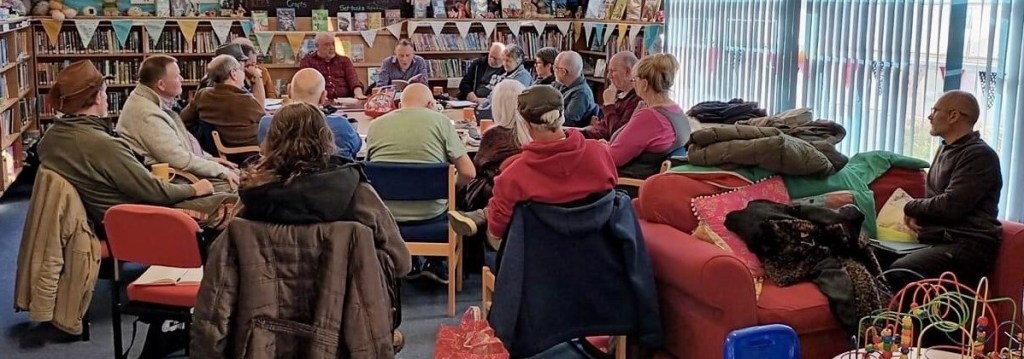
The brilliant poet Ian Parks, whose Selected Poems is forthcoming from Calder Valley Poetry, founded Read to Write in Mexborough seven years ago and it’s gone from strength to strength. Its activities include workshopping sessions and, as its name implies, reading and analysing texts by great writers, including an ongoing project to read all 37 of Shakespeare’s plays.
The week before my reading, I went to a Saturday afternoon fundraiser for Ukraine at Doncaster Ukrainian Centre Club, at which Ian, Sarah Wimbush (the organiser) and Joe Williams were the featured poets among an open mic session of most of the Read to Write regulars and other poets from further afield, beautifully MC’d by Mick Jenkinson. I’d recently read Sarah’s marvellous Bloodaxe collection, Shelling Peas with My Grandmother in the Gorgiolands, available here, having previously enjoyed and admired her pamphlet Bloodlines, so hearing her read from it was a delight. The whole afternoon was a pleasure. As ever with open mics, you never know quite what you’re going to get, but in this instance, the overall standard was refreshingly high.
Despite practising beforehand, I felt a bit ‘ring-rusty’ when I read at Balby, but the group were so warm and lovely that any nerves I had soon vanished. The questions were good ones and kept me firmly on my toes – they’re a very knowledgeable group. Up and down the UK, local groups are the lifeblood of poetry, especially for those who are just starting out, and might not have read or written poetry since they were at school. In this case, the group impressively encompasses writers at different points on their poetry journey. I hope to get along regularly to the group’s sessions once I have a bit more time, which I hope to have later this year.
My thanks to Ian for the invitation and to him and all the group for being so welcoming.
-
On a haiku by John Hawkhead
there it is again
that harvest moon in the well
of my whisky glass
The Japanese tradition, like the preceding Chinese poetic tradition, is rich in moon haiku, and especially ones in which the moon is seen in water, particularly by poets who’ve drunk too much sake. With this haiku, first published in Presence 50, John Hawkhead cleverly reimagines the sub-genre. Hawkhead has been writing haiku, and has seen them published in many reputable journals, for many years. He’s also one of the very few English-language haiku poets on Twitter whose haiku are well worth reading.
I’m not a huge fan of statements in haiku, but this one sets up the picture and the mood engagingly: it strikes a tone which could be read as either wearisome or full of wonder, or anywhere between the two. There’s an audible pause at the end of the statement, as if a colon is in place.
The precision of the middle line needs careful unpacking. Why ‘that’? It possibly gives the reader a sense that the moon is being an irritant. Crucially, it means that the line doesn’t need two instances of ‘the’. Then we’re told that this full moon is a specific one, which appears closest to the autumn equinox; so here is the season reference. What gives the poem its real power is the fact that Hawkhead doesn’t opt for a more prosaic and generic option of writing ‘there it is again / that harvest moon / in my whisky glass’. The addition of ‘the well / of’ bestows a layer of depth.
If one reads the poem as a study of melancholy, in which a solitary whisky-drinker cannot even find solace in the sight of the moon at the bottom of his glass, then the word ‘well’ triggers its other noun sense, of a deep, round underground source of water. And the fact that the moon is visible in the glass means, surely, that the finger or two of whisky has been drunk, adding to the melancholic mood.
Even if one reads the haiku merely as an expression of curiosity – that the moon has appeared to align its bright white roundness into and with the roundness of the glass’s bottom – it is still a magical moment, like the alignment of planetary bodies.
A more cynical reading might be that including ‘the well / of’ enables the haiku to fall unobtrusively into a 5–7–5 pattern and provides an alliteration with ‘whisky’. For me, though, the addition truly enriches the poem. This haiku is the exception to the rule that 5–7–5 haiku in English are generally too verbose and therefore need trimming: here, cutting back to a 5–4–5 would diminish the poem’s effectiveness.
There is a recording of John Hawkhead reading some of his haiku on the Living Haiku Anthology website, here.
-
On The Iron Book of British Haiku
2023 marks 25 years since Peter Mortimer’s Iron Press published The Iron Book of British Haiku, still available on the Iron website, here. It was co-edited by David Cobb and Martin Lucas, both of whom are no longer with us. I seem to remember reading somewhere that it sold over 5,000 copies. It certainly found its way into many bookshops and for years was usually the only English-language haiku book available.
It contained 73 haiku poets, including two of the four who participated in a kasen renga which was appended after the individual poets. Of the 73, I reckon just 14 are still writing haiku and at least three of those 14 have ceased seeking publication for their output. A good few of the others have since died – Norman Barraclough, Janice Fixter, Seamus Heaney (!), Ken Jones, Stuart Quine and David Walker among them. That’s unsurprising, because in those early days of the British Haiku Society (BHS), which had only been founded eight years before, the average age of the membership must’ve been well over 60, and I was usually the youngest attendee at events.
At the time, I was chuffed to bits to be in the anthology, even though I only had two haiku (both about snails!) in it. I went to the launch at a bookshop whose name and exact location in London escapes me, and which was memorable for a hypnotic reading by Mimi Khalvati, one of three poetry ‘heavyweights’ (alongside famous Seamus and Anthony Thwaite) who were shoehorned into the book to add some clout. Of course, haiku readings are mercifully brief.
In reality, the British haiku scene, as the BHS saw it then, wasn’t sufficiently developed to warrant such an anthology. Like the Haiku Society of America had done before it, the BHS in those years was largely concerned with trying to form a consensus about what haiku is, though it was easier to agree on what it isn’t. Unsurprisingly, some poets disagreed and left to pursue their own paths.
In 2002, the book was superseded by the Snapshot Press anthology, The New Haiku, again co-edited by Martin, this time with John Barlow. It too is still available, here. In terms of both representation and quality, it far exceeded the Iron Book, but the latter had set the bar.
The Iron Book had some noticeable omissions: James Kirkup, whom David had roped in as one of the founding triumvirate of the BHS and its first president, had left on bad terms; Gerry Loose, Peter Finch, Chris Torrance and, posthumously, Frances Horowitz might’ve been included. Whether or not David and Martin had tried to rope some or all of them in I don’t know.
Equally, some poets were included who wrote fine haiku (and other poetry in some cases), but who have long since vanished from the haiku (and wider poetry) scene: Claire Bugler Hewitt, Geoffrey Daniel, Jackie Hardy and Susan Rowley.
To me, the standard of the haiku in the book is highly variable, including a fair few – especially some which have been crowbarred into telegram-like 5-7-5 without articles – which today would be highly unlikely to be published anywhere except, unfortunately, by their authors on social media, as well as several minimalist poems and sequences which aren’t even especially haikuesque.
Yet the selections included some really good poems which have stood the test of time. Here are just a few that I like:
after dad
tidies her scarf
the toddler fixes it herself
Annie Bachini
thunder
my woodshavings roll
along the verandah
Dee Evetts
caught in a storm
wearing nothing waterproof
except mascara
Janice Fixter
into the busker’s cap
a chill wind blows
bronze leaves
Stuart Quine
loose now
on the knuckle
the thin gold
Susan Rowley
Evetts’s haiku reflects his job as a carpenter, later documented in the excellent collection endgrain (1995). Aside from a couple of classic haiku by David Cobb himself, the book is light on the sort of resonant haiku which rely not on an instant first-reading effect but yield their subtleties and layers over time.
The renga – by the tremendous quartet of Fokkina McDonnell, Stuart Quine, Helen Robinson and Fred Schofield – was, Fokkina, tells me, written on 11 May 1996, in her front room in Manchester at a Yorks./Lancs. Haiku Group meeting. Although it takes some slightly offbeat turns, by and large it’s the best thing in the book, which isn’t something you can often say about renga – in my experience, they’re often just a bit of fun rather than an exercise rich in literary quality.
So in all, one can say that the Iron Book was very much reflective of its time; and it’s about time now for another anthology of the best British haiku, which, to my mind, have come on in leaps and bounds in the last quarter of a century.
-
New poem – ‘Dentistry’
With thanks to editor Ben Banyard, I’m pleased to see my first publication of the year, over at Black Nore Review, here.
It recalls a very strange day; one which, I expect, most people alive in the UK then – especially in the south – will remember well.
-
New poem – Smallpiece
I was recently very fortunate and glad to see four of my poems published in the most recent issue of the lovely journal Pennine Platform – three short ones plus a longer one, ‘Smallpiece’, named after the gardener at Cecil Beaton’s Wiltshire home, Reddish House.
A recording of me reading ‘Smallpiece’ is now on the Pennine Platform website, here.
I’m very grateful to the journal’s editor, Julia Deakin.
-
OPOI reviews of John F. Deane, Clare Best and Mark Wynne
The last batch of one-point-of-interest reviews for 2022 were published on Sphinx yesterday, here. They include my reviews of pamphlets by: John F. Deane, here; Clare Best, here; and Mark Wynne, here.
As ever, though, there are lots of reviews, by and of a diverse range of voices, to enjoy and pique your interest.
Thanks for reading my blog in 2022 and happy New Year!
-
On On Poetry by Jackie Wills
I’ve been saving this up as my last non-collection/pamphlet read of the year. I bought and much enjoyed Wills’ collection Woman’s Head as a Jug (Arc) 10 years ago, and during the pandemic I got copies of three of her other five collections, which I also really enjoyed. So I had to buy a copy of On Poetry, curiously the second excellent book with that title to be published by Smith Doorstop in the last couple of years, after Jonathan Davidson’s. This one, though, seems implicitly to have a different book – Glyn Maxwell’s brilliant, but somewhat didactic classic – in its sights.
Wills’ book is subtitled ‘Reading, writing & working with poems’ and illustrates her points with poems which all bar two (Donne’s ‘The Flea’ and Edward Thomas’s ‘Digging’) are not written by White men, thus providing a necessary corrective to Maxwell’s and other ‘how-to-write-poetry’ books. For example, Wills’ unpacking of Patience Agbabi’s superb poem ‘The Doll’s House’ – available here – is a lesson itself in how to read poetry and tease out its subtleties and gifts.
A key feature of Wills’ ideas is the centrality of metaphor. She approvingly cites Susan Sontag’s line that, ‘A great poet is one who refines and elaborates the great historical store of metaphors and adds to our stock of metaphors.’ I often find metaphors hard to grasp and use them sparingly in my own poems, so this is a little challenging for me. However, it’s good to be challenged, and essential, I think, for any creative person to reassess their own thoughts and practice in the light of others’.
I’m only halfway through the book, but I’m enjoying it so much that I’m having to take it slowly so I can fully savour it. You can buy a copy on the Poetry Business website, here.
I should mention too that Wills maintains an always highly readable blog, here, and that her latest collection, A Friable Earth (2019), and three of its predecessors are available to buy on the Arc website, here.
-
My year in haiku
As I said recently, I write precious few haiku nowadays and never try to force them out. It’s surprising for me to find, then, that this year I’ve written as many as 16 which I like to think have some merit to them. By some distance my favourite among them is this one, which Tanya McDonald kindly published in Kingfisher 6:
a dove’s two-note song . . .
I sink a pint of bitter
in the old pub’s shade
It was a rare instance of a haiku popping into my head fully formed, in the hot days in Holderness back in August, which I partially reported on here. I was sitting on a bench outside the White Horse, Easington, a few minutes after it opened at the odd time of 4pm, when I had an hour or so to kill before the bus was due to ferry me back to Holmpton. (The vagaries of East Yorkshire’s buses were as much of a mystery to me as those of the Kingston Loop railway would be to any non-south-west-Londoner.)
By accident rather than design, it’s a rare-for-me 5-7-5 haiku, though that in itself doesn’t make it any better or worse than any other haiku of mine. More to the point, maybe, that iambic second line and the third have a sing-song rhythm comparable to the collared dove’s call.
The fact that it was a pub called the White Horse was very pleasing to me, because it was also the name of the first pub, in Kingston, in which I regularly drank under-age. The latter, long since gone, was an odd boozer, with a landlord known as Orville, and a regular propping up the bar who was Samuel Beckett’s double and known to all as Roadrunner, on account of the fact that the only thing he ever said was ‘Beep’. I have no idea how he ordered his bottles of Guinness. Orville ended up doing a runner with the takings, which really can’t have been worth it.
Perhaps my pencils will jot down more haiku next year than they manged to this. Either way, rather like East Yorkshire’s buses, they’ll come when they come.
-
On obscurity
A BBC website piece on the international appeal of Detectorists, available here, provides some instructive reading, in how superb writing can transcend supposed barriers: that, far from obscure cultural references being deterrents, they can actually possess intrinsic appeal because of their obscurity.
I’ve had similar thought when reading We Peaked at Paper, subtitled ‘an oral history of British zines’, co-written by Gavin Hogg and my friend Hamish Ironside. It covers fanzines devoted to all manner of obscure subjects, including, to my delight, A Kick up the Rs, about the mighty QPR. What’s evident is the passionate energy which the founders brought to their individual fanzines and it’s that which is important, surely, in enabling niche content to reach beyond those who might already be converted. I can’t recommend the book, which is beautifully produced and available here, enough.
The same thought occurred to me when reading my favourite poem, ‘Behind The Turnip Harvest’, in Julia Deakin’s 2012 collection, Eleven Wonders, published by Graft Poetry and available here. It describes how, when she was young, she and her family once went round to the adjoining semi-detached:
Perched on their mustard settee
on our best behaviour, we sipped tea
in their front room, which was ours
inside-out, with the same criss-cross
wooden knick-knack rack but strange
ornaments and more furniture.
Deakin evokes the time and place of her childhood with such precision, yet such a light touch too. The poem contains references to ‘Embassy Regal smoke’, a ‘Vymura trellis’ and ‘our Rowland Hilder’, which cast the reader into that early-1960s world. I had no idea what a Rowland Hilder was until the penny dropped that Hilder was the artist who painted the (presumably reproduction) picture in the poem’s title. The fact that Deakin had left it to the reader to work this out made the poem even more enjoyable and is a reminder that less is often more.
-
Review of Greta Stoddart
My review of Greta Stoddart’s collection, Fool is up on The Friday Poem, here. It was a labour of love to undertake all the requisite back-catalogue re-reading before I read Fool and eventually started to write.
As ever, the Friday Poem website has lots of really interesting reviews, articles and, of course, poems to read. It’s become such an indispensable part of the poetry community that it seems incredible that it only started last year.
-
On Fokkina McDonnell’s ‘Safe House’
The first and only occasion I’ve met Fokkina McDonnell in person was at the tail-end of the last century, at a British Haiku Society conference in Ludlow. At the time, I don’t think I knew that Fokkina also wrote longer poems; gradually though, in the last decade or so, and especially from her blog, available here, and in online Poetry Business workshops during Covid, I’ve become aware that Fokkina is not only a poet per se, but a very fine one at that. It is remarkable and admirable that Fokkina writes poetry in English, even though, because she is Dutch, it isn’t her first language – like many of her compatriots, Fokkina speaks and writes it more proficiently than many for whom it is their mother tongue. Fokkina has spent much of her adult life in the UK, but now lives in the Netherlands again. To be able to write excellent, readable literary works in a second language surely requires not just first-rate linguistic aptitude, but extraordinary cultural awareness and perception also.
Remembering / Disease, recently published by Broken Sleep Books and available to buy here at a bargain price, is Fokkina’s third full collection, following Nothing Serious, Nothing Dangerous (Indigo Dreams Publishing, 2019) and Another Life (Oversteps Books, 2016) and a pamphlet A Stolen Hour (Grey Hen Press, 2020). Fokkina received a Northern Writers’ Award from New Writing North for this latest collection.
It’s a book which is simultaneously challenging and delightful: thematically, subjects-wise and, not least, in its almost-total absence of upper-case and total absence of punctuation. This format seems to be inspired by Andrew McMillan’s poetry, and, perhaps, by the standard presentation of (English-language) haiku and tanka. (The rarer presentation of haiku as single lines, as, inter alia, Stuart Quine near-exclusively practised, might be another influence.) Readers accustomed to Fokkina’s poems will know that she has a great gift for sudden shifts of thought and emphasis which wrong-foot and surprise the reader. Many years’ practice as a psychotherapist must have informed Fokkina’s acute sensitivity to how the brain and heart interact. Her poems implicitly ask questions but usually stop short of providing answers – as with effective haiku, the reader is invited to do some work, in effect to complete the poems. There’s a lightness or playfulness which sporadically surfaces among the trauma; a sense which I can only really explain fully by using the Japanese haiku concept of karumi, which Michael Dylan Welch explores so well in an essay available here. And where Fokkina does apparently provide answers, the reader has to wonder if they are the answers of an unreliable narrator of sorts.
When I asked Fokkina if I could feature and write about one of the collection’s poems here, there were so many I could have waxed about that making the choice was far from easy. The poem below is reproduced with Fokkina’s kind permission.
Safe House
Where will it be? What will be inside?
you already know if you are living in this small space a
cardboard cupboard that even the best of lives are flammable
the strawberry box of memories
Dave Brubeck’s Take Five
at the end of the line someone will be waiting for you
someone to whom you have ties their shoulders are a temporary
saloon
the picture of the ice cutter from Alaska a few
small men on the ice coloured anoraks
singing is escaping so fast no-one can catch you Scarlatti as
a rope ladder over the abyss
photos a card her Venetian mask
a fire blanket in the kitchen
don’t follow the first instruction until you have examined it closely
it may be something metal from which you can only escape by
removing yourself from your limb
a coffin of white wood
(bad people would not think to look inside)
the narrow old blue chair that holds you
a ginger cat but not called Louis
that name is taken
the only safe house is time about 6:30 the long golden shadow
the voice of the person who kept you safe when you were small
*
The notes at the back of the book say that this poem is ‘after the poem of that title by Andrew Waterhouse’. In fact, the title of Waterhouse’s poem was slightly longer: ‘Safe House at the End of the Line’. It was the penultimate poem in his first and, alas, only collection, in, published by The Rialto in 2000, because he took his own life a year later, aged 42. Waterhouse’s death was a huge loss, comparable to that of the suicide of the American poet Thomas James who, like Waterhouse, left behind just one, brilliant book.
It’s always tricky to know precisely what the word ‘after’ means when a poet says that a poem is after a work of another poet (or artist), and how much the latter has influenced the former. In some cases the connection appears tenuous at most, but in this instance, the links between the two poems are so strong that, before attempting to analyse Fokkina’s poem on its own terms, it feels necessary to detail and explore those links – though before even that, it’s worth noting that the two poets were born and grew up either side of the North Sea – Waterhouse was born in Scarborough and raised in Gainsborough, 40 miles inland from the Lincolnshire coast.
Waterhouse’s poem consists of two sections, entitled ‘where will it be’ and ‘what will be in it’ (without question-marks), which together, with question-marks, make up the subtitle of Fokkina’s poem. Waterhouse’s poem begins, beautifully, with what feels like a fictionalised version of the Lincolnshire or Yorkshire coast: ‘By the Northern Ocean, at the peninsula’s tip / unmarked on the best maps, known only to wise seals / and brightly coloured migrants blown well off course.’ (Those ‘wise seals’ remind me of the seal in Elizabeth Bishop’s ‘At the Fishhouses’.)
The clause ‘at the end of the line’ in Fokkina’s poem echoes the title of Waterhouse’s poem. Other echoes include:- ‘coloured anoraks’ (FM) / ‘yellow cagoule’ (AW)
- ‘strawberry box’ (FM) / ‘Red rooms’ (AW)
- ‘a ginger cat’ (FM) / ‘the last cat / I stroked’ (AW)
- ‘the only safe house is time’ (FM) / ‘time’s breakfast’ (AW)
So, what should we make of these allusions? One might intuit that Fokkina is paying homage to Waterhouse and his brilliant poem; her poem is most certainly in keeping with the spirit of the latter, which describes the safe house as a place in ‘the lowlands, / known only by my friends and good relations’. It’s perhaps noteworthy that classical Japanese haiku frequently alluded to other poets’ haiku. More pertinent for me, though, is the impression I glean that Fokkina’s allusions are like those of an auteur, projecting images which recall and correspond with those of other directors’ films. I very much like this impression, and the way in which it enables the reader to reach down into extra depths of what, even examined without reference to Waterhouse’s poem, is a multi-layered, richly rewarding reading experience.
For me, it is essential that, as Fokkina is here, the poet is transparent about the allusion and influence. Crucially, Fokkina’s poem doesn’t state below the title that it is ‘after’ Waterhouse’s poem but in the book’s end-notes, and this gives the reader the opportunity to read Fokkina’s poem on its own terms before any consideration of how it interacts with Waterhouse’s poem.
Now to unravel Fokkina’s poem. What of the title and subtitle? Yes, they provide direct allusions to Waterhouse’s poem, but what is the concept of a safe house?
Without looking it up, it immediately conjured for me a physical safe space for those fleeing terror or violence. Runaway slaves. Maybe resistance fighters against, or Jewish people hiding from, the Nazis. (Fokkina’s nationality alone summons the Occupation connotations, even if it is irrelevant to an interpretation of the poem, except, possibly, as a thread of inherited trauma.) Groups – like the Weather Underground Organization (AKA the Weathermen) and the Black Panthers – which operated in the shadows against other tyrannically oppressive regimes. The millions of refugees from war zones in Afghanistan, Iraq, Syria, Ukraine and elsewhere. Those seeking sanctuary from domestic abuse, almost always perpetrated by men against women.
Then there is the psychological concept of ‘safe house’ which is ancillary to any of the physical safe spaces. That it is defined as a safe house presumably roots the concept in the metaphor of a child’s feeling of security within a loving and nurturing home environment.
The spare nature of this poem, and how its phrases and clauses collide, at times somewhat hallucinogenically, means that picking a way through it ought to be undertaken slowly and thoroughly.
Quite often, when a poet uses the second person it is a device for masking a first-person narrative. Here, I perceive it to be simply a way of putting the reader into the protagonist’s shoes, like a cinematic camera-angle device for heightening the viewer’s awareness.
With that near-homophonic ‘cardboard cupboard’ at risk of fire, the poem’s opening couplet makes plain the precariousness of the safe house concept – like the scariness of being sought in a game of hide-and-seek, that most metaphorical of children’s games.
The poem then indents with the first of five couplets which are detached from the lefthand margin. One wonders at first whether these indented lines could be interpreted as providing a meta-commentary on the left-justified lines, but then the penny drops: the left-justified lines outline where the safe house will be and the indented ones outline what will be inside it. At least, that’s how the format seems to start, but as the poem continues the two strands become blurred, as if place and contents of place become one, in existential terms.
The phrase ‘the strawberry box of memories’ is rich in itself: is this a box which is (painted) strawberry-coloured, or did it actually contain strawberries? Since the Netherlands is renowned among other things for its all-year-round production of fruit, I’m inclined towards the latter, but I’m often far too literal. (In my mind’s eye I also conflated strawberry fondants and chocolate box, but hey ho.) As with the entire poem, McDonnell, as Waterhouse did, is showing – magnificently – rather than telling, so each reader’s interpretation will be the ‘right’ one.
The reference to Brubeck’s famous 1959 jazz tune, and its unusual 5/4 time-signature, bestows another filmic quality, of the score creeping almost unnoticed into the viewer’s hearing. Here it acts – or could act – as a soundtrack for the first part of the poem, its heterodox 5/4 time being entirely fitting for a poem whose spirit and content is as alarming as it is reassuring. In poetry workshops I attended, Pascale Petit used to ask and remind participants to ‘use all the senses’, including synaesthesia and kinaesthesia, and Fokkina certainly packs a lot of different sensations into this poem – not in a workshop-like manner though, but with the touch and expertise of a poet who truly has the full range of poetic effects at her fingertips.
That ‘at the end of the line’ I take, firstly, to be a railway station in a coastal town and then metaphorically as the idea of being in a backwater – Waterhouse’s poem includes the fabulous line, ‘At the end of a road starved to a track between stationary sheep’. Instantly, I also imagine the sort of flat, featureless, yet danger-filled landscapes beloved of Scandi-Noir writers and film/TV adaptors. The association is apt because ‘someone will be waiting for you’ sounds menacingly ambiguous; a shiver-inducing feeling that the clarification in the next line – that ‘someone to whom you have ties’ – doesn’t quite dispel, since the word ‘ties’ could suggest being bound or beholden to that ‘someone’. The next clause, however, appears to offer reassurance, albeit that it is like a ‘temporary saloon’, a disconcerting phrase. The word ‘temporary’ promises only a fragile respite; and ‘saloon’ has several alternative meanings but it’s difficult to pinpoint one which might be intended more than others in this context.
The second indented couplet takes the reader to another landscape via what might be pictures in a children’s book or a copy of National Geographic. The descriptions are very precise: not just an ‘ice cutter’ but one who hails from ‘Alaska’; and the men are ‘small’, a word given extra emphasis by its effective delayed appearance due to the preceding line-break. Fokkina’s well-judged use of specificity is underlined by the fact that she doesn’t overdo it; the deployment of ‘coloured’ is restrained – the anoraks aren’t necessarily multicoloured and so a semblance of ambiguity is retained. I suspect the fact that Waterhouse used a specific colour for the cagoule in his poem may have been decisive here.
The next stanza ratchets up the tension: ‘singing is escaping so fast no-one can catch you’ is a bold statement, akin to the certainty of the opening stanza, and one which, if the reader just accepts it as fact, is quickly followed by the implicit horror of ‘Scarlatti as / a rope ladder over the abyss’. When I think of Scarlatti, it isn’t his music I think of, but his appearance in Basil Bunting’s ‘Briggflats’, arguably the finest long poem written in English in the Twentieth Century:
It is time to consider how
Domenico Scarlatti
condensed so much music into
so few bars
with never a crabbed turn or
congested cadence,
never a boast or a see-here; and
stars and lakes
echo him and the copse drums
out his measure,
snow peaks are lifted up in
moonlight and twilight
and the sun rises on an
acknowledged land.
But I digress.
How can Scarlatti’s music be, or be like, ‘a rope ladder over the abyss’? I’m not sure, and no matter: it’s a wondrous piece of synaesthesia. An ‘abyss’ is an Ancient-Greek-derived word for a bottomless pit devoid of objects, of course, the polar opposite of a ‘safe house’.
The phrases in the next indented couplet are shorter and more staccato, providing acceleration for the reader before the wordier, more prosaic, imperative content of the next stanza. Signifiers of identity – the ‘photos’ and ‘a card’ – give way to one which protects identity, albeit that it is an implicitly familiar one: ‘her Venetian mask’. At this point, the reader might be puzzled by the sudden female possessive pronoun, the first hint of another person. Is it a mother figure, perhaps foreshadowing the poem’s final line? And then there’s ‘a fire blanket in the kitchen’, offering security against the possible flammability iterated earlier in the poem; an everyday item which is taken for granted in the expectation that the likelihood of ever having to use it is statistically low.
The poem’s middle stanza, the only one with more than two lines, reads as though it’s been cribbed from a bizarre health and safety manual, the straightforward, sensible advice of the first line leading to the weird horror of ‘it may be something metal from which you can only escape by / removing yourself from your limb’. Is this intended to be literal, or is it a psychological theory of detachment? The potential self-immolation is rendered more shocking by the inversion: not ‘removing your limb’, but ‘removing yourself from your limb’. The thought comes then that this could only be done with a knife, saw or other very sharp implement. The reader may be forgiven for wanting to move on swiftly.
Nonetheless, the poem piles on the horror here: ‘you’ may have to hide in ‘a coffin of white wood’ because ‘bad people would not think to look inside’. Again, the specificity is on the nail: the wood is ‘white’, the colour which in old times (in England anyway) was associated with death, long before black took over. And then comes the fear that the ‘bad people’ might, after all, think ‘to look inside’.
Somehow the poem resolves itself in a quasi-happy ending. At last, there is grounded familiarity – ‘the narrow old blue chair that holds you’ – yet it isn’t a person who ‘holds you’ but a piece of furniture, notwithstanding that it is described so accurately as to be one for which ‘you’ have affection. The order of the adjectives is intriguing here. It would be more natural sounding to write ‘the old narrow blue chair’ or possibly ‘the old blue narrow chair’; by putting ‘narrow’ first, the description accentuates the restricted physical space, as if, even in safety, there isn’t, and can’t be, total freedom. The words ‘hold you’ themselves have a double meaning: on the one hand there is the security of feeling held and on the other there is the sense of being held against one’s will.
Likewise, a pet doesn’t provide unfettered comfort: this is ‘a’ – not ‘your’ or even ‘her’ – ‘ginger cat’. (Note again, the specification of colour.) Moreover, in a sub-clause which superficially looks amusing but is, in fact, considerably perturbing, the reader learns that it isn’t the cat which ‘you’ thought it either was or, by your naming of it, could be one with whom you were familiar. The line-break after ‘Louis’ adroitly defers the oddness of ‘that name is taken’.
Unsurprisingly, the conclusion when it comes is equally unsettling: the reader is informed matter-of-factly that ‘the only safe house is time’, but not time per se, but a particular-ish time, ‘about 6:30’. One senses from ‘the long golden shadow’ that this is 6.30 p.m., during the magic hour before sunset, when shadows flicker and appearances change in subtle, unnerving ways. At the end, all that is available to make you feel safe, the poem implies, is ‘the voice of the person who kept you safe when you were small’. However, even that isn’t necessarily the voice itself of a living person with whom you can still interact; it may well be the memory of how their voice sounded, its cadences, mannerisms and stock-phrases, and its lulling ‘when you were small’.
It might be pertinent at this juncture to compare this equivocal resolution with the finality of the ending of ‘Safe House at the End of the Line’, which details ‘a variety / of favourite rocks arranged on shelves, / in chronological order from time’s breakfast / to the approaching abrupt end.’ Of course, knowledge of Waterhouse’s suicide retrospectively hangs very heavily over that last phrase.
For a comparatively short poem, ‘Safe House’ contains not just a wide array of imagery and shifts of tone, but also conveys a multi-layered emotional charge and metaphysical, all but eschatological, journey. The poem’s form – the generous amount of white space as well as the lower-case and lack of punctuation – mitigates against both the implicit and explicit terrors which the poem suggests life itself can hold and which we are each attempting, with our own singular methods, to avoid. Tackling such subject-matter to create a work of art like this requires abundant skill, dexterity and all-round poetic craft and ability.
-
On the haiku of Caroline Gourlay
With thanks to Chris Boultwood and Judy Kendall, my essay on the haiku of Caroline Gourlay, published in Presence #73 in July, is now on the journal’s website, here.
I owe a personal debt to Caroline, for a good deal of encouragement and friendly advice when I was starting out as a haiku poet 30 years ago or so.
-
On (Eavan Boland and Colm Tóibín, again, on) Elizabeth Bishop
Having savoured Colm Tóibín’s book On Elizabeth Bishop, I then re-read words on Bishop by another great Irish writer, Eavan Boland: the chapter ‘Elizabeth Bishop: an unromantic American’ in her wonderful book A Journey with Two Maps (Carcanet, 2011), available here.
The focus of that book is on Boland’s own poetic journey and how women poets helped her shape her ideas about how she could relate in poems her own experience as a woman, wife, and mother; therefore, her thoughts on Bishop are somewhat subsumed to that purpose. Nonetheless, Boland’s discussion of Bishop’s ‘tone’, as distinct from her ‘voice’, is illuminating. As is her dissection of ‘At the Fishhouses’, from Cold Spring (1955), available to read here: rightly, she notes that, in amongst Bishop’s usual litany of precise visual perceptions, there lurks a “superb meditation on water as an emblem of tragic knowledge”, interrupted by the lighthearted, cameo appearance of a seal: ‘He was curious about me. He was interested in music; / like me a believer in total immersion, / so I used to sing him Baptist hymns’.
While Tóibín highlights Bishop’s paradoxical observation, ‘as if the water were a transmutation of fire’, Boland’s commentary oddly stops short of addressing the last 19 lines of the poem, in which Bishop’s description of the sea reaches a tidal crescendo, culminating in the poem’s brilliant, six-line final sentence:
It is like what we imagine knowledge to be:
dark, salt, clear, moving, utterly free,
drawn from the cold hard mouth
of the world, derived from the rocky breasts
forever, flowing and drawn, and since
our knowledge is historical, flowing, and flown.
If a poet took lines like these to a workshop nowadays, the response, more’s the pity, would no doubt be that the poet should axe at least half the adjectives and re-consider the purpose of writing about an abstract noun.
What’s especially intriguing to me in those lines is how Bishop separated the adjectives with commas in the second and last of them, but didn’t in the third. Strict grammarians may say that in a string of adjectives qualifying the same noun, there should always be commas between them; in poems, though that often looks fussy, if not off-putting to the reader. It could be, too, that by not separating adjectives with commas, one can enable them to have a pleasing and surprising compound quality. In this instance, Bishop used commas where she wanted to slow down the reader’s attention. Judging when to do this in poetry isn’t necessarily straightforward. Pacing, though, is a key component of a poem’s efficacy – and it isn’t just a case of deciding which overall form suits the words, and the speed at which the poet wants the reader to absorb them, but also how the pace of the words in each line looks and, moreover, sounds.
I could witter on about how Bishop brilliantly and repeatedly shifted the focus within the poem as a whole without it ever seeming as through its coherence was slipping; however, Tóibín is a much better guide to that than I’d be.
 Matthew Paul: Poetry & Stuff