I’ve been steadily reading another library book, Under the Sun, Bruce Chatwin’s letters, edited by Elizabeth, his wife, and Nicholas Shakespeare, author of the excellent first biography of him. I like collections of writer’s letters: as well as the fact that letter-writing is a dying art and will, presumably, never be replaced by anyone’s collected emails, they often give a less guarded picture of a writer’s thought processes. For me, they’re also ideal for reading when there’s a few minutes to fill. The flavour of Chatwin’s letters can be gauged from this extract from a letter, dated 26 July 1978 and posted from Malaga, to his friend, Sunil Sethi, an Indian journalist:
Don’t give a thought to your self-doubt: mine is in full flood. The last month has been a wearisome frittering away of time, unenjoyable, expensive, unproductive. I have at last found a place to hole up in, an exquisite neo-Classical pavilion restored by an Argentine architect who has run out of money. BUT I FRY. I feel hotter here than in Benares. Five hours of work and I’m exhausted. I will the words to come, but they won’t; don’t like what I’ve already done: feel like burning the manuscript [of what became The Viceroy of Ouidah].
Chatwin was a superb prose writer. Getting on for 20 years ago, I binge-read all six of his books published during his sadly short life. Of them, I especially loved two of his books: On the Black Hill and Utz. I suspect that those which can be more easily classified as novels will endure in a way more than the others. Like WG Sebald’s output, some of Chatwin’s books – In Patagonia and The Songlines particularly – defy easy categorisation. Shortly before his own premature death, Sebald summarised Chatwin, in Campo Santo (tr. Anthea Bell, 2005), in words which can, of course, equally apply to Sebald:
Just as Chatwin himself ultimately remains an enigma, one never knows how to classify his books. All that is obvious is that their structure and intentions place them in no known genre. Inspired by a kind of avidity for the undiscovered, they move along a line where the points of demarcation are those strange manifestations and objects of which one cannot say whether they are real, or whether they are among the phantasms generated in our minds from time immemorial.
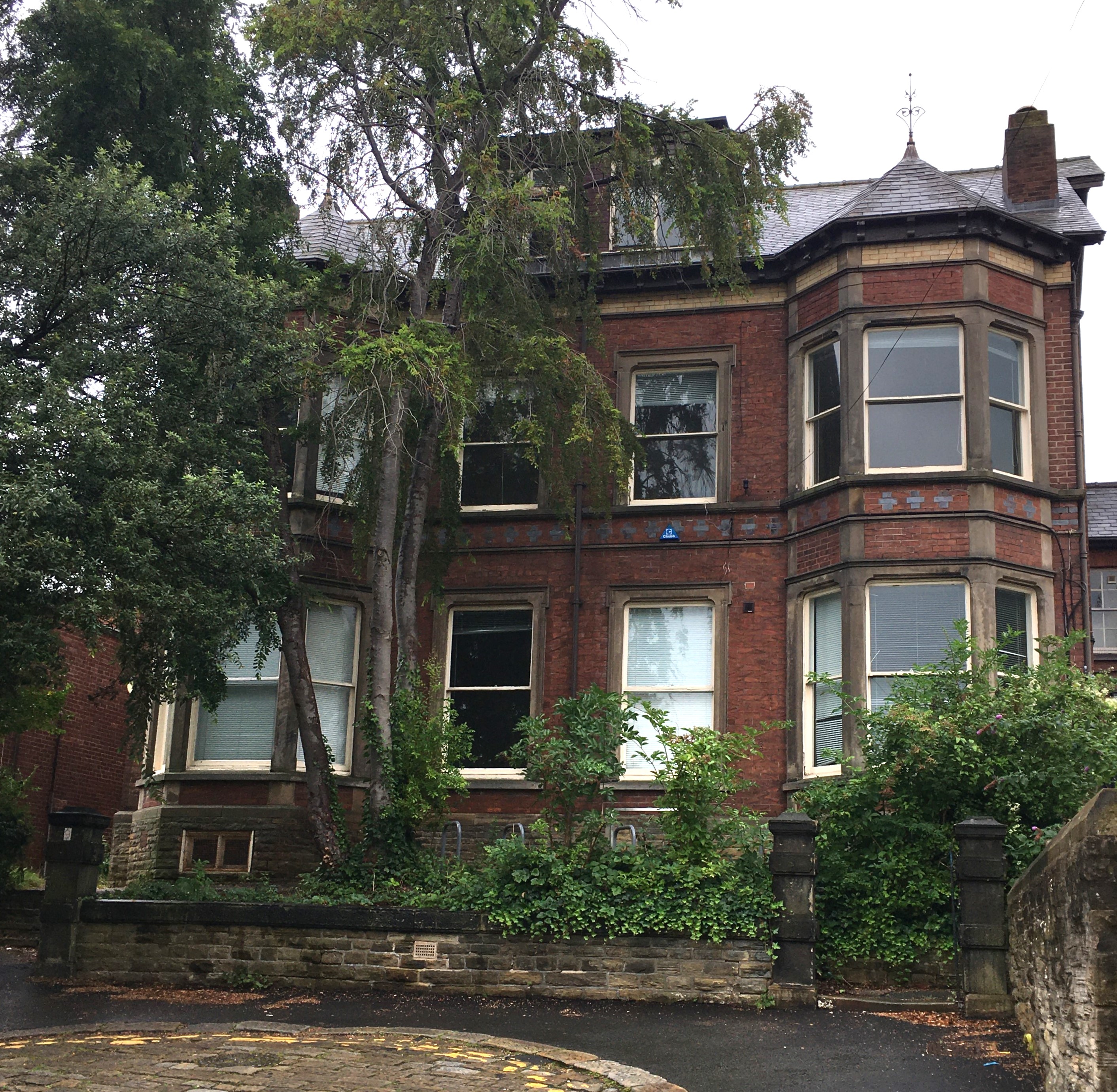
I read that biography by Shakespeare five or so years ago and marvelled at how much Chatwin packed into his life, and the range and depth of his knowledge. He was, as his books make plain, restlessly nomadic. But I’d forgotten that he was born in Sheffield, in a nursing-home in Shearwood Road, adjacent to the former Glossop Road Baptist Church which now houses the University of Sheffield’s drama studio. His mother was the daughter of a clerk to one of the city’s many cutlery makers, and had returned home after the outbreak of war – Chatwin was born in 1940 – while Chatwin’s father was away with the navy.
I went to have a look yesterday. I’m not sure what the nursing-home building is used for now, though it’s probably a private residence.
He was such an elegant wordsmith that it’s a wonder that he didn’t become a poet as well as a prose-writer. His friends included several well-known and wildly different poets: Charles Tomlinson, his neighbour in Gloucestershire; Peter Levi, with whom he travelled to Afghanistan, as recounted in Levi’s The Light Garden of the Angel King; and George Oppen, the arch Objectivist.


 Matthew Paul: Poetry & Stuff
Leave a reply to Richard Spencer-Smith Cancel reply