Belated happy new year to you. I’ve not really one for making resolutions, so it’s about time I did, so here goes: (a) I will not worry about how long some poems have been out there under consideration (including one since 26th May – that’s 2025, I hasten to add, though it feels a darn sight longer), and, more importantly, (b) I will not send poems out until absolutely every single word, every item of punctuation and the form is as good as I can possibly make it and is doing its job to the best of its ability. ‘Common sense, Matthew,’ I hear you say, but it’s all too easy to get impatient and het up about submissions and/or prematurely over-excited about shiny new poems, isn’t it?
I mentioned the latter the other day when I was talking to a poetry group in Sheffield who had kindly invited me to read some poems, relate my ‘poetry journey’ and set them some exercises. They were a lovely and enthusiastic group, mostly fairly new to writing poetry and yet to get anywhere near as cynical about the mug’s game as I am. My journey, such as it is, has been circuitous, and it often still feels, 43 years after I started, that I’m not even halfway there yet. There is, of course, always much room for improvement. I said to the group that, if they are using memories and other personal experiences as the basis for poems, that it’s perfectly fine to change details, and almost entirely fictionalise if need be, as long as a kernel of truth remains. How one defines that kernel of truth is up to the poet, but the reader will almost certainly be able to sense whether it is there or not.
I also talked about the importance of community, both the wider poetry community per se and small groups, like theirs, which provide mutual encouragement, and, hopefully, get to the point of being able to make constructive criticisms of each other’s work, so that they can improve as poets. Not everyone wants to hear, let alone act upon, criticism of course, which is fine if poetry is just a hobby, like playing badminton or something; but poets who are serious about their poetry have to be resilient as we know.
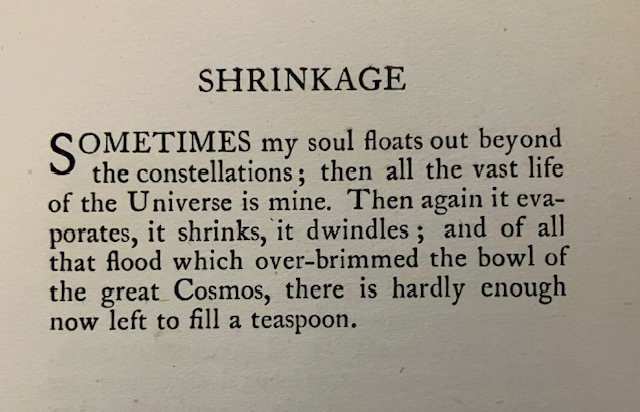
Among the new collections I’ve enjoyed and admired of late are Lady by Laurie Bolger (Nine Arches), In the Lily Room by Erica Hesketh (also Nine Arches), Lives of the Female Poets by Clare Pollard (Bloodaxe), and, at the moment, I Do Know Some Things by Richard Siken (Copper Canyon). The latter consists of single-paragraph prose-poems. In their quirkiness, they remind me of the epigrammatical mini-essays by Logan Pearsall Smith (1865–1946), which were really proto-prose-poems, I think. Here’s an example from his collection, More Trivia (1922), which I bought just before Christmas:
In a letter dated 21 My 1919 to Ottoline Morrell, Virginia Woolf described Pearsall Smith thus: ‘I think there is a good deal of the priest, it may be of the eunuch, in him.’ As a young man, he was a friend of Whitman’s in the latter’s old age, and they used to take (horse-drawn) cabs round Central Park following ones in which lovers were passengers to see how far they got, as it were. That incident apparently sparked Robert Lowell’s line ‘I watched for love-cars’ in his great ‘Skunk Hour’, available here, the last poem in Life Studies. Who knew? Well, I didn’t until I read the notes in the very heavy paperback I have of Lowell’s Collected. I’ve been reading Lowell off and on since I first read his poems at school, in the first year of sixth form, way back in 1983, and many of them remain among my all-time favourite poems.



 Matthew Paul: Poetry & Stuff
Leave a comment