A fortnight today I’ll be 60, which seems ridiculous but such is life. Half a lifetime ago I wrote this (not especially brilliant) haiku, which was published in Blithe Spirit in 1997:
thirtieth birthday
yellowing pears
in a porcelain bowl
In Stepping Stones (British Haiku Society, 2007), a book of commentaries on English-language haiku by British poets, based on his doctoral work, Martin Lucas wrote of that haiku:
The internal comparison is rather obvious, but [. . .] there is a secondary appeal: the intrinsic beauty of the sill life, which we can dwell on for its own value.
As an introduction to the possibilities of haiku in English, it’s yet to be bettered, because Martin had such a gift for analysing haiku simply and concisely, in the spirit of the haiku themselves.
Of late, I’ve continued my fiction binge, including two novels very removed from haiku: Eleanor Catton’s first two, The Rehearsal (2008) and the Booker Prize-winning The Luminaries (2013); both brilliant, as you may well know – I’m very late to these parties! I can’t imagine two novels more different from one another, both immaculately plotted and intriguing. At 832 pages, The Luminaries must be the longest novel I’ve read since slogging my very reluctant way through Little Dorrit for A-level (an experience that pretty much put me off Dickens for life), but it flew by: a gripping tale of crime and double-crossing in the New Zealand gold rush of the 1860s. I have Catton’s third novel, Birnam Wood, to read too, but I’m saving that for a holiday.
Rumer Godden’s The Battle of the Villa Fiorita (1963) was a recommendation on the excellent Jacquie’s Wine Journal book blog, here, which my wife, Lyn, bought and loved; I loved it too, for all the reasons that Jacquie articulates and more. We must find and read more of Godden’s novels.
Lyn wasn’t keen on Han Kang’s famous The Vegetarian – about a woman who stops eating meat and is treated like an outcast for doing so, within a deeply patriarchal society – but I admired its construction and almost nihilistic tone. It’s a difficult read, but easier than the only other book of hers I’ve read, Human Acts, set during the Gwanju rebellion in 1980.
I’m currently reading The Undertaking, the debut novel by Audrey Magee – details here – having enjoyed her second one, The Colony, last year. It’s another fine novel, a real page-turner if ever there was one., despite its setting in Germany and on the Eastern Front in 1942-43. The contrasts between the home front and the Battle of Stalingrad are accentuated by Magee’s style of interweaving the two parallel narratives.
On the poetry front, I’ve reread Jackie Wills’ s latest collection, Making the Wedding Dress (Salt, available here, though you should ignore the misleading ‘synopsis’ that reads as if it’s been cobbled together by AI), because it’s book of the month (my recommendation) for the poetry book club I’m part of. It’s been a real pleasure to read it again, even though it’s not been long since I read it for the first time. It’s also led me to re-read Wills’s On Poetry (Smith Doorstop, 2022, available here), which contains lots of wise advice for the beginner and the more experienced poet alike, and incidentally also got me re-reading collections by the wonderful poet Catherine Smith for the first time in ages.
Despite all this reading, I’ve not written any new poems for a while now, and have just been tinkering revising, and often adding to, poems originally drafted way back when, in some cases yonks ago. That suits me fine. I find revisiting old poems, i.e. ones that have hitherto not quite worked for whatever reason in order, to see if they’re salvageable almost as enjoyable as editing newly drafted poems. Some poems of mine have been as reworked and battered about as sculpture maquettes, in attempts to elicit their true heart and point. Poems without heart and point aren’t worth persevering with, yet I’m a terrible one for hoarding drafts of poems that I know are never going anywhere, usually because there’s some line or phrase that I think might be recyclable. That said, I’ve inadvertently managed to delete many drafts over the years. For every poem I’ve written that I’m happy with, I would think there’s another 10 or 20 that didn’t cut the mustard – an eyewatering total, I should think. I may be older, with forty-four years of writing poems behind me, but dragging them into the light doesn’t necessarily get any easier.
Tonight sees the return to UK TV screens of 7 Up, in what appears to be its last ever instalment, 70 Up. It’s surely ITV’s finest-ever programme (maybe The Sweeney, Minder and Corrie run it close in their disparate ways!). Lyn and I finished re-watching it all up to 63 Up only a few days ago. It will be deeply moving, and a reminder that, even with promulgators of hatred on the loose in greater numbers in this country than at any other point during my lifetime, there is still so much that binds the ordinary, decent people together – and that everyone ordinary is also extraordinary in their own way.
Tag: poem
-
September
-
August reading
Summer – especially a long one like this – is, of course, ideal for getting lost in books. Late to the party of the marvellously entertaining Ill-advised by Bill Nighy podcast, available here, I’ve started reading some of his book recommendations. I began with All Fours by Miranda July (Canongate Books, 2024), a book which you’ve probably already read yourself and which I read faster than any other novel I can remember: it’s a rollicking, multi-layered read that defies the reader’s expectations repeatedly and brilliantly. It felt to me like a feminist antidote to On The Road, were one to be needed; a road-trip that goes, well, to places that few such well-written novels, if any, have been before. No wonder it caused such a (mainly positive) furore when it came out, as a BBC article, here, relates (with spoiler alerts). I was a fan of July’s films, but now I will have to read more of her books.
Next up was a novel that could scarcely have been more different: Thomas Bernhard’s Concrete (originally published in 1982; my copy published by Faber, 2019), as translated by David McLintock. It was high time I read a Bernhard novel, given his massive influence on other novelists and writers per se, including Sebald. Concrete is a dauntingly unparagraphed monologue in the voice of an Austrian musicologist who has for years been struggling to write a monograph on Mendelssohn, in face of inertia and the taunts of his gadabout sister. To me, it had shades of Dostoevsky, Gogol, Kafka and Thomas Mann, and I could see how its narrative voice might’ve influenced that of Sebald. If all that sounds dull, I can assure you that it’s anything but, and it comes with a glowing endorsement by Edna O’Brien.
I wrote last month about my love of Ciaran Carson’s prose books and I’ve recently read his first one, Last Night’s Fun (1996), subtitled ‘About music, food and time’. Ostensibly, it’s a treatise on Irish traditional music, of which the multitalented Carson – a flautist and tin whistler – was an exponent, but, as with all Carson’s books, such was his erudition that he digressed in many directions before bringing things back to the main motifs, like a traditional tune does. As I’ve said previously, that erudition of his had fuller and better rein in his prose than in his (still brilliant) poems, even when he used a Whitmanesque/C.K. Williams-ian long line. The book starts in a place I know, or rather once knew, very well indeed: Portrush, and a music session in the Harbour Bar. As a brief sample of how Carson got at the heart of what music does and is, and more besides, this short paragraph will suffice:
Musicians learn to get their tongues round things. They are chameleons, and have independent eyes by which they recognise each other while they blink at someone else. They understand that time itself is a chameleon, so they mark it and keep it, and they syncopate it. Creatures of a changing blue lagoon, they drift down through its depths like shoals of semiquavers, making new tunes as they swim in temporal agreement.
I saw the other day that an unpublished novel of his is due to be published soon, which is wonderful news and not the sort of pleasant surprise you usually get during the silly season.
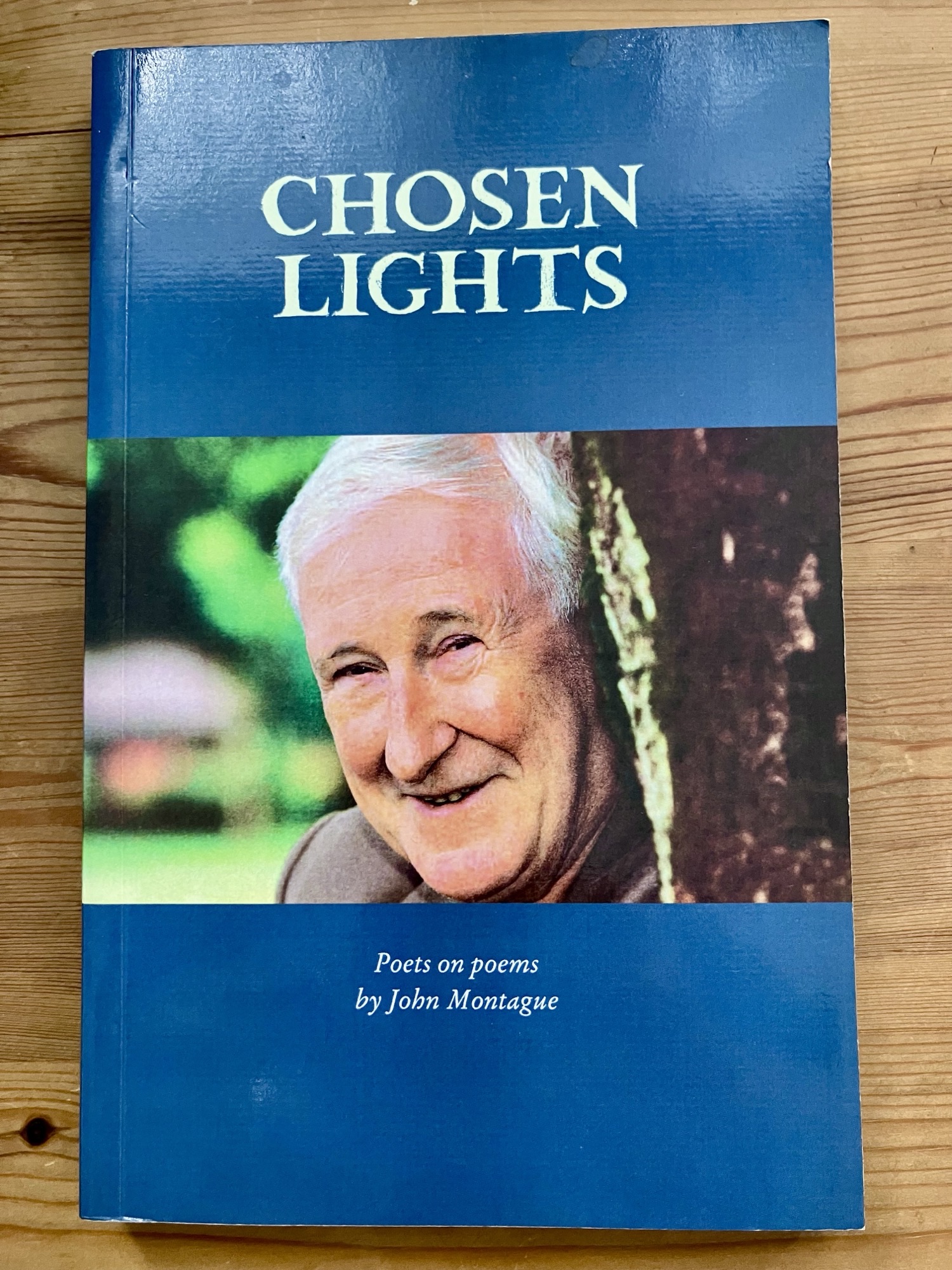
Carson – along with a host of other great Irish poets like Boland, Heaney, McGuckian, Mahon, Muldoon, Dennis O’Driscoll, etc. – was one of the contributors to Chosen Lights, (Gallery Books, 2008, rev. 2013), subtitled ‘Poets on poems by John Montague’, in which each poet chooses and writes about a poem by Montague.
Cover of Chosen Lights It’s the best poetry book I’ve read this year, in how it not only presents some fantastic poems by a major poet who is criminally little-known outside Ireland and perhaps France, where he lived for years, but also, in most (though not all) cases, the splendid thoughts and insights on the poems. They inevitably include his best-known poems, such as the gloriously cinematic ‘All Legendary Obstacles’, available here. Montague wasn’t included in Michael Schmidt’s Harvill Book of Twentieth-Century Poetry in English (1999), though his equally celebrated ‘Like Dolmens round my Childhood, the Old People’ made it into the other brick that is the Norton Anthology of Poetry (rev. 2005). In Chosen Lights, Alan Gillis writes especially well about that poem. Carson, unsurprisingly, chose ‘The Country Fiddler’, and wrote of the influence that Montague’s The Rough Field (1972) had upon him:
In its ambitious patterning, its bricolage of quotations set as marginalia to the poems, its obsessive circling around themes of exile and identity, its concern with language and music, it seemed like a more urgent retelling of The Waste Land: modernist in scope and method, but shot through with personal anxiety and grief for the loss of a cultural hinterland.
Montague’s death nearly 10 years ago was met with an outpouring of deeply-felt tributes from Irish poets, led by the then President of Ireland, Michael Higgins. Is there a country on Earth which values its poets more than Ireland? By comparison, it’s a sorry state of affairs here in Britain – and not just in how poetry is regarded at that.
Our Poetry Book Club book of the month is Rhizodont by Katrina Porteous (Bloodaxe, 2024), which won last year’s Laurel Prize for the best collection of eco-poetry. It is, though, eco-poetry without the capital ‘e’ that seems so often to typify what passes for poetry shouting alerts at us – as if poetry readers are idiots who need such alerting – to the catastrophic impacts of climate change and habitat and species loss. I’ve seen Porteous read a couple of times over the years, at New Networks for Nature conferences, and while she was a dynamically charged reader of her work, it wasn’t quite the right arena for such performances. Despite that dynamism, her poems still read magically on the page and the reader’s ear: infused with a stronger sense of place, of her native Northumberland, than any collection I’ve read for a good long while, they sparkle with dialect, music, rhythm and rhyme. It’s an over-stuffed book that could easily have been halved, yet its size doesn’t detract from its riches.
-
Some of my July reading
In the latest, brilliant issue of The Dark Horse, there’s a really fine double review by its editor Gerry Cambridge of two debut collections – Andrew Neilson’s Little Griefs (Blue Diode Press) and Graeme Richardson’s collection Dirt Rich (Carcanet) – and on the strength of it I had to read Richardson’s book (having already read and written about Neilson’s). Cambridge writes:
Too often contemporary poetry now is concerned to present its writer as a deeply humane, even saintly figure, as if one could exist without sin and guilt, terrible contradiction and the multiple ironies of actual life; there is none of that in Richardson, none of the self-congratulatory worthiness attendant at points at, say, some poetry award readings, a bunch of evolved, middle-class souls agreeing with commendable poetry sentiments that no one of any sense would disagree with.
While the generalisation of this sentence can, like all generalisations, be punctured by pointing to examples which aren’t as self-satisfied as Cambridge’s targets, it would be hard to disagree with the gist of it. Richardson, as Cambridge implies, is a warts-and-all poet whose output gets down and dirty with the dark side of life (and death) as well as the light(er). In poems covering his years an Anglican priest, notably in his native Notts., and in others of his childhood and adolescence, he is refreshingly frank and unflinching. Take the octet of his sonnet-of-sorts, ‘Bearings’:
One poor dear – 84, in the hospice,
just a few picked chicken-bones
under the sheets, fists
bulbs of dried garlic,
and a head of dandelion fluff
almost blown –
before she finally gave up
cried out all night for her Mum.
As much as the precision of the three uncompromising comparisons, the cumulative impact of which served to remind me of my mother’s last days, I like that it took me a couple of readings to grasp the syntax. I like the line-endings too – six end with a noun and all of them end with words which are significant in conveying the overall portrait of the elderly woman: here is a poet who knows how to arrange his sentences across and down the page. What should we make of the opening, ‘One poor dear’? Is it condescending, demeaning and/or sexist? Yes, to a degree, I think, but it’s the sort of language which many of us would use. The unnecessary capitalisation of the first em of ‘Mum’ possibly serves to emphasise the woman’s reduced and infantilised state. It’s unsparing writing, and for that reason will be read as either brave or beyond the pale, depending on your viewpoint.
The poem on the facing page, ‘In Holywell Cemetery’, is, for my money, the finest in the book; a beautiful lyric of five ABAB-rhymed quatrains. Here’s the opening stanza:
Swirling iron, craquelure and rust,
shuddering with slowly crawling cars,
Earth absorbs the poison with the dust;
graves await an amaranthine grass.
The trochaic meter, reminiscent of Auden, well suits a poem about a Victorian Oxford cemetery. Those two words ‘craquelure’ (the cracks in a painting) and ‘amaranthine’ (of, or like, plants in the amaranth family) are showy indicators, as clear and bold as the meter, of Richardson’s ability to write in a high, traditional register. The poem isn’t moving solely because of these facets, but they augment the poet’s intention to write a poem with an ambition to say something beyond the superficiality of its concrete subject-matter. The full poem can be read here, in Bad Lilies (edited by Neilson and his wife Kathryn Gray) where it was first published – as you’ll see, it unfolds and circles back quite beautifully. While I knew who Kenneth Grahame and Walter Pater were, I had to look up (Charles Buller) Heberden, a vice-chancellor of Oxford.
While that might sound a bit fusty, crusty and, well, patriarchal, I can assure you that Dirt Rich comprises an array of forms, both classical and contemporary, and subject-matter. It was quite bizarrely overlooked for the Forward Prize longlists for both first and best collection, let alone the shortlists, at the expense of some collections which I’ve read and found much less rewarding. I know that prizes aren’t important, that lists are subjective and, worst of all, that judges appear not to recuse themselves from evaluating collections published by their own publisher and instead seem merrily oblivious to how that looks; however, it doesn’t help the poetry landscape of the UK if books as good as Richardson’s don’t get a look-in. Maybe he’s upset too many people with his reviews in the TLS and the Sunday Times – not that I’ve ever read the latter, but I gather that he can be quite trenchant.That brings me to Caroline Smith’s collection Bycatch (Nine Arches Press), which has been shortlisted for the Forward best collection prize. Its 69 poems, arranged in six apparently chronological sections, address the mental and physical decline of Smith’s elderly parents, especially of her father who had dementia and whose death is the book’s end-point. Some poems recount well incidents that illustrate that sense of degradation, such as ‘In Decline’:
To start with there was an odd word
left like a fridge on a street corner,
not where you’d expect,
but easy enough to explain.
Then we noticed whole sentences
being wedged into strange places,
a collection of beer cans glittering
in an otherwise ordinary winter privet hedge.
This is admirable writing, and I particularly like the compound description of the hedge, hinting at the weird-anti-thesaurus-like language of a person with increasing dementia.
Alas, though, there are also a fair number of poems in very prosaic language and with insufficient, sometimes hardly any, artistry. That reaches its nadir in a poem called ‘Shower’ which consists of three sentences of the plainest reportage, e.g. ‘The paramedics say they’ll have to / take him into hospital if he tries / to get out of bed again on his own.’ Simply describing an incident – however awful it is – isn’t enough to make memorable poetry. One poem, ‘Pigeon’, that expounds the tale of when Smith witnessed the flattening and miraculous survival of the title’s bird, aims for an epiphany which, apart from the repetition of ‘nodding’ and the oxymoron of ‘cold sunlight’, is undermined by the flatness of the language; the dull verbs and repeated prepositions:
It wouldn’t stop nodding, nodding.
The fishmonger
in his black beanie,
was unloading
white dripping polystyrene boxes
that sprayed arcs of water
in the cold sunlight.
(The missing comma, after ‘ fishmonger’, is unfortunate.)
The title of Smith’s collection, as mooted in the poem of the same name, is intended as an overarching metaphor and provides a greater degree of ambition than is commonplace elsewhere within the book:
Indistinguishable, like dying fish,
old men lie there, long faces
silver heads and black triangular mouths.
They are the bycatch of a trawler
that has dragged its weighted nets
and steel rollers through their lives,
torn up fragile habitats
and the symbiosis
of ancient partnerships.
(Again, there’s a glaringly missing comma, after ‘faces’.) The trawler and bycatch metaphors are akin to Philip Larkin’s death-as-‘black-sailed unfamiliar’ (in ‘Next, Please’), but not as successful. I appreciate the writing here, and the picture of the boat with its ‘weighted nets’ and ‘steel rollers’ but I’m not sure what exactly the trawler is a metaphor for. It can’t be dementia itself, because that has only catch, rather than bycatch (unless the relatives of the sufferers are the bycatch, which the poem obviously isn’t suggesting). In his endorsement for the book, the (wonderful) poet Bernard O’Donoghue asserts that, ‘The title suggests with beautiful delicacy the way ordinary lives might seem incidental to the country’s history which they constitute, described in a narrative of great precision and clarity in a marvellous evocation of place and time.’ Presumably, that was the sense that Smith was aiming to convey; I confess, though, that I didn’t intuit it from her poems.
For me, the book’s best sections are ‘Removal’, in which the small details of domesticity are gradually undermined (e.g. ‘I’m not sure when the Teasmaid / stopped being part of their lives’), and ‘Archaeology’, containing poems in which Smith harks back to her and her parents’ younger days. One, ‘Woolwich Ferry’, recounts times from her childhood, when, ‘in the back of the old Singer Gazelle’ (Larkin’s car of choice, incidentally), her father would tell the story of how his parents met: ‘His voice strangely low, / carried along with the grind of gears, / the streetlights’ tired glow above’. This is fine writing, where the language is fresher and working harder.
Another more successful poem is ‘Forest Canopy’, in which Smith imaginatively deploys the title’s metaphor to good effect:His language has become
its own ecosystem
high up in the roof of the cloud forest
broken free from the ground.
Most of the poems are in blocks, and I suppose a case could be made for saying that the block’s innate lack of form (other than choices at where the line-breaks are made) is a good match for the jumbled confusion of dementia and its impacts, but the lack of variety becomes a bit wearisome. Smith’s line-breaks are almost always in the places where breath has a pause, which is perhaps too neat for the subject-matter; and, disappointingly, there’s barely any rhyme, either end- or internal; and barely any assonance or alliteration.
I don’t wish in any way to trivialise the experiences which fed into Smith’s poems, and I say that as someone with great sympathy and empathy for what Smith and her parents went through; however, there is no doubt in my mind that, though Smith writes well, the abiding impression for me is that her good poems could, if worked harder, have been much better and that there were plenty of weaker ones that could have been weeded out.
Our poetry book club choice for July was The Storm’s Flora by Laura Wainwright, published by Seren. As is often the case, I appreciated the book more when we looked at poems in detail during our Zoom meeting than when I’d read the book beforehand. Wainwright’s poems reminded me at times of Gillian Allnutt’s: invariably beautiful in how she makes the words sing, but a little too minimalist and therefore a bit dissatisfying, in the same way that a really lovely tapas doesn’t feel quite like a full meal. That said, the poems in The Storm’s Flora are full of a very keen sense of place and shot through with Welsh mythology and flora and fauna in a way which makes this a very coherent and interesting collection. No wonder it’s recently won Welsh Book of the Year.
The book I enjoyed the most in July was Ciaran Carson’s unclassifiable Fishing for Amber (Granta, 1999). Ranging across Irish folk tales, Greek myth, Shakespeare Dutch Golden Age art and science and much else besides, Carson often slips barely perceptibly into fiction and back out again, like W.G. Sebald did. In his range of erudition, and the beauty of his prose, he deserves to be as well-known and at least as highly-regarded as Sebald, but he didn’t fit the bill in quite the way that Sebald’s overnight rise from quiet academic obscurity did. Carson cited his references, while Sebald never did, and the latter deliberately obscured his life, background and influences – other than those like Stendhal, Browne and a host of German and Austrian writers little-known in the Anglophone world whom he acknowledged.
While reading the book, I was reminded of Zbigniew Herbert’s prose book, Still Life with Bridle, which I re-read last year and write about here (scroll down), and so I wasn’t surprised to see it listed at the back as one of Carson’s many source books. I was also reminded of some of the writings of Berger and Borges. What Berger, Carson, Herbert and Sebald all had in common was a restless search for knowledge, which came together in their writings like an alchemist’s experiments synthesised all kinds of arcana. I love Carson’s poetry too, but, if anything, I think he was an even greater prose writer than he was a poet. Lucky me, that I have some more of his prose books in the TBR pile.

-
On Stuart Handysides’s The Last One Picked
There are few fine haiku poets who also write fine longer-form poems, in the UK anyway, but Stuart Handysides is one of them. His first collection of poems, The Last One Picked, won the Indigo-First Poetry Prize 2024 and was published by Indigo Dreams Publishing in 2025. It’s available to buy here.

Cover of The Last One Picked I’ve written previously about my sense that haiku and longer poems come from different parts of the brain; how haiku, the best ones, distil the collision of two sensory experiences in one moment to produce a spark, a connection or contrast, which the reader has to intuit, whereas longer poems, with their wider canvas, can move backwards and forwards through time in a manner rarely possible in haiku. The Last One Picked benefits from having a lifetime, and a whole career’s worth (as a GP), of experience and thought to draw upon.
Handysides writes ruminatively about his upbringing, and its strict morality, in a very religious household, impacting on even the joy of collecting, as in ‘History of the Motor Car in Fifty Picture Cards’ where ‘you felt ashamed for asking’ the ‘elderly or uncommitted friends’ if you might have ‘the cards we saw on mantelpieces’, only to be told ‘in no uncertain terms: / those are for my grandson, nephew[,] / someone who means more to me than you. That ‘uncommitted’ is satisfyingly ambiguous as to its meaning.
There’s an encounter with a horse in ‘A Solitary Mare’ which is reminiscent of Larkin’s ‘At Grass’ in how it sympathetically regards the animal’s age, but it feels much more real than Larkin’s deskbound speculation. It ends thus:
At night she nears my caravan.
I hear her snort, tear off the grass
I feel her presence, weight of hooves nearby
and next day when I sit to wire a plug
she comes to see
her long head reaches over me
hot jets of horse breath on my hands
she rubs her mighty forehead on my back
her fellow feeling floors me.
The absence of punctuation other than the two full-stops is irksome at first, but adds to the fluidity of the action, as does the alliteration at the end.
Handysides is very good at finding intriguing titles for his poems, none more so than for an excellent edgelands poem, ‘Stopping for a Slash’, in which the poet-persona might ‘choose a lay-by with trees’ and ‘break down brambles, trample nettles, tissues / half-crushed cans of Stella and Red Bull’, and then get happily distracted by the unexpectedness of nature: ‘the wind you’ve missed / in the car’ and a well-observed litany of avifauna and flora.
For me, the book’s finest moments arrive in the pleasingly thoughtful and melancholic ‘Spring Morning in the Surgery’, the opening stanza of which brilliantly imparts information to the reader in a condensed sensory fashion:
My hand palpates an abdomen,
but though I meet my patient’s eyes
to reassure and look for pain
my own are drawn across the way
where, up a tree, a harnessed man
swings out and sounds his chainsaw on a branch
that duly falls, scooped up by his mates below.
These lines have a lovely rhythm and music to them, with several unexpected but apposite words: the perfect ‘palpates’; that ‘sounds’; and ‘mates’ which conveys a more intimate togetherness than, say, ‘colleagues’ would have done. The poem goes on to explore the nature of a working life, the doctor–patient relationship and mortality itself, all with a skilful delicacy which shows Handysides at his very best – and his best is very good indeed.
-
Surfing the heatwave
Yesterday, on the second day of this, our third official heatwave of the English summer, I was meant to be catching a bus to Worksop then a train, on what is known as the Robin Hood line, to Mansfield, to meet a poet friend, but I checked on the trains before I set out and found that while one train was running towards Mansfield, there would be none coming back unless I wanted to take a near-two-hour rail replacement bus. Anybody who endured that really ought to get a gong in the next honours list. So instead we agreed to meet in Nottingham, to and from which trains were thankfully running via Sheffield. When I arrived in Nottingham, I noticed that the reason given for the cancellation of the Worksop to Mansfield (thence to Nottingham) trains was the ‘severe weather forecast’. Well, it was certainly hot – 30 degrees – and unrelentingly so, yet it begged the question that if this is the impact of climate change on our transport (and other) infrastructure now, then what will it be like in 20, 30, 50, etc. years’ time? Surely even the most rabid of Reform voters living in or near Mansfield (the constituency of Lee Anderson, ‘30p Lee’ himself, is next door) must now be able to recognise, and maybe, just maybe, even start to worry about, that. Anyway, we had an excellent afternoon of chewing the fat, bemoaning various aspects of the poetry world – particularly the egregious nepotism in prize-judging – and toasting Count Binface.
All that is a roundabout way of saying that it’s just too damn hot to do anything much, isn’t it, and least of all writing. Even reading – to any acceptable degree of concentration – is far from easy. Nonetheless, I’ve ploughed through a Beverley Bie Brahic poetry collection from 2016, Hunting the Boar, CB Editions, quality-wise a book of two halves, the first being fine, especially poems set in small French communes, but the second not so much. Now, I’m reading Rory Waterman’s excellent Devils in the Details (Five Leaves Publications, available here), his entertaining, erudite, and beautifully-written yomp around Lincolnshire in search of folklore.
On the publication front, I had a poem in the latest issue of The Fig Tree, available here, last week, about the deputy headmaster of my secondary school all those years ago. My thanks to the editor, Tim Fellows. The three poems by the featured poet, Laura Strickland, are important ones, in how they reclaim the voices and lives of the victims of Peter Sutcliffe. They reminded me that Blake Morrison’s 1985 poem ‘The Ballad of the Yorkshire Ripper’, available here, consisting of 100 quatrains written in West Yorkshire dialect and the cornerstone of his 1987 Chatto & Windus collection of the same name, is all but forgotten nowadays. The ethics of a male poet attempting to write such a poem have undoubtedly shifted since then; however, Morrison’s unequivocal and (arguably too graphically) unflinching contextualisation of Sutcliffe’s terrible crimes within the very widespread misogyny of his family, friends and wider society and culture remains, to my mind, largely admirable and ahead of its time.
Over on this blog’s younger sibling, my Substack, I’ve posted the first two of a series of pieces on items which relate to my family history. They can be read here and here. I’d be delighted if you were to read them.
-
Summer daze
I’ve always found the summer to be the only season in which I struggle to write poetry. Of course, an extraordinary heatwave like the current all-but-unbearable one inhibits doing very much except lounging about in whatever shade there is. Jackie Wills’s brilliant new collection aside, I’m also struggling to concentrate on reading; or doing anything else of consequence for that matter, though I enjoyed watching Ecuador win last night. If only all the World Cup games were on in the afternoon and evening . . .
That said, I finished a rare political-ish poem last week and sent it off to the Morning Star, who have since said they’ll publish it in August. As a lifelong leftie, it does my heart good to help to support a publication with values broadly similar to my own. I never quite understand why poets might, instead, want to place poems in right-wing rags, like The Spectator, which gives platforms to some truly odious far-right ‘thinkers’, such as very far-right Douglas Murray (its associate editor) and Max Klinger, and is edited by Michael Gove for pity’s sake. It also happens to be owned by Paul Marshall, the hedge-funder who set up GB News. I like its poetry editor Hugo Williams and most of his corpus of poetry as much as anybody does, but, to me, The Spectator’s values aren’t in the slightest bit compatible with the inclusivity of poetry.
I don’t buy the argument that getting poems published in journals and papers which don’t specialise in poetry must be a good thing per se; or that putting poetry in front of the sort of people who like to read very right-wing tripe might broaden, perhaps even change, their minds. I suspect that is very unlikely. In the same way that publications are necessarily picky about the poems they publish, poets surely have a moral responsibility to be picky about where they attempt to place their poems.
A counter-argument is that placing left-leaning political poems in left-leaning publications like the Morning Star and the New Statesman will only preach to the converted, but how likely is it that a right-wing publication would publish a left-leaning poem or even one that, say, even tangentially alerted the reader to the horrendous adverse impacts of climate change?
In other news, I thoroughly enjoyed my trip to Penarth, at the weekend just gone, to read at the literary festival organised by the fabulous Griffin Books. Not just my reading itself – alongside Bethany Handley, Hilary Watson and Tracey Rhys, each of whom read an excellent set of poems – but the whole weekend. The amazing poets Stephen Payne and Katherine Stansfield co-hosted the event, and Stephen even wrote and read out a clerihew for each of us four readers.
L to R: Stephen Payne, me, Tracey Rhys, Bethany Handley, Hilary Watson and Katherine Stansfield Stephen and I also met up with about half of our fellow poetry book club members for a curry on Saturday night, and some of us went to see the ace Gwen John exhibition in Cardiff on Sunday afternoon. It served to remind me that it’s lovely to be part of different poetry communities, all of which are part of a wider, overarching one. I must mention that Stephen’s next collection will be published by Parthian Books this autumn. Parthian – website here – make beautiful books, including Tracey Rhys’s, with excellent covers and end-flaps and all.
-
Recent readings and an imminent reading
Now that the pain of my frozen shoulder has considerably lessened, I’ve been better able to concentrate on and enjoy reading, which is just as well because trying to force my own poems out has been like trying to squeeze a last smidgen of toothpaste out of a spent tube; at such times, it’s far better to stick to reading for a good long while.
Among other things, I’ve read a good few poetry pamphlets. I’ll start with one for which I have to declare an interest since it’s published by my own publisher: Before It’s Too Late, by David Harmer (Crooked Spire Press, available here). David is perhaps better-known as a children’s writer and as one half of the Glummer Twins (watchable in action here), but is also an excellent poet for adults, as this publication shows. Many of the poems depict childhood memories; others are elegies, for his parents and friends, as the title hints. My favourite poem of this rich seam is the closing one, ‘Out of Our Hands’, which movingly shows how responsibility passes through the generations, in this case to David and his wife Paula’s children:
It took the kids, all grown up
and in charge of a skip, to hack away
the thickets and tangles, dig up
the roses they wanted, complete the task
of organising our chaos; a job we once
did for them, but they are young enough
to learn a new trick, clear up January,
uncover old pathways with a smile.
Another very fine pamphlet is Hilary Menos’s Vox Wah Wah (New Walk Editions, available here). Again I have to declare an interest in that Hilary is the editor of my reviews and essays for The Friday Poem. Its 20 poems are mainly themed around music, and musical gear (like that in the title), and encompass, inter alia, Hendrix, Coltrane, Davey Payne of the Blockheads, the Dead, Sinatra, Elvis (several times), Karen Carpenter and, magnificently, Etta James. Shot through these poems is Hilary’s love not just for music but also for her partner Andy Brodie, who plays guitar in at least one band. (I must point out here that, just like the fine cover of Before It’s Too Late features a painting by David Harmer’s wife, Vox Wah Wah’s equally fine cover is designed by Andy.) ‘Used & Vintage’ lists the guitars which Andy (presumably) has owned and how he acquired and got rid of them, and ends, rather beautifully, with ‘the blue Dan Dunham / which he ditched last year for the Blonde Tele here in his lap’ with its
ash body, maple neck, just starting to open up
the way tome woods do, like sycamore, spruce, mahogany,
the sap settling in sweeter patterns the more you play
so with use and age come depth and resonance
and I look at him and think, yes.
Well-researched information (and/or anecdote) is always presented in service of the poem rather than for facts’ sake, helped by Hilary’s skilled use of varied forms – couplets, tercets, chunky long-lined stanzas, etc. – and often, as in the example above, by subtle, unobtrusive end-rhyme. Again like Before It’s Too Late, it’s a pamphlet which repays re-reading to absorb its intricacies and pleasures. Zoë Walkington’s Missing Person (smith | doorstop, available here) was my reading matter of choice on trains to and from Leeds on Saturday. It’s ground-breaking: a mash-up of poetry pamphlet and police procedural detective fiction, in which we encounter suspects, and police investigators in a case of child abduction from an underpass in York. The reader is invited to read the poems and solve the case. I’m glad to report that yours truly did indeed crack the case. (No wonder I bought a copy of the complete Sherlock Holmes in the book sale at the Leeds Library.) The richness of Missing Person lies, though, in the details – I have to say ‘gritty’ details. ‘Black Gloves’ opens thus:
How much for these? I ask the bloke
behind the trestle, who looks like
he has just eaten his own young.
And he looks me up and down
and says Seven quid to you, and I say
I’ll give you three and he shakes his head
as though I’m asking him which of his
Alsatians he wants to have put down.
The (black) humour here will be recognisable to anyone who read Zoë’s marvellous I Hate to Be the One to Tell You This (smith | doorstop, 2023). I won’t spoil the surprise and cleverness of Missing Person any further.
I also enjoyed some heftier non-fiction. Barry Miles’s London Calling, subtitled ‘A Countercultural History of London Since 1945’ was right up my street, since Miles, as he’s always been known, was almost as Zelig-like as Joe Boyd in the late-Sixties. Friend of the Fabs, McCartney especially, Miles was one of the organisers of the ‘International Poetry Incarnation’ at the Albert Hall in 1965 at which Ginsberg, Corso and Ferlinghetti read among more local poets like Adrian Mitchell and Harry Fainlight; co-owned and ran (with John Dunbar and Peter Asher) Indica, the gallery and bookshop – pictures here – where John and Yoko first met; was involved with the International Times (IT) and Oz; and was seemingly at every happening, like the 14 Hour Technicolour Dream at Ally Pally. Unsurprisingly, Miles’s book is especially good on the Sixties and early-Seventies, and less so on the movements he wasn’t directly part of, such as Punk and the New Romantics. Nevertheless, it’s a jolly jaunt, chock-full of great stories.
David Shields and Shane Salerno’s oral biography, Salinger (Simon & Schuster, 2014) is an extraordinary book in how it mixes interviews with Salinger’s friends, family, colleagues and comrades-in-arms with previously published written testimony, and leaves the reader in no doubt as to the traumatic impact of what he’d seen and witnessed from D-Day on to the liberation of satellite camps of Belsen. It conveys so well how driven he was as a writer, in a manner reminiscent of Sylvia Plath, to the detriment of the succession of (young) women whom he groomed into relationships with him and of his daughter.
I’m currently reading Matchdays (Simon & Schuster, 2015), subtitled ‘The Hidden Story of the Bundesliga’, by Ronald Reng, translated into English by the novelist James Hawes. The history of football is necessarily reflective of wider social and political history , and Reng’s book proves this in spades. The Bundesliga was only founded in 1963, as if West Germany’s ‘economic miracle’, out of the ashes of the defeat of the Nazis, had to mature before a league competition could be permitted. Even then, footballers’ wages were capped for far longer than in England, TV coverage was amateurish until well into the ’70s, and tactics seem to have been all but non-existent at many clubs, despite Bayern Munich’s and Borussia Mönchengladbach’s European successes. At the book’s heart is the story of the immensely likeable Heinz Hoher, a cut-above-journeyman player who became a manager of the same ilk.
At the top of my TBR pile is Jackie Wills’s new collection Making the Wedding Dress (Salt), her first since 2019’s A Friable Earth (Arc, 2019). Wills is one of my favourite poets, so I know this will be an unqualified pleasure.
*
This coming Sunday I’ll be one of four readers – alongside Bethany Handley, Hilary Watson and Tracey Rhys – in the poetry showcase, the final event of the weekend-long Penarth Literary Festival, organised by the terrific Griffin Books. I’m also very much looking forward to meeting in person several other members of the poetry book club which I’m a member of. My thanks go to Katherine Stansfield and Stephen Payne for inviting me to read. Tickets are available here.
-
Recent and future readings and recent reading
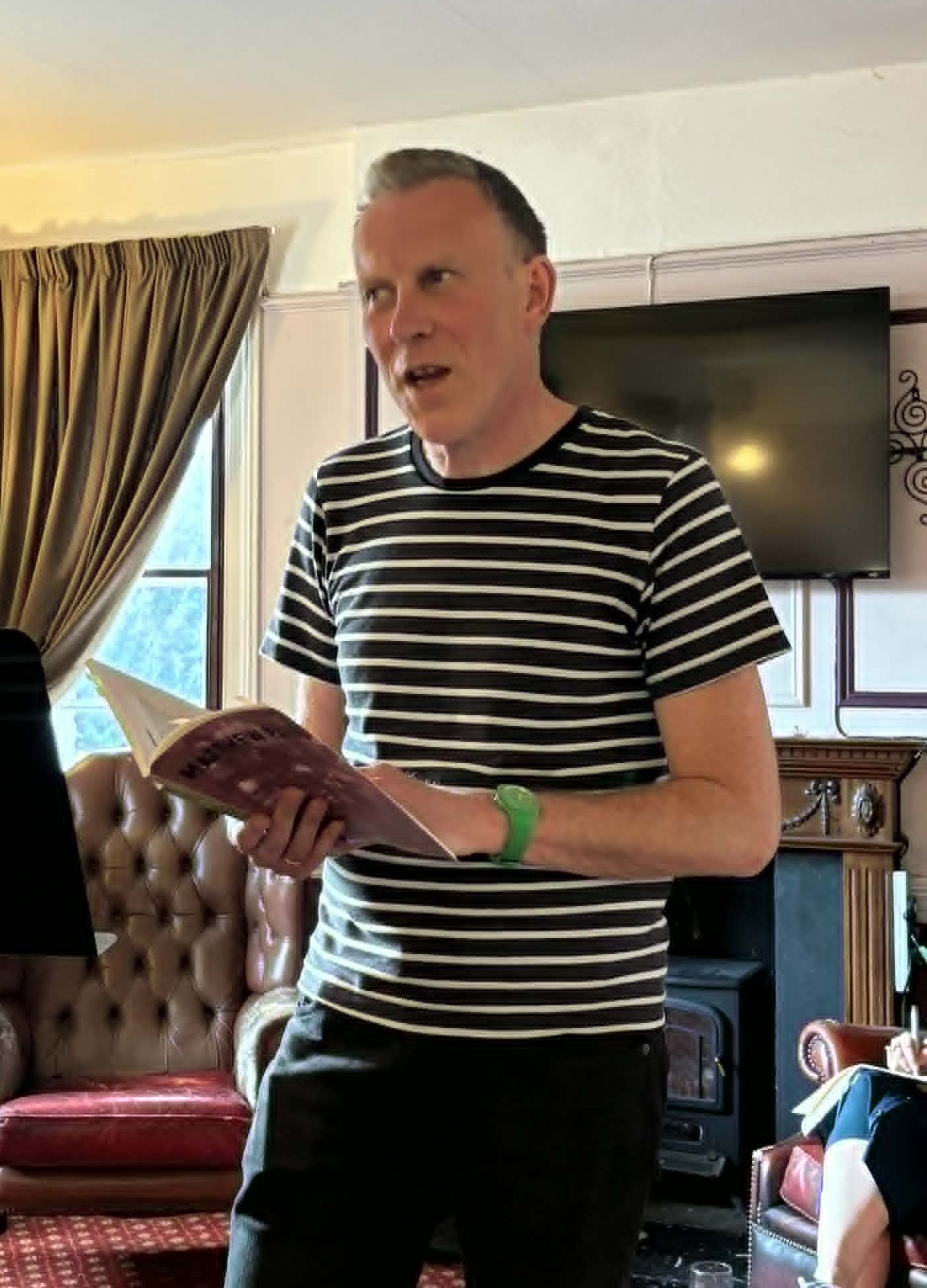
On Sunday, I read for a lively crowd at poetry Performance in the Adelaide pub in Teddington. It was a very enjoyable evening, hosted impeccably by Del Bowen and with a diverse set of open mic readers, including the inimitable Heather Moulson. My thanks to Heather and Anne Warrington for inviting me. Here’s a picture, taken by Heather, of me in action:

Me reading at Teddington On Wednesday, I was one of the three guest readers for the York Launch of Andrew Neilson’s excellent collection, Little Griefs (Blue Diode Press), alongside Andrew’s wife, the brilliant Seren poet Kathryn Gray, and Katy Mahon, fine poet continuing her father Derek’s trade. It was held at the new branch of the Poetry Pharmacy, which looked splendid. I’m grateful to Andrew for inviting me.
On Sunday 21st June, I’ll be one of four readers at the Poetry Showcase of the Griffin Books Literary Festival in Penarth, alongside Bethany Handley, Tracey Rhys and Hilary Watson. My thanks go to Stephen Payne and Katherine Stansfield for their invitation. Details and tickets are available here.
I’ve read a lot of poetry lately, mostly books which have sat on my TBR pile for a good while. I enjoyed Mona Arshi’s latest Mouth (Chatto and Windus, 2025), or should I say I enjoyed two-thirds of it, as the poems based on Greek mythology left me cold as all poems about Greek (or Roman) mythology do, even when they were dealing with the most important of subjects, like the terrible ordeal and immense bravery of Gisèle Pericot. I realise that sounds rather Philistine, and that I ought to take the trouble to read the original stories which underpin such poems, but I just have an untreatable blind spot. (It might’ve been reading and studying Racine’s Andromaque for French A-level that caused it.) On a positive note, though, there were many lovely, lyrical poems that I liked and admired, not least ‘Driving’, the final four lines of which are these:
How carefully I drive now, so like my father,
into those powder-light memories where there’s
a sharp smell of foxes and a beetle is busy
in the twig-crotch scratching out its wretched sound.
I liked reading new poems by John Montague back when I subscribed to Poetry Ireland Review in the Eighties, so I was pleased last year to come across a copy of his 1999 collection Smashing the Piano (Gallery Books). There’s an argument to be made that he was almost as fine an Ulster poet as any of the famous ones, but, because he was a generation older than Heaney, Mahon and Longley, and left his native Tyrone long before the 1969-onwards Troubles, he somehow didn’t get mentioned in the same breath as them, except perhaps in the Republic. Smashing the Piano contains many reminiscing poems about his upbringing, translations of poems in Irish, poems of travel, and a sequence, ‘Civil Wars’ addressing the Troubles (and the years of IRA campaigns beforehand):
A RESPONSE TO OMAGH
All I can do is curse, complain.
Who can endorse such violent men?
As history creaks on its bloody hinge
and the unspeakable is done again.One poem in the book leapt out at me as eminently anthologisable: ‘There are Days’, which begins thus:
There are days when
one should be able
to pluck off one’s head
like a dented or wornhelmet, straight from
the nape and collarbone
(those crackling branches!)
and place it firmly down
in the bed of a flowing stream.
I can empathise with that!
Having worked my way some while ago through the slab of a book which is C.K. Williams’s Collected Poems and much enjoyed the long-snaking-line style which he adopted in the mid-Seventies, I got round to reading his last collection, Falling Ill (Bloodaxe, 2017), published two years after his death. Each of the 52 poems was written in five, unpunctuated tercets. Alas, though, Williams wrote them throughout his cancer treatment, so the shadow of death understandably hangs over them to such an extent that they make for a grim, all but unbearable reading experience.
Much more enjoyable and intriguing was Lydia Macpherson’s new, highly-recommended collection The Heights (Calder Valley Poetry), available to buy here. It’s rooted in history, mainly of the area of West Yorkshire in which Lydia grew up and now lives again, near Haworth and the wuthering heights of Top Withens; encompassing the Cragg Vale Coiners, enclosure, domestic service and other issues of class and ownership which still resonate in our landscapes and society today. One poem I particularly liked was a partially-rhymed sonnet ‘Windows in Snow’, consisting of three elegantly-turned sentences, the middle of which is this:
Sometimes, a hint of a fly caught
like those in Baltic amber, or a tilt
across the diagonal, where some apprentice
knocked the frame in surprise
when they brought the news
of the death of the French queen.
Leontia Flynn’s Selected Poems (Carcanet, 2026) draws from all five of her collections and her book of translations of Catullus. I found many of the poems less engaging than I had anticipated and much less than the extravagant praise on the cover. That feeling reached its apogee when I (re-)read ‘Letter to Friends’ the rambling 11-page lowlight of Profit and Loss. I most enjoyed the seven sonnets from Drives concerning Casablanca, Beckett, Baudelaire’s mother, F. Scott Fitzgerald, Hitchcock, Bishop and Orwell; subjects which somehow suit her good-humoured style. A sucker for poems about swimming, I also enjoyed ‘Saturday at the Pool’ and ‘In the Municipal Pool’; the former opens with an arresting image:
The boy pauses at the end of the diving-board
then dives: a broad sword
cleaving the water – there is parting! And rejoining!
Catching the Light (Fairfield Books, 2026), the anthology of cricket poetry edited by Nicholas Hogg and Tim Beard, contains, as it should, several poems by the doyen of cricket poets, Alan Ross, including ‘Watching Benaud Bowl’: ‘Leg-spinners pose problems much like love, / Requiring commitment, the taking of a chance.’ But among the great and the good (Agard, Arlott, Dabydeen, Hughes, Brian Jones, Kunial, McMillan, O’Brien, Rollinson, Selby, etc.), there are many individual poems which leap out, especially those by S.J. Litherland – one of only nine female contributors – and Matt Merritt; the latter’s poignant pair of portraits ‘Two Orthodox Left-armers’ celebrates two Yorkshire and England greats, Wilfred Rhodes (‘Every ball an interrogation, / every over a conspiracy of art and science’), and Hedley Verity, who died in an Italian hospital of wounds sustained from fighting the Germans in Sicily (‘Shell-bursts, a net of tracers closing fast, / but as upright among blazing Sicilian corn / as on any Scarborough dog day.)
Another of the fine contributors to Catching the Light, Rishi Distidar, has just had his fourth collection published: Cherry Blossom at Nightbreak (Nine Arches Press, 2026). In it, his trademark quirky wordplay and use of form gets full rein – just a scan of the titles gives you the idea. At times, his wish to entertain occasionally spills into silliness, but that’s no bad thing in my book, and there are precious few other UK poets around – Selima Hill and Mark Waldron come to mind – who seem to remember that poetry can be something to enjoy as well as be moved by. Those familiar with Rishi’s oeuvre will know that he also writes poems on the most important subjects, like ‘On board the ‘Tynesider’’, concerning Martin Luther King’s visit to Newcastle in 1967, which ends with these beautiful lines:
But actually he was at his best
when he was harried, harassed –
by time as well as the times –
at 1am on a slow train to somewhere
he would never go again, minting
coin as easily as he breathed, currency
we still spend in the realm of hope.
It feels apposite that Rishi’s books should sit on my shelves between the Dickman brothers and Michael Donaghy. (Curiously, for me, one of the three dedicatees of the collection is the brother of a very sadly deceased schoolfriend of mine whom I mentioned in the title-poem of The Last Corinthians.)
*
In other news, my elder son, Conor, got 459 votes for the Greens in the ward (Surbiton Hill, in Kingston) he was standing in – the party went from nowhere to come second, in terms of votes, to the Lib Dems, meaning, obviously, that they beat the Tories, Labour and Reform (in that order). A win was never likely against a party who won almost every seat in the 2022 election, but still a good and encouraging effort. Under a PR system, the Greens would be the opposition; under first past the post, there is no opposition, which is very unhealthy for democracy. Anyway, well done, Conor; I’m very proud of him for standing and proud of his result.
-
On Ian Storr’s Late Light
This, Ian Storr’s second, beautifully-titled collection of haiku (and haibun), has been a long time coming, 16 years in fact, since Seeds from a Larch Cone. Ian is my friend, and was my long-time colleague at Presence haiku journal – he was the managing editor from 2014, following the tragic death of Martin Lucas, until last year, a stint in which he undertook much more than the lion’s share of the work involved in cementing its reputation as one of English-language haiku’s best journals, if not the best.
I know I’m biased but I have no hesitation in saying that Late Light, published by Alba Publishing and available here (scroll down) is the most important collection of haiku by a British poet since (at least) Thomas Powell’s Clay Moon (Snapshot Press, 2020) and the two collections by our late Presence colleague Stuart Quine (Alba Publishing, 2018 and 2019).
Ian hails from Sheffield and still lives there. He spent his working life as a children’s social worker, an immensely important and difficult job. The compassion, objectivity, resilience and intelligence needed for that profession shine through in Ian’s haiku. Take this one for example:
March winds
our old men talk of compost
and plants for shade
I first read this as an allotment scene, with the ‘our’ being an affectionate determiner for two or more regulars sharing their years of knowledge and generally chewing the fat at the start of an implicitly cold spring. Then I thought perhaps it’s a memory, or after a photograph, of Ian and his wife’s (or someone else’s) fathers finding common ground (pun intended!). Either way (or maybe in another reading), it’s that subtle ‘our’ which surely raises this delicate and precise haiku beyond merely good.
The collection is sequenced, as Ian says in a brief preface, ‘to follow the progression of the seasons, starting and finishing with late winter/early spring’. I’ll cite three more poems to exemplify Ian’s ability.
three yards a day
the dry-stone waller’s answer
. . . dusk on the moor
Like Issa’s daikon radish-puller pointing the way with a daikon, this haiku has both a drollery and specific local context of its own. We might intuit the waller’s pride or maybe boredom at repeatedly being asked the same question by passersby. The crepuscular isolation of the scene undercuts the gentle humour, thereby adding another layer.
And how’s this for a classic British haiku:
day at the seaside
she buys a thicker sweater
in a summer sale
We’ve all been there: tolerating the unseasonal lack of warmth on the beach or as we stroll around the resort until we reach breaking-point. In this case, there seems every chance that the thicker clothing will lead to more stoicism of the ‘We’re here and we’re bloomin’ well going to enjoy it whether we like or not’ kind. We might also note the ironic, and slightly old-fashioned use of the word ‘sweater’, rather than ‘jumper’.
Finally, here’s one from, I sense, the point in October when British Summer Time ends:
shorter days
red admirals quiver
where the wild plums split
This is the sort of haiku which could easily be dismissed as a nature note, but it’s a classic autumn haiku: the butterflies by now probably a bit ragged around the edges, seeking sustenance where they can, here at the opened windfalls. The relentless annual cycle of the butterflies and the tree(s) inevitably remind us of our own mortality, the haiku’s active verb denoting transience.
The collection ends with a five-haiku sequence, ‘Martin Lucas at Bleasdale’, which, for those of us privileged to have known and loved Martin, haiku/tanka poet, founding editor of Presence and much-missed friend, will be especially poignant to read. It’s Ian’s gift, though, to be able to make the specific universally resonant, which is what the best haiku do.
The fine haiku and haibun poet Sean O’Connor says in his introduction, ‘In these pages, we meet Ian Storr the writer, the poet, the person, with his unique and insightful perspective of the world as expressed through his outstanding and engaging writing.’ As respite from the warmongering, racist rhetoric and selfishness growing more prevalent today, Late Light is indispensable.
-
On poetry competitions and personal taste
As much as the first cuckoo ever was, the (almost) annual brouhaha over the choice of winner of the UK’s National Poetry Competition (NPC) is a sure indicator that spring has sprung.
The week before last, Hilary Menos, poet and editor of The Friday Poem, and Victoria Moul, poet–critic, chewed over and pretty much spat out the poem by the splendidly-named winner, Partridge Boswell, here; as did many poets, both good and not-so-good, on social media. I found the poem to be neither as bad as has largely been made out nor especially deserving of being plucked out as the best of 21,000 poems. However, I wasn’t privy to reading the rest of them, so what do I know? I can only surmise that it’s a thankless task which somebody has to do.
This Friday just gone, Hilary and Victoria, discussed more generally, here, the challenges of judging competitions. Victoria acknowledged the truth that, ‘Everyone knows competitions of any kind and in any sphere are a blunt tool.’ They are indeed; but really, as we all know, a poetry competition is principally a money-making exercise upon which the financial health of the organising outfit usually depends, so they are intrinsically vital for the flourishing of high-quality published poetry.
The issue, if it is one, that none of the top three poems was written by a British poet, is, for me, wholly unimportant. I’m not at all convinced by Victoria’s insistence that she, ‘would like to see the National Poetry Competition restrict its entry criteria to British citizens and/or those living in the UK and make a serious attempt to help readers see and appreciate what is distinctive about British poetry’, given that the globe has never been as closely linked as it is now. Using the UK’s most prestigious poem competition as a means to discern some sort of set of British poetic values seems to me as futile as the coalition government’s witless introduction just over a decade ago of the requirement that ‘British values’ in general – as itemised in guidance here – be taught in schools. Aside from the fact that many serious and good poets rarely or never enter competitions, it would be rather ‘Little Britain’, wouldn’t it? Has the Man Booker Prize been devalued or enhanced by the widening of its eligibility from novels in English by British and Commonwealth writers to novels in English by writers of any nationality as long as they have been published in the UK or Ireland? Surely the more internationalist readers become, the better that is for their general outlook on life and for the health of a diverse, tolerant and culturally-enriched society?
Moul’s additional argument that, ‘In literary matters as in others, America is, we might say, a rather dominant and aggressive colonial power’ is more than a little insulting to the thousands of American poets who, presumably more so than the average American citizens, oppose their government’s warmongering foreign policy within their poems, pronouncements and protests, as many of their predecessors did during (and since) the Vietnam War. American poets, like British poets and poets everywhere, tend to be among the most compassionate citizens within any society. Beyond D’Annuzio, Marinetti, Pound and Campbell, how many well-known avowedly right-wing poets have there ever been? I can’t think of any contemporary ones. In the current political climate here in the UK, restricting the NPC would play into the hands of far-right politicians and voters who, I strongly suspect, are, in the main, highly unlikely ever to be able to recognise a good poem, let alone articulate why it is good or, moreover, how it is distinctively British.
British poetry is diverse in many kinds of ways, and I’m very glad that it is; attempting to nail down any common features would be well-nigh impossible. Even decades ago to argue, perhaps, that a certain emotional restraint and traditional forms were broadly more common features of British poetry than in its American counterpart would have been undermined by the poetries of those many poets influenced by Modernism and all shades of Post-Modernism. Even a poet such as Philip Larkin, often misleadingly described (including by himself in his later, heavy-drinking years) as an archetypal Little Englander, was open to, and very clearly influenced by, the work of French Symbolist poets throughout his career, as much as he was by, say, Hardy. And would he have written a poem like ‘This Be the Verse’ without the liberating impact of the poems of Allen Ginsberg and the other Beats, as later filtered into British poetry by the Children of Albion crowd, the Mersey poets et al?
As for evaluating an individual poem, it shouldn’t be too hard to come to a consensus about how this should be done, or should it? When he chaired the Booker Prize panel in 1977, Larkin outlined, in his winner-announcing address, his own process in considering any of the novels he had had to read:
I found myself asking four questions: Could I read it? If I could read it, did I believe it? If I believed it, did I care about it? And if I cared about it, what was the quality of my caring, and would it last?
(From ‘The Booker Prize 1977’, collected in Required Writing, Faber, 1983.) Those questions, as Larkin implied, could, and would, equally apply if he were reading a poem. Unconsciously, don’t we all go through that or a very similar kind of process? Sometimes, though, I wonder if enough importance is attached to Larkin’s second question. What Larkin also implied, and elsewhere stated unequivocally, was that a poem without emotion, and incapable of arousing something other than indifference or hostility in the reader, wasn’t worth reading. If it were up to me, the four questions might be amended/updated as follows:
1) Could I read it?
2) If I could read it, did I believe it?
3) If I believed it, was its impact conveyed without the sledgehammer emotional approach of a sad-backstory act on Britain’s Got Talent?
4) If so, did I care enough about the poem to want to read it again?
Then again, it’s all too easy to over-think these things, and better, maybe, just to trust one’s instinct.
-
What news there is
As the world goes to hell in a handcart again, it seems perverse to be saying anything about what I’ve been up to, but then again, why let the fascists win? Alas, though, I’ve been up to very little this last month; I haven’t gone further than my local park except to see two films – Midwinter Break (excellent adaptation of an excellent book) and La Grazia (also excellent, as it should be since it involves one of the most fruitful director–actor collaborations). It’s been difficult to concentrate on, or get excited by, much. I know I’m not alone in having those sort of feelings at the moment. Had I been up to it, I would’ve joined Conor, my eldest, at the massive anti-racist march in London last Saturday, which the BBC saw fit not even to mention in their news outlets. One thing which has really lifted my spirits, though, is that Conor will be standing for the Greens in the upcoming local elections – I couldn’t be prouder of him. The ward he’s standing in has been a Lib Dem stronghold for the last eight years, so it would be an upset were he to get elected, but he knows his stuff and everything is possible now.
I’ve been cheered, too, by the imminent publication of a cricket poetry anthology, in which I have five haiku and four longer poems: Catching the Light, edited by Nicholas Hogg and Tim Beard and published by Fairfield Books – details are available here. Unfortunately, I won’t be able to make the launch for it, which is doubly annoying as it’s next to the Oval, where so many of my formative cricket-watching days were spent with my dad, and where the ghostly echo of Robin Jackman’s LBW appeal will forever resound . . .
Further cheering was an invitation from Andrew Neilson to be one of his three guest readers (alongside his wife, Kathryn Gray, and Katy Mahon) at the York launch of his tremendous Blue Diode Press collection, Little Griefs, on Wednesday 6th May. Details and (free) tickets are available here. Fingers and everything else crossed that I’ll be fit enough to make it.
Ditto for my reading three days before that, for Poetry Performance, upstairs at the Adelaide in Teddington, at 6pm. I’m grateful to Heather Moulson and Anne Warrington for the invitation.
I’ve recently ceased, for a second and final time, my involvement (except as a contributor) with Presence haiku journal, not, I hasten to add, as the result of any falling-out with the members of the Edinburgh Haiku Circle who took on management of the journal last year, and are doing a fine job, but because it made sense for them also to take on my role as website editor. It’s 22 years since Martin Lucas asked if I’d like to help with the journal, and it feels like a lifetime ago. I have mixed feelings about stopping, which are inevitably wrapped in my missing Martin still.
My recent reading has been a mixture of systematic and otherwise. The former concerns the centenary, later this year, of the polymathic genius that was John Berger. I’m writing an essay to coincide with it, so I’ve been re-reading Keeping A Rendezvous (Granta, 1992), the most diverse of his essay collections, which even includes one called ‘A load of shit’, triggered by his clearing out of the communal waste of his Haute-Savoie home:
In the world of modern hygiene, purity has become a purely metaphoric or moralistic term. It has lost all sensuous reality. By contrast, in poor homes in Turkey the first act of hospitality is the offer of lemon eau-de-Cologne to apply to the visitors’ hands, arms, neck, face. Which reminds me of a Turkish proverb about elitists: “He thinks he is a sprig of parsley in the shit of the world.”
In ‘Lost off Cape Wrath’, Berger summed up his uncompromising approach:
The writer should be informed to the maximum about what he is writing. In the modern world in which thousands of people are dying every hour as a consequence of politics, no writing anywhere can begin to be credible unless it is informed by political awareness and principles. Writers who have neither produce utopian trash.
I’ve read too one of the few novels of his I hadn’t read before, To The Wedding (Vintage, 1995), concerning the lead-up and individual journeys to the beautiful set-piece wedding, near the mouth of the Po, of Gino and Ninon, who has AIDS, as narrated by an omniscient blind Greek tamata seller. (Tamata, you ask? Yes. Some examples can be seen here.) It’s one of Berger’s most pan-European and passionate books. Berger always wrote with passion, which is a major reason why I like his writing so much. It’s almost hard to believe that he was born and spent most of the first 36 of his 90 years in England, before he went into his permanent exile.
On the poetry front, I enjoyed Jane McKie’s slim pamphlet, Mine (Cinnamon Press, 2025, available here). Her poems are quiet, mostly short, and dream-like, often reflecting her upbringing on the Sussex coast. It’s a brave poet who successfully tries to depict starling murmurations in words: ‘Like the flinch of a dreaming / eyelid, two harpooned / whales of iron filings / scatter’ (‘Starlings in flight’). The comparison to iron filings is an obvious one, but that of the whales is far from being so, and all the more effective as a result. ‘Fool’s spring’ begins,
The hawthorn is athwart with cream, its petals, tiny pink
and white panes through which sun breathes, palely.
The archaic preposition ‘athwart’leaps out of course, not because of its appearance alone, but because it looks like a near anagram of ‘hawthorn’. Such close attention to how language works on the senses is what makes McKie a singular talent. Steadily, she’s built up an impressive number of collections and pamphlets over the years.
A poet friend of mine kindly sent me a copy of Peckinpah Suite by Paul Munden, published by the Australian publisher Recent Work Press last year, but it wasn’t really my cup of tea. Nearly every poem consists of six stanzas of seven lines each, largely concerning the work of Sam Peckinpah’s film-making career. Only the middle section, ‘Castaway’, differs: it’s a long poem, with lines tumbling across the pages, about Peckinpah’s unsuccessful attempt to get off the ground a film of a novella of the same name. Munden’s condensing of his research is admirable, but the poems too often feel as though the stories and incidents they are relaying are simply prose being shoehorned into stanzas against their will. Take this, as a random example, the first stanza of ‘The Wild Bunch’:
Three wilderness years
have made you plan
this believing your life
depends upon it, but
still you’re up at sunrise
staring into space as if
conjuring a miracle.
That placement of ‘this’ at the start of the third line is awkward – if it has to go there, then at least rescue it with a comma – and the use of the ‘life depends upon it’ cliché is less than pleasing. The best, i.e. most natural and therefore most appealing, poems are those where Munden explores his boyhood experiences of watching and reenacting Westerns:
We forget, perhaps,
what being dead was like
when we played cowboys
in the woods, counting
from one to a hundred
with a mounting
visceral dreadthat the bad guys—
by which I mean everyone—
moved on. But since
our lives were mostly play
back then, death—
by which I mean our pretence—
was how we got from dayto day, holding our breath
for as long as it took
to sense the danger.
[. . .]I fear the book will have limited appeal beyond those extensively familiar with Peckinpah’s oeuvre and life. Endorsement-writers often exaggerate of course, and here the back-cover claim of ‘sophisticated formalism’ feels far-fetched.
Rather more enjoyable was Declan Ryan’s much-lauded debut full collection Crisis Actor (Faber, 2023). Threaded through it are 10 fine poems about boxers, Ali, Louis and Tyson among them; well-crafted and contextually set (against a backdrop of racism for example) though those are, an appreciation of the finer points of the ‘sport’ on the part of the reader would make them even more interesting than they might otherwise be. There are also poems about a number of other well-known people: Sam Cooke, Nick Drake, Alun Lewis. But I prefer the poems about Ryan and his milieu, particularly the ‘ordinary’ characters he knows or has invented. Here are the closing, knowingly self-deprecatory stanzas of the book’s opener, ‘Sidney Road’:
I was the future, for a week, a while ago.
At a summer garden party, I met
a looted favourite poet:
over his empty, one-use flute he wrangled
about the etiquette of ‘watering the foliage’.
A marginal constituent, I’m more witness
than antagonist to flourishing damp.
The months pile up since my last confession;
wheels spinning slowly, hazards on,just low enough for running down the battery.
Although Ryan perhaps principally chose it for its rhyme with ‘flute’, ‘looted’ is such an interesting adjective, neatly suggesting that the poet in question has nothing left to offer except tedious, euphemistic chunter as ‘empty’ as his plastic glass. It’s an exemplar of how to sketch a character with a bare modicum of words.
Lastly, I must again mention Andrew Neilson’s Little Griefs. It includes all nine of the poems in his 2025 Rack Press pamphlet Summers Are Other, which I (very favourably) reviewed, here, for The Friday Poem. Like Ryan, more so, in fact, Neilson is a technically adept poet, with an easy command of form and register. It seems incredible that it took him so long to find a publisher willing to take on his poetry, especially with endorsements from poets as celebrated as Rachael Boast and Sean O’Brien. We are living in odd times. ‘Casualties’ opens with a quick question then a 10-line sentence across two and a half fully-rhymed quatrains, with lines alternating ten and eight syllables, thus:
Ever felt like this? You’ve gate-crashed yourself
in the manner of Banquo’s ghost,
now shaking thy gory locks at thyself
even as you open the post,or brew a coffee or take the meetings
(in body if not quite in mind),
or any of a million other things
you do for no reason, resignedto do it this way because that’s the way
you have always gone and done it.
It takes a hefty amount of skill and practice to write like this. The opening query is reminiscent of the opening of Michael Donaghy’s poem ‘Liverpool’(‘Ever been tattooed?’) – though I should confess that I used that poem as a model of sorts for one of mine (‘Kingston’, in my first collection). The long sentence is beautifully controlled across its fluid enjambments – read it aloud and hear how it rolls. There’s plenty more terrific poetry in the book.The next book on my pile is a novel I’ve been looking forward to starting: The River Brings the Sea by Ali Thurm, published by Lendal Press.
This coming Saturday I hope to make it to the Unitarian church in Doncaster to be one of the 20+ readers at the launch of the Fig Tree Anthology 2025, edited by Tim Fellows. To mark the centenary of the General Strike, Tim has just put out a call for poems about the strike and the union movement more generally. Details of both the reading and the call-out can be found on the Crooked Spire Press website, here.
-
Beetle in a box
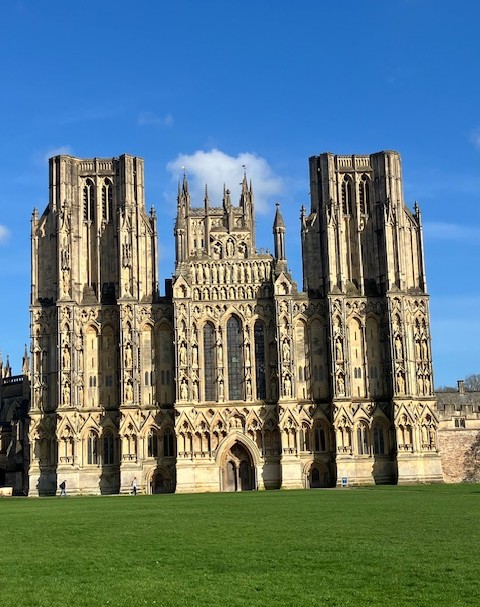
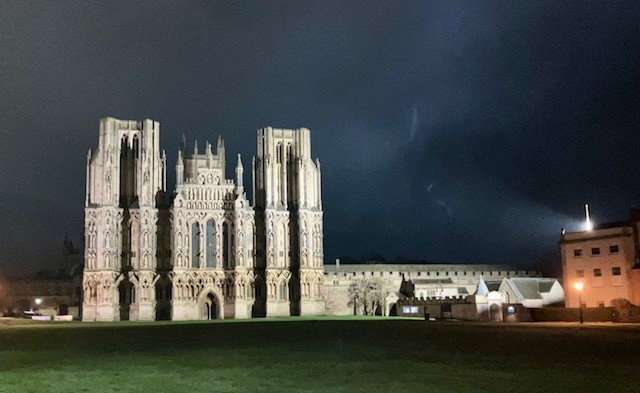
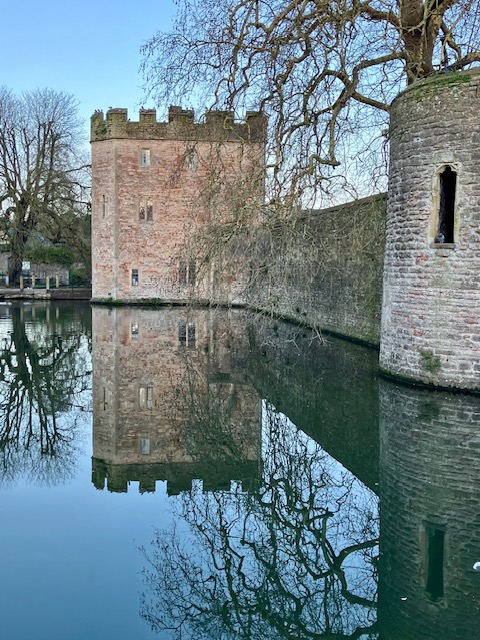
I spent the weekend before last with my brother Adrian at his home in Bath, which is the longest period of time we’ve spent together for donkey’s years and was really lovely. I then caught a bus which travelled through the former mining areas of Somerset around Radstock and Midsomer Norton, before going through the Mendips, with Glastonbury Tor on the horizon, and descending to Wells, the (self-proclaimed) smallest city in England. Wells has a lovely centre – mainly but not only the beautiful Gothic cathedral and the adjoining, fully-moated Bishop’s Palace.

Wells Cathedral by day 
Wells Cathedral at night 
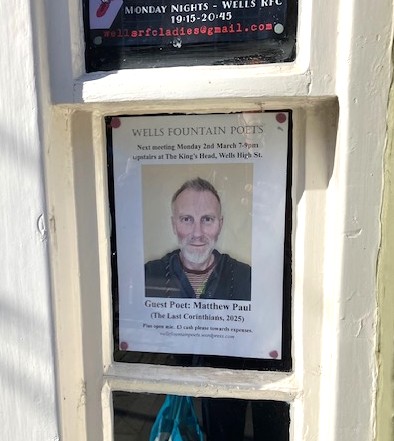
Bishop’s Palace, Wells I got there early enough to go round and inside the cathedral, and then, up the High Street, to see a photo of my then-bearded mug on a small poster in the window of the King’s Head. Just as well I’d shaved the beard off at the start of this year, otherwise there would have been mayhem: a posse of citizens out to lasso the wanted man.

Wanted! Ama Bolton and her group of like-minded folk, the Fountain Poets, were very welcoming, and read – and, in Rachael Clyne’s case, sang – some fine pieces. I read from both my collections plus a couple of new poems too. Ama has kindly invited me back for another reading next March, so I’d better write lots more poems in the next 11 and a half months. I must add the not-quite-random fact that both Ama and I have had poems published about dental hygienists!
Much of my reading has again been for reviews, and, for once, of books which I enjoyed and admired without exception. Among the books I’ve read solely (or mainly) for pleasure are Dean Browne’s After Party (Picador, 2025), this month’s Poetry Book Club choice, and Ted Kooser’s Winter Morning Walks: one hundred postcards to Jim Harrison (Carnegie Mellon University Press, 2000). Two more different books you’d be hard-pressed to find, yet I like them both: the inventive verbal fireworks of Browne’s poems contrast sharply with Kooser’s quiet, weather- and nature-based short poems. In a preface, Kooser says he write the poems ‘during [his] recovery from surgery and radiation for cancer’, with a two-mile walk every dawn because he’d ‘been told by [his] radiation oncologist to stay out of the sun for a year because of skin sensitivity’. Even without that background information, Kooser’s poems would still have been very moving. I hope he won’t mind me quoting this one in full:
March 10
Quiet and cold at 6 a.m.
At dawn in the roadside churchyard,
the recent, polished headstones glance and flash
as if the newly dead were waving pink placards
protesting the loss of their influence.
But the soft old marbles, grainy from weather
and losing their names, have a steady glow,
like paper bags with candles lit inside,
lining a path, an invitation.
Earlier this year, I started getting a bit of pain in my right shoulder, but I thought little of it. It’s considerably worsened since then, with constant pain down my right arm and in my neck, to the point that each ordinarily simple task is a bit of an ordeal. After an x-ray a fortnight ago and appointments with a doctor and a physio this week, it seems that the top of my spine is the most likely source of the problem and that it’s all related to my nervous system – ‘my noives’, as Oliver Hardy would say. I might know more after blood tests on Sunday and more physio on Monday.
In #293 (et al)) of his Philosophical Investigations, Wittgenstein considers what we mean when we each, individually, talk about ‘pain’, and compares it thus;
Suppose everyone had a box with something in it: we call it a “beetle”. No one can look into anyone else’s box, and everyone says he knows what a beetle s only by looking at his beetle.—Here it would be quite possible for everyone to have something different in his box. One might even imagine such a thing constantly changing. [Etc.]
I like to imagine the beetle in my box is a shiny, metallic green. I think I have a fairly high tolerance for pain (for a man), but this is testing my patience to the limit. I’m also struggling to do things one-handed, and with the ‘wrong’ hand at that, and with not being able to run. I walk much slower too. These are intensely annoying things, but I realise many people live with much worse conditions. Dean Browne, via a character, defined pain as something else, in the opening of his poem ‘Quiche’, available here.
-
February update
January was a blast, despite the year’s first rejection winging its way to me on only the 5th: I’ve been far more productive, poems-wise, than usual. That may in part be due to reading the long, elegant, syntactically-gorgeous lines of C.K. Williams’s poetry at bedtime, which seems to have unlocked a part of my brain hitherto securely bolted. I’ve been to two fantastic weekend workshops, at both of which the other participants wrote amazing, inspiring poems. In editing my own, I’ve found, not for the first time in the last year or two, that I’ve spent at least as much time adding to the poems as I have deleting or tweaking phrases and lines; for me, that’s a very happy place.
I’ve been delighted to see some poetry pals buoyed by recent successes, a reminder, if one were needed, that the poetry world has room enough for everyone with flair, imagination and a willingness to work hard at their craft.
Something else which has made me think a lot about the use of language is learning Italian: I’m in the second year of evening classes and I’m at the point now where I relish the challenge of rendering Italian into idiomatic English. (Or even idiotic.) I can’t say that I’m speaking Italian with great confidence, but I like having a go and I enjoy how the words flow into one another more seamlessly than English words do.
Two recently-published anthologies each include a poem of mine. Firstly, My Ear is Full of Milk: An anthology of writing for Laurel & Hardy, edited by Simon Barraclough and Aaron Kent, Broken Sleep Books, available here. As my (not brilliant) contribution relates, Stan and Ollie enlivened my summers, because, back in the ’80s, the BBC used to show one of their short films every day before the test match coverage. Stan Laurel surely deserves to be ranked among the greatest Britons of all time. I’m itching to read it, but my TBR pile has much more pressing candidates. Secondly, I’m very proud to have a poem in The Poems: Forty Years of The North – published by Smith|Doorstop and available here – which contains a whole heap of wonderful poems first published in my favourite poetry journal.
Books and magazines I read in January included: Will Birch’s excellent and suitably lively biography of another great Briton, Ian Dury (Pan MacMillan, 2010); No Turning Back: The Peacetime Revolutions of Post-War Britain by Paul Addison (OUP, 2010); Andy Beckett’s Promised You a Miracle: Why 1980–82 Made Modern Britain (Penguin, 2015), based on interviews he conducted with many major and minor players in the first years of Thatcherism, including some excellent stuff on the GLC administration led by Ken Livingstone and how revolutionary and influential they were, despite much right-wing press opprobrium (which I remember well) and still are; the latest issues of Acumen, The Dark Horse and PN Review (hurray for a terrific new poem by Roger Garfitt); a re-reading of Jonathan Edwards’s fine Gen (Seren, 2018) for poetry book club; and more of Richard Siken’s prose-poems.
I’m currently reading Ken Worpole’s Brightening from the East: Essays on Landscape and Memory, Little Toller, 2025, available here, the first essays of which rambled about rather and contained little new for anyone, like me, who is already familiar with the coastline and countryside of Essex and the edgelands of north-east and east London. It’s also let down by a lack of footnotes or references of any kind other than a long list of source material. But where the book really comes alive, and beautifully so, is when Worpole starts to reminisce about his grandmother, his childhood and his teacher training and practice at a time when folk traditions still featured strongly in English primary education. Another essay concerns Essex-based Tolstoyan and other model communities, ground covered to an extent by the genius that is Jonathan Meades in his BBC4 programme The Joy of Essex (2012), but happily it includes the Othona community, at Bradwell, next to the seventh-century church of St Peter-in-the-Wall. I stayed there in 2003 at a British Haiku Society conference, at which Brian Tasker got us doing Playback Theatre, which involves acting out stories or incidents recalled by audience members, and probably wouldn’t have been sanctioned by the network, details here, that started and oversees it. It was a strange experience, not least because someone from another, Christian group staying there watched us doing Playback and wanted to defect from her group to ours . . .
-
New Year resolutions
Belated happy new year to you. I’ve not really one for making resolutions, so it’s about time I did, so here goes: (a) I will not worry about how long some poems have been out there under consideration (including one since 26th May – that’s 2025, I hasten to add, though it feels a darn sight longer), and, more importantly, (b) I will not send poems out until absolutely every single word, every item of punctuation and the form is as good as I can possibly make it and is doing its job to the best of its ability. ‘Common sense, Matthew,’ I hear you say, but it’s all too easy to get impatient and het up about submissions and/or prematurely over-excited about shiny new poems, isn’t it?
I mentioned the latter the other day when I was talking to a poetry group in Sheffield who had kindly invited me to read some poems, relate my ‘poetry journey’ and set them some exercises. They were a lovely and enthusiastic group, mostly fairly new to writing poetry and yet to get anywhere near as cynical about the mug’s game as I am. My journey, such as it is, has been circuitous, and it often still feels, 43 years after I started, that I’m not even halfway there yet. There is, of course, always much room for improvement. I said to the group that, if they are using memories and other personal experiences as the basis for poems, that it’s perfectly fine to change details, and almost entirely fictionalise if need be, as long as a kernel of truth remains. How one defines that kernel of truth is up to the poet, but the reader will almost certainly be able to sense whether it is there or not.
I also talked about the importance of community, both the wider poetry community per se and small groups, like theirs, which provide mutual encouragement, and, hopefully, get to the point of being able to make constructive criticisms of each other’s work, so that they can improve as poets. Not everyone wants to hear, let alone act upon, criticism of course, which is fine if poetry is just a hobby, like playing badminton or something; but poets who are serious about their poetry have to be resilient as we know.
Among the new collections I’ve enjoyed and admired of late are Lady by Laurie Bolger (Nine Arches), In the Lily Room by Erica Hesketh (also Nine Arches), Lives of the Female Poets by Clare Pollard (Bloodaxe), and, at the moment, I Do Know Some Things by Richard Siken (Copper Canyon). The latter consists of single-paragraph prose-poems. In their quirkiness, they remind me of the epigrammatical mini-essays by Logan Pearsall Smith (1865–1946), which were really proto-prose-poems, I think. Here’s an example from his collection, More Trivia (1922), which I bought just before Christmas:
‘Shrinkage’ by Logan Pearsall Smith In a letter dated 21 My 1919 to Ottoline Morrell, Virginia Woolf described Pearsall Smith thus: ‘I think there is a good deal of the priest, it may be of the eunuch, in him.’ As a young man, he was a friend of Whitman’s in the latter’s old age, and they used to take (horse-drawn) cabs round Central Park following ones in which lovers were passengers to see how far they got, as it were. That incident apparently sparked Robert Lowell’s line ‘I watched for love-cars’ in his great ‘Skunk Hour’, available here, the last poem in Life Studies. Who knew? Well, I didn’t until I read the notes in the very heavy paperback I have of Lowell’s Collected. I’ve been reading Lowell off and on since I first read his poems at school, in the first year of sixth form, way back in 1983, and many of them remain among my all-time favourite poems.
-
A Twixmas meditation
Lyn and I seem to have spent a large chunk of our Christmas evenings this year in the north of Ireland, Belfast to be precise, courtesy of watching Say Nothing (Netflix), the film Good Vibrations (2013, on BBC iPlayer) and Trespasses (Channel 4). All three are set during the Troubles; the series both star the brilliant Lola Petticrew; and Good Vibrations is a biopic of Terri Hooley, who founded the legendary Belfast record shop of the same name, starring the equally brilliant Richard Dormer, who was also so impressively fine in the first series of Blue Lights. It seems as though after years of neglect by television and film drama, aside from Kenneth Branagh’s dreadful Belfast, the Troubles have at last become a subject worthy of dramatic portrayal, and of exploring the question of whether all, or any, of that killing was actually worth it. Novelists, notably Anna Burns and Paul McVeigh, and poets got there first, of course.
Anyhow, all this got me thinking about – or, rather, even more about – my years, from 1985 to 1991, living in Portrush and latterly Coleraine. My first published poem, in Poetry Ireland Review in 1987 (I have eternal gratitude to the late, great Dennis O’ Driscoll), was set in Dundonald. My first collection included five poems directly, and two indirectly, about those times, and The Last Corinthians included three more. Of those 10 poems, one, ‘Pietà’, first published in Magma, dealt head-on with the killing of two RUC men in Portrush in April 1987. I’ve written others but never submitted them. I’ve got plenty more to say, if I ever bother to turn the tap back on – a visit over there would no doubt do the trick.
Perhaps the worst time, Troubles-wise, in those years was that fortnight in March 1988 when the SAS shot three IRA in Gibraltar, then Michael Stone, the UDA man, killed three and injured 60-plus mourners at the Milltown Cemetery funerals of the Gibraltar victims, and then, three days later, two off-duty army corporals were killed by mourners on the route of the funeral cortege of one of Stone’s victims. Thankfully, that cycle did stop, though there were countless other such reprisal attacks.
I found out about 10 years ago that my professor of Philosophy at university, Terry O’Keeffe, was one of the Catholic priests who tried to help and give last rites to some of the 13 victims of the Paras’ shootings in Derry on Bloody Sunday on 30 January 1972. Terry gave evidence to the Widgery Tribunal whitewash about his arrest, beating and torture at the hands of the Paras at Fort George, and, years later, did so over again to the Saville Inquiry, who praised him for his courage and honesty. He died aged 79 in 2020, during Covid.
I’ve written elsewhere about the poet James Simmons, who taught at my university (before my time) and was the headliner at the first reading I gave, in 1987, in the Anchor Bar, Portstewart. He was the eldest of the great generation of Heaney, Longley and Mahon and is the most neglected, understandably, as much of his poetry hasn’t aged especially well; but the best has a poignancy and power which resonates across the decades. Heaney was a little uncharitable about Simmons in Stepping Stones. Simmons set to music and sang, here, his poem ‘Claudy’, about the IRA bombing in 1972 of the village of that name, coincidentally the home of one of my best friends at university, with whom (plus her sister) I spent the summer of 1987 in Berlin. Personally, I prefer Simmons’ heartfelt poetry to that of Longley, though both surely pale in comparison with Heaney and Mahon.
But I’ll close this brief bit of reminiscing with part of a poem by James (Jim) Caruth. I mentioned on here in the summer my admiration for Jim’s collection Speechless at Inch, available here. Jim hails from Belfast but has lived on the edge of Sheffield for many years. One of the many fine poems set in his homeland is ‘Milltown Sequence’ about the cemetery I referred to above. The last four of its six sections are as follows:
IV
Once, we heard a corncrake
in the meadows, watched
and waited for some sign of it,
the slightest movement in the long grass.
But only that intermittent ratchet call
as it sounded its own name.
V
Here is where we bury our Republican dead,
squeezed into this attended plot.
The killed-in-action,
the tit-for-tats and reprisals;
so many names we must remember.
Enough songs to last a lifetime.
VI
The poor ground,
three small fields of indigent grass,
few pennies to weight their eyes.
Over this shamed earth Divis broods,
its dark spine a horizon. A last frontier
before heather, bracken, bog.
For me these lines have a nobility worthy of Robert Lowell at his most serious.
My final, though far from original, thought is that it really is time that Ireland was united. Britain, or rather Norman England, began its imperial aggression by ravaging Ireland nine centuries ago and it’s high time that all vestiges of its empire in Ireland and elsewhere were removed.
Thank you to everyone who has read my ramblings on here this year and a very happy New Year to you when it arrives in your time zone.
-
Recent readings and reading
The evening in York was a memorable one: Janet Dean and Ian Parks, whose new collection we were celebrating, read beautifully, and Jane Stockdale’s songs and tunes were delightful. I stuck to my usual set of poems from The Last Corinthians, tempting though it was to read different ones and even some from my previous collection and/or some new ones.
Five days after York, having been invited by Katie Griffiths to read in Walton-on-Thames alongside Sophie Herxheimer, I skedaddled down south for what was perhaps the most enjoyable gig for me since the one in Nottingham in September. Sophie is a force of nature, an artist as well as a poet, whom I could’ve listened to all evening. She got everyone making zines during the interval. Katie herself read a poem; it’s excellent news that Nine Arches will be publishing her second collection next year. There was also a short open mic, the readers including marvellous Jill Abram.
Photo by Cris Fells of Sophie Herxheimer, Katie Griffiths and me. As Walton is only a few miles west of Kingston, I tailored my set accordingly, with more locally-set poems than I would normally read, though I decided – wisely, I think – against reading one, ‘The Blue Bridge’, which features Sham 69, who came from the neighbouring town of Hersham. In all, it was a joyful evening, and a good way to end this year of readings, which has seen me appear in eight cities and towns in England within the space of six months. It’s been more of a meander than a tour, and two of them were serendipitous invitations at fairly short notice; nonetheless, it’s been lovely to read my poems out loud in front of attentive listeners, not all of whom are poets themselves. I’m thankful to everyone who’s come along, whether because of me, my co-readers or both. I’ll start again in 2026, with a trip to Wells in March.
Meanwhile, my friend and fellow native-Kingstonian poet Greg Freeman, wrote a kind review, available here, of The Last Corinthians for the Write Out Loud site, for which he is the news editor. I am especially grateful to Greg for this, for he not only also reviewed the first launch event at Doncaster back in June but was also the first person to review my first collection. Many congratulations are due to Greg for graduating yesterday from the Newcastle University / Poetry School MA in Poetry.
This last week has seen me join up with poet–friends for a residential in Cloughton, four miles north of Scarborough and just under a mile from the North Sea. Due east from there, there’s no landfall until Schleswig Holstein.
The track to Cloughton Wyke. Although there were intense mornings of drafting poems using prompts, there were also lots of laughs and games, including guess-the-mystery-poets, pool and table tennis, despite the games room (a big shed) being a bit flooded. There was also lots of that great British delicacy, fried bread, at breakfast, which was right up my strasse. I can’t say that I wrote especially well, and sometimes in such weeks the real pleasure to be had is in hearing how well others can draft fully-formed poems in under 10 minutes, and in the conversations at meal-times and in small workshop groups. I very rarely write well from prompts, and usually only if I go off on a tangent, but that’s not necessarily the point; it’s more about getting words down on a page and seeing what might emerge, either immediately or much later when the words are revisited. It is invariably amazing to discover what memories, thoughts and word salads appear.
In between times, I’ve been reading books and journals in a rather unsystematic manner. Here are my thoughts on some of them.
I very much enjoyed Amanda Dalton’s third full collection, Fantastic Voyage (Bloodaxe, 2024, available here), which riffs on the wacky 1966 film of the same name and also includes her moving meditation on grief, the two long poems which make up ‘Notes on Water’ (which I briefly reviewed, here, when it appeared as a Smith | Doorstop pamphlet in 2022), as well as a series of tremendous prose poems which are as funny as they are affecting, as in the opening and ending of this one:
Auntie Irene says that cousin John got a tapeworm from stroking the sheep. [. . .] Every time I see my cousin John I want to ask him if the tapeworm is still growing in his insides and every time he speaks to me I wonder will it come out of his mouth like words he didn’t mean to say.
Alan Buckley’s Still (Blue Diode Publishing, 2025, available here) was for me rather a disappointment after his sublime 2020 debut full collection, Touched (HappenStance Press): every (single-word title) poem consists of six couplets with seven syllables per line, a form which Buckley calls the ‘douzaine’, and most of them are about nature and were written during Covid times, though too many of them seemed like nature notes, inhibited rather than helped by the form, in which the thoughts he conveys aren’t quite brought sufficiently into focus and sometimes lapse into cliché, such as ‘May you burn brightly as long as you can’ (‘Glow’), or the obvious – a magpie described as having ‘piebald simplicity, / disturbed by metalline blue’). The paring-back dictated by the form, which he talks about in the book’s end-matter, lacks the powerful concision of haiku and doesn’t quite leave enough room to develop the plethora of ideas that he evidently has. However, I do, admire Buckley’s determination to try something different and at their best, these poems have a fine simplicity, as one would expect from such a talented poet: ‘As the final transport plane / leaves Kabul, here in Marsh Park // the Afghan boys play cricket. / They made their journeys on foot, // in trucks. Some don’t know if those / they left behind are alive.’ (‘Cricket’) Maybe a re-reading will prove more profitable.
At the age of 80, Peter Jay has collected his poems 1962–2024, as The Last Bright Apple, published by Anthony Howell’s Grey Suit Editions and available here. Jay was the founder and chief editor of Anvil Press Poetry from 1968 until it ceased in 2016, when some of its poets and back-catalogue were taken on by Carcanet. Jay had impeccable taste; as well as perhaps his most lucrative (!) asset, Carol Ann Duffy, I have on my shelves Anvil books by real favourites of mine, like Martina Evans, Michael Hamburger, Anthony Howell himself, Peter Levi, E.A. Markham, Dennis O’Driscoll and Greta Stoddart, and Edmund Keeley and Philip Sherrard’s translations of Elytis, Seferis and others. As is often the case, Jay is better-known as an editor than he is as a poet, and this nicely-titled and beautifully-produced book will go some way to restoring his reputation as a poet. I say some way, because it’s not the most substantial of outputs and includes many translations from a variety of poets and languages. At his best, though, Jay’s poems are warm, attractive and cerebrally ruminative without being esoteric, as in the opening half of ‘Thoughts’:
There are days when the mind grazes,
Circling itself like an answer
Lazily guessing its question.
How fragile they are, thoughts,
How delicately to be hoarded!
When a white thought runs away,
It takes on the colour of air,
Of water. Unguarded thought,
Home thought in search of a heart,
Heartless though in search of a home,
Desert thought thirsting for an oasis,
Pale fractured thought, let me catch you,
Name you and give you a colour.
These lines, perhaps unsurprisingly, remind me of Levi and of the late collections of Hamburger. Elsewhere, Jay is a pleasing observer of what passes for natural wonder in nature-depleted England, e.g. ‘Swans on the tarn / move with the weather, / rain, wind or sun, / drifting together.’ (‘Little Langdale’), and is wryly reflective on his life’s work: ‘What can be done with poets? / Such awkward people. We know / They don’t matter at all; why then / Do they concern us?’ (‘Ars Politica’). In all, this is a collected poems which, despite being comparatively slender at 150 or so pages, contains the sort of fine, philosophising poems which are sadly out of fashion these days.
I’ve also spent time revisiting the metaphysical rococo wordscapes of Lucie Brock-Broido. The four collections published by Alred A. Knopf before her death in 2016 at the age of just 61were and are magnificent. It amazes me that, although Carcanet published a fine selected, Soul Keeping Company, in 2010, the individual collections are yet to be published over here. Maybe they’re waiting for Knopf to publish a definitive collected.
I have more reviews to write before Christmas, and one appearing next week. It has without doubt been my busiest year of poetry, and for that I am very grateful.
-
On the last while
It’s been a bit of a poetry whirl of a month for me. The National Poetry Day readings at Rotherham Civic Theatre were well-attended, and not just by the readers, for the launch of Ourselves Reflected Back, the anthology of local voices, edited by Vicky Morris. The quality of the poetry was unsurprisingly variable, but the passion and commitment were exemplary and never in doubt. Many poems were poignant or funny, or both. (The event also reminded me never to have an alcoholic drink before reading – in this case a pint of Guinness I walloped down in a couple of minutes in the theatre’s bar – because it always impairs my diction, even after, as in this case, just one drink.)
On Tuesday 7th, I read at the Dusty Miller, in Mytholmroyd, West Yorkshire. Before the reading, I made the obligatory pilgrimage to the house where Ted Hughes was born and lived, before he and his family moved to Mexborough when he was seven. The readings were co-hosted by the lovely duo of fine poets Carola Luther and Ian Humphreys, who set the tone for the evening with very thoughtful, perceptive and generous introductions for my co-readers, Molly Prosser and Kim Moore, and me. As I often do, I learnt a lot by listening and watching the other readers, especially Kim, who worked the room in as natural and engaging a manner as Peter Sansom had at Five Leaves bookshop, Nottingham, back in September.
The following Saturday saw the launch in Doncaster Unitarian Church of Ian Parks’s new collection The Sons of Darkness and the Sons of Light, published by Tim Fellows’s Crooked Spire Press. As with my collection, Tim did a great job in producing the book. There was a supporting trio of readers – Susan Darlington, Steve Ely and Laura Strickland – each of whom read their excellent poems with gusto. Liam Wilkinson sung some terrific songs, accompanying himself on guitar. Ian himself read beautifully from his tremendous collection. Most notably, to end proceedings, Ian read the long and moving title-poem of his book, gradually building up the pace and power of his pitch. It was a highly memorable experience, up there with any long-poem reading I’ve ever heard, including Allen Ginsberg reading ‘Kaddish’ at the Albert Hall. There’s an account of the day, by Tim, plus plenty of photos, on the Crooked Spire Press website, here.
I then watched Ian’s online reading on Tuesday 21st. There was music again, by Liam’s dad, Allan Wilkinson, who is also a very talented singer and guitarist, and guest readings by Bob Beagrie, Gaia Holmes, Vanessa Lampert and Charlotte Wetton, a diverse array of distinctive poets, with different styles and subject-matter, all of whom read exceptionally well, as did Ian himself. As anyone who’s tried knows, reading online is trickier than reading in person, because you can’t see everyone and therefore can’t gauge their reactions as easily; nor can you really tell how loudly you’re speaking. On this occasion, though, all the readers coped very well and MC Tim Fellows ran things very efficiently and effectively.
This Thursday just gone, I travelled down to Stroud, in Gloucestershire, to read at the Museum in the Park, at an evening organised under the aegis of Yew Tree Press run by Philip Rush, who was on the second Poetry Business Writing School programme I attended in 2019–2021, which was curtailed by Covid. The other two readers, Mark Corcoran and Polly Howell, were/are both local poets who deserve to be better-known. I changed my set a bit from the Mytholmroyd reading, which was easy to do because my slot at both was (up to) 20 minutes – however, well a poet knows and can therefore remember the words of their poems, it does, I think, get a bit wearying always reading the same ones. Of course, some poems in collections, in mine at least, just don’t work particularly well when read to an audience; this can be because of: words which might be heard as their homonyms; obscure references (a speciality of mine!) which necessitate explicatory preambles; are too short or too long; or page layouts which are an intrinsic part of the poems’ effectiveness and so can’t be orally conveyed. Philip and the Stroud audience were really warm and responsive, and I enjoyed the evening immensely. It was great also to meet the poet JLM (Juliette) Morton, whose Broken Sleep Books collection Red Handed I enjoyed reading last year, and to see in person again David Hale, my fellow member of the workshop group, the Collective, whom I first met when he and I were on my first Poetry Business Writing School programme back in 2017–2018. (Nice though it is to see David and everyone else in the Collective over Zoom every other Sunday, seeing them in person is even better – though we’re yet to meet together in person; in fact, there are two members, Ben McGuire and Lydia Harris, whom I’ve never met in person.)
On Friday, I was one of six readers at an Off the Shelf Festival event in the University of Sheffield Drama Studio’s theatre, as a celebration of forty years of my and every other UK poet’s favourite poetry journal, The North. Hosted by the co-editor (and co-director of the Poetry Business), Peter Sansom, it consisted of a delightful 20-minute reading by the Sheffield Poet Laureate, Beth Davies, whose pamphlet The Pretence of Understanding won the New Poets’ Prize 2022, and then short readings – by Peter, Alan Payne, James (Jim) Caruth, Kate Rutter and me – each of three poems which had appeared in The North. I read Stephen Payne’s superb villanelle, ‘Dai’, Victoria Gatehouse’s brilliant, and brilliantly-titled, ‘Reservoir Gods’, and my own ‘The Prang’. It was another very memorable event, and a fitting tribute to Ann and Peter Sansom’s work over the years to cement The North as a hugely important pillar of the poetry scene in the UK and beyond.
And then yesterday, I went to my third poetry event in as many days. I have to say that by this point I was feeling as though I was permanently living in a bubble of poetry. But the quality of the event was such that I had another great time. It was the launch, at the amazing Leeds Library, a venerable and beautiful subscription library founded in 1768, of Ian Harker’s Smith | Doorstop pamphlet, Gain Access, which Kim Moore chose as the winner of last year’s Poetry Business International Book and Pamphlet Competition. Gain Access is available at the bargain price of £6 here. The event was MC-ed by the poet Joe Williams, who read and recited two poems of his own, and Ian had two guest readers, Melanie Banim and Tom Weir, both of whom read their fine poems very well indeed. Tom and Ian were also on the Poetry Business Writing School programme alongside me, in my first and second ones respectively. It was great to see Tom read some old favourites, plus some new, heartrending poems. Ian’s pamphlet, which I haven’t had time to read in full yet, consists of poems about his days as a housing officer for Leeds City Council. Everyone in the room was privileged to hear Ian read a selection of them yesterday. As a former local authority officer myself, and with my daughter having recently moved roles in the council she works for (from Customer Services) into Housing, as a homelessness officer, the poems resonated very strongly with me. As we all know, public servants in general in the last 15 years have, alas, had to get used to doing more with less funding, as a result of Cameron and Osborne’s Austerity, May’s ‘hostile environment’ and failure to control the roguest elements of her party as it went hell for leather towards the national economic suicide that was Brexit, Johnson’s plumping for Brexit purely as a way of self-aggrandisement and his incompetence and lies at the helm throughout the pandemic, Truss’s crashing of the economy for entirely ideological reasons, Sunak’s failure to effect any improvement to people’s wellbeing, and the huge disappointment, so far, of Starmer’s government to effect the positive change they were elected to. Hearing Ian’s poems about the day-to-day impacts of all that on ‘ordinary’ people’s lives was intensely moving; they are extraordinarily well-crafted poems, which impart their message and import without preaching or hammering.
What I learn from watching and listening to other poets read isn’t just how they make their poems engaging, but where they pause, what they emphasise, how they vary their pace and all manner of tricks which make reading poems to an audience into a proper performance. Inevitably, I also get inspired to write new poems, because memories and ideas get triggered.
Much though I loved all those events, I’m glad to have a bit of a break before the next one, another 20-minute reading I’ll be doing in support of Ian Parks (and with Janet Dan and musician Jane Stockdale) in York on the evening of 21st November – details and (£5) tickets are available here.
This month’s Poetry Book Club book is Ash Keys, the ‘New Selected Poems’ of Michael Longley, published by Cape not long before he died. Of his generation of poets from the north of Ireland, he’s not, to my mind, up there with either Heaney or Mahon (or for that matter, with the younger generation of Carson, McGuckian and Muldoon). I do, though, like some of his poems, especially his short ones on the flora of the Burren, in the west of Ireland. My chosen poem to talk about at the meeting is a section of his elegiac sequence on Peter, his twin.
The poetry collection I enjoyed reading the most in the last month was Gunpowder by Bernard O’Donoghue, another Irish poet, published by Chatto & Windus back in 1995. It pulled off that rare hat-trick of making me laugh, swoon at his skill and admire how it seemingly effortlessly moved me. I shall have to find and read more of his collections. On my shelves, Gunpowder sits happily between collections by Sean O’Brien and Dennis O’Driscoll, which is surely a fine place to be.
-
September reading and other news
On Tuesday, I had the great pleasure of reading at Five Leaves bookshop in Nottingham, alongside two lovely poets whose poetry I love: Kathy Pimlott and Peter Sansom. As Kathy mentioned during her reading, she and I met because we were both participants in the Poetry Business Writing School run by Peter and Ann Sansom. I think our sets of poems complemented one another’s. I’m very grateful to Ross Bradshaw of Five Leaves and Tim Fellows of Crooked Spire Press for introducing our readings. Here’s a photo taken afterwards:

Photo of Kathy Pimlott, Matthew Paul and Peter Sansom I have two readings coming up in October, at the Dusty Miller, Mytholmroyd, on the 7th, and at the Museum in the Park, Stroud, on the 23rd. Both are free events, with no ticketing. Details are available here.
I’ve been reading Peatlands (Arc Publications, 2014), written by Pedro Serrano, the Mexican poet, and translated by Anna Crowe, both of whom I was due to be reading alongside in Mytholmroyd. (They have been replaced by Kim Moore and Molly Prosser.) In his poem ‘El Arte de Fecar’ / ‘The Liminating Art’, he writes, ‘Shitting is like the art of writing: / you have to give it thought and just so long / for everything to come out good and strong.’ I can’t argue with that.
I’ve also been (re-)reading Us (Faber, 2018) by Zaffar Kunial, as it’s the chosen book for this month’s Poetry Book Club. In these days when the media are encouraging the open racism of far-right fuckwits, his poems exploring what it means to belong have taken on added importance. I’ve also re-worked my way through the poetry oeuvre of Seamus Heaney, accompanied again by Stepping Stones (Faber, 2008), Dennis O’Driscoll’s seminal interviews with him. For me, Heaney remains a paragon of how a poet can negotiate the politics and events of their time.
I’m also savouring Flint Country (Saraband, 2025, available here) by Laurence Mitchell, whose East of Elveden blog (here) I have long enjoyed. It’s a lovely, heartfelt meditation on the character, history and importance of flint in Norfolk, Suffolk, Sussex and beyond.
Finally, I’m very grateful to Jonathan Taylor, who featured two poems from The Last Corinthians on the Creative Writing at Leicester site, here. I should mention again that Jonathan’s short-story collection Scablands (Salt, 2023), available here, is one of my reading highlights of the year.
-
On Mary Mulholland’s ‘Stilling Time’
Mary Mulholland has been steadily building up an impressive body of work over the last decade and more: her latest publication, the elimination game, published by Broken Sleep Books and available here, is her second solo pamphlet, following her 2022 Live Canon debut What the sheep taught me, in addition to her two Nine Pens collaborations with Vasiliki Albedo and Simon Maddrell. Mary is also the founder of the Red Door Poets (details here), of whom I was an original member; I can testify to Mary’s deep poetic intuition and generosity.
With intelligence, humour and carefully contained ire, the elimination game tackles the stereotypes, pitfalls and apparent invisibility of older women in contemporary British society. As a late-middle-aged man in the same society, I can’t, and don’t, pretend to know what it feels like to be an older woman in Britain today, but Mary’s poems provide a good idea.
The content contains a plethora of memorable lines and images, such as the eponymous hero of ‘The General’s Widow’ who, once ‘The funeral’s over’ finds ‘it’s such a relief, / she’ll spend the night making paper planes, / hurl them at his eyes, nose and brains’, and the title-poem in which a litany of misogynist and agist insulting terms for older women are rebuffed in no uncertain terms (‘kindly wait while i /find a bucket to list & puke in’) and then refuted by another, much more positive litany of achievements: ‘last year I swam in the / arctic trekked the sahara then / mastered roller-blading next up / i’m starting classes in mandarin’.
There are heartfelt poems from the perspective of both motherhood and grandmotherhood (both subjective and objective, and in ‘The Grandmothers, both), celebrating the passing on of the torch of female fearlessness; and of the incredible family memories and history which need to be handed down through the generations before it’s too late (the vivid ‘Fallen Tree’); and, in ‘Reading the Silence’, the quiet, uneasy moments of a later-years (heterosexual) relationship, in which the man’s apparently dominant voice and ‘exploits’ are quietly undercut by the woman’s unsaid response:
Once in Africa, with rain like steel drums
on the tin roof, he said whisky was saferthan water, and the grey parrot, once owned
by a bronchial old man, coughed.
She pauses her knitting, replays her thoughts,
plain, purl, clacketing needles, perhaps time,
to cast off. She glances. He raises an eyebrow,
she half-smiles.
There are poems, too, about the perils of older sexual attraction and perfunctory, unfulfilling sex, surely underexplored topics in contemporary British poetry, and, most poignant of all, a rueful list-poem, ‘The Regretting Room’.
There is a degree of interplay and echoing between the poems, not in a way which duplicates ideas, but, rather, augments them with different facets of the same sub-themes. This helps to make this pamphlet unusually well unified. I, for one, would like to see a full collection from Mary, in which she can bring her skills and life-experience to bear on the larger canvas.
The 25 poems in the pamphlet are varied in form: blocks, 5; bullet-points, 1; columns, 1; couplets, 6; haiku, 1; irregular stanzas, 4; quatrains, 2; sestets, 1; tercets, 4. Such variety remains, I think, an under-rated aspect of collecting poems into a coherent whole. Unless a collection is themed by form (e.g. a collection of sonnets), reading poem after poem in the same or similar forms, whether block poems or in couplets, will never be the most enjoyable experience, however excellent the content maybe.
11 of the poems are in standard upper- and lower-case; the others, though, are in lower-case only – first-person singular, names, other proper nouns and all. I presume the decision as which case to use when was made on an intuitive, poem-by-poem basis, rather than with any preconception. I can’t be the only reader who finds the lower-case-for-everything format to be unnerving to the point of mild irritation, because I can’t quite see the point of it, other than as a needless layer of further variety, but I’m endeavouring to get over myself. (For years, there has been a sizeable minority of English-language haiku poets who have deployed the lower-case for each and every word, and within three lines – or just one – that approach looks a trifle pretentious. Often the ‘i’ instead of ‘I’ was/is used to indicate an absence of ego by Zen-infused poets, but to my mind it has had the opposite, self-defeating effect on the reader, of drawing attention to itself.)
You may wonder, then, why I’ve chosen the poem below rather than one of those in standard upper- and lower-case. The answer is simply that I like the content very much. So it seems that I’m succeeding in getting over myself, which must be a good thing.
Mary has kindly given me permission to quote the whole of the following poem.
*
Stilling Time
when she turned eighty my aunt refused to go
to bed, because that’s where most people die.
at eighty eleanor of aquitaine rode on horseback
like a man when she went to visit the king of spain.
a woman even older circumnavigated the world,
another ran marathons, one wrote racy books.
when i’m eighty i’m going to retrace my steps
to the grand canyon, breathe again the air
where i first encountered the majesty of creation.
i will touch a black stone ninety million years old
and feel young. i’ll bump into a family elk
at dawn, we will hold each other’s gaze.
I’ll tell them I come in peace, leave my shadow
falling over the canyon edge, sinking into earth.
*
I’ll be straightforward for once and start with the title. A play-on-words on ‘stealing time’ is intentional, I assume; at least, that allusion came immediately to mind. The idea of stilling time is attractive: of enabling a pausing, even a thwarting, of its sly progress. It’s a fine title with which to end the pamphlet, because the passage of time is the underlying stratum of all the poems within it.
Do seven couplets always make a sonnet? Not necessarily, but there’s a definite turn in this one, after the third couplet, so it’s fair to call ‘Stilling Time’ a reversed sonnet, like Elizabeth Bishop’s ‘Sonnet’ (the 1979 one).
The opening line contains arguably the pamphlet’s finest line-break: I admire how it leads the reader to think that ‘to go’ indicates that death was imminent for her aunt, and then the second line, showing her resilience, intelligence and wit, reveals that she wasn’t quite near the brink yet. Poets nowadays seem more adept at that kind of double-meaning line-break in which the reader is lulled into one interpretation before being directed elsewhere. Here it is all about how much time the reprieve will provide.
That opening couplet leads very nicely into the second, with the precise age of eighty neatly linking the two verses. Eleanor of Aquitaine lived one of the most remarkable lives of anyone of ‘high’ birth in the early Middle Ages: married three times, including to King Louis VII of France and Henry II of England, with both of whom she ruled jointly, she outlived each of them, and even survived imprisonment by Henry. She also outlived her son Richard the Lionheart, for whom she acted as regent during his almost perpetual absences from England, and enabled the succession of her younger son, John, in face of much baronial and other resistance. I’m scarcely doing justice to her full biography here. Suffice it to say that in the cut and thrust of male-dominated diplomatic shenanigans between England and France, she was a central figure for well over half a century. Eleanor’s journey which this couplet refers to was across the Pyrenees to fetch her granddaughter Blanche of Castile to marry Louis VIII of France and in so doing consolidate John’s shaky hold on the English throne. She was, and is, an example of a hugely successful and important long-lived woman, indomitably defied her advanced years. She’s an excellent example in another way too: being equally at home in England and France, like Mary and her family, as shown in several of the poems.
The third couplet, in almost throwaway style, is less specific in its old-age-resistant examples but is precisely-worded to sound salubrious to the ear.Although they link and shift like the verses of a renga, each of the first three stanzas is discrete, content-wise. From the fourth couplet onwards, however, they flow into one another, despite the full stops in the fifth and sixth, thereby giving the heart of the poem a lovely impetus after the somewhat stately, though no less well-made, opening trio of couplets.
At this point, the defiantly adventurous tone becomes reminiscent of Jenny Joseph’s very well-known poem ‘Warning’, available to read here, with its much-quoted opening,
When I am an old woman I shall wear purple
With a red hat which doesn’t go, and doesn’t suit me.
And I shall spend my pension on brandy and summer gloves
And satin sandals, and say we’ve no money for butter.
I shall sit down on the pavement when I’m tired
And gobble up samples in shops and press alarm bells
And run my stick along the public railings
And make up for the sobriety of my youth.
I shall go out in my slippers in the rain
And pick the flowers in other people’s gardens
And learn to spit.
There the comparison ends, though: the ambition in Mary’s poem is much bolder and more outlandish (in a good way). Note that it’s not ‘retrace my steps at the grand canyon’ but ‘to’, as if the poet–persona will take a longer and slower route, like Eleanor of Aquitaine. The segue into the fifth couplet is elegantly managed, with that pause on ‘breathe again that air’. To make the syntax here work to its optimum maybe either a semi-colon is needed after ‘creation’ or ‘touching’ should replace ‘i will touch’, but that’s quibbling. The elk encounter in the sixth couplet is utterly delightful and reminiscent, for me, of the similarly close encounter with elks in Dorianne Laux’s superb poem ‘The Crossing’. The unravelling of the clauses towards the void at the end is beautifully achieved and delivers a delicate and most noteworthy note on which to close the pamphlet.
-
July reading
You might think it invidious at the moment to be reading books by anyone called Donald, so it’s strangely coincidental that I’ve just read two in a row. I’ve mentioned before that Lyn and I have read several books recommended by the excellent Jacqui’s Wine Journal website, and Mr Bowling Buys a Newspaper by Donald Henderson is the latest of them. Jacqui reviewed it here, and her verdict is as dependably spot-on as ever. It’s very much a period piece as many older crime novels are, but that’s its joy.
Toy Fights, Faber 2023, Don Paterson’s memoir of the first 20 years of his life, is full of the rich details and meta-commentary that readers of his poetry would expect. His recall of memories is phenomenal, as if he’s channelling Ray Bradbury, who said, on Wogan in the Eighties, that he could remember everything that had happened in his life, even back into the womb. Paterson says, though, that, after three years of age,
the memories are vivid, but they still can’t be trusted. I am wont to confuse memory and photographs, other folks’ memories with my own, and things I saw on television with things that happened to me.
Paterson writes well about his jobbing musician father, at whose club gigs Paterson joined him as a side guitarist from the age of 15, though his mother, still alive at the time the book was written, is less of a presence. The biggest character, aside from Paterson himself, is the city of his birth and upbringing, Dundee. As a fan of the joyously daft BBC4 sitcom Bob Servant – written by Neil Forsyth who also wrote the fantastically well-plotted The Gold among other things – I was pre-programmed to like the colourful characters, community spirit and language of Dundee which Paterson brilliantly and often hilariously conjures. He’s very good, too, about the painful years of his adolescence, including two or so years as a devout Christian in a cult-like group, and his subsequent musical education, as listener, player and part of the local music scene, which at that time encompassed The Associates, led by much-missed Billy Mackenzie. The most memorable section concerns a breakdown he had aged 19, chiefly caused by drugs, and his subsequent four-month stay in Ninewells (psychiatric) Hospital. The book ends with Paterson setting off for a job in a band in London. Poetry barely gets a mention. Paterson’s ability to self-analyse with candour and honesty is extraordinary and provides many of the book’s funniest moments.
I’ve written before, here and here, of my admiration for the writing and performing of Philip Hoare, and it was about time that I got stuck into his book Spike Island (Fourth Estate, 2001), subtitled ‘The Memory of a Military Hospital’. Ostensibly, it’s concerned with the history of the humungous hospital built from 1856, opened in 1863 and mostly demolished in 1966, at Netley, near Southampton; but it’s much more than that, suffused as it is with Hoare’s memories of growing up a stone’s throw away in Sholing, his family history in general, aspects of British social history from mid-Victorian times and much else. It’s the most Sebaldian of his books, I think, with photographs interspersed throughout, and was in fact one of the last books which Sebald himself endorsed, in the Sunday Telegraph books of the year, before his death in December 2001: ‘A book that has everything a passionate reader could want – a subject that far transcends the trivial pursuits of contemporary writing, concerns both public and private, astonishing details, stylistic precision, a unique sense of time and place, and a great depth of vision.’ Hardly unique, though, as those words could’ve been applied to any of Sebald’s own books. Thanks to its proximity to the port of Southampton where the troopships docked, all British soldiers injured in the nation’s colonial wars were initially treated there, including those suffering from shell-shock inflicted on the Western Front, who were sectioned off in ‘D Block’, where the dreadful treatment was very much based on the notion of using military discipline to bully the inmates back to some kind of ‘normality’. I thought of James Goose, my great-grandfather, who was sent to South Africa in 1899 as part of a Norfolk militia regiment, got shot in the face by a Boer sniper (the wound turned cancerous and killed him years later) and came home on a ship named Roslin Castle, pictured here: he was so relieved to be home that he and my great-grandmother Agnes (née Riches) named their son Roslin, though maybe sensibly he was known as Rossie.
On the poetry front, I much admired Richard Scott’s second collection, That Broke into Shining Crystals, Faber, published earlier this year. As in several of Pascale Petit’s collections, this contains work which very skilfully, and with a marvellous ear for musical cadence , transforms the pain of sexual abuse into beautiful poetry. Each of the 21 poems in the first section, Still Lifes, responds to a different still life painting by painters from the 1600s onwards to Bonnard. The second part, a response to Marvell’s ‘To his Coy Mistress’ felt less successful, as it employs Seventeenth Century language in a manner verging on parody. The third section contains 22 poems after types of crystals and gemstones, as refracted through Rimbaud’s Illuminations as translated by Wyatt Mason, and are, for me, the most successful in the book, because the prose-poem form allows Scott to give fuller vent to his gift for articulating emotion through vivid and sensuous imagery and language, as in this extract from ‘Emerald’:
The field is a body. Wild grass rippling over breasts and muscles, the jut of a hipbone. Some of the grass is trampled down into mud like a battlefield – screams catch the air. Some of the grass is spread over little hillocks like shallow graves. Some of the grass is cut into a bit, desire lines and goat paths, leading to all the places you ever dreamed of going but didn’t.
As I discovered from listening to his interview with Peter Kenny in Series 5, Episode 10 of the ever-excellent Planet Poetry podcast, here, Scott talks very thoughtfully and eloquently about his craft.
I’ve also been knee-deep in the poems of Wisława Szymborska, as translated by Clare Cavanagh and collected in Map, Houghton Miflin Harcourt, 2015, for the poetry book club I’m part of. My jury is still out thus far, but then it’s a heftily daunting tome.
I’m also about halfway through Diane Seuss’s Modern Poetry, published last year in the USA by Graywolf and in the UK by Fitzcarraldo Editions. Her telling-it-as-it-is style might not be everyone’s cup of tea, but I really like the way she throws it all in and takes disjunctive leaps in her poems. I adore her poem ‘An Aria’, 23 irregular quatrains which are propelled with a fearsome energy. I found myself getting funny looks on the Tram Train to Sheffield last Thursday as I read out sotto voce. If poetry can make me do that, it has to be good.