A decade or so ago, I was a member for two or three years of the Twickenham Stanza group of the Poetry Society until it ceased following the closure of Langton’s bookshop, Church Street, in which the group met. The quality of the poems we workshopped was invariably high. Among the members was the fine poet Paul McLoughlin, who was generous to me with his time and entertaining anecdotes. Sadly, he has recently passed away.
Paul occasionally mentioned the poet Brian Jones (1938–2009) – not to be confused with the Strolling One – and a few years ago, his own publisher, Shoestring Press, published a selection of Jones’ poems. I must get round to buying a copy. In the meantime, I recently bought a lovely copy of Jones’s Interior, 25 poems published by Alan Ross in 1969. There is something Larkinian about his poetry, though without the misanthropy or suppressed bigotry. More than anyone, though, his poems remind me of Dennis O’Driscoll’s: droll, acutely aware of mortality and on the nose.
A three-part poem ‘At the Zoo’ was always going to appeal to me, because I adore zoo poems, and zoos in fact, hard though it is not to feel simultaneously thrilled by proximity to the creatures therein and repulsed by their captivity. The third part concerns Chi-Chi, the giant panda who was brought to London Zoo from Frankfurt in 1958 and was a major attraction until her death in 1972, and opens thus: ‘This is the panda that wouldn’t be shagged!’. After a superb simile, ‘wondering kids hoisted like periscopes’, he elaborates on the panda’s situation and attitude:
This is the girl
who would have none of it, who let the world
proclaim and plan the grandest wedding for her,
who travelled in state and with due coyness
one thousand miles in a beribboned crate,
who ate well at the reception, honoured the ritual,
and when the time arrived for being shagged
chose otherwise, rolled over, went to sleep.
Anthropomorphic, to a degree, this may be, but it’s fine writing, with a deceptively easy rhythm.
The same panoptical and omniscient voice is at play in his poem ‘In a University Library’, the last two stanzas of which build to a mightily unexpected and extraordinary flourish:
So here I am, game for another try.
Across hushed floors, I follow appropriate rules—
check catalogues, use cards, go straight to a shelf,
extract one book with unambiguous hand,
pass girls with gentle faces and lyric hair
without a second glance, become a bulk
of silence at a table, open the words—
and Time leaps cartwheels and the blood runs loutish
as sunlight strokes the pages where they swell
in sumptuous buttocky mounds from the shadowed spine.
It’s a poem to which I can fully relate. Pre-computerisation, university libraries must’ve been even stranger environments than those I inhabited in the mid to late ’80s; nevertheless, the timelessness of being, in that perfect phrase, ‘a bulk of silence’ is marvellously depicted.
The masterpiece in Interior is ‘Death of a Cultured Golfing Motorist’. With a title like that, how could it not be? In seven intricately-woven tercets, Jones maintains the poise and tension of a tale which we already know will not end well. Here are stanzas 3 to 5:
And on the course was never such a day—
the ball sprang from the gorgeous woods
like a bolt of joy, hung in subtle flight
from wedge and spoon. The greens played like a dream
and light was dreamlike, reducing distances.
And driving home, he heard his car
croon like advertisement—the stubbed gearstick
floated between the ratios, the tyres
discarded corners with brisk disdain.
I won’t give away the brilliance of the poem’s closing couplet. For the anthology of poems about sport which I am slowly compiling, ‘Death of a Cultured Golfing Motorist’ is an absolute shoo-in.
Category: Uncategorized
-
On Brian Jones (no, not that one)
-
On football poetry and why it matters
If you dislike football, and QPR and/or England even more, then you probably ought, as Des Lynam used to say, to look away now.
I’ve been a football fan almost as far back as I can remember, and in 1973 chose QPR, then newly promoted to the old First Division, as my team. I sometimes wonder what I’ve done to deserve almost a lifetime of supporting them, though, on balance, the highs have just about outweighed the many nadirs, the lowest of the low perhaps being, in 1998, the brief simultaneous appearance in the hoops of Razor Ruddock, carrying more timber than a glen-full of caber-tossers, and Vinnie ‘off-to-Hollywood’ Jones, both barely bothering to walk, let alone run, with Jones spending much of the game very loudly calling his rather more energetic young teammate Tony Scully a ‘fucking cunt’.
I’ve also endured (on telly) nearly every England game since one happy Saturday in 1975 when I rushed home from my junior school’s fete to watch then QPR and England captain Gerry Francis inspire them to their second best ever 5–1 win, over the Auld Enemy. It wasn’t until 1982, following an infamous qualifying disaster in Oslo, that I was able to see England play in a tournament. That World Cup started perfectly, with a scintillating win over Platini’s France, but ended, as it always has in my lifetime, in defeat, Keegan and Brooking’s last-throw-of-the-dice double-act unable to save them. Naturally, England fans ran riot, inspired by Thatcher’s colonial war to save Britons so patriotic they chose to live 8,000 miles away. Then they were back to the old ways of failing to qualify, for the Euros in ’84, before the agony of Mexico ’86. Everyone remembers Maradona’s Hand of God and that sensational run for his and Argentina’s second, revenge of sorts for that war I mentioned, one of the four defenders he left in his wake being QPR’s Terry Fenwick; but it’s the England response that sticks most in my mind: on as a sub, John Barnes’s wing-play was unbelievably good, setting up one goal and providing a cross which Lineker was an inch away from. I remember pacing around the house afterwards, feeling the disappointment of that defeat as real physical pain.
The ’88 Euros were a shambles: three games, three defeats, seven goals conceded and only two scored. Lord knows how Bobby Robson (born, incidentally, on the same day in 1933 as Yoko Ono and my mum) was still manager two years later for the near-glory of Italia ’90. England started slowly at that tournament, as they’ve done many times since, and grew and grew into what looked like an unstoppable force. Whether the switch to a system with mad Mark Wright a revelation as sweeper really was, as supposed, senior England players’ idea or Robson’s, it was inspired. In retrospect the fact that it took a fluky deflection off QPR’s Paul Parker for that brilliant German side to score was testament to how good that England team – Gascoigne, Lineker and all – had become. Again, the disappointment was something tangible.
I won’t discuss hapless Graham Taylor’s reign except to recall that on a pre-season tour of Sweden, after he’d just taken over as Wolves manager in the summer of ’94, he went over to thank some Wolves fans, asked them why they’d come all that way and got a blunt Black Country reply along the lines of “We would’ve been in America, but you fucked that up for us, didn’t you”. I also recall a Bolton fan being up in court for throwing a turnip at him and then having his fine doubled by the magistrate for declaring that it was worth it.
Euro ’96 was a blur of excitement, guided by ex-QPR boss (and player) Terry Venables, but that Gascoigne miss lingers . . . You get the gist. Beckham’s red card against Argentina in ’98 (what a game it had been up to that point). Keegan’s gung ho naivety in 2000. That 2002 side which also grew and grew, with ex-QPR Trevor Sinclair outstanding, but which didn’t properly show up against a Brazil team whom they were more than capable of beating, and lost to a ridiculous lob over the head of also ex-QPR David Seaman.
I won’t go on. But I will say that England’s current crop are playing the best and most assured tournament football that I reckon I’ve ever seen from an England squad. Whereas previous England teams, including that of 1990 which almost exited against Cameroon, have been prone to panic at the mere sight of opposition players running at their defence, this squad has defended brilliantly, from front to back. Kyle Walker, who had a fondly-remembered loan spell at QPR 10 years ago, has made many blisteringly fast recovery runs to snuff out trouble despite being the oldest member of the squad. Going forward, their resources are as rich as any squad I can recall, and Sterling, on QPR’s books until he was 15, has been chief among them. More than that is the exemplary manner of how they conduct themselves in the manner of their manager, an affable, dignified man who knows and celebrates the fact that the players he’s picked reflect the true diversity and inclusiveness of English society. These are footballers who recognise that they are role models and that their fabulous wealth can be used to help remedy the wrongs inflicted by years of years of uncaring, selfish government. Even if they lose tomorrow night, they have already done so much to erase the pain of all those previous near-successes.
*
‘What of football poetry?’ I hear you ask. Well, when I was a boy, I could turn to my dad’s Wisden collection for fantastic writing about my other sporting love, yet football literature consisted mostly of annuals, in which the likes of Ken Dodd, and even Marty Feldman, arsed about and gurned at some club or other’s training ground. Although I used to read match reports in the Guardian, it was only later that I discovered that there were some anthologies containing superb prose accounts of great games and players by the likes of Geoffrey Green, Hugh McIlvanney and my favourite, Brian Glanville. Those books would often contain a few poems, mostly by the doyen of football poets, Alan Ross, whose hymn to Stanley Matthews remains perhaps the most famous football poem in English, plus Ted Hughes’s fine ‘Football at Slack’. Ross’s poem ‘G. Lineker’ obliquely but cleverly addresses the approach of that celebrated goal-poacher:A style suggested by a name,
A way of comportment, of playing
In the merging of ‘line’ and ‘glint’
Necessary elusiveness, hint
Of mother of pearl, ‘nacreous’,
As in the opening, knife-edged,
Of two halves of an oyster.His poem ‘Football Grounds of the Riviera’ is lovely:
Menton at home to Nice, the French league leaders.
Sun only a rind squeezed dry of its heat,
And below us the voices of bathers scratch
At the cellophane air, airing ignorance of the match.
For me though, the incidence of excellent football-related poetry seems remarkably low given how central a role the sport has played in our cultural landscape over the last 150 years. Thankfully, there are some exceptions.
Don Paterson’s ‘Nil Nil’ from his 1993 (debut) Faber collection of the same name, contains, despite its digressions, a rich kernel:
McGrandle, majestic in ankle-length shorts,
his golden hair shorn to an open book, sprinting
the length of the park for the long hoick forward,
his balletic toe-poke nearly bursting the roof
of the net
All that assonance – ‘ank’/‘book’/‘park’/‘hoick’/‘poke’ – is rather trowelled on, but the description of the player’s movement and finish is undeniably vivid.
Rory Waterman’s ‘Alfreton Town 0, Brackley Town 1 (89’)’, from his 2020 Carcanet collection Sweet Nothings, captures the weird devotion of grown men to football clubs way down the football pyramid (though both clubs in the poem are now in the sixth tier of English football): ‘The pitch is white where the sun’s not been seen / on its hill-cresting flight. The tea queue is long / and shrouded in breath, as men in fat coats / grunt at each other, though the game’s going on’. I won’t quote any more because it would ruin the surprise of a terrific poem which is both very funny and sad. That image of ‘men in fat coats’ is beautifully observed. It reminds me of those different, absurdly long coats which Arsène Wenger used to wear, which resembled sleeping bags and/or made him look like Olive Oyl, depending on your viewpoint.
I also much admire ‘Geese Above Highfield Road’ by Oliver Comins, first published by Alan Ross in his London Magazine. Matthew Stewart has rightly highlighted its brilliance on his Rogue Strands blog. It’s one of those poems which I wish I had written, having many times seen Vs of geese heading over Loftus Road. As Matthew notes, it can’t have been easy being a Coventry fan, as Peter Raynard would also testify, in recent years, so it’s gladdening to a poem set in their more stable times.
I should highlight Matthew’s own ‘Las Cigüeñas’ which is as atmospheric, in its own way, as Oliver’s, to which, being equally prompted by the seemingly incongruous sight of birdlife, it could be a Spanish cousin. The reasons outlined by the editors of The Friday Poem as to why they chose it for publication are spot-on. As a fan, like Rodney Wood, of Aldershot Town, Matthew must also know a thing or two about the travails of following an unfashionable club, and one with at least two QPR connections – Ian Gillard and Gary Waddock, both of whom I saw play many times at the tail-end and beginning/prime of their respective illustrious careers.
In his 2018 Seren collection Way More Than Luck, Ben Wilkinson included a 14-poem middle section, ‘An Ordinary Game’, devoted to football, to Liverpool FC specifically and several of its key figures in particular: Shankly, Barnes, Grobbelaar, Liddell, Gerrard, Fowler, Torres, Suárez and King Kenny himself, who adorns the cover. The Dalglish poem, an unrhymed sonnet, is arguably the most memorable of them, because rather than attempting to depict his indescribable playing ability, it focuses on his immensely brave response the day after the Hillsborough disaster. To have witnessed that after having also been present at Heysel in 1985 would’ve broken a lesser person. Wilkinson’s poem captures the heartrending moment:
The one man, making no fuss, steps up,
sits down two teddy bears, gifted by his kids;
a man who’s performed miracles on this field,
resurrected hopes. Who’ll pay his respects
to every one, not in duty’s name, but love’s.
They supported Liverpool Football Club.
It’s the turn of the Club to support them.
As all these poems, bar perhaps Ross’s Matthews one, show, the best poems about football, about sport in general – like novels and films about sport – transcend the sport itself. A few days ago, I watched, for the first time in many years, Lindsay Anderson’s 1963 film of David Storey’s novel This Sporting Life. The rugby league sequences within it are remarkably well done when compared with other sport sequences in dramatic films, like Escape to Victory or The Damned Utd. One couldn’t expect an actor to convey the skills and balance of top-class footballers. Poets, on the other hand, can, with words, do exactly that and more, and widen the angle to show exactly why football matters.
I couldn’t not finish by quoting the last stanza of Ross’s poem ‘World Cup’, about the final in 1966:
Arms raised like gladiators, they embrace.
Human emotions swamp them, childishly even
For such protagonists of perfection.
And involved in this mixture
Of the fallible and the dreamy,
The percussive and the lilting, they demonstrate
How art exist on many levels, spirit
And matter close-knit as strangling lianas.
-
On Kavanagh, Hughes, Burra and Sisson
A correspondence on haiku and then sonnets led me to dip into Don Paterson’s 1999 anthology 101 Sonnets (Faber). I was pleased to find Patrick Kavanagh’s ‘Inniskeen Road: July Evening’ included. It’s the only poem I’ve ever ‘borrowed’ from – I used the equally punning phrase ‘blooming sun’ in the first poem, concerning a herd of cows in County Down, which I had published, in Poetry Ireland Review, appropriately, in 1987.
I bought a copy of, and was greatly affected by, Kavanagh’s Collected Poems in my first year at university, in 1985/86. That was around the time that Tom MacIntyre’s play adaptation of Kavanagh’s masterpiece, ‘The Great Hunger’, was finishing a triumphant run at the Abbey Theatre, Dublin, which had revived interest in a poet whose posthumous reputation had, it seems, not been as high as it ought to have been, despite advocacy from the likes of Heaney and Montague. (The play incidentally reminds me of Paul Durcan’s poem, ‘What Shall I Wear, Darling, to The Great Hunger?’ which I saw him read at Coleraine in, I think, 1990.)
Paterson’s verdict on Kavanagh’s sonnet is brief but mostly spot-on:
This is about as good as it gets – effortless rhymes, effortless accommodation of natural speech to the form – and that lovely pun on ‘blooming’. Fine witty poem on the predicament of the provincial aesthete.
The Predicament of the Provincial Aesthete sounds rather like the title of an Angus Wilson novel.
I like the way that the first half of the octet is packed full of an energy and activity which is deliberately lacking from the second half, as if the ‘mile of road’ could be in a Beckett play or a Jack B. Yeats painting. The three phrases which stand out from the octet – ‘the half-talk of mysteries’, ‘the wink-and-elbow language of delight’ and (‘not / A footfall tapping secrecies of stone’ – are perfect: economical yet conveying some sort of magic in the air.
The turn of the poem is a large one: whereas the octet is entirely observation of the all-seeing narrator, the sestet moves into the personal. Poems which talk about poetry are often dull as ditch-water, but here the comparison with the model for Robinson Crusoe leads the reader, this one at least, to consider whether Kavanagh was doing more than a sketch of ‘the predicament of the provincial aesthete’. Do these six lines, especially the couplet, not give a sense, again, that a poet anywhere is as isolated as Selkirk was, and, like an old-time traveller or tramp, ‘king / Of banks and stones and every blooming thing’? That would do for me.
Somehow thought of ‘the provincial aesthete’ led my mind to Ted Hughes and, specifically, his 1979 collection Moortown which contains several of his mythopoeic sequences, including ‘Prometheus On His Crag’, but also perhaps the oddest poem within his oeuvre, ’Orts’, part 5 of which, ‘In the M5 restaurant’, is extraordinary stuff. It’s a scrawled excoriation of the sub-standard fare at a motorway service station in 1970s England, wrapped around an environmentalist warning about the primacy of the car. As a whole, it’s a rather Existentialist take on the poet’s life on the road:
Our sad coats assemble at the counter
The tyre face pasty
The neon of plaster flesh
With little inexplicable eyes
Holding a dish with two buns
Symbolic food
Eaten by symbolic faces
Symbolic eating movements
The road drumming in the wall
The road going nowhere and everywhere
My freedom evidently
Is to feed my life
Into a carburettor
Petroleum has burned away
But a still-throbbing column
Of carbon-monoxide and lead.
I attempt a firmer embodiment
With illusory coffee
And a gluey quasi-pie.
I can’t be alone in finding the last stanza hilarious – the poet-as-food-critic, disgusted by the horror he finds before him. In my experience. It’s tempting, naturally, to suggest that very little has changed in the intervening forty or fifty years.
It’s reminiscent for me of the peculiar, equally stark Environmentalist-ish paintings which Edward Burra produced in his last decade or so. His widowed sister Ann would drive him all over England and Wales and what he saw from the passenger seat would feed into ominous-looking landscapes, in which hills and mountains are rendered in grey and black, and petrol tankers and lorries dominate the undulating roads. It’s a vision absolutely in parallel to Hughes’s despair at a soulless England. What on earth would either or both of them make of the state of the nation today, now that government, more than ever, is in thrall to big business with next-to-no though of the consequences beyond unpublished impact assessments made by put-upon civil servants? C.H. Sisson’s epitaph, born of his own bitter experience and included in his 1961 collection The London Zoo, will suffice:
On a Civil Servant
Here lies a civil servant. He was civil
To everyone, and servant to the devil.
-
On HappenStance Press, the reader and the poet
In these days when UK politics and world events are enough to make you despair, it’s difficult to know whether blogging about poetry and other stuff has any relevance. There are many much more important voices which need to be heard than mine. So, I post on here now more out of occasional habit and, more happily, a need to celebrate the things which give me some joy among the gloom.
It’s in that spirit that I want to write about HappenStance Press, that most discerning of British poetry publishers. I’ve mentioned before on this blog how the customer service of many other poetry publishers leaves an awful lot to be desired, lacking the courtesy even to scrawl ‘Thanks for your order’ on a post-it note when they send you a book or two. Helena (Nell) Nelson at HappenStance is the antithesis of that: every order is accompanied by some little booklets which enhance the pleasure of opening the parcel. Enclosed with my latest order, of books by Tom Duddy and Gerry Cambridge, was an essay by Nell entitled A Demand and a Promise and subtitled ‘a poetry manifesto’, which is full of wisdom, such as this:
As a publisher of poetry, what I want more than anything else of poetry—more than prizes and accolades, more than reviews and remarks—is good readers. Good readers are worth their weight in poems. I want to hang onto them by offering poems that richly repay their promise. How? I choose the work that does it for me. I don’t make that choice lightly.
Like their publishers, poets need not pander to the reader, but it’s equally prudent not to treat them with disdain, as though they must be given a code book before they can approach a poem with anything less than fear; a fear that they might interpret the poem ‘wrongly’. It must be a fair presumption that most readers of poetry, whether poets themselves or not (more on that below), are generally cultured, intelligent and able to understand and enjoy or be moved by fairly complex syntax, narrative and argument, whether obvious or slightly obscured. During an Arvon week in 2014, Jacob Polley said to me that he felt every single poem had to have a ‘point’ to it at heart. At the time, I was a bit resistant to the idea, as I believed that some poems could just operate as a superficial sound-poem or on a purely descriptive level. Now I think he was right. Poetry, like drama, is, among other things and perhaps primarily, a form of entertainment, even at its darkest; without some element of playing to, and manipulating the emotions of, the audience there is nothing to see and nothing to enjoy. In the end, the best-loved poets (and creative artists per se), like maverick footballers, are those who realise that their audience have paid to have their time occupied by a spectacle of some sort.
Yet how often do we read the phrase that so-and-so is/was ‘a poet’s poet’? That translates, more-or-less, as: only one of the elect could possibly be attuned to the high degree of skill and craft of that no doubt unjustly neglected poet’s poems. It’s akin to the bleating of ex-professional footballers that the average punter in the street can’t, for even a moment, hope to understand the intricacies of the beautiful game unless they’ve played and/or coached at its highest levels. That’s not to say, though, that poetry has to be, at one extreme, provided in an easy-read format or, at the other, that it shouldn’t challenge the reader, in the same way that no sensible football crowd wants to watch their team playing hoof-ball every game.
Nell also mentions an interesting and often-since-asserted observation by Billy Collins, made two decades ago, that, in Britain, ‘the number of poets is equal to the number of readers of poetry’. Nell, rightly I think, says that there may well be more poets than there are readers of poetry. Stop me if I’ve told you this before, but 10 or 15 years ago, when I was directly employed by a certain south-west London local authority, there was an article in the staff newspaper about a member of staff who had self-published a pamphlet of his poems and who was quoted as saying words-to-the-effect that he didn’t read contemporary poets because he considered none of them to be worthy of his attention. It hadn’t seemed to occur to him that potential readers of his pamphlet might agree with him and therefore decide that his output was equally unworthy of their attention. I have no idea whether he sold any copies. I hope not. The sheer arrogance of someone wanting to write and air poems without first reading widely and absorbing the lessons of their reading into their own poetry-writing goes beyond (predominantly male) entitlement to the point of being downright peculiar. He’s probably since progressed to become one of those people who go along to open mic sessions to read their poem, invariably exceeding their time-slot, then leave at the interval so that there’s no possibility that they might feel obliged to hear too many of anyone else’s poems or to look at, let alone buy, any of the books on sale. (I realise, though, that not everyone has the financial wherewithal to buy books.)
Nell also says that ‘a good and loyal reader is harder to find than a poet’. If every person who knows the value of contemporary poetry were to buy books for those who haven’t read any poems since school and tell them, with as much vehemence as necessary, that they really will enjoy the experience, then the poetry readership can grow. Despite the un-self-aware idiots like the one I’ve described above, there are still many fine poets to be discovered; more, probably, than one could ever hope to read whilst living a full-ish life. Why shouldn’t a book or two of poems on the beach be as common a sight as crime novels, thrillers or bonkbusters?
Having said that, I’m stilly surprised when a novelist or other creative non-poet includes a poetry collection among their books of the year or summer reading whenever the Grauniad publishes such features. I get the sense that it’s far less common now than it was say, a century ago, for generally ‘cultured’ people to keep up with newly published poetry. Leslie Stephen, father of, inter alia, Virginia Woolf and Vanessa Bell, and albeit an author on many subjects, ‘was able to read on the last morning of his life [. . .] a new poem by Thomas Hardy’ (letter from Virginia to Charles Eliot Norton, 13 March, 1904). Maybe I’m wrong. I hope so.
-
On ruined abbeys
Even in the summer, a visit to the ruins of any abbey in England is likely to prompt recollection of Shakespeare’s sonnet no. 73:
That time of year thou mayst in me behold
When yellow leaves, or none, or few, do hang
Upon those boughs which shake against the cold,
Bare ruin’d choirs, where late the sweet birds sang.
In me thou seest the twilight of such day
As after sunset fadeth in the west,
Which by and by black night doth take away,
Death’s second self, that seals up all in rest.
In me thou seest the glowing of such fire
That on the ashes of his youth doth lie,
As the death-bed whereon it must expire
Consumed with that which it was nourish’d by.
This thou perceivest, which makes thy love more strong,
To love that well which thou must leave ere long.
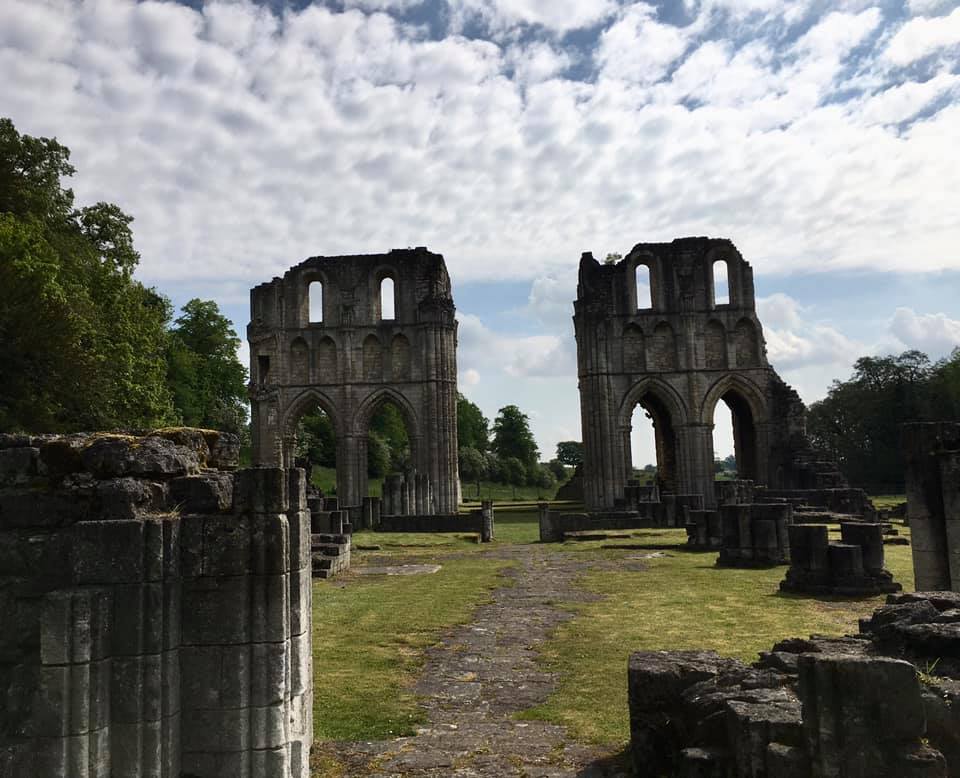
Thanks to a top tip from Julie Mellor, a seven-mile trip out this morning from Rotherham to Roche Abbey, established by the Cistercians in 1170 and dissolved in 1538, certainly did so for me.


But it also brought to mind Peter Levi’s magnificent long poem, ‘Ruined Abbeys’, poem no. 111 in his Collected Poems 1955–1975, Anvil, 1976:
Monastic limestone skeleton,
threadbare with simple love of life[,]
speak out your dead language of stone,
the wind’s hammer, the stone’s knife,
the sweet apple of solitude
And:
Ruins are like a strong body
growing its strength in country air
then breeding age until you see
nettles are waving in its hair,
the ruined body keeps its shape
by the mechanics of landscape:
fox in the gorse, wind in the tree,
raincloud, fellside, mystery:
what was born wild is never tame:
ten numbers never written down,
fellsides and abbeys are the same:
until time draws like a deduction
true proportions for their destruction.
The poem was written when Levi was still a Jesuit, and, like the best of his poetry, has a simple, likeable mysticism which bears his vast erudition lightly. I must get a copy of Brigid Allen’s biography of Levi, himself the biographer of Horace, Virgil, Shakespeare, Milton, Tennyson and Pasternak. 13 years ago, I spent a wonderful week at Heythrop College in Oxfordshire, which was formerly the UK headquarters of the Jesuits and where Levi trained for the priesthood. I was occupied, officially at least, by undertaking a Prince2 course, but my memories are mostly of exploring the extensive grounds, muntjac deer and all, and writing haiku in beautiful May sunshine. Among Levi’s many other books is The Frontiers of Paradise, 1987, subtitled ‘A Study of Monks and Monasteries’, which is a favourite of mine, not because I have, or ever have had, any leanings towards the monastic life, but because it’s a richly entertaining book, with many unexpected laughs.
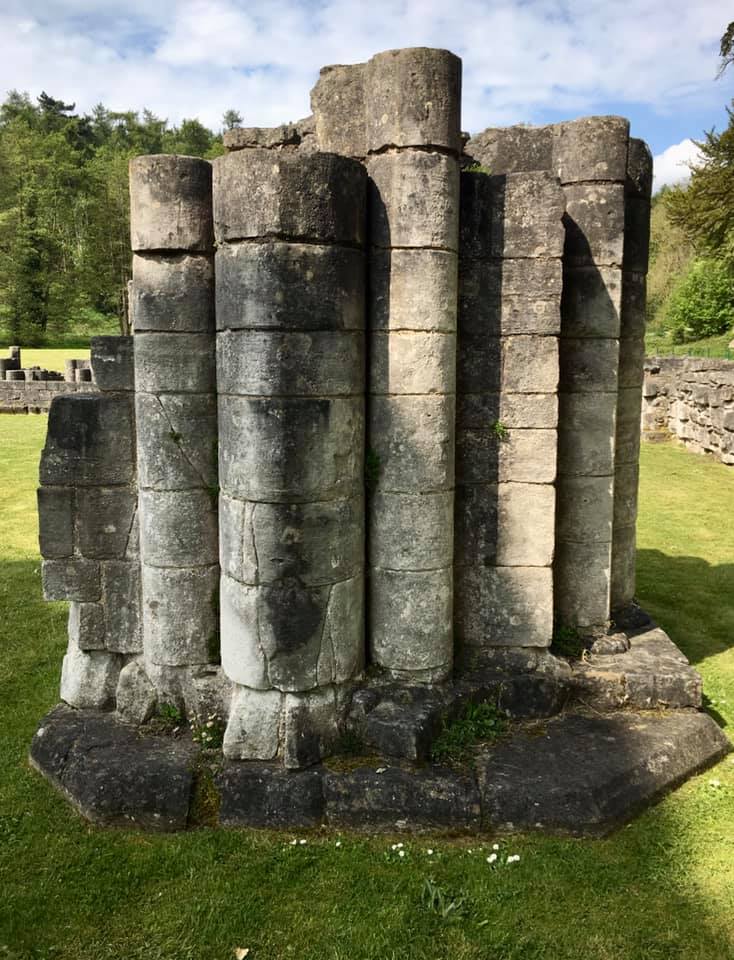
Roche sits snugly below the limestone promontory from which its name derives, and straddles Maltby Dike which provided water for washing and beer, presumably upstream of its use as a depository from the latrine. It’s a beautiful setting, as ruined abbeys almost always are. No wonder that Turner, Constable, Piper, Sutherland and others were drawn to paint them so often. On a day like today, when the sun has finally arrived to announce the start of summer, the scene at Roche looked very beautiful indeed. It reminded me very much of Waverley Abbey, near Farnham in Surrey, the Cistercians’ first abbey in England. There, I wrote this haiku, published in Presence no. 54 and undoubtedly echoing Levi subconsciously:
ruined abbey:
the dark mullein’s yellows
light the transept
I wrote some more haiku this morning. It would have been rude not to, since they’re such inspiring places.
-
OPOI review of Matthew Hollis
My latest OPOI (‘one point of interest’) review, of a pamphlet by Matthew Hollis, is on the Sphinx website here. As ever, there are lots of other, fine reviews to read.
-
On Rebecca and J.A. Baker
Among the many pleasures of watching Hitchcock’s 1940 rather-less-than-faithful but compelling adaptation of Rebecca is the array of acting talent; the Oscar-nominated trio of Olivier, Joan Fontaine and the unforgettable Judith Anderson as Mrs Danvers, with her amazing range of faraway, disturbing looks; and also the supporting cast of British talent: brilliantly caustic George Sanders; Mexico-born Nigel Bruce, doing his usual buffoonish turn, memorably in caveman fancy-dress, and Gladys Cooper, born in Hither Green, as Major and Mrs Lacy; Hitchcock regular Leo G. Carroll; and founder of the Hollywood Cricket Club, C. Aubrey Smith.
Before taking up acting, Smith had a successful career as a ‘gentleman’ cricketer, for Cambridge, Sussex and England – in one test, in which he took seven wickets, and as captain on a tour of South Africa before they’d been ascribed test-playing status. His obituary in the 1949 edition of Wisden includes the following:
Over six feet tall, he made an unusual run-up to deliver the ball and so became known as “Round The Corner” Smith. Sometimes he started from a deep mid-off position, at others from behind the umpire, and, as described by W.G. Grace, “it is rather startling when he suddenly appears at the bowling crease”.
Both Anderson and Cooper became dames. At the start of the 1970s, Anderson, then aged 73, toured America as the Prince in Hamlet.
Sanders’s life took in all sorts: birth in St Petersburg 11 years before the Revolution, a Best Supporting Oscar for his role in All About Eve, similar brilliance in a strange and chilling adaptation of The Picture of Dorian Gray, the unmistakable drawling voice of Shere Khan in Disney’s Jungle Book, Mr Freeze in the 1960s Batman TV series, and multiple marriages (including Zsa Zsa Gabor, her sister Magda, and Ronald Colman’s widow), and death by barbiturate overdose, with three suicide notes, in a village near Barcelona in 1972. Javier Marías has written about him at length.
I should add that the score by Franz Waxman, one of many great film composers who was a refugee from Nazi Germany, is a precursor of the knob-twiddling weirdness of 60s and 70s cult classics; and that the cinematography of George Barnes, especially the way the camera dwells on the shadows of the flames as Manderley burns, augments the intense atmosphere of the film.
*
Last week, I read Hetty Saunders’s My House of Sky, an intriguing, excellent biography of the short, sad life of J.A. Baker, which relies heavily on her own archival work and that of one of the founders of New Networks for Nature, John Fanshawe. The two books – the only two he published – for which Baker is remembered, The Peregrine and The Hill of Summer, are the most poetic prose books I’ve ever read, chocker with outlandish similes and metaphors, to the extent that I can only read them very slowly. They’re shot through with a deep melancholy born of his loveless start in life as an only child and then a late-teens breakdown induced by the horrors of German bombing in his home town of Chelmsford. It’s a pity that no footage or tape has survived of the television and radio appearances he made during his few years of relative fame following the publication of The Peregrine in 1967. Perhaps one will turn up in someone’s loft one day.
Here is an extract from Chapter Two (‘May: A Storm’*) of The Hill of Summer to illustrate his remarkable, unsurpassed nature-writing style:
A garden warbler sings in the caves of the darkness under the misty birches, sings endlessly over the arches of bramble. Through the hiss and roar of the rain that bows above the trees, the bird pours out his pure breath of song. It flows unbrokenly, loud and mellow and far-echoing. He sings in the shining green bubble of his own world. The whole wood is an exultant respiration of storm-driven wind and rain. It is like being inside the hollow bones of an immense bird, listening to the sudden inrush of air and the measured heart-beat of huge wings.
Curiously, the few poems by Baker which Saunders includes in her biography of him are
overblown to a degree which, whilst it works beautifully in his prose, becomes too much when set out as verse. Baker was a great fan of poetry, especially of Dylan Thomas, Housman (thus the title of his second book) and Hughes (unsurprisingly). It would still be fascinating to read an edition of his collected poems.
Over on her website, Kathy Pimlott describes how she can’t stop wanting to tinker with poems, even after they’ve been accepted for publication in a collection. That’s a compulsion I share. I often can’t tell whether I should just leave a poem alone or needlessly search for perfection. I know full well that including prosaic phrases among the more poetic ones serves to provide a background against which the high-register language can shine, and that even the greatest poets wrote dull lines occasionally; but even so, the urge to revise is overwhelming. It can be a curse. It’s interesting to note that the response – from critics and readers alike – to Baker’s The Hill of Summer was much more muted than the outpouring of praise which he received for The Peregrine, and, though some of that is due to the less compelling sense of narrative in the former, I believe it’s also attributable to the almost tangible degree to which Baker was trying to make every single phrase and sentence sparkle. Without the shade, the light becomes blinding. I realise that’s blindingly obvious, but it’s good to remind oneself of that every now and then.
* Coincidentally, as I typed this, thunder sounded outside on this May evening.
-
Australia Haiku Society’s John Bird Dreaming Award
Much to my amazement, one of a few haiku I sent for the Australian Haiku Society’s inaugural John Bird Dreaming Award for Haiku has been placed second. My thanks to the judges, Vanessa Proctor and Michael Dylan Welch, and to Ron Moss for his haiga.
-
On Martin Lucas
Seven years ago today, at about this time of day, I received a phone call confirming the passing of Martin Lucas, haiku and tanka poet and editor.
Here are a few of Martin’s haiku, selected from the first and final (#12) issues of Snapshots haiku magazine, edited, respectively, by John Barlow in 1998 and John and Matt Morden in 2006. For me, they display Martin’s observational brilliance, wry humour and ability to present each ‘haiku moment’ in spare, just-so language. Due to the manner of Martin’s passing, the final haiku has a particular resonance.
the play of light
along the slow canal—
cygnets preening
*
flag at half-mast—
summer breeze
big enough to flutter it
*
autumn evening
a cardboard box
walks down the hill
*
October dawn
the flicker of lights
at the river mouth
-
On moving to Rotherham
It’s nearly three weeks now since Lyn and I moved from Thames Ditton to Rotherham. Since then, it’s been jolly cold, as it seems to have been everywhere in the UK, and full Lockdown in England has been in place until today, when anyone who’s hard(y) and/or desperate enough can go and drink outside (but not inside) a pub. Fortunately, barbers and hairdressers can also now open, which means I no longer have any excuse for looking like a member of the Hair Bear Bunch.
What that all means is that we’ve not been out of the house much. We’ve found a lovely woodland, which contains evidence of human life going back to the Bronze Age. Curiously, it was whilst walking round it last weekend that we bumped into our new neighbours, who are very nice and kind.
I’ve tried several different running routes, chosen by looking at my copy of the A to Z of Sheffield and Rotherham, but what that publication doesn’t show, of course, is the contours of the land. There are no flat roads or paths anyway around here – you’re either climbing a very steep gradient, which I confess I quite like, or going down one, which I don’t like, because I always fear that I might get shin splints unless I put the brakes on. My thighs and ankles have never taken so much punishment in such a short space of time. I’m beginning to sound like the Hunchback of Rother Hame, bellowing ‘The hills, the hills’ to anyone who’ll listen.
I’ve been pondering the socioeconomic differences between Thames Ditton and Rotherham. The tables below, of ONS data for 2016–2018, relate to the local authority areas in which the two places are situated:Female Male Elmbridge 22.6 20.5 Rotherham 20.2 17.9 Table 2: Further life expectancy from age 65 onwards I can’t be alone in thinking that such marked differences are scandalous. Of the 317 Tier 1 and Tier 2 local authority areas in England in 2019, Rotherham was the 50th most deprived and Elmbridge the 310th. Is anyone foolish enough to believe that our present government truly cares about addressing such inequalities as these? Opinion polls suggest that they are, which makes me very sad. Not that the last Labour government, 1997–2010, did much to ‘level up’, in today’s parlance, either.
The books I’ve read prior to, and since, our move include: the Collected Poems of Moya Cannon, the simplicity of which have an accumulative power and brilliance; Scouse Mouse, the last volume of George Melly’s memoirs, which is packed full of details and entertaining incidents from his childhood in 1930s Liverpool; and Lydia Kennaway’s superb pamphlet of poems, A History of Walking.
I’ve written nothing new of note for several months now. I suppose that’s to be expected given the move. Yesterday, I did my first reading this year, as part of the Red Door Poets events. It seemed to go well, though apparently the Wi-Fi kept making my voice dip out. Whilst it’s great that online readings (and workshops) can attract people from anyone on the planet, it will be lovely to return to in-person readings – Covid permitting, of course.
-
OPOI reviews of Steve Ely, Daniel Fraser and Cliff Yates
Three more of my OPOI reviews have been published on Sphinx, of excellent pamphlets by: Steve Ely, Daniel Fraser and Cliff Yates.
-
Words for The Wild
I’ve long admired the Words for the Wild website, not just for the writing it features but also how stylishly it does so. I’m very happy, then, to have a poem of mine, ‘Swallowing the Toad’ (which, before you start sniggering, isn’t a euphemism) from The Evening Entertainment, on there as part of the Gilbert White feature. It includes some amazing photos of toads and a recording I made the other day of me reading the poem. As with my poems on The High Window the other day, I’m lucky and glad to be in fine company.
From my parents, I inherited a copy of both White’s Natural History of Selborne and Richard Mabey’s biography of him. Lyn and I visited White’s house in Selborne a couple of years ago. It’s well worth a visit. It’s curious, though, because half the house is given over to a display about Lawrence Oates, he of “I am just going outside and may be some time” fame. What I remember more than anything of the display was that when Oates had been posted with the Army to India, he’d taken with him his pack of hounds, but I digress.
-
On Edward Burra
Nowadays, the words ‘great’ and ‘greatest’ are bandied around with egregious abandon, but a strong claim can be made for averring that Edward Burra (1905–1976) was the greatest British painter of the Twentieth Century. Certainly he was, as Jonathan Meades described him in a Radio 4 Great Lives programme, “the greatest watercolourist imaginable”.
In a career spanning more than fifty years, Burra pursued his own path, through many different phases, despite the major disadvantage of poor health throughout: from a young age, he suffered from a severe form of rheumatoid arthritis and then hereditary anaemia, which tired him out quickly, thus his propensity for watercolour over the more labour-intensive oils. In later years, it was discovered that he had an enlarged spleen which caused him further, intense pain. Crucially, these conditions seem to have dampened his (gay or bisexual) libido into nothing further than looking and longing, and one can’t help but speculate that his art contains the subjugation of his sex drive.

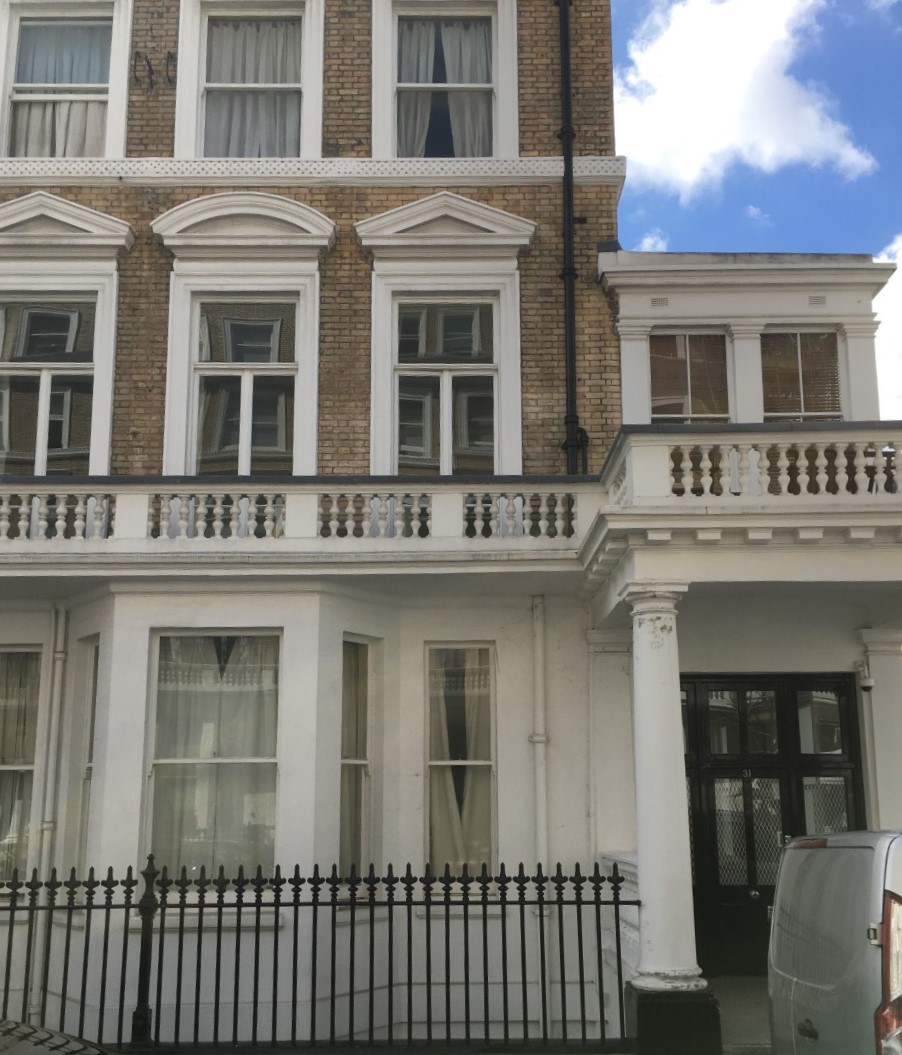
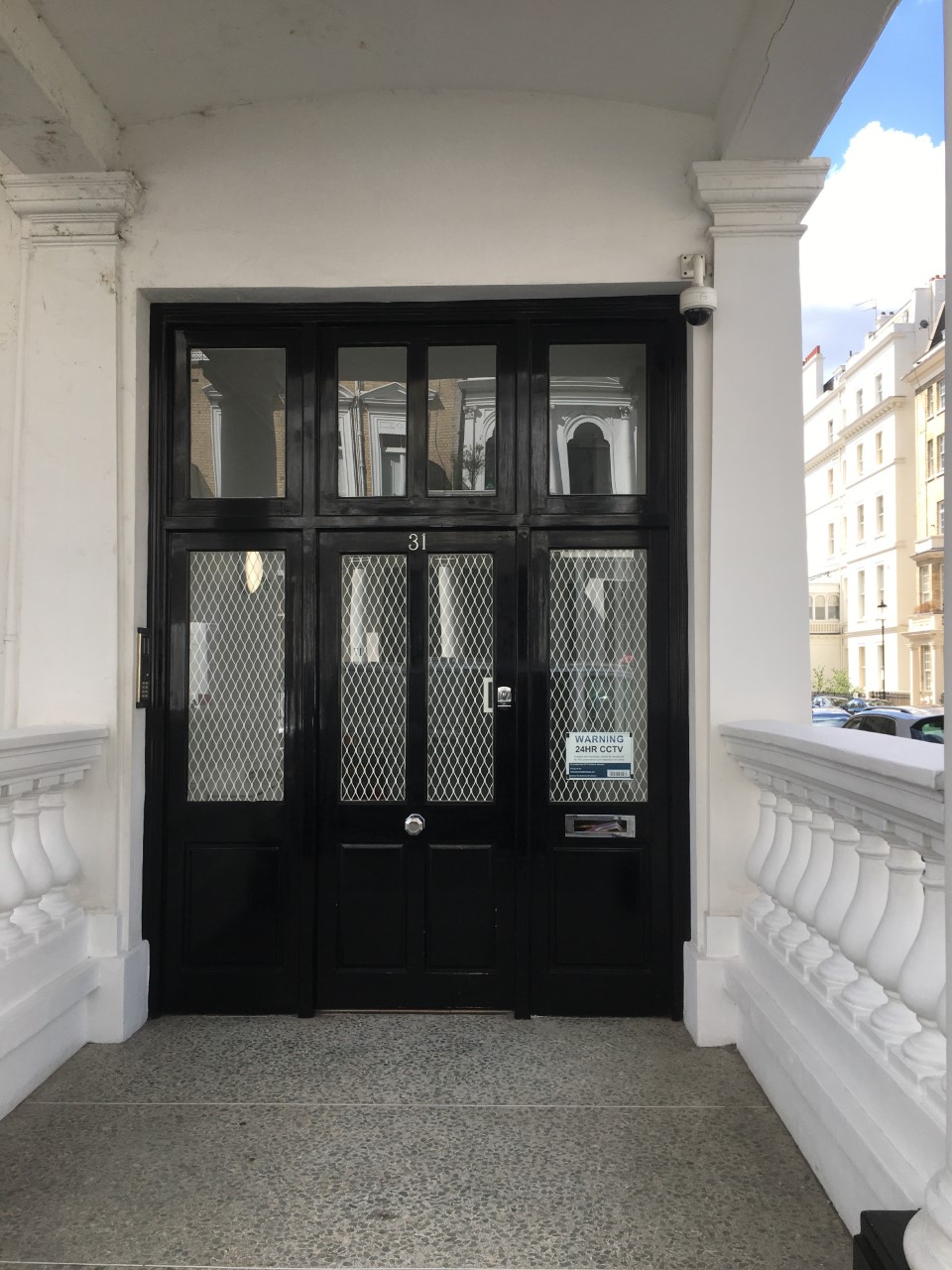
Born at his maternal grandmother’s house, 31 Elvaston Place (above), in South Kensington, he lived much of his life in his well-to-do family home, Springfield Lodge, in Playden, just to the north of Rye. Although he was sent to a boarding prep. school, he – or rather his rheumatism-addled body – baulked at the thought of the Eton entrance exam and his parents, to their credit, enabled him to be home educated. As his copious and brilliantly droll, gossipy letters attest, his grasp of spelling and grammar was atrocious; nevertheless, he was extraordinarily well-read and became fluent in French and Spanish.

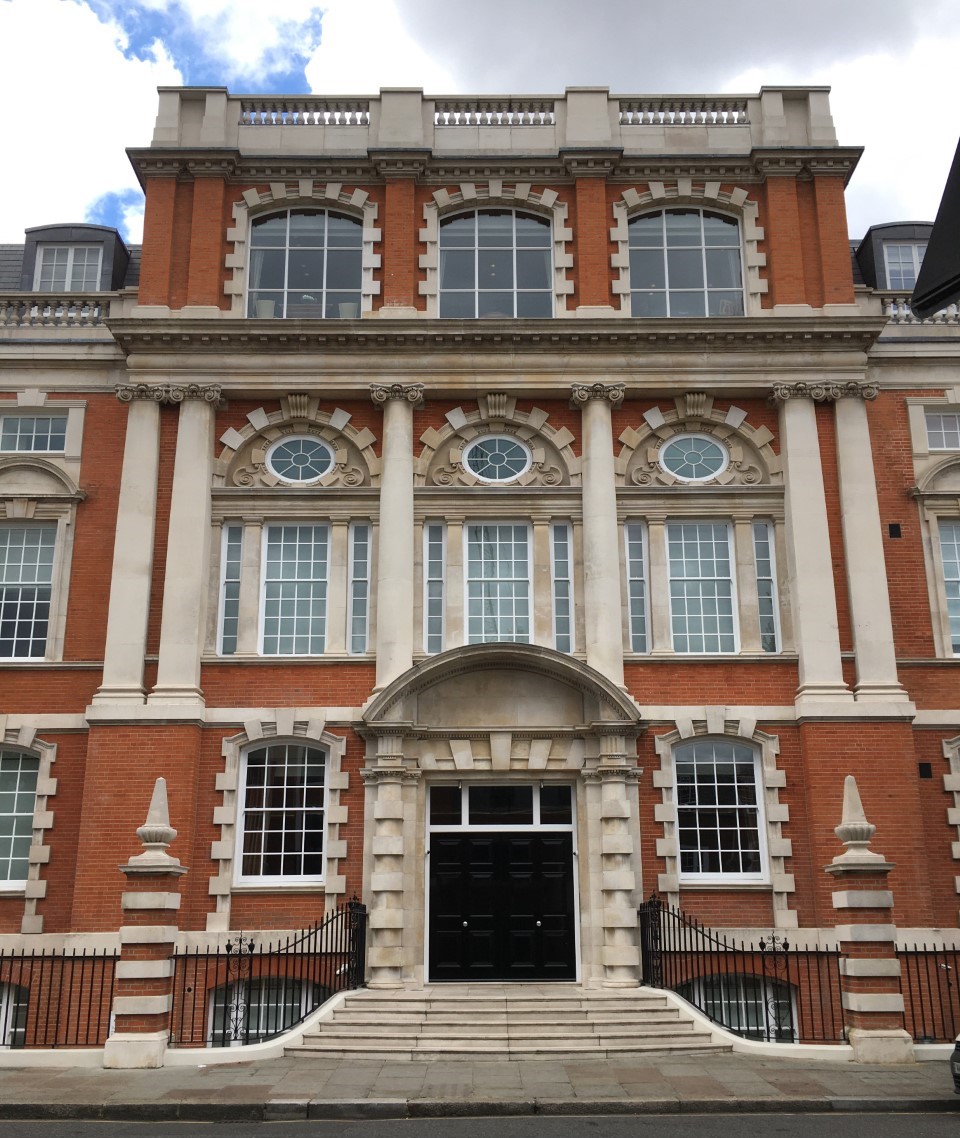
At the age of not quite 16, he enrolled at Chelsea Polytechnic (above), in Manresa Road, and there learnt the basic of what was called ‘commercial art’, as opposed to the more classical theory of, say, the Slade, and progressed to the Royal College of Art, where there was little they could actually teach him, such was his ability by then. At Chelsea and the Royal College he met and became lifelong friends with a core group – among them, the later-to-be ballet dancer and choreographer Billy Chappell, Barbara Key-Seymer, who became a brilliant photographer, and Clover Pritchard, who was just brilliant full-stop. Due to his condition, Burra was inevitably more of a brilliant observer than a participant. Chappell, in Well Dearie (1985), his selection of Burra’s letters, noted how Burra’s talent flourished:
His great gifts were obvious. Still in his teens he drew like an angel with a strength and purity of line more than exceptional. The years at Art School nourished and developed his obsessive interests. His absorption with the fantastic, the grotesque and the absurd, and always with visual truth[.]
The quartet of friends established themselves within the wider socialite circles of the ‘Bright Young Things’ who lived for the wild parties fictionalised in Evelyn Waugh’s 1930 novel Vile Bodies. As Chappell said:
Edward and his friends were scrambling out of adolescence into a world of high, and excessively perverse, sophistication. How tempting and dangerous, beautiful and wicked, gloriously anarchic and strange, Life appeared. Sexual ambiguity was the rule. Sexual promiscuity and sexual aberration the mode. Had Edward known quite ordinary strength and health there is little doubt he would have become extremely wild. Wilder than any of them.
After college, Burra returned to Springfield, where he produced gloriously colourful and louche figurative paintings, much against the grain of the prevailing trends, and always from memory, without preparatory sketches. He made frequent trips up to London to see his friends and then, from the late Twenties afterwards, popped out, without telling his family as they would only have fussed, to places further afield: the fleshpots of Marseilles and Toulon; New York, more precisely Harlem, where he recorded street scenes and nightlife with an appreciation which few White artists of the time accorded; Spain, just before the Civil War; and Mexico. All those places inspired his art, or ‘fart’ as he offhandedly called it – though he had a deep knowledge of the canon of Western art.Burra’s friend Paul Nash roped him into Unit One and the Surrealists, but he wasn’t an artist who could easily be pigeon-holed and he wasn’t a natural joiner – he rarely even attended his own exhibitions and apparently cared little for his paintings once they were out of the door. In an age of artistic movements, his recurrent refusal to be easily categorised did him no favours, and still today means that his name is far less known than other, much less technically gifted painters like Nash. That’s not to say that he’s unknown; far from it: among the super-rich cognoscenti, his most prized works sell for millions.
In many of his paintings, there is an underlying and disconcerting oddness, born, perhaps, of not having been expected to live long and of the trauma of seeing Betsy, the beloved youngest of his two sisters, die a long and feverish death from meningitis at the age of 12. That oddness often took on a more sinister appearance; as Meades says, “He makes everything look threatening”. But that is an over-statement, as Burra’s paintings are also very often trenchantly amusing and full of small details containing intriguing sub-narratives. The people in his paintings are almost always frozen in the act of doing something, from the seeming mundanity of drinking tea or biting a ham roll, to flirtation, striptease or fortune-telling.
Burra’s friendships with Chappell and Frederick Ashton, and involvement in the world of ballet in general, led to his designing sets and costumes for numerous productions in which his work was frequently cited as the best feature.
Ahead of his time, from the late Forties onwards he became a prolific recorder of British, mostly English, landscapes, and their degradation by road building. His sister Anne, who took on the principal role as general carer for him once their parents reached their dotage, would drive him all over the country, the wilder the terrain the better – as his biographer Jane Stevenson observed, “He loved the bare landscapes of England”. One could easily make a case for him being a proto-environmentalist.
Ultimately, it is the rich range of Burra’s work which sustains his reputation – and its manifestation of a well-travelled, outward-looking Englishness which our current political leaders seem only too keen to suppress. At times, there are hints in his art of the influence of predecessors and contemporaries, such as Arcimboldo, de Chirico, Dalí, Dix, Goya, Grosz, Ozenfant and Posada; yet none of them are especially key influences, and his vision was resolutely, and almost always instantly recognisable as, his own. His paintings are so full of zest and unspoken, hinted-at stories that they trigger memories and thoughts of my own which have, I hope, a similar outlook and characterisation. I can identify with his contradictory love of life and misanthropy. He is a heroic figure, who, though blessed with a wealthy background, overcame a disability which would surely have defeated other souls. He threw what energy he had into his paintings (and his letter-writing), with a controlled, thought-through looseness to which all great art surely aspires.
That Burra lived most of his life in the part of the world from whence my Paul grandparents’ forebears hailed adds to my sense of connection with him. My paternal and idiosyncratic grandfather, Walter RH Paul (1903–1989), from Eastbourne, thirty miles west of Rye, undertook teacher training at the College of St Mark a mile away up the Kings Road from where Burra was honing his craft at Chelsea Polytechnic. I like to imagine they may have bumped into each other occasionally, but who knows.
If you are unfamiliar with Burra’s art, you’re missing out. Seek it out.
All of this is a long preamble to the fact that, last summer, I wrote several poems inspired by Burra paintings. Many ekphrastic poems seem to me to be simply a rendering into words of the scene depicted in the artwork. I tend to use them, as I always did on Pascale Petit’s now legendary Poetry from Art sessions at Tate, as springboards to explore my own tangents. That’s the case with both my published poems after Burra: ‘The Nitpickers’, and ‘Blue Baby: Blitz Over Britain’. The latter is one of three poems of mine published in the spring issue of The High Window today.
-
Sheepleas
around the headstone
of one who died at twenty:
wind-puffed primroses
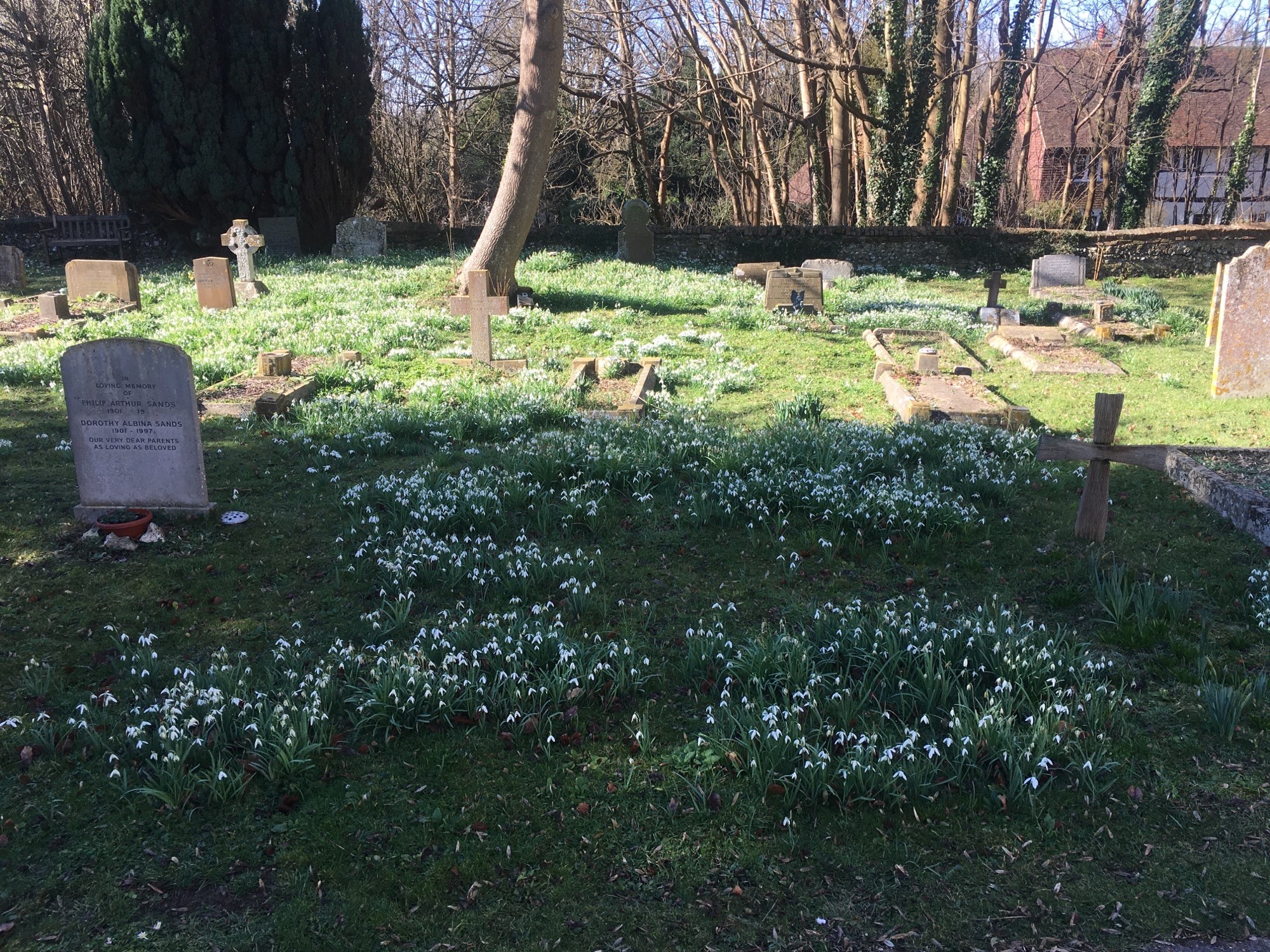
This haiku of mine, published in Presence 56, resulted from a trip a couple of late-Februarys ago to Sheepleas, a nature reserve maintained by Surrey Wildlife Trust between West Horsley and East Horsley. The easiest access to Sheepleas is via the track beside St Mary’s church, the history of which reflects many of the most significant events in English history from Norman until Victorian times. Its graveyard is rather beautiful, as even my photo (from a subsequent, early-February visit) below shows.
Much has been written about haiku as a concept and how it is practised in English – and whether, indeed, what we know of as haiku in English can really be called haiku at all, given the cultural freight attached to the original Japanese form, which itself emerged from another form. That debate has often centred on whether or not a sound-unit in Japanese is equivalent to a syllable in English and, according to the two extreme views, that the 5–7–5 ‘syllabic’ count in Japanese should either be strictly followed or strictly avoided. Personally, I’ve always been happy to let content determine syllable count in my own ‘haiku’, rather than being insistent on a particular count. That said, I’ve often found 4–6–4 and 4–5–5 to be forms into which the sound properties of English words can be naturally expressed. In the haiku above, though, the words which I formed in my head and then wrote in my notebook on a chilly Saturday morning emerged, without any conscious thought, as 5–7–5.
In his magnum opus Flora Britannica (Sinclair-Stevenson, 1996), Richard Mabey, the doyen of British nature writing who’s just turned 80, reminds us that the word ‘primrose’ derives from ‘prima rosa’, i.e. that it – Primula vulgaris – is the first flower of spring. As he does with many different flowers in the book, Mabey documents the folklore and customs surrounding the primrose, much of which comes from submissions made by amateur botanists and flower-enthusiasts. He also cites the following:
A more formal celebration is Primrose Day on 19 April, when primrose flowers are placed on Disraeli’s statue in front of Westminster Abbey (and also on his grave at Hughenden in Buckinghamshire). They were the politician’s favourite flower, and Queen Victoria regularly sent him bunches from Windsor and Osborne. After his death, the botanist George Birdwood suggested inaugurating a ‘Primrose Day’ and the custom has been kept up ever since.
Such different times!
In my poem, I went for ‘first thought, best thought’ in describing the impact of the wind on the flowers. Sometimes, one can over-complicate a haiku by thinking too much about whether an adjective (or a verb) is the best fit. In this instance, it was definitely a case of following Roy Walker’s advice. But in one of those nice incidences of synchronicity (or deeply-buried unconscious association), a beautifully illustrated book, Shakespeare’s Flowers by Jessica Kerr (Longman, 1969), which I bought in Warwick on a visit there with John Barlow about 10 years ago, has jogged my memory of a famous quotation from Act 1, Scene iii of Hamlet: ‘Whiles, like a puff’d and reckless libertine, / Himself the primrose path of dalliance / treads.’ Despite having studied Hamlet in depth several times in days gone by, I can’t claim that the allusion in my poem was deliberate. Pleasingly, the book lists several other mentions of the primrose in Shakespeare’s oeuvre, including the Porter’s line in Act 2, Scene iii of Macbeth, about ‘the primrose / way to the everlasting bon-fire.’ In The Two Noble Kinsmen, listed as a joint work between Shakespeare and John Fletcher, the primrose is described as ‘first-born child of Ver / Merry spring-time’s harbinger.’
In early spring, another member of the primrose family grows abundantly at Sheepleas: the cowslip, Primula veris, to the extent that a large field in the reserve is known by the lovely name of Cowslip Meadow.
-
One Hand Clapping
I’m very pleased to have a poem, here, as part of the latest issue of the excellent One Hand Clapping journal, and in some august company too. Given the pay-off of my poem, it seems very appropriate that this is where the poem should have found its home.
-
On coincidence
At Christmas 2019, I, and then Lyn, had a hideous virus the symptoms of which were exactly the same as the classic symptoms of Covid-19, including loss of taste and smell. Whether or not we, like many others who seem to have had Covid symptoms a couple of months before it was supposedly first detected in the UK, it’s very unusual for me to be ill – I’d not had a virus or flu or anything like that for 20 years or more before then.
What I remember most is that I was really feverish for a few days and for some reason the name of the ‘Avant Garde’ composer Cornelius Cardew popped into my head. I looked his details up and found that he died in the early hours of 13 December, 1981, a victim of a hit-and-run on Leyton high road, on the humpback bridge next to Leyton Tube station. Conspiracy theorists claimed that his politics made his death suspicious. One can’t really blame anyone for thinking that, given that it was round about the same time that Hilda Murrell was bumped off (though a local man was subsequently convicted for her murder).
At the time of my illness, I’d just started reading an Amy Clampitt collection What the Light Was like, published by Faber in 1986, and, immediately after looking up Cardew on my phone, I opened the book on her elegiac poem ‘A Curfew’, about the day that her brother Richard, a doctor, died, at the age of 56. The poem is subtitled ‘December 13, 1981’. The billions-to-one coincidence was increased by the fact that ‘fever’ occurs three times in the poem, including as its opening word.
Anyhow, Clampitt was a fine poet, as the selection of poems on this website to her memory shows. I especially like, as I did when I read it in my feverishness, ‘The August Darks’, about the Maine coast, with its nice quotation from Middlemarch at the end and its overall tone reminiscent of Bishop and (Robert) Lowell.
-
January Reading
Work’s been madly busy, so I’ve had little time for reading, but what I have read, usually at bedtime, has been tremendous. First, I worked my way through Arnold Bennett’s Journals, covering the years from 1896, shortly after his 29th birthday, to September 1929, two years before his premature death. They give periodic insights into his theory of writing but rather more about the practice; he would rise early and knock out a couple of thousand words before spending the rest of the day socialising, letter-writing, napping and socialising again over dinner. He would, it seems, work out a novel’s plot and characters on long walks. What I hadn’t quite realised before was that, like other great writers whose books of specific place have a universal quality to them, he was extraordinarily urbane, the George Sanders of English literature perhaps, and lived and worked in Paris, then, after his late marriage (to a Frenchwoman), Fontainebleau. Fluent in French, he was arguably more steeped in the French canon than the English, more in Zola than Dickens, and kept up with the latest French literature. He knew Gide well, and indeed crops up in Gide’s Journals 1889–1949 far more than Gide does in his.
He returned to England in 1912, to a large 18th Century house, ‘Comarques’, in Thorpe-le-Soken, a few miles inland from Clacton and Frinton. By then he was famous and his books sold in vast quantities, matched only by those of his close contemporary and friend, H.G. Wells, with whom he stayed on many occasions. Although he knew and dined with many of the best-known writers, artists, politicians and other celebrities of his age – among them Woolf and DH Lawrence (with neither of whom he seemed to get on, whilst acknowledging the individual genius of each), Barrie, Conrad, Ford Madox Ford, Sickert, Asquith Churchill, Kitchener, Beaverbrook, who appointed Bennett as Director of Intelligence in France towards the end of the Great War, and many others – he remained true to his roots in Burslem and returned often.
Bennett was well aware that his readership wanted more novels like his most popular – Anna of the Five Towns, The Card, Clayhanger, The Old Wives’ Tale, etc. – but he pursued his own path rather than do as John Galsworthy, another of his close contemporaries, did and churn out a saga, even though Galsworthy went to get the Nobel in the days when the awarding was apparently random.
At the end of each year, Bennett would record the year’s productivity; on New Year’s Eve, 1908, for example:I have never worked so hard as this year, and I have not earned less for several years. But I have done fewer sillier things than usual.
I wrote Buried Alive, three quarters of The Old Wives’ Tale, What the Public Wants, The Human Machine, Literary Taste: How to Form it; about half a dozen short stories, including ‘A Matador in the Five Towns’; over sixty newspaper articles.
Total words, 423,500.
How he didn’t get RSI, I don’t know. And that was before he decided to start writing plays too, at which he was also phenomenally successful.In 1907, he turned his mind to another literary form:
Lately I have been thinking more and more of writing verse. And now I seem to be getting hold of ideas as to the sort of verse I am likely to write, something individual and unlike anything else.
(14 February)
Last night I had the itch to write more verse. I had the itch without the subject. I wanted to do something short. I thought of the effect of gaslamps on the promenade as a subject.
(16 March)
I wrote about ten more lines of my poem, and these took me pretty nearly all day. At this rate I should say it is just about as expensive for me to write poetry as it would be for me to keep a motor-car, or a yacht.
(18 March)
All day I worked at my poem, and I finished it and called it ‘The Lamp’. At the end of thirty-seven days, it has taken me two and a half days, and I probably shan’t make a cent out of it.
(19 March)
What become of his poems, I’m not sure.
It’s high time Bennett was widely read again. His novels are so much more interesting and entertaining and insightful than those of, say, Galsworthy who was given a Nobel in the days when they were allocated on what now seems like a random basis.*
Philip Hoare is another writer whom I admire. His Risingtidefallingstar (2017) is Sebaldian in many ways: its episodic mixture of what appears to be autobiography – though Hoare doesn’t, fictionalise it like Sebald did – and potted accounts of incidents from the lives of literary and other figures of historical importance. Risingtidefallingstar includes chapters on gay and bisexual writers – Wilde and Stephen Tennant (about both of whom he has previously written at length), Wilfred Owen (about whose life I hitherto knew little bar the Craiglockhart interlude and the agonising futility of his death so close to the Armistice) and Virginia Woolf. But Hoare also recounts biographical details from the lives of others intimately connected with water: Melville, Nelson, Thoreau, Elizabeth Barrett Browning, Shelley and Byron.
I know its details well, but the story of Shelley’s end resounds with me whenever I read it. In June 2017, Lyn and I honeymooned in Viareggio, where Edward Trelawney, Byron and co. ceremonially burnt Shelley’s corpse on the beach, fifteen days after the fatal boat trip and five after the body had washed up. A year later, we took the train north from Pisa to La Spezia, and then a taxi, whose driver initially dropped us at the wrong place in Lerici, before dropping us at Casa Magni itself, where Shelley and his family and friends were staying when he died. Hoare’s account, like others I’ve read (including that of Richard Holmes), states that the house is in Lerici, but it’s actually couple of miles along the coast, in San Terenzo, with a lovely beach and bay of its own. When we arrived, we found the house, now a hotel, locked up and there was no answer when we rang the bell. After a while, we were admitted and shown to what was Shelley’s bedroom. For several days we were the only guests, and the staff were absent to the point of invisibility, as if it were our own house. When two other (English) guests appeared at breakfast, it felt like a gross intrusion.
As one would expect from someone who grew up and still lives in the great port city of Southampton, whence the Titanic began its voyage, the book is dominated by the coastline – e.g. the pretext for Barrett Browning’s inclusion is her sojourn in Torquay – and oceans and the peril they bring. In that, it reminded me of Anne-Marie Fyfe’s equally restless mixture of memoir, biography and travelogue, No Far Shore, with which it shares some concerns. Followers of Hoare on Twitter will be well aware of his daily swim in the sea and how it’s an essential part of his life. As the cetacean-obsessed writer of Leviathan, he is, or would love to be, half-man–half-dolphin, meeting jellyfish and a singing whale. At New Networks for Nature a few years ago, Hoare enthralled me and the rest of the audience with his tales of close encounters with sperm whales off the coasts of the Azores. As I read his book, I heard and felt his enthusiasm and learning.
I especially enjoyed the part of the book charting his repeated stays with the artist Pat de Groot in Provincetown, Massachusetts, on a sometimes wild stretch of the Atlantic seaboard, and for a long time a bohemian haunt and LGBT resort, attracting many artists and writers, including Mary Oliver, Mark Doty, Stanley Kunitz, John Waters, Tennessee Williams, Hopper, de Kooning, Rothko, Motherwell and Kline.
Alex Preston’s perceptive review in the Guardian notes not only the influence of Sebald but that of Charles Sprawson, author of Haunts of the Black Masseur, which, along with JA Baker’s The Peregrine, is the most poetic English prose I’ve ever read. It also remarks on the influence of David Bowie, whom Hoare draws the reader back to throughout the book, curiously never named, but omnipresent, like a patron saint for this man brought up Catholic, whose paternal antecedents were Irish.
For me, the real beauty of the book lies in how Hoare weaves the details together, and finds strange coincidences and mirrorings, much in the way that Sebald did.
*I’ve also been enjoying the latest issues of Under the Radar, Poetry Salzburg Review and The North. On the rare days at work when I’ve snatched a lunch break, Derek Walcott’s The Arkansas Testament, with its poems of St Lucia and the magnificent frigatebird, crossing the sound to Pigeon Island, have been my companion.
-
OPOI review of N.S. Thompson’s Ghost Hands
Here’s my latest OPOI review for the ever-excellent Sphinx. There are some cracking reviews of what sound like cracking pamphlets on there at the moment, e.g. Ramona Herdman on Cliff Yates, Mat Riches on Martin Stannard, and plenty more besides, so fill your boots.
-
Snow Biz
When I start my weekly Sunday run, at 9.33, it’s just starting to snow. I presume, though, that it will be nothing more than the lightest, icing-sugar dusting. It hasn’t snowed properly in this corner of north-east Surrey / south-west London for about six years, but down it comes. To run through it is a full-on, sensory, exhilarating experience.
refilled as quickly as I make them footprints in the snow
I watch my footing and slow my pace: I’m sure that pitching up at A & E with a broken ankle would not endear me to the brave, fantastic folk at Kingston Hospital.
snow settles
on a small allotment:
the bean canes aslant
An hour and a half later, my feet are enjoying the creak through the gorgeous compactness of the snow. Victoria Park, in Surbiton, provides enough space for socially-distanced snowball fights. The pavements on Brighton Road are all but empty.the one-man band
strums to no one
swirling snow
At home at 11.07, my hands are numbed in my pink and black gloves. I have to warm them on the radiator by the front door before I can get them off and untie the laces on my drenched running shoes.
the only traffic
in endless snowflakes:
speedy foxBefore long, I’m happily re-heating in the bath, the bubbles echoing the snow.
even through the frosted glass snow light
2, 3: from The Lammas Lands
4: from The Regulars
-
Bloody politics
After this week, it’s hard to discuss anything but politics on some level: chiefly, that failed coup incited by the supposed Leader of the Free World and put down with considerably less lethal force and speed than last year’s Black Lives Matter protests were; but there’s barely any moral high ground here in England where our disgraceful government has presided over more than 80,000 deaths from Covid (and those are just the official figures) and pushed the NHS to the brink of collapse, and headteachers and so many others to despair. Meanwhile, Stanley ‘Acquiring French citizenship and vaccinated’ Johnson is all right Jack, as is Murdoch. Still plenty of idiots say or imply, ‘They’re doing their best’ – yes, to line their and their donor-friends’ pockets. Of course it’s impossible to take to the streets to protest during the Covid lockdowns. As Robert Lowell observed in 1964, ‘a savage servility / slides by on grease’. The only people who are out protesting here are the scarily gormless anti-vaxxers and Covid-deniers, with many of whom I had a seemingly endless Twitter spat back in August.
So it’s been appropriate for me that one of my poems published this week in #36 of Poetry Salzburg Review is (mildly) political: ‘The Ballad of Mike Yarwood’. Yarwood was the first variety act I ever saw in person, when I was five, at the Winter Gardens Theatre in Bournemouth, with Peters and Lee as the music act. At home and at junior school, we all loved Yarwood, and he ‘spawned the nation’s mimicry’ in playgrounds and workplaces alike. But having made a fortune from impersonating politicians and celebrities of different kinds, he became a Tory donor and cheerleader and drank himself off our screens. My poem’s ending sees him stuck in one of those hideous Apartheid communities for the absurdly rich which litter parts of the Home Counties and elsewhere, and which JG Ballard described so chillingly in Cocaine Nights and Super-Cannes.
I should add that one of my other two poems in Poetry Salzburg is ‘The Pigeon Fancier’s Daughter’, and had I known that Mat Riches was such a racing pigeon aficionado before I sent the poem off, I may well have dedicated it to him.