Before 2021 ends, there’s just time to note the passing of two fine poets.
Sylvia Kantaris, who died in November, was a poet whose name I’d long been aware of but whose poetry I hadn’t read until recently. I bought a copy of her 1985 collection The Sea at the Door in Nottingham in August and I’ve enjoyed many of its poems; for example, her colourful character study of her grandfather, ‘William Yates’, which opens thus:
Elbows stuck out like a Toby-jug,
thumbs in the belt strapped
under his stomach as if to hold it up,
Grandad stood between Margot Fonteyn
and us, and paused
before delivering the verdict:
‘Bloody bally!’
At one flick of the wrist
the swan gave up its ghost.
Grandad walked out
We knew he wasn’t really a poet.
Bloodaxe recently released a statement about her, containing a tribute to her by Philip Gross, which is available here.
*
I was sad to read that Kirsty Karkow had died, on Christmas Eve. She was a fine haiku and tanka poet. I had some correspondence with her twenty or so years ago and had been in online kukai groups with her in the late ’90s. She’d lived in Maine for many years but was born and educated in England. On Curtis Dunlap’s old ‘Blogging Along Tobacco Road’ blog, which was always a pleasurable read, you can still find Kirsty’s admirable contribution, here.
*
Finally, a thank you to everyone who’s read, liked, commented on, shared any of my posts this year. Happy New Year to you – here’s hoping it will be a happier year than 2021 has been.
Category: Uncategorized
-
On Sylvia Kantaris and Kirsty Karkow
-
On scarecrows
Last night, I watched the latest wonderful Worzel Gummidge story by Mackenzie Crook, the fifth he’s written, directed and starred in. As Andy Paciorek wrote in an essay in issue two, available here, of the excellent Waiting for You: a Detectorists zine, ‘The writing, casting, acting and the luscious Unthanks’ music [. . .] blend mellifluously to create a rare, special slice of television.’ Hooray, then, for another episode tonight.
The programme never fails to remind me that my paternal great-grandfather was a scarecrow. Yes, really. It was his first job after finishing what little formal education he received. My granddad wrote a bit about it in his memoirs, which I then used as the starting-point for my poem about it, which was published in The Evening Entertainment:
Scarecrow
Charles Paul, Aged Ten, 1872
St Swithun’s Day dawn. A goshawk
fossicks the fields of Combe Hill Farm.
All the crows and jackdaws have flown.
Charley drowses within the corn,
though woe betide if Master Buss,
the headman, should witness him so.
Charley can read and write; will soon
become a journeyman butcher
in Eastbourne, wed, like his parents,
at the Zoar Strict Baptist Chapel,
Lower Dicker, then propagate
roses and seven fine children.
Now, he scares a ten-hour day,
for a shilling sixpence per week,
swivelling the rat-a-tat clapper
over his head, like the Zulu
chieftains brandishing assegais
in Illustrated London News.
-
The arch Deakin
Another entry in the wonderful Notes from Walnut Tree Farm, on pp.228–9:
Obscurity is what a writer needs to get on with work well away from the public gaze. Under the glare of lights is the last place you want to be, so, moth-like, you burrow away into some basement or corner of the country, where you can talk to yourself, pace about and think. [. . .] Above all else, though, the writer needs not to think too much about what he’s [sic] doing. [. . .] I blame the Romantics for all this self-consciousness about landscape and inspiration. Wandering lonely as a cloud may be the last thing you need sometimes. Going round the corner for breakfast in a steamy café may be much more like it.
Although he lived alone, on the edge of a common in Suffolk, Deakin seems to have been a gregarious soul, as happy in the city as he was in the sticks, and content to find beauty in the smallest of things. Kathleen Jamie’s description, in this review, of his friend Robert Macfarlane as a ‘lone enraptured male’, seeking out wild(er)ness like a Victorian colonialist, fitted Deakin rather less easily despite the latter often (including by Jamie) being cited as Macfarlane’s ‘mentor’. Macfarlane made several appearances in Notes from Walnut Tree Farm, as did Ronald Blythe and Richard Mabey, but Deakin spent more prose on articulating how he would miss his postman, who was moving on, than any of them.
I’m glad to have found a radio programme by Deakin, canoeing down the Waveney, here.
Incidentally, I wonder if the days of steamy cafés, with Formica tables and squeezy plastic tomatoes full of ketchup, are all but gone forever. When I was about 20, my list of books I would never get round to writing included a guide to where you could get the best all-day veggie breakfasts in London – it would’ve been an intense labour of love.
-
Return to Hope
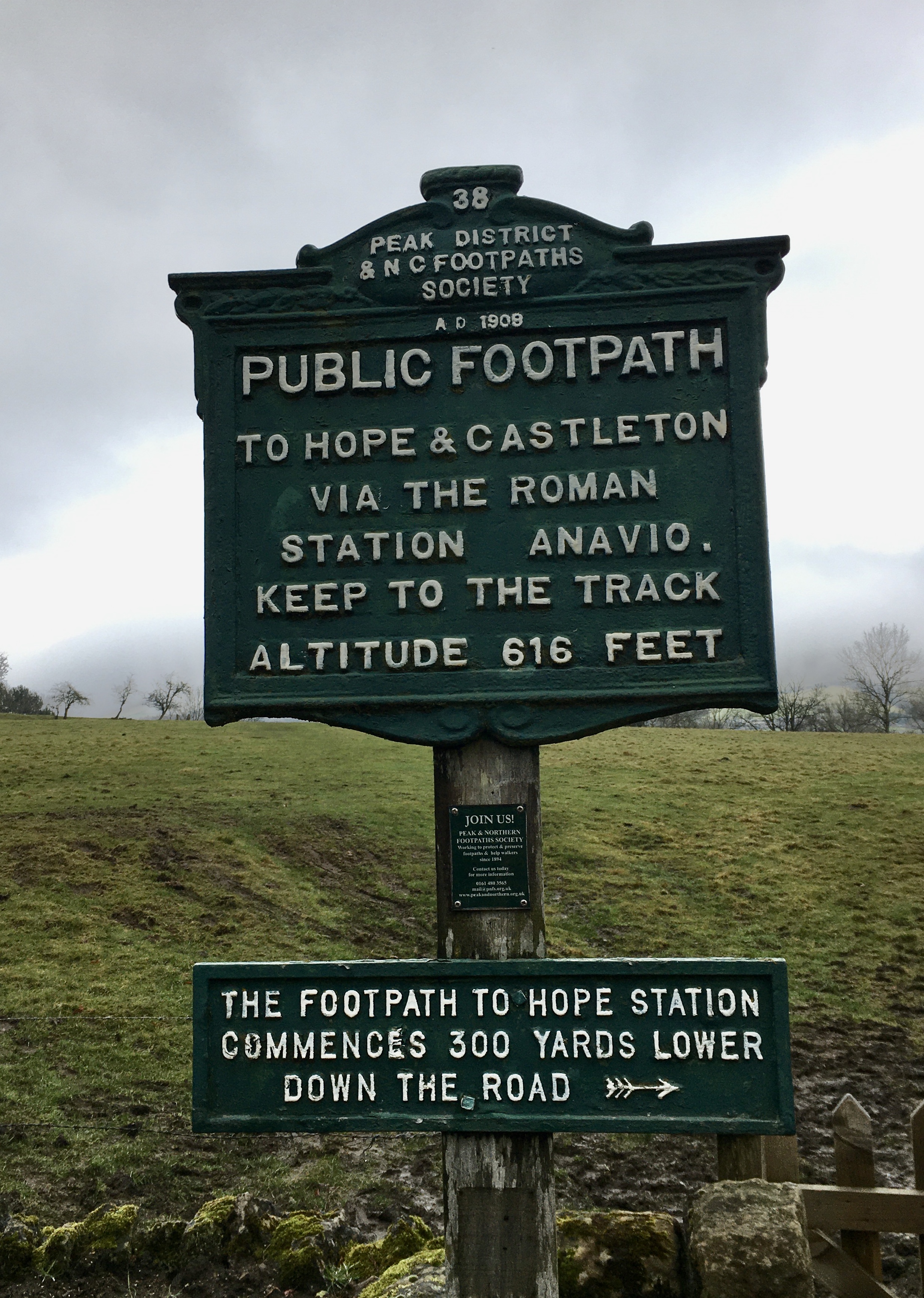
No, this isn’t inspired by Johnny Mathis blaring out at all hours, but my Christmas Eve trip out into the Peaks. I caught the Hope Valley line from Sheffield and walked along to Brough, with the intention of finding the site of the Roman fort Navio, before taking an anti-clockwise route up Win Hill.
Navio, first established around 80 CE, was strategically important for the Romans because it was the next fortress across middle England from Templeborough, remnants of which now stand in Clifton Park, Rotherham, just down the road from where I am now. In his Roman Britain (1955), the first volume of ‘The Pelican History of England’ (sic), I.A. Richmond outlined its economic importance also: ‘Yet another exploitation is the lead ore from stream deposits found in the Roman fort at Navio (Brough on Noe), from which the district was in part policed.’ Lead was invaluable to the Romans as a source of silver by the process of cupellation, and no doubt a major reason why they hung around in this distant island for as long as they did.There are all but the slightest traces of the fort on the site. Buxton Museum contains the artefacts recovered from it. It must’ve been a bleak place to be stationed, even with the view across the River Noe towards Lose Hill, and Mam Tor to the west. Auden’s couplet sonnet ‘Roman Wall Blues’, with its memorable opening, comes to mind:
Over the heather the wet wind blows,
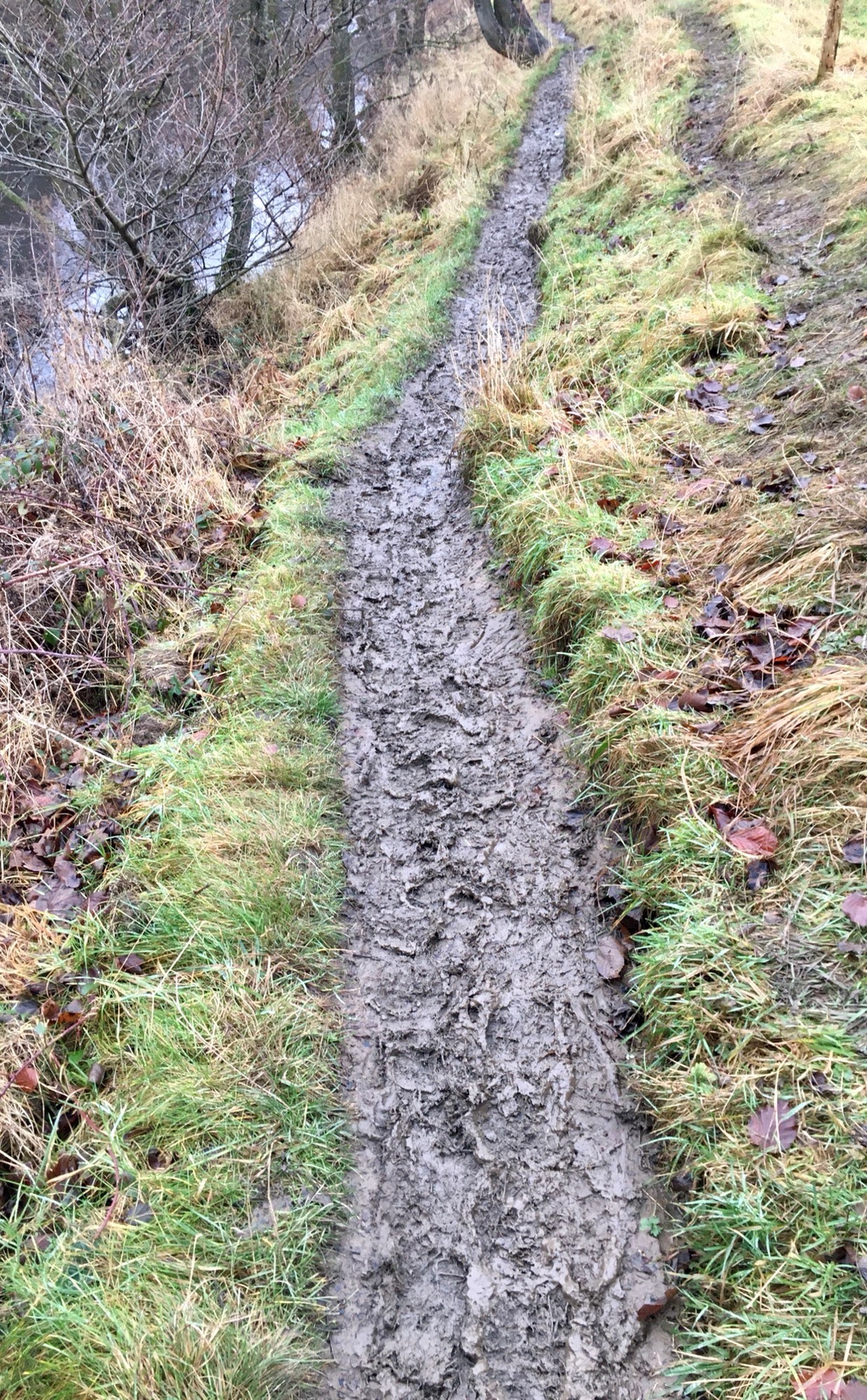
I’ve lice in my tunic and a cold in my nose.I didn’t go up Win Hill though, for two reasons: firstly, its summit, Win Hill Pike, was wrapped in low cloud; and secondly, my eye was drawn to a path which led from the road-bridge at Brough along the Noe to where it rushes in to the Derwent at the delightfully-named Shatton; and then by the path which followed the south bank of the Derwent to just south of Hathersage. On paper it looked an easy walk, and for two miles or so it was, until the path got muddier and muddier and so squelchy and slippery that my pace was considerably slower than the river’s.
It’s a wonder that I only fell over the once, and, moreover, that I didn’t slip down the steep bank into the river. As an exercise in eye–feet coordination, it was scarcely beatable.
mid-river riffles . . .
at right angles
to the flowI was much relieved to reach the bridge at Leadmill and the wonder of pavement, leading to Hathersage.
-
On Roger Deakin
Back in the summer a new community interest company (CIC) self-described arts bookshop and work space called Typeset opened in Rotherham’s High Street – but this high street is the antithesis of most high streets in having only independent shops and businesses. It’s also really rather beautiful as high streets go.
So on the day it opened, I popped into Typeset, had a browse and happily found a secondhand copy of Roger Deakin’s Notes from Walnut Tree Farm. I read and very much enjoyed both Waterlog (1999) and Wildwood (2007) shortly after their publication, though the enjoyment of the latter was dampened by the fact that Deakin had died in 2006, at the age of 63. In the back of my mind somewhere was the thought that one day I would get round to reading Notes from Walnut Tree Farm, also posthumously published (in 2008), so I was very pleased to come across a copy, almost as if it had come to me.
The book consists of a selection, arranged from January to December, from Deakin’s notebooks, edited by his partner Alison Hastie and his friend Terence Blacker. Deakin’s home, in Mellis, north Suffolk, was an Elizabethan timber-framed house which he bought when it was in a state of dereliction in the late Sixties and then restored. His account of swimming in its moat is one of the highlights of Waterlog. The joy of the book, for me, lies in the variety of the entries, from nature notes and philosophical vignettes to descriptions of battles with bureaucracy, coppicing, conversations had in meetings or on walks with acquaintances, and much else. Here are a few examples:
The basic idea of consideration is at the heart of all true conservation. You act out of consideration, out of fellow feeling, for other living things, and other people. Most of the degradation of our land, air and water is caused by selfishness. (p.60)
*
The human relationship with farm animals is fundamentally a deceit. It is a betrayal of the animals’ trust, since all the time, as the farmer nurtures them, and their trust in him deepens, he is concealing in his heart a murderous intention. (p.62)
*
I am well on the way to becoming a tree myself. I put down roots. I sigh when the wind blows. My sap rises in the spring, and I turn towards the sun. My skin even begins to look more like bark every day. Which tree would I be? Definitely a walnut; an English walnut, Juglans regia, the tree with the greatest canopy. (p.69)
*
The experience of skating is so intense that it stays with you. The cold frosty wind rushes into your face, up your nostrils. The whole pond becomes a musical instrument, with the ice as its sounding board. There is a music of skates, a rhythmic ‘swish’ as the blades cut through the virgin surface of the black ice.
[. . .]
The world is made vivid by the reflected light of snow and ice. Skating is one of those words that may be relied upon to trigger a flood of memories. (p.77)
*
Some of these thoughts may be scarcely original, but it is the care which Deakin put into their expression, and the economy of words used, that appeal so much to me. His erudition could so easily have tripped into mansplaining, as plenty of his ‘New Nature Writing’ contemporaries’ did. (Incidentally, I like to think and hope that mine is the last English/British generation of men that was instilled at a young age with an innate propensity – and pomposity – to mansplain at every opportunity; in fact, I still hear and see myself doing it regularly, in spite of my attempts to check such atrocious behaviour. My daughter rightly called me out on it last week, despite – and because of – my protestation that there is a fine difference between dadsplaining and mansplaining . . .)
In many ways, the book reminds me of Derek Jarman’s Modern Nature, which is as fine a book of a similar kind as any I’ve ever read, with an awareness of mortality underpinning both. For me, reading Deakin’s words is the right experience at the right time – now I am old enough to appreciate what he was on about, and, moreover, just when I had started to slip into yet another slough of despond.
*
Postscript: I went into Typeset this lunchtime and found a 1987 King Penguin edition of Joseph Brodsky’s selected essays, Less Than One, so things are definitely looking up.
-
Penlee
I realise I’ve written about it before on this blog, and in my essay here, but Patricia Beer’s poem ‘Lost’, about the Penlee lifeboat disaster, which happened 40 years ago today, can be read in its entirety on the LRB website, here.
As well as standing tall in its own right, ‘Lost’ makes for an exercise in contrast with Jennifer Edgecombe’s latter-day (2020) take on the disaster, published by Wild Court, here. Both poems, it seems to me, are brave; approaching the terrible events from different, oblique angles. Beer’s shows the impact from afar, on a village community in the neighbouring county of Devon, whereas Edgecombe’s, rather like Alice Oswald’s book-length poem ’Dart’, collages a series of voices, of those who bore witness at closer hand.
The RNLI continue to risk their lives to save others’, whatever the circumstances.
-
It was twenty years ago today
The Saturday before last, I went along to the launch of the Selected Poems of Harold Massingham, edited by Ian Parks and published by Bob Horne’s admirable Calder Valley Poetry. Despite torrential cold rain, there was a very good turnout. It was held at the former boys’ grammar school in Mexborough that Massingham and his slightly older contemporary, a lad called E.J. Hughes, attended (as did Parks, many years later). The excellent readings of Massingham’s poems were undertaken by different members of the Read to Write group, and even included a couple of musical settings for guitar and voice, plus some full-throttle Anglo-Saxon. It was a moving and memorable event, in part due to two of Massingham’s children being there. The book, with fabulous drawings by Pete Olding, is rather beautiful, inside and out, and I’ve been enjoying dipping into it.
Not much doing on my poetry front of late – but I’m happy with one new poem. Very unusually for me, it merrily decided it wanted to be a prose poem, a form about which I’ve traditionally been a little sniffy, despite including two in my first collection. In fact, I found writing and shaping it really rather enjoyable. It may well be to do with an exercise which Katrina Naomi put us through on the Arvon course last month, the effects of which are still on my mind apparently. I’ve also started writing poems in response to sculptures by George Fullard in Sheffield city centre – it’s early days for that project though.
I was saddened to be told the other day that the haiku poet Malcolm Williams had died. Throughout the 10 years or so that I dealt with postal submissions to Presence, Malcolm was the most constant and enthusiastic of submitters, and often a very good one, whose letters and cards I always enjoyed receiving. As with the example here (please scroll down), he sometimes wrote two-line haiku, which, in my experience, is very rare.
On the subject of mortality, today marks exactly 20 years since W.G. Sebald’s death. I’ve been thinking more about his life as related in the biography by Carole Angier; whether the details of his life, research and writing practices add to or detract from my understanding and evaluation of his writing. What’s perhaps as intriguing as anything about his life is the unique speed, just a couple of years, at which he went from being virtually unknown outside his academic field to being touted as a candidate for the Nobel, such that the interviews he gave were, and still are, regarded as the precious utterings of a sage for the Baby Boomer generations, and that ‘Sebaldian’ has become a synonym for writing infused with melancholy. There are certainly few prose writers whom I find as re-readable as him – maybe just Berger and Woolf these days. As I said last time, I think his poetry is yet to be properly appraised and will grow in stature as time passes. There is a brilliant review by Ryan Ruby of Angier’s deeply flawed biography in New Left Review, here, which forensically details its omissions, errors and dubious judgements. Amongst many things, Ruby is surely right about the weight which Angier accords to each of Sebald’s four major novels – I can’t say that Vertigo is anywhere near my favourite of the four; nor that it merits far more attention than either The Rings of Saturn or Austerlitz.The highlight of my recent reading continues to be Gillian Allnutt. I love the polished simplicity of her poetry, which makes much contemporary poetry look and sounds overwritten in comparison. Take these lines from ‘Tabitha and Lintel: An Imaginary Tale’ from her 2001 collection Lintel: ‘Snails have crossed the doorstone in the dark night / secretly as nuns, at compline, in procession’. Probably not everyone’s cup of tea, but I like it.
-
November news
Where to start. Probably with what I was up to last week, which was an Arvon course, at lovely Lumb Bank.

It was tutored by Mimi Khalvati and Katrina Naomi and was as inspiring as I had thought it would be. There are always many things to learn, especially from two brilliant and wise poets as Mimi and Katrina are. Fortunately, my fellow participants were a really great bunch too, so in all it felt like a real pleasure. I got my head down and made the best possible use of all that writing time. As with previous Arvons I’ve attended, the end-of-week read-round proved to be revelatory and celebratory, with the fruits of hard work so evident.
My reading of late has been my usual mixture of systematic delving into poetry collections with non-fiction on the side. I hugely enjoyed Henry Shukman’s One Blade of Grass, which made me question, in a good way, the value of writing poetry in the grand scheme of things, but also flagged up the importance of meditation: how it had helped him with the clarity of his poetic vision, back in the days when he still published poetry. It’s a real shame for me that he no longer publishes his poems, but his book explained over the course of many years’ spiritual journey why he doesn’t.
I’ve been intrigued too by the poetry of Gillian Allnutt, whose 2013 collection Indwelling I bought in Nottingham a few months ago. Her poems are sometimes so short and gnomic that I find them disconcerting, in a beneficial way. Whilst at Lumb Bank, I took the opportunity to read more of her books and will continue to seek them out. I’ve enjoyed too, a conversation she had with Emily Berry, here, and another with wonderful Geoff Hattersley, here. In the latter, Allnutt compares the gaps in her poems to the holes in her mind which she wrestles with during meditative practice. I was also interested in what she had to say about when the use of footnotes (or end-notes) might be appropriate. For me, they are generous to the reader, preferably as end-notes so that the reader has more choice over whether to read them or not. Allnutt does acknowledge that most poets take the view that the reader can simply “Google it” whenever they encounter a reference with which they are insufficiently familiar.
I’ve read two hefty biographies, of near-contemporary Germans who both hugely enriched our culture here in the UK and worldwide: Nico and WG Sebald. You Are Beautiful and You Are Alone: The Biography of Nico written by Jennifer Otter Bickerdike and published by Faber quite rightly iterates the misogynistic treatment which Nico received throughout her indomitably creative years, not least at the hands of Lou Reed, and, most interestingly, has more detail from her years living in England towards the end of her life than any other period. It pushed me back towards her music, especially the trio of albums produced by John Cale – The Marble Index (1968), Desertshore (1970; co-produced by Joe Boyd) and The End (1974) – which are like nothing else ever recorded, except perhaps Agnes Buen Garnås’s collaboration with Jan Garbarek, Rosenfole. The book contrasts Nico’s dry sense of humour with her deep melancholy, which are the two personality traits which also shine forth in Carole Angier’s biography of Sebald, Speak, Silence, published by Bloomsbury. I went to an absurdly brief online interview which Angier gave under the auspices of the LRB Shop, and she explained that, whilst she had been able to draw on the recollections of many of Sebald’s childhood and adult friends, she hadn’t been able to convince Sebald’s wife to cooperate. The sense of omission is palpable in the book, but, as the first biography of him to be published, it outlines the basic facts and inspirations for his writing, which was clearly a gargantuan task alone. Angier also examines the degree to which Sebald stole, misused and appropriated others’ writings for his own. I don’t think the laying bare of these facts necessarily reduces my admiration for him as the great writer he undoubtedly was. Angier’s work was almost entirely silent on Sebald’s poetry, because she felt unqualified to write about it. I would dearly love to read a study of Sebald as a poet, as opposed to the superlative writer of unclassifiable prose.
Lastly, issue 4 of Kingfisher, a haiku journal edited by the fantastic haiku poet (and person) Tanya McDonald, has just arrived in sunny Rotherham. As with issue 3, I’m very pleased to have three haiku in it, because, as I’ve said here many times, I’ve written so few in the last couple of years. I’m grateful to John Barlow for nudging me to submit and very pleased to be alongside him, Simon Chard, Thomas Powell and a whole load of excellent haiku poets from across North America and beyond. Here’s one of my haiku from issue 3, one of the wordiest I’ve ever had published:
rain from nowhere
a short-horned cow snaffles
cobwebbed blackberries
-
OPOI reviews of Claire Booker and Ian Crockatt
Amongst the latest batch of ‘one point of interest’ (OPOI) reviews at Sphinx are two by me, on Claire Booker’s The Bone that Sang (Indigo Dreams) here, and Ian Crockatt’s Skald (Arc) here.
Dipping into OPOI reviews makes for a pleasant digression, as they are just the right length to give the potential reader of the pamphlet enough of a flavour to pique their interest (or not, as the case may occasionally be), and because some of the more regular reviewers have their own distinctive voices.
My thanks, as always, to Nell Nelson for publishing my reviews and editing them so skilfully.
-
The clocks going back
Fokkina McDonnell’s post on her ever-fabulous blog today – here – prompted me to dig out this poem, from The Evening Entertainment:
BRITISH SUMMER TIME’S END
As Dad lolls down in the care-home armchair,
cleft double chin almost touching his shirt,
I ease him upright and, for what it’s worth,
unstrap his watch to wind it back an hour:
that Dad no longer knows the day, the month
or year is probably neither here nor there.
An un-drunk milky tea squats on a plate.
‘I was a crack shot; especially at
the Bren, but it was much too accurate.’
By night, he gets half-dressed for going out:
‘To interrogate a Russian spy, caught
red-handed with a nuclear secret.’
I ask him if he’ll eat his slice of cake.
‘I’m off to the school to teach them to waltz.’
The lead clinician laughs for laughter’s sake.
-
On Jonathan Davidson and James Caruth
Having enjoyed reading Jonathan Davidson’s On Poetry (as much, probably, as Glyn Maxwell’s very different book of the same name) and A Commonplace, I very much enjoyed Ruth Yates’s interview with him, here.
I especially related to these sentences:
I would, therefore, describe my role as simply a writer who wants to be read. There’s a novelty. Not to win, to be praised, to be advanced, to be ennobled, to be deified, to be paid, even, but simply to be quietly read by those who might quietly find pleasure in such reading.
I couldn’t agree more with these sentiments. Yes, prizes and competitions help to oil the poetry economy, but as a poet and a reader there’s nothing more I aspire to than to be read and to enjoy reading.
In the summer, I was one of about 15 poets/readers who met up with Jonathan at Grindleford station for a walk round Padley Gorge, interspersed by Jonathan reading his and other poets’ poems, in the spirit of A Commonplace. It was a memorable poetry occasion and the sort of thing which ought to happen more often. After almost two years of Zoom readings and workshops, it felt very special indeed to get out in the open ait with like-minded souls to enjoy Jonathan’s drollery, fine poems and good taste in other poetry.
I felt much the same the Sunday before last when I went into Sheffield to see/hear Peter Sansom introduce two more Smith Doorstop poets, David Wilson and James (Jim) Caruth. I hadn’t read David’s collection beforehand, but I had read Jim’s. It’s a bit like going to a gig – if you know the songs before, then your excitement at hearing them performed live will be enhanced, not least because you won’t know what’s on the set list. Anyone who knows Jim will tell you that he has the most mellifluous Belfast brogue, so when he reads out his brilliant poems, it’s as rich a poetry treat as anyone could have. His collection Speechless at Inch is sensationally good, but no doubt, for whatever reasons, it won’t get nowhere near any award lists. No matter – it’s an immersive and enriching experience for any reader and I can’t recommend it highly enough. The recent online launch, with Jane Clarke also reading, is available here – Jim’s reading starts about 25 minutes in.
-
Essay on Patricia Beer
I’m delighted that my essay on Patricia Beer has today been published on The Friday Poem, here. I greatly enjoyed the reading and research for it and I hope that it might rekindle interest in this superb poet.
-
Autumn almanac
It feels like a long time since I’ve rambled on about what I’ve been up to, so here goes.
As well as reviews for Sphinx, I’ve written two 2,000-word essays, which will appear in the next few months. Both involved a lot of intense reading, of course, which was more enjoyable than my routine reading, probably because it was consciously more purposeful. (Not that I ever read as passively as, say, I watch the telly, but the older you get the easier it becomes to tune out, of course.)
In an average week, I guess I read two poetry collections (and/or journals), but I rarely get so engaged with any of them that I read them straight through again immediately after. That happened to me last week, though, when I read Country Music by Will Burns, published by Offord Road Books. It wasn’t that (m)any of the poems were so individually brilliant that they jumped out at me; rather it was their cumulative power, how they are beautifully crafted to cohere with one another and form a whole. At their best, they have that quality which Michael Donaghy’s poems had, of seeming both impeccably honed and effortlessly natural. Like Donaghy, Burns is a bit of a muso (the Chilton of the Chilterns perhaps?) as attested by the title of his collection, his collaborations with Hannah Peel, and his appearances on the eclectic bills of Caught By the River shows. His poems make reference to the late great Townes Van Zandt, Chet Baker, Warren Zevon, Merle Haggard (twice) and Elvis. I especially enjoyed a trio of sonnets – ‘Bastard Service’, ‘True Service’ and ‘Wild Service’ – which convey an unexpectedly edgy edgelands feel to (presumably) Buckinghamshire. Above all, there’s just a simpatico, warmly melancholic tone about his poems which makes me enjoy them so much.
A week or two before the same thing happened with Stephen Payne’s equally exceptional The Windmill Proof, published by Happenstance. Stephen has a brilliant gift for form, derived, I think, from close attention to the poetry of Frost in particular. Again, though, his tone is so charming. I am in awe of Stephen’s cleverness, but, as in his first collection, he wears his erudition lightly. And for every poem which involves mathematics or physics there’s another delightful one which involves, for example, a random encounter (‘The Mousetail Man’), swimming (‘The Pool’ and ‘The River Swimmer’) or bowls (‘Crown Green Bowls’). The Happenstance online launch for the book, incidentally, was by far the best and warmest poetry event I’ve attended this year.
A few poems in to Speechless at Inch (Smith Doorstop), the first full collection by James (Jim) Caruth and I have that same feeling of reading a book which I know I’ll want to re-read in order to take a closer look at how the poems tick.
Other collections I’ve enjoyed in the last six months or so, since Lyn and I upped sticks to Rotherham, include these: The Historians by Eavan Boland (Carcanet); Boy in Various Poses by Lewis Buxton (Nine Arches); Beautiful Nowhere by Louisa Campbell(Boatwhistle); The Years by Tom Duddy (Happenstance); do not be lulled by the dainty starlike blossom by Rachael Matthews (The Emma Press); Tigress by Jessica Mookherjee (Nine Arches); Fury by David Morley (Carcanet); The Long Habit of Living by M.R. Peacocke (Happenstance); The Coming-Down Time by Robert Selby (Shoestring); and Letters Home by Jennifer Wong (Nine Arches).
Of older collections, I’ve especially enjoyed The Never-Never by Kathryn Gray (Seren), Berg by Hilary Menos (Seren), The Brink by Jacob Polley (Picador) and After Nature by WG Sebald, tr. Michael Hamburger (Hamish Hamilton), the pleasure of which I had been deliberately deferring for ages.
It would also be remiss of me to mention a trio of excellent books by poetry friends of mine: Marples Must Go! by Greg Freeman (Dempsey & Windle); Key to the Highway by Chris Hardy (Shoestring); and the remarkable and marvellous When Listening Isn’t Enough by Rodney Wood (self-published, but that’s the loss of publishers out there).Now I have a stack of what look like wonderful books, plus the latest issue of 14, to keep me busy in the next while.
On the actual poetry-writing front, in roughly as many months I’ve written only five poems which will make the cut if and when another collection of my poems appears, but I tell myself it’s all about quality not quantity.
-
The Alchemy Spoon, issue 4
This coming Saturday, 11 September, 7.30pm, British Summer Time – I’ll be one of the poets who have recorded a video for the YouTube launch of The Alchemy Spoon, issue 4. The launch link is here.
-
OPOI reviews of James Aitchison and Felicity Sheehy
My two latest one point of interest (OPOI) reviews, of pamphlets by James Aitchison and Felicity Sheehy, for Sphinx are now online, amongst another bumper crop of reviews. I very much enjoyed reading and writing about both of these poets’ poems.
-
On office machinery and Kath McKay
Old, obsolete office equipment is a fascinating subject to me, since I’ve spent almost all my working life in offices (including my own; well it’s more of a room with a PC in it, but hey ho). When I first started in local government in Kingston in 1992, there were cupboards still full of weird gadgets which looked like instruments of torture: Gestetner duplicators, comb binding machines, gigantic hole-punchers, etc. As I may have related before, there was one word processor between 11 of us and it broke down regularly; and for the processing of many millions of pounds of student grants and fees per year, we used an old and creaking mainframe computer which churned out reams of print-outs.
In 1996, I moved on to another London borough, Hammersmith and Fulham and, following the General Election in May ’97, it became a Labour flagship borough, with lots of money for new computers and the revolutionary new communication and knowledge opportunities offered by email and the internet. I remember sending my first email, to my work colleague and friend James in which, for some reason, I accused him of some unspeakable deviancy; typically, I contrived to send it to the whole of the Education department. The fact that nobody even mentioned it to me, let alone warned me about my conduct, showed that email in the workplace really was in its infancy. But I digress.
Obsolete office equipment is also an excellent subject for poetry. I’ve written previously about Emma Simon’s delightful poem, ‘In the Museum of Antiquated Offices: Exhibit C, Fax Machine’, and have just come upon another, ‘Elonex Word Processor Circa 1998’ by Kath McKay, from her fine collection, Collision Forces, Wrecking Ball Press, 2015. As I’ve experienced at first hand, from Saturday writing sessions with the Poetry Business in Sheffield, Kath is a very perceptive and articulate poet who tells it how it is. This particular poem opens pricelessly:
Boxy as a Soviet car, it took up two thirds of my desk,
while others slimmed down, became pencil like.
This bod had to warm up. Every day rebooted seven
or eight times.
I’m sure many readers can empathise with that. The opening simile is perfectly judged, comically conveying a sense of this piece of hardware being innately behind the times. I like too the dry humour in that exaggerated second line and of that ‘bod’.
The poem goes on to encompass a search for her partner’s personal details following his sudden death, an event which understandably dominates the middle of the book:
Later I scoured the hard drive for your bank statements, spread sheets,
calendars: something of you coiled deep.
The last seven lines of the poem consist of a litany of old machines. As I implied when I wrote about Emma Simon’s poem, this obsolescence has a poignancy to it, and, of course, an ecological cost too, both to the extraction of the raw materials required for new products and to the waste of the old: about 10 years ago or more, an article in the Richmond and Twickenham Times, back when it still contained some proper-ish local journalism, revealed that hundreds of knackered computers from the local FE college had shamefully ended up dumped on a beach in Ghana.
There must be scope for more excellent poems on this theme. Perhaps some are already published. I hope so.
A final thought: I’ve been reminded of the 10,000 Maniacs’ classic, ‘Planned Obsolescence’.
-
On the poetry of reservoirs
It must be difficult to be a poet in Yorkshire and not feel a need to write, at least once, about reservoirs. Near where I grew up, in south-west London, the reservoirs were more often not forbidding places with no or limited access, surrounded by high walls, which kept the water out of sight, and grassy banks grazed by strangely suburban sheep. When they were visible, the water was enclosed by undisguised concrete. Some are havens for urban birders – Stephen Moss undertook much of his formative birding at Staines Reservoir.
Those in Yorkshire tend to be tucked away, in moorland hills, and properly absorbed into their environments. Therein lies their beauty, perhaps: the knowledge that even though we, and the creatures who live in and around them, appreciate them as natural lakes (and who doesn’t love a nice lake?), they are artificial , existing only to be functional; to provide clean water to the great conurbations of the Ridings. Peter Sansom’s marvellous ‘Driving at Night’, the opening poem of his 2000 collection Point of Sale, begins:
The res through trees
is a lake or calm sea on whose far shore
a holiday is waiting, a fire laid in the grate,
the larder stocked with tins, milk in the fridge,
and on the hearth a vase of new tulips.
I know instinctively what he means. The contentment invoked in those lines is topped off by that ‘new’: these are pristine tulips, with no sign yet of their heads drooping.
I’ve mentioned previously Ted Hughes’s poem ‘Widdop’, about the reservoir of the same name, a few miles north-west of his house at Lumb Bank, which he subsequently gave to the Arvon Foundation. Its opening lines are as vividly memorable as Peter’s:
Where there was nothing
Somebody put a frightened lake.
When I spent a very hot week at Lumb Bank in 2018, I wrote a poem set against the backdrop of the making of the Walshaw Dean reservoirs between 1900 and 1912, and one, channelling Seurat, called ‘Bathers at Widdop Reservoir’.)I drafted a haiku about five years ago, while walking round Damflask, one of the reservoirs which supply Sheffield, and then forgot about until a few weeks ago, during a return visit to Bradfield, when I added the allusion to the Great Sheffield Flood of 1864:
a hairpin bend
to where a village drowned—
the smell of pigs
It was, though, the appearance in issue #66 of The North of Victoria Gatehouse’s brilliant – and brilliantly-titled – poem ‘Reservoir Gods’ which set me off on this post. Vicky brought it for workshopping in a session of the last Poetry Business Writing School, but we had nothing constructive to say because it seemed – it was – already word-perfect. As the title indicates, the gaze of the poet romanticizes the protagonists, but within a framing of the risks which they take:
They pay no heed to warning signs
about deep water and toxic blooms
of blue-green algae. These are dangers
which don’t concern them
Earlier in this Covid year, with little to do but head out into the natural and not-so-natural world, there seem to have been a lot of drownings in reservoirs – including one of a 16-year-old boy in the closest, Ulley, to where I live. Gatehouse doesn’t say explicitly that the people she’s writing about are young men, but it’s obvious that they are, as confirmed by the rich details: ‘all swagger, / in a hit of Hugo Boss’. The description continues beautifully, as if this is a Rococo Arcadian scene painted by Watteau:
and the afternoon cracks open, fizzes
like a shaken can, all vigour and foam
as they strip and dive in.
It’s one of those poems which needs to be anthologised as the instant classic it is.
-
On Patricia Beer and the RNLI
The news from a few days ago that Nigel Farage, the ‘Poundland Enoch Powell’ as Russell Brand memorably called him, had berated the RNLI on social media for providing what he called ‘a migrant taxi service’ across the Channel was of course both fascist flatulence about the value of migrants’ lives and a crass trivialisation of the dangers which the migrants and RNLI volunteers face in the world’s busiest shipping lane. It’s no wonder that the RNLI responded so robustly, or that donations to the RNLI soared as a result.
In my university days, a frequently heard sound was the lifeboat siren echoing around Portrush, which sent half a dozen very brave men scurrying from whatever they were doing down to the harbour. The man, whose name I can’t recollect, who owned and/or ran the chip shop was one of them. To see them setting off into the North Atlantic was an intensely memorable sight.
Farage’s drivel also reminded me of a great poem by Patricia Beer which I read recently: ‘Lost’, concerning the Penlee lifeboat disaster of December 1981, and first published five months later in the London Review of Books. Devonian by birth and by residence after years away, Beer became a laureate of the West Country, and this poem captures both the personal and the universal profundity of the tragic events.The middle two of the six stanzas of ‘Lost’ are almost unbearably poignant:
The storm was here too, blowing its own trumpet,
Holding up the white wings of my neighbour’s geese
As they fought like angels in the growing darkness.
That night the news, fraying from the Stockland mast,
Stuttered across the valley that the Penlee lifeboat
Was lost with a crew of eight.
The image of the geese provides a powerful foreshadowing, and that description ‘fraying from the Stockland mast / Stuttered across the valley’ gives the relaying of the news a timeless sense to it, as though it might be by semaphore rather than the radio and TV transmission mast. Both ‘fraying’ and ‘Stuttered’ are far from obvious verb choices but they work superbly.
Beer’s approach to such difficult subject-matter is exemplary in how it acknowledges and deals with tragedy; and how it shows the impact of that tragedy on the wider community. The distance from Upottery, in East Devon, where Beer lived, to Penlee Point, in Cornwall, where the Penlee lifeboat was based then, is 86 miles, or ‘two moors away and three lighthouses’ as the poem goes on to say, but the congregation in the final stanza are nonetheless deeply affected by it:
Yet when the vicar paused in his prayer that Christmas Eve
There was true silence in the church as though
The lost souls had been found for a few minutes
Who had no time for ‘Nearer my God to Thee’.
It would be difficult, I think, to over-emphasise the brilliance needed to pull off a poem like this, which addresses an event which struck with grief not just the people of Cornwall and Devon, but the country per se and beyond. To a nation brought up on the heroics of Grace Darling, Penlee had a terrible resonance. Beer does not include the heart-breaking familial details of the disaster and hers is not a journalistic account of the deaths of the eight volunteers; rather, it is an oblique yet profound and humane response which only a poet of genius could have created.
-
Quiet flows the Don
If you’ve read either of my haiku collections, you’ll know I have a fondness for rivers; but then, who doesn’t? Living in the middle of England, fifty-five miles from the nearest coastline, landlock naturally means that I gravitate to rivers and canals. Rotherham is where the Rother ends, at its confluence with the Don.
The upstream Don has long ago been split so that part of it forms and is shadowed by the Sheffield and South Yorkshire Navigation, i.e. canal. It bends round the back of Rotherham United’s New York Stadium, in the New York part of the town, because the steel produced locally was used to make the fire hydrants in NYC.


From Meadowhall, the retail cathedral replete with lead-green roofing, we followed the Five Weirs Walk towards Sheffield. We were amazed to find that each of the weirs dates back several centuries – Sanderson’s Weir since the 1580s and Brightside Weir since 1328. We got a riverside view of Lady’s Bridge, so called because, like Chantry Bridge in Rotherham, it had a chapel on or beside it in medieval times.


I was also very happy to see tansy:

There was already plenty of yellow about, with the preponderance of ragwort and sprawling hedge mustard (“as wild as Leo Sayer”, Lyn noted), but tansy is slightly more golden, a lovely contrast to the pinkish purple of slender thistles and teasel and the proper purple of buddleia. In England, it’s at its best at this time of year. I wrote about it 10 or so years ago, when I spotted a clump of it along the Thames, heading upstream between Ham and Kingston:
school’s out
the riverbank flush
with tansy florets
-
Poems on Wild Court
My thanks to Robert Selby for publishing two poems of mine today, over at the Wild Court website, here.