With thanks, as ever, to Hilary Menos and Andy Brodie of The Friday Poem, my review of Sarah Wimbush’s excellent STRIKE, which was nominated for the Forward Best Collection Prize, is here.
-
‘Writing through place’ podcast
I’ve been listening to a National Centre for Writing podcast on ‘Writing through place’, a conversation between two fantastic poets, Rebecca Goss and Heidi Williamson. It’s available here and is really lovely and inspiring.
-
September reading
Another miscellany, which is how I like it.
I tried my best to get to grips with Kay Ryan’s Odd Blocks – Selected and New Poems (Carcanet, 2011), and liked her quirky, playful poetry to start with; but as the book wore on, it felt like I was reading a weird mixture of Lorine Niedecker, Anglo-Saxon riddles, the Martian Poets, Dr Seuss and the utterances of Chauncey Gardiner in Being There.
Ryan was one of the poets new to me in the truly excellent anthology, Women’s Work, subtitled ‘Modern Women Poets Writing in English’, edited by Eva Salzman and Amy Wack, published by Seren in 2016 and available here. It’s a chunky book, divided up by (loose) themes, and is as readable and enjoyable as any anthology I’ve ever read. Come to think of it, I’ve rarely read an anthology all the way through like I did with this one. Other poets featured whom I was aware of but had never really read before include Dorianne Lux, Ruth Fainlight, Sarah Hannah and Olive Senior. I’ve since bought collections by some of them to add to my TBR pile. It reminded me that the purpose of an anthology should never be an attempt to be fully representative of a cohort or period, because that would be impossible; but rather to shine spotlights, however brief, on poets and poems as little known as some of the others are well-known. It’s that rubbing of shoulders which provides the delights for seasoned readers. That’s not to say, though, that Women’s Work wouldn’t make an excellent introduction for readers who haven’t read much contemporary poetry because it most certainly would.
For the Finding Poetry Book Club of which I’m a member, we read Abigail’s parry’s 2023 collection, I Think We’re Alone Now. On first reading, though I admired Parry’s craft, I didn’t care for the book at all, and thought it was trying too hard to be clever at the expense of feeling. I struggled to puck a poem I liked enough to read when the group of us met online, and then fundamentally misread the poem. However, by the end of the evening, I had a better understanding of, and liking for some of the poems in the collection, which, I suppose, is precisely why book clubs are a good idea.
I also started reading the Selected Poems of Denise Levertov, in a NDP edition from 2002, just three years after she died. I first read some of Levertov’s poems in my teens, but this is the first time I’ve read her in any depth. Like Gunn, Levertov was born and brought up in England and emigrated to America in her early Twenties; this, together with her mixed religious heritage and her own beliefs and values, made for a background which infuses her poetry. I’m not usually a great one for religious poetry of any kind, but her six-part poem ‘The Showings: Lady Julian of Norwich, 1342–1416’ has an appealing clarity and tone. Levertov had had deep friendships with William Carlos Williams and Kenneth Rexroth, and was also associated with both the Black Mountain Poets and New York School, and all of those can be discerned in her poems; yet she was most definitely her own woman:
Julian laughing aloud, glad
with a most high inward happiness,
Julian open calmly to dismissive judgements
flung backward down the centuries—
‘delirium’, ‘hallucination’;
Julian walking under-water
on the green hills of moss, the detailed sand and seaweed.
pilgrim of the depths, unfearing;
twenty years later carefully retelling
each unfading vision, each
pondered understanding
How much this is a self-identification with Julian is hard to tell, but I find it more moving and memorable than, say, her poems of the Blitz, during which she worked as a nurse, and those protesting against the Vietnam War. The same goes for her incredible poems ‘The Change’ and ‘Enduring Love’, both as good as any poem about the dead that I’ve ever read. It seems that, again like Gunn, she suffered from being thought of as ‘English’ in America and ‘American’ in Britain, i.e. that she somehow remained neither one nor the other, and therefore much less significance was attached to her than she deserved. It’s good that Gunn is now belatedly getting more critical attention over here, but Levertov may well still be unjustly under-read and under-appreciated.
Thanks to the library, I read two memoirs in September: Eileen Atkins’s marvellous Will She Do?, which she wrote during the Covid lockdowns when acting was next to impossible, and Janice Galloway’s All Made Up (2012). Atkins’s descriptions of her working-class childhood in Tottenham and her circuitous route into her profession are brilliantly recalled and often very funny. Galloway’s book, detailing her hard early life in Ardrossan in the Sixties and Seventies, is largely memorable for the superb portrait painted of her (16 years older) sister, Cora, whose attitude to life seemed to invoke in Galloway both revulsion and admiration, and for Galloway’s own determination to make her way in the world.
The best novel I read in September was the black comedy Sheep’s Clothing by Celia Dale, originally published in 1988 and reissued by Daunt Books. It’s another book recommended in a review by the excellent Jacqui’s Wine Journal, here. Dale was 75 when it was published, yet it’s as fresh, masterful and richly funny as if it was the work of a current contemporary, especially in the wonderful dialogue. It’s as fine as any British novel of the 1980s that I can recall.
-
Poem in The Honest Ulsterman – ‘The Walrus Club’
Having recently taken up swimming again for the first time in years, I’m delighted to have a poem about that pastime (and other stuff) in the latest issue of The Honest Ulsterman, here. I’m grateful to the editor, Greg McCartney.
The full issue can be accessed here.
-
Poem at Black Nore Review – ‘Reversing the Charges’
Getting poems published surely is like waiting for buses. With my thanks to editor Ben Banyard, I’m delighted to be back on the Black Nore Review site today, here.
-
Featured poet in The Fig Tree #4
I’m delighted and honoured to be the featured poet in the new issue of The Fig Tree, here.
I am grateful to its editor and fine poet and reviewer, Tim Fellows. Although it’s based in Derbyshire and has thus far predominantly featured poetry from writers based in the North of England, it’s open to submissions from anywhere – details are here.
-
Poem in London Grip – ‘Picasso in England’
My thanks to editor Michael Bartholomew-Biggs for publishing a poem of mine, in good company, in the autumn issue of London Grip, here.
-
The Understory Conversation
As well as her own poetry, I’ve long admired Charlotte Gann’s dialogues with creative artists, poets especially, so it’s a real honour for me to talk with Charlotte about a poem of mine, and its motivations, here.
-
July–August reading
Thanks mainly to Rotherham Library’s engagingly eccentric stock, I’ve got through a real miscellany of books in the last two months. I’ll begin with fiction.
I admired Patrick McGuinness’s excellent The Last Hundred Days (Seren, 2011), a thriller of sorts set against the backdrop of Ceausescu’s downfall. Its dark comedy and Kafkaesque absurdities reminded me of the novels of Milan Kundera.
Having enjoyed both the Swedish and Kenneth Branagh adaptations of Henning Mankell’s Wallander novels, I thought it was about time I read a couple of them. But I also read his last book, After the Fire, not a Wallander, which was drenched in melancholy and therefore right up my street.
Natasha Brown’s Assembly (2021) gives her take on what it is be a young Black woman within the strata of British society. It’s as powerful in its own way as Claudia Rankine’s book-length poem, Citizen: An American Lyric (2014), to which it owes something in its stylistic flourish.
Will Eaves’s The Absent Therapist (CB Editions, 2014) is a series of short, often comic vignettes and digressions on all sorts of serious topics – including racism, misogyny and other forms of oppression – which only occasionally, have any inter-relation. I found its non sequiturs as annoying as those which used to pepper my mother’s conversation.
Having read reviews of it when it was published two years ago, I was very glad to read The Colony by Audrey Magee. Its central premise – an English painter going to stay in an Irish-speaking community on a small island in 1979 – may be clunky, but the spare, multi-voiced narrative quickly becomes addictive. Magee’s microcosmic takes on British colonialism, the power and value of language per se and the century-old debate within Ireland about the cultural importance of the Irish language are all layered within beautiful prose. None of those concerns are original of course – Brian Friel’s 1980 play Translations certainly got there first – but I’m sure it’ll be adapted for the cinema soon enough. If it is, it won’t be able to convey the richness of Magee’s writing.
Of poetry collections, John Burnside’s swansong Ruin, Blossom was too full of Catholic theology for my taste, but did also include some memorable poems, chief among them ‘The Night Ferry’, which reads now like a death poem, in the Japanese tradition, with this ending:
Give me these years again and I will
spend them wisely.
Done with the compass; done, now, with the chart.
The ferry at the dock, lit
stern to bow,
the next life like a footfall in my heart.
The repetition of ‘done’ and the mention of ‘the compass’ in the same breath must be a nod to Donne’s great poem ‘A Valediction: forbidding Mourning’.
I initially liked the tone – surely influenced by Geoff Hattersley and maybe by Fred Voss – and craft of the poems in Philip Hancock’s House on the A34 (CB Editions), but grew a little weary of them over the course of the full collection.
Among non-fiction, it was intriguing to compare Margaret Forster’s final, autobiographical book, My Life in Houses (2014), with her husband Hunter Davies’s second part (maybe second half, given his lifelong football addiction?) of autobiography, A Life in the Day (2017). Davies has always been irreverent, especially in comparison with Forster’s more serious approach, but his self-deprecation and his moving account of Forster’s illness and passing lift his memoirs into the best company. Forster’s book is equally fine, and its premise of a life through home-making is both poignant and as well-written as you would expect from one of Britain’s finest novelists.
Stephen Enniss’s 2014 After the Titanic: the Life of Derek Mahon, published six years before Mahon’s death, was very disappointing, not least in its many factual errors (especially regarding the geography of the North of Ireland), but leaves room for a far better, critical biography of this hugely gifted poet.
Colm Tóibín’s New Ways to Kill Your Mother (2012), subtitled ‘Writers and their families’, though really just literary hackwork largely compiled, it seemed, from other writers’ biographies, was entertaining in part, especially so on Yeats and his wife, Georgie Hyde-Lees, and on Thomas Mann and his children. It reminded me too that I must read Patricia Craig’s biography of Brian Moore, who was, to my mind, a more consistently excellent novelist than Tóibín makes out.
The cricketer Graeme Fowler’s 2016 autobiography Absolutely Foxed, ghosted by John Woodhouse, provides a candid canter through the career of this elegant batter (and superb fielder), and his subsequent coaching at Durham University and battles with mental illness, a subject he broaches more fully in another book, Mind over Batter (dreadful title). It couldn’t fail to remind me of the life and recent tragic end of another England left-hander, Graham Thorpe.
The most resonant non-fiction book I’ve read of late was one which, on the surface, wouldn’t normally have grabbed my attention given that its main subject is cycling; however, I can’t recommend enough Ned Boulting’s 1923: The Mystery of Lot 212 and a Tour de France Obsession (2023). Hitherto best known as a TV commentator on the Tour, and on darts, Boulting’s book delves into the post-Great War history of Belgium, France and Germany in a never less-than-compelling manner – his obsession becomes contagious. Cycling is way down my list of interests – I haven’t owned a bike in years – but 1923 is like a Sebaldian novel, full of mysteries, coincidences, psychogeography, Existentialism and the sort of poetic prose you wouldn’t necessarily expect a sports commentator to write:
We will never know the inner lives of others, whether they really come past us at speed, so fast we catch a breath of wind as they pass, or whether they only exist many years later as a ghostly moving image, recorded and preserved semi-incidentally.
-
Poem in The North #70 – ‘Invigilator Slater’
I’m delighted to be in another issue, of The North, for my money Britain’s best poetry journal. My poem is below.
The issue also contains poems by Ian McMillan, Pascale Petit, Kathy Pimlott, Ruth Sharman, Paul Stephenson, Maria Taylor, Pam Thompson and many other poets I admire. Details of this and other issues, and of subscription rates, can be found on the Poetry Business website, here.
*
Invigilator Slater
I fail the first O-level Physics paper
with over an hour to spare.
Ball-bearings rain bashes the corrugated-iron
roof of the Nissen-hut gym.
I take Zen and the Art of Motorcycle Maintenance
from my pocket, and Mr Slater,
our English teacher, baby-giraffes his corduroy-
jacketed six-feet-eight between
Gorgeous-George-the-caretaker’s neat lines of desks
to whisper, ‘Betcha don’t finish it.’
-
Poem in the Morning Star
On Monday of this week, I wrote a poem which was published online yesterday, here, and which is in today’s print copy of the Morning Star.
For the best eyewitness reporting of what happened at Manvers on Sunday, and how close it came to being mass-murder, please read this superb, brave journalism by Dan Hayes, here.
-
On Ian Parks’s poetry of music
For the month from late July until late August, the poet Paul Brookes has been / will be publishing, at his Substack journal The Starbeck Orion, daily contributions to a festschrift for Ian Parks, to mark forty years since Parks’s first poem was published.
After a lovely piece by Parks’s songwriting partner, Mick Jenkinson, yesterday’s instalment also included a short essay by me on Parks’s poetry about music, and jazz and blues in particular. It’s available here, at the bottom of the page.
-
On Edward Burra again
I’ve written about Edward Burra before, here, and my admiration for him, his art and his life are undiminished. A couple of weeks ago I visited Playden, a mile north of Rye, East Sussex, where Burra grew up and lived until 1957, after his father died. The family lived at Springfield Court throughout those first 52 years of Burra’s life.
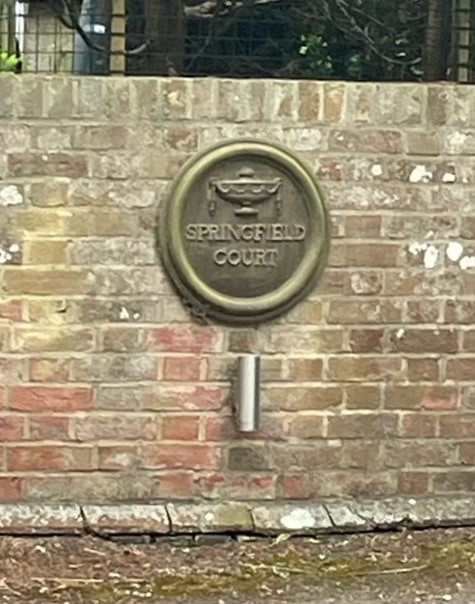
Name-sign of Springfield Court 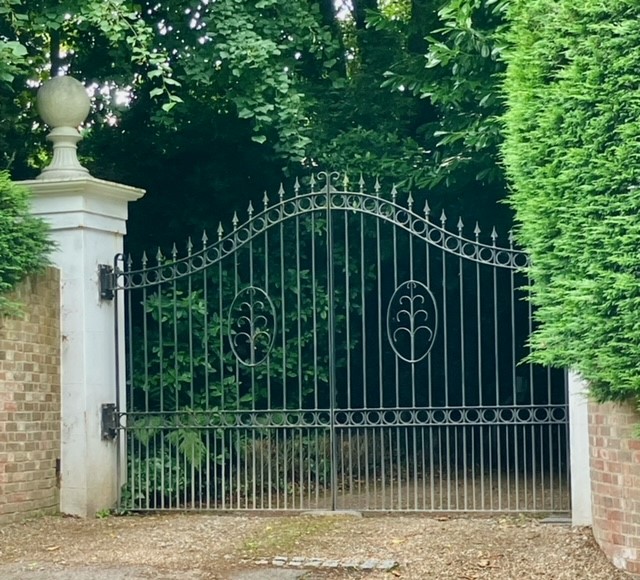
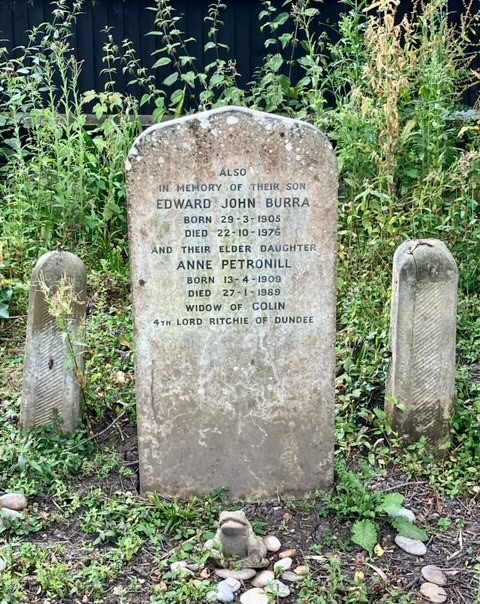
Gate of Springfield Court Burra is buried in the close-by churchyard of St Michael’s, Playden. It’s a surprising resting-place, given that he held no Christian beliefs, but it’s a pleasant spot, replete with a stone frog.
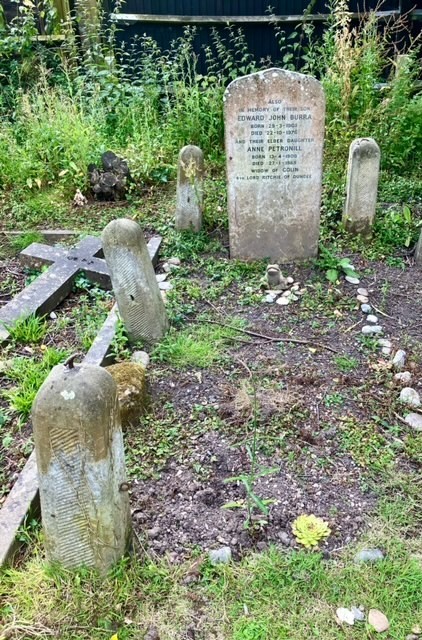
Burra’s grave 
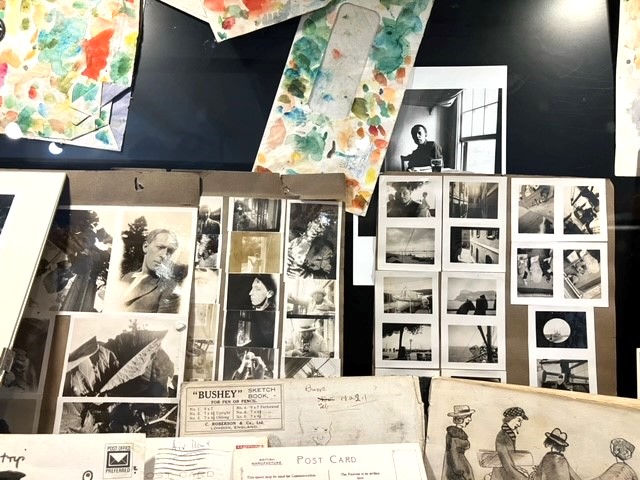
Burra’s headstone Rye Art Gallery has a room dedicated to Burra, including a cabinet full of his brushes, photographs and other ephemera.

Burra’s photo albums 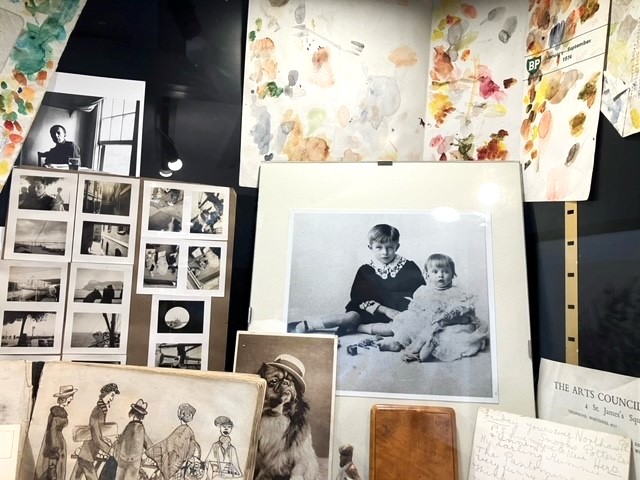
More Burra ephemera 
Burra painting I aim to write more poems about him and/or in response to his paintings. For now, though, below is the poem (loosely) based on his 1943–5 painting of the same name, accessible here, and which was published in issue no. 4 of The Alchemy Spoon.
The Cabbage Harvest
Halfway up the back road to Leigh,
under hard-bastard, leaden skies,
two wind-rounded labourers squeeze
the heads to test maturity;
decide the time is ripe, before
Storm Dudley breaks; to lop them free
from the stalk base and rapidly
cram the lot into sacks galore;
spread-eagling their fingers and palms
across the lumps, as if they’ve topped
the gangmaster—and roughly chopped
his carcass up, like lemon balm.
-
Presence
After an absence of five years, I’ve rejoined the Presence team, but under tragic circumstances: to fill the gap created by the very sad passing of Chris Boultwood, who, as well as being a fine haiku poet, took great care of the journal’s website for many years and also very efficiently administered the annual contest which subsequently became the Martin Lucas Haiku Award.
I’ve updated the website with selections from the last four issues, chosen by me (#76), Alison Williams (77), Judy Kendall (78) and Julie Mellor (79), here.
If you’re not a subscriber, it’s well worth becoming one, at still very reasonable prices – details are available here.
-
On Philip Rush’s ‘Shacklegate’
A characteristically astute review by Helena (Nell) Nelson in The Friday Poem the other week alerted me to the fact that Philip Rush had a collection of his distinctive poems (and photos), entitled Camera Obscura, newishly available from Michael Laskey’s The Garlic Press, here. Nell’s review can be read here.
Enthused by Nell’s review, and knowing Philip a little and (some of) his poems from the last Poetry Business Writing School programme just prior to the pandemic, I bought a copy of Camera Obscura straightaway. Nell quite rightly highlighted the quirkiness, humour and sheer likeability of Philip’s poems. His wit is of the driest, but not irritating know-all, kind. I’m glad, too, that Nell noted the following:
The writing’s mainly rooted in the natural world where everything is as ordinary (and as miraculous) as a leaf, if you look at it carefully. He does look. And the more you read him, the more you trust him to tell you what he sees.
In Philip’s poetry, one can easily discern that sense of wonder, as Van the Man put it, and perhaps of immanence; some kind of indefinable yearning towards a quieter pace of life in which observation is valued purely for its own sake. In these respects, his style is not dissimilar to Laskey’s own, or that of Peter Sansom and Jonathan Davidson.
The book concludes with a true masterpiece, ‘‘Folk Routes, New Routes’ An Ode to Davey Graham & Shirley Collins’, a freewheeling hymn to, maybe elegy for, the outward-facing, optimistic England of the Sixties. Ostensibly written around the hugely influential 1964 album recorded by Graham and Collins, with Gus Dudgeon at the mixing desk, but which also contrives to encompass maps, cars, football, Dr Johnson, wild flowers and the old, pre-1974 counties, including Philip’s own Middlesex. In it, a ‘vintage old-school / road atlas [ . . .] / includes a short / and largely pointless / section of the M1, / a stub of the M5 / leading south from Birmingham / and the entire M50.’ (And also, no M4, on which Dudgeon and his wife Sheila died in 2002.) It’s a poem like no other I know.
I’m featuring a work in a similar vein, in how it harks back, though, I hasten to add, not in any absurd, Reform-UK-supporting manner. Philip has kindly given me permission to quote the whole of the following poem.
*
Shacklegate
At the heart of all this edgeland
I’m sure
is Shacklegate Junction —
its dead-end rails
its island of dry grass
its sheds
and its flicker of butterflies
like an old film
like the arcs
of sharp electricity
which every now and then
but always
unexpectedly
played for a fraction
of a second
beneath the rolling stock.
Once in a blue moon
or to be fair
more often than that
our train would pause here,
hesitate forward and stop.
The engine died
and a kind of queasy silence
took its place.
Poems have been written
about such moments.
In those days, no-one spoke
or watched their phones.
*
The shadow of Edward Thomas’s ‘Adlestrop’ – written in 1915 about a train journey he undertook on 24 June 2014, and published in the New Statesman three weeks after he was killed in action on 9 April 2017 – has slanted across the best poems about railway journeys by English poets since then, from ‘The Whitsun Weddings’, Patricia Beer’s magnificent ‘The Branch Line’ and ‘Southern Railway’, to Peter Sansom’s ‘Alfreton and Mansfield Parkway, June Evening’. Its quiet depiction of a golden, prelapsarian English summer’s heat haze may well be an influence on Philip’s poem too.
I have to declare a personal attachment here, in that the spot which ‘Shacklegate’ describes is one I know well, because I have so often passed it, and been beside it in a stopped train. The triangular junction lies on the Kingston Loop, the line from Waterloo to Kingston and back to Waterloo, taking in Teddington, Twickenham, Richmond and Barnes among other stations. Having lived and worked in both Kingston and Twickenham, I imagine I’ve passed the junction many hundreds of times. The junction, adjoining Strawberry Hill Golf Club, lies just before Strawberry Hill station on the dead-straight stretch from/to Teddington. It’s a junction because it also contains the start/end of the branch line forking off to/from Shepperton, which quite possibly owes its post-Beeching survival to the presence, a few stops down, of Kempton Park station, servicing the racecourse. Shacklegate isn’t really a place now, if it ever was; there’s a Shacklegate Lane which runs west from the Waldegrave Arms to the Stanley Road crossroads in north Teddington, which imperceptibly becomes another non-place, Fulwell; known, if at all, for being where Manoel II, the exiled last king of Portugal, lived until his murder in 1932.
The poem opens in media res: we are joining an engaging talk which has already started and might well be halfway through. We can intuit the arms of the narrator opening out as he shows us where he and we are. It’s that ‘all this’ which does it, especially ‘this’; rather than using ‘of the edgeland’ or ‘of edgeland’, the fuller phrase shows us more, by rooting us to the very spot. The word ‘edgeland’, or ‘edgelands’ plural, was coined in 2002 by the writer, environmentalist and campaigner Marion Shoard as a label for the out-of-the-way places between urban and rural areas which are, at the same time, somehow a mixture of both and neither. It was popularised by the publication in 2011 of Paul Farley and Michael Symmons Roberts’s brilliant book of exploratory essays, Edgelands, with its cheeky subtitle, ‘Journeys into England’s True Wilderness’, cocking a snook at the pretentious neo-colonialism of Robert Macfarlane’s The Wild Places. The suburbs of south-west London, in which Fulwell and Teddington are situated, are chocker with classic edgelands.
The short second line is simultaneously assertive and uncertain, as if the narrator is, in fact, not really certain at all, or might even be being a little bit flippant. The naming of the place is a surprise, in that edgelands are often unnamed. Then a linguistic joke is played on the reader, because this junction is also the railway equivalent of a cul-de-sac, with ‘dead-end rails’, an ‘island of dry grass’ (no doubt interspersed by clumps of ragwort, brambles, buddleia and rosebay willowherb), ‘sheds’ (in which some of the ‘dead-end rails’ terminate) and, quite beautifully, a ‘flicker of butterflies / like an old film’. That each of these nouns is prefixed by an ‘its’ is an interesting poetic choice: technically superfluous, their pleasant repetition could conceivably provide a sonic imitation of either the train’s clicks over the rails as it slows round the bend of the Shepperton branch line or of midsummer insects chirring. But the run-on into the second stanza gives a more likely answer: ‘the arcs / of sharp electricity’. That ‘arcs’ is contained within the word ‘;sparks’ is surely no coincidence; ‘arcs’ is a less obvious but fine choice, though, because, as well as its implicit sound and its assonance with ‘sharp’, it implies movement in order to extend the lovely similes. Despite the prefiguring of ‘ an old film’, the ‘electricity’ simile wrongfoots us into the past. The unfolding of the linked clauses in the second stanza is delightful on the ear, none more so than the verb. Because ‘played’ is surely not the first word which came to mind. In which sense is it meant here? – ‘acted’, ‘performed’, ‘amused itself’ or all of these? Paradoxically, each of these definitions seems both incorrect and just right. The line-breaks are excellent too, giving a vivid tension to what the reader suddenly understands to be a repeated memory from years ago, probably many years ago. The tumble of quick breaks after ‘always’, ‘unexpectedly’ and ‘fraction’ bestow extra emphases on each of those words and speed the reader along in real time. The stanza, and the poem’s opening sentence, ends with that mellifluous old-fashioned ‘rolling stock’, a catch-all, of course, for engines, carriages, wagons, flat-beds, cranes, etc.
Each of the first three lines of the third stanza consists of a cliché / stock phrase, in a manner reminiscent, to me, of Beckett. (Christopher Ricks’s 1993 book Beckett’s Dying Words, OUP, includes the wondrous sentence, ‘Clichés are an opportunity for a writer exactly in being on the face of it nothing to write home about.’) The effect is mildly comedic, a digressive, meta aside, containing the sort of delicately conversational phrasing which workshopping a poem would sadly remove. Then we come to the line ‘our train would pause here’, notable not just for the pause itself, but also because of that ‘our’ which tells the reader that this is a shared reminiscence, and because the echo of ‘Adlestrop’ (‘[. . .] one afternoon / Of heat the express-train drew up there / Unwontedly’) is at its strongest here. Again, the poet surprises with his verb: ‘hesitate forward’ is a perfect oxymoron, not least because the action described so simply is exactly, still, what trains in England do.
After the abundance of the stanza’s opening sentence, the closing three lines bring a nice contrast of tight precision. It’s tempting to see ‘The engine died’ as an inadvertent mirroring of ‘The steam hissed’ in Thomas’s poem, but whereas in the latter ‘Someone cleared his throat, here ‘a kind of queasy silence / took its place’. That ‘queasy’ is spot-on, because in such circumstances, the passenger cannot help but feel slightly anxious – or even more so if they are in a hurry, particularly if they have a connection to make. The absence of an explanation – if the guard doesn’t provide one – for the unscheduled stop can, the longer it goes on, induce all sorts of unforced terrible reasoning.
The poem’s penultimate sentence shakes the narrator out of his nostalgic reverie, by going full-on meta and undercutting what might have been too earnest a poem without a change of perspective. The poem ends where is started, in the present day (presumably), with a rose-tinted, possibly grumpy-old-man-ish, ‘back-in-my-day’ reflection. On first reading, I was disappointed by this stanza, but it’s grown on me: its detached, ironic tone is in keeping with the earlier undertone of flippancy at naming and recalling something fairly unimportant. Memory, it seems to say, can recall such uncomplicated, apparently trivial moments because there were fewer distractions way back when, and the social code dictated that people didn’t act in trains (and other confined public spaces) like they would in their own homes. It feels right that the stanza is only half the length of the prior three, because it wouldn’t have done to labour the ending’s points. As Nell put it, in regard to the book’s opening poem:
Somehow it demonstrates how not to end a poem on a high point. In fact, Philip Rush may be a master of anti-climax.
What of the poem’s form? In her review, Nell also discussed Philip’s use of short, indented lines and how they ‘pace the reader’s progress, ensuring that the end of the sentence arrives with full impact’. Like the brief narratives in many of William Carlos Williams’s poems, Philip’s own are well-matched to what can be quite a lolloping form.
What, too, of the spare punctuation; above all, the near absence of commas? To me, with a tendency to over-punctuate, it’s something I’ve had to accept by holding my nose – to start with anyway. I can see that the minimalist approach aids the flow of Philip’s first-rate poems.
-
On Berlin
The 2024 Euros Final in the Olympiastadion in Berlin tomorrow reminds me that when I spent the summer of 1987 in West Berlin with my university friend Caroline and her sister Sharon, one day we happened upon the stadium and just walked on in, because we could, and took in the view that spectators had had at the Olympics only 51 years before. Like the football stadia in England at that time, it was run down and all but abandoned.
It seems that Hertha Berlin played their Bundesliga games there up to 1986, but then spent three years at the much smaller Poststadion because their attendances weren’t large enough to justify staying at the Olympiastadion. (A similar fate befell my own team, QPR, when they spent a few years – 1931 to 1933 and the 1962/63 season – at the 1908 and 1948 Olympic stadium, White City, although, conversely, their record attendance, 41,097, was set there for an FA Cup game against Leeds in 1932. Curiouser still, their record attendance at Loftus Road was also against Leeds – 35,353 in 1974.)
I can’t claim that we felt the days of the Wall and the DDR were imminently numbered, but there was perhaps a sense that change was within reach. As a capitalist island within East Germany, West Berlin was a strange, anomalous place, and at any party we went to, there always seemed to be someone who’d escaped from the East. I thought I knew everything then.
Of the two poems I’ve written and had published about that summer, the following, from The Evening Entertainment, is the one I like the most.
*
-
Election time
How wonderful it is to have the Tory clouds lifted from the UK after 14 dark and dreadful years. Yes, Labour won’t be – or be in a position to be – as radical as I and many others would like them to be, but a large swathe of the populace who have just elected them undoubtedly wouldn’t have done so if Labour had stood on a radical platform like they did in 2019. I’m just glad that, as many people have noted, there are grown-ups back at the helm.
Voting is, of course, a privilege which we shouldn’t take for granted. It always grieves me when people say they can’t be bothered to vote and ‘all the parties are the same so what’s the point?’ Thousand of very brave people fought for universal adult franchise and many died in doing so. And, frankly, if people can’t differentiate between the Tories and parties to the left of them, then they really aren’t using their senses in the manner they were designed for.
I always enjoy elections and the act of voting. In order to celebrate that, and the outcome of Thursday’s election, here are some poems by the late, great haiku poet David Cobb. The first is from Jumping from Kiyomizu (Iron Press), 1996, happily still available here; the second and third were published in his 2000 collection A Bowl of Sloes (Snapshot Press); the fourth is from Wing Beats, ed. John Barlow and me (Snapshot Press, 2008), available here; and the fifth was published in David’s 2015 self-published collection Chiaroscuro.
It’s nice to see that David was well ahead of the game in observing dogs at polling stations.
*
wet election day
poster-faces all
a pulp on sticks
*
canvassing again
the dogs seem bigger
this election time
*
politician’s face –
the billboard stuck
in a rabbit hole
*
polling day—
swallows swooping
through a mist of flies
*
polling station
the wall-eyed dog
chained to the door
-
May–June reading
Taking some books back to the library a few weeks ago, I hadn’t intended to borrow a new lot, but I had an uncanny inkling that I would find something unexpected and fine. I loved Hugo Hamilton’s memoir of his German–Irish childhood, The Speckled People, a few years ago, so I was delighted to find his novel Every Single Minute (2014) on the shelf – and even more so when I saw that it was set in Berlin, a city with which I have my own relationship.
It’s a thinly fictionalised account of Hamilton and the Irish memoirist Nuala O’Faolain visiting the city as a last hurrah for O’Faolain facing an imminent death from cancer, and is packed full of lines and phrases which jump out at the reader. This extract gives a flavour of the novel:
She want to know what makes me happy.
I’m not talking about the normal things, she says, like love and drink and drugs and the day your daughter was born.
What else is there?
Things that lift your heart, Liam.
Like a lighthouse.
What lighthouse?
Any lighthouse. I tell her I feel glad whenever I see a lighthouse. I have no idea why. Maybe it reminds me of being close to home. Something about the summer. Even the word lighthouse makes me happy. I don’t go looking for them. It’s just lighthouses I happen to see or hear about.
You’re right, she says. Lighthouses.
I tell her I’m like everyone else, I love travelling. I love hearing languages I don’t understand. Far away languages, like Japanese. I wouldn’t have a clue what they were saying. I like that. And Irish. I tell her I love it when Radio na Galetachta comes on by accident in the car. When you hear somebody talking his head off with great Irish and you don’t understand half the words.
Go mbeirimíd be oar an ám seo arís.
She says it’s the Irish for being alive around the same time next year. Literally. May we meet again alive this time.
(I asked Fourth Estate for permission to quote this extract but received no reply.)
Family – and what we owe to them, and how they are remembered – is a key theme, but the book is much more than that. As Colm Tóibín says in his endorsement, ‘It is a world haunted not only by death, but
also by beauty and the strangeness of being alive.’ It’s also very funny and deeply moving. There’s a good piece in the Irish Times about it, available here.
Extraordinary, isn’t it, how stumbling upon a mesmerising book awash with wisdom can alter one’s perspective?
I also borrowed Deborah Orr’s memoir, Motherwell, published in 2020, a few months after her death from breast cancer at the age of just 57. It’s a brilliant account of her working-class childhood; of her Scottish steel-worker father and his prejudices; and, especially, of her domineering and irascibly contrary Essex mother. Aside from repetitive explanations of what narcissistic behaviour entails, it was a book I felt compelled to read to its end, but in small doses. On reflection, that was probably due to the fact that Orr’s descriptions of her mother reminded me so much of my own Essex mother.
I bought a copy of Hunter Davies’s 2017 memoir, The Co-op’s Got Bananas, subtitled A Memoir of Growing Up in the Post-War North. Like Orr’s, it painted a rich picture of childhood, in Scotland and Carlisle, but also of university in Durham, his first proper journalism job for the Manchester Evening News and his courtship days with Margaret Forster. As memoirs go, it’s a largely jolly affair, with plenty of laughs, but shot through with an underlying note of melancholy.
I’ve been dipping in and out of other books, notably Lara Pawson’s much-praised Spent Light, from the estimable CB Editions, though somehow it’s irritated me as much as I’ve enjoyed or admired it. There’s no doubting her talent: her memoir-of-sorts, This is the Place to Be (2016), was moving, chilling and courageous in equal parts.
The latest issue of Butcher’s Dog is as lovely to look at and read as ever. If only all poetry journals were put together with such care and taste.
I’m also working my way through another publication which has been beautifully produced: the posthumous Wild Cherry: Selected Poems of Nigel Jenkins assembled and introduced by Patrick McGuinness (and available from the publisher Parthian Books here), which is this month’s reading for the poetry book club I belong to. I’m thus far warming most of all to his political poems, which isn’t something I very often say because political poetry usually bores me rigid; Jenkins’s, though, sparkle with fierceness, wit and Welshness, which makes them as relevant now as the times in which they were written.
Finally, I’ve almost finished Barbara Pym’s first (1950) novel, Some Tame Gazelle. It’s very funny and wonderfully well-written; much funnier than, say, either Wodehouse or Benson and much truer to life too. I can see why Larkin was such a fan of Pym, and can also discern an influence on his poetry in the vividness of her similes and metaphorical verbs. Thankfully, we have more Pym novels in the house to keep me entertained as long as the summer lasts.
-
On Lydia Harris’s ‘This library of forgetting and remembering’
I daresay I’ve paraphrased Orwell thus, or something similar, before: all poets are unique, but some are more unique than others. Lydia Harris certainly falls into this category, thanks to her instantly recognisable combination of subject-matter, style and purity of diction. Fairly hot on the heels of her first collection, 2022’s Objects for Private Devotion (Pindrop Press) comes her latest, Henrietta’s Library of the Whole Wide World, published by Blue Diode Press and available to buy here. The space of only two years between the collections has not, however, led to a dilution of quality; far from it, because the book fully illustrates Harris’s gifts.
Lydia moved from York to Westray, the sixth largest of the 70 or so Orkneys, a decade ago, and much of her poetry investigates the archipelago’s people (women especially), history, religion, flora, fauna and much else .
Henrietta’s Library is an assortment of 68 concise, closely-linked poems concerning the library of an imagined predecessor in Trenaby, a settlement on Westray. The poems talk to and echo each other in a manner reminiscent of Gillian Allnutt by way of Borges.
Lydia has kindly given me permission to quote the whole of the following poem.
*
This library of forgetting and remembering
Of the treatises, one is much consumed with mould,
she wears fine linen gloves to smooth the folds,
mixes paste from wheaten flour to glue the Bible’s skin,
wraps the psalter in a velvet gown to stay salt air from seeping in.
The Hours of Boniface perch on her wrist, take flight,
return to her palm. She lectures the mice.
Shelves creak as if they were still at sea.
She binds into each volume a past too big to carry.
Sews gathering into the spine of the land,
the island a volume which rests on her hand.
She appeases the dead, inks a plough in a margin,
three crows and a vine curling to heaven.
*
Let’s start with the form. Here we have rhymed couplets; irregular in length and syllable-count, both within and between them. It’s an attractive form, not just because of its work on the ear, but visually also. That there are only six couplets means, as always with short poems, that every word really does have to count by playing its part, on its own terms and as a contribution towards the whole. End-rhyme is used sparingly in the collection as a whole – only three other poems, including an excellent villanelle )’Henrietta’s Library of the Spaces-between’) – consistently contain it, but many of the poems use occasional end-rhyme and plenty of internal rhyme without it ever seeming obtrusive or forced.
The poem presents puzzles to the reader from the outset. Does that ‘with’ mean the treatise in question is upon the subject of mould, or, as it more likely appears, is it just a synonym for ‘by’? And why is there no conjunction between the two lines, either through a semi-colon, colon or dash after the first line or a ‘so’ or ‘therefore’ at the start of the second line; because surely the wearing of the gloves is a consequence of the pages being mouldy? Or is it? As it stands, it looks and sounds ungrammatical, but does that matter? The impact on the reader’s understanding is, perhaps, one of rendering the ‘action’ pleasingly synchronous and consequently timeless. What century is the poem set in?
The flow into the second couplet provides no answer to that question, because wheat paste has been used for millennia to bind books, and here it’s being used, by Henrietta we presume, to repair ‘the Bible’s skin’, most probably vellum. The eye-rhyme between ‘paste’ and ‘psalter’ helps to bind the lines. The poem’s fourth line, like the whole, rings beautifully on the ear, helped by that delightfully archaic ‘stay’ and the sequence of ‘s’ sounds. The care with which Henrietta undertakes her work is amply shown but not pointed out.
The third couplet is more puzzling still. One might presume that the ‘Hours of Boniface’ is a canonical liturgy, written by the Devon-born Benedictine saint of that name, but how the daily offices can ‘perch on her wrist, take flight’ and ‘return to her palm’ is a mystery: it is as if they have merrily metamorphosed into a butterfly. The magical realism is compounded by the couplet’s extraordinary second sentence, presented so simply that the reader can do no more than accept it at face value; the word ‘mice’ echoing the last syllable of the saint’s name.
The poem’s vista is extended beyond the confines of the library within the fourth couplet. Again without explicitly telling the reader so, that ‘still’ somehow implies that the shelves are made from wood salvaged from a ship. The trust that the poet has in the reader here, and throughout the poem and the collection as a whole, is a lesson in itself. The couplet’s second line plays more outwardly with the concept of time; it’s a statement-making line which speaks eloquently for itself, yet its profundity does not overload the poem.
In the fifth couplet, a knowledge of sewing is helpful in order to intuit the meaning fully. Wiki gives the following:
Gathering turns the edge of a piece of fabric into a bunch of small folds that are held together by a thread close to the edge. Gathering makes the fabric shorter where it is stitched. The whole of the fabric flares out into irregular, rolling folds beyond the gathered stitching.
Here, that meaning makes Henrietta the binder of the world around her: the image of Westray as ‘a volume which rests on her hand’ is a delight. The syntax is once more slightly askew, in that one would expect a comma at the end of the preceding couplet and a lower-case ‘s’
at the start of ‘Sews’; nonetheless, it reads and sounds perfectly compatible with the rest of the poem and its spirit.
The poem might well have ended there. Harris, though, is canny enough to move the poem, in one more couplet, to another angle: the book-restorer turns illustrator, and in so doing, we are told, ‘appeases the dead’. What is meant by this? Presumably, it is in keeping with the tradition of Dark Ages and medieval manuscript illustrators who added to, and annotated, the works of their forebears. The couplet, like its two immediate predecessors, is very weighty in terms of significance, but the simple, limpid lightness and sureness of the language ensures that the poem can be received as if the fantastical content is entirely straightforward. The poet’s sleight of hand in accomplishing that achievement cannot be underestimated.
So, back to the start, what of the title? It nods, for me, to Kundera’s novel, The Book of Laughter and Forgetting, though I doubt that was intended. The act of ‘remembering’, of summoning and respecting the ghosts of the past, suffuses the poem. Maybe the ‘forgetting’ refers to the mouldy decay into which the treatise has been left, before Henrietta’s work provides the ‘remembering’. It’s a title which cross-refers to plenty of others in the collection: ‘This library of forgetting and remembering’ is a library within a larger library. Underlying the poem, and the collection, is a deep love and reverence for books as sources of knowledge and as articles in themselves. In these times of increasing digitisation, it serves us all well to be reminded of those values.
-
New poems – ‘A Short History of Greenhouses’ and ‘Edward Burra at the Gaiety, Hastings’
With many thanks to editor (and very fine poet) Robert Selby, I have two new poems up at Wild Court, here.
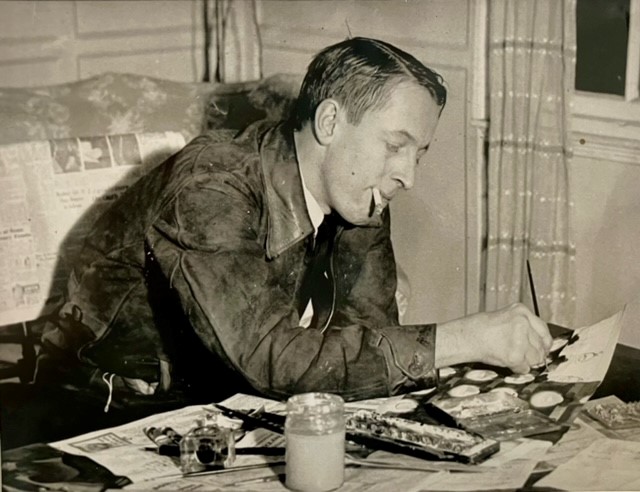
Burra designed sets for several ballet productions, including Helpmann’s Miracle in the Gorbals, 1944, and was a lifelong film buff.

 Matthew Paul: Poetry & Stuff