Tag: books
-
Recent readings and reading
The evening in York was a memorable one: Janet Dean and Ian Parks, whose new collection we were celebrating, read beautifully, and Jane Stockdale’s songs and tunes were delightful. I stuck to my usual set of poems from The Last Corinthians, tempting though it was to read different ones and even some from my previous collection and/or some new ones.
Five days after York, having been invited by Katie Griffiths to read in Walton-on-Thames alongside Sophie Herxheimer, I skedaddled down south for what was perhaps the most enjoyable gig for me since the one in Nottingham in September. Sophie is a force of nature, an artist as well as a poet, whom I could’ve listened to all evening. She got everyone making zines during the interval. Katie herself read a poem; it’s excellent news that Nine Arches will be publishing her second collection next year. There was also a short open mic, the readers including marvellous Jill Abram.
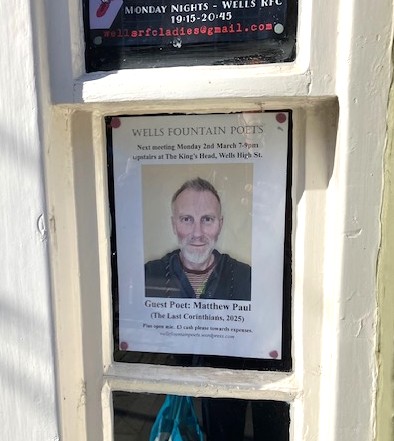
Photo by Cris Fells of Sophie Herxheimer, Katie Griffiths and me. As Walton is only a few miles west of Kingston, I tailored my set accordingly, with more locally-set poems than I would normally read, though I decided – wisely, I think – against reading one, ‘The Blue Bridge’, which features Sham 69, who came from the neighbouring town of Hersham. In all, it was a joyful evening, and a good way to end this year of readings, which has seen me appear in eight cities and towns in England within the space of six months. It’s been more of a meander than a tour, and two of them were serendipitous invitations at fairly short notice; nonetheless, it’s been lovely to read my poems out loud in front of attentive listeners, not all of whom are poets themselves. I’m thankful to everyone who’s come along, whether because of me, my co-readers or both. I’ll start again in 2026, with a trip to Wells in March.
Meanwhile, my friend and fellow native-Kingstonian poet Greg Freeman, wrote a kind review, available here, of The Last Corinthians for the Write Out Loud site, for which he is the news editor. I am especially grateful to Greg for this, for he not only also reviewed the first launch event at Doncaster back in June but was also the first person to review my first collection. Many congratulations are due to Greg for graduating yesterday from the Newcastle University / Poetry School MA in Poetry.
This last week has seen me join up with poet–friends for a residential in Cloughton, four miles north of Scarborough and just under a mile from the North Sea. Due east from there, there’s no landfall until Schleswig Holstein.
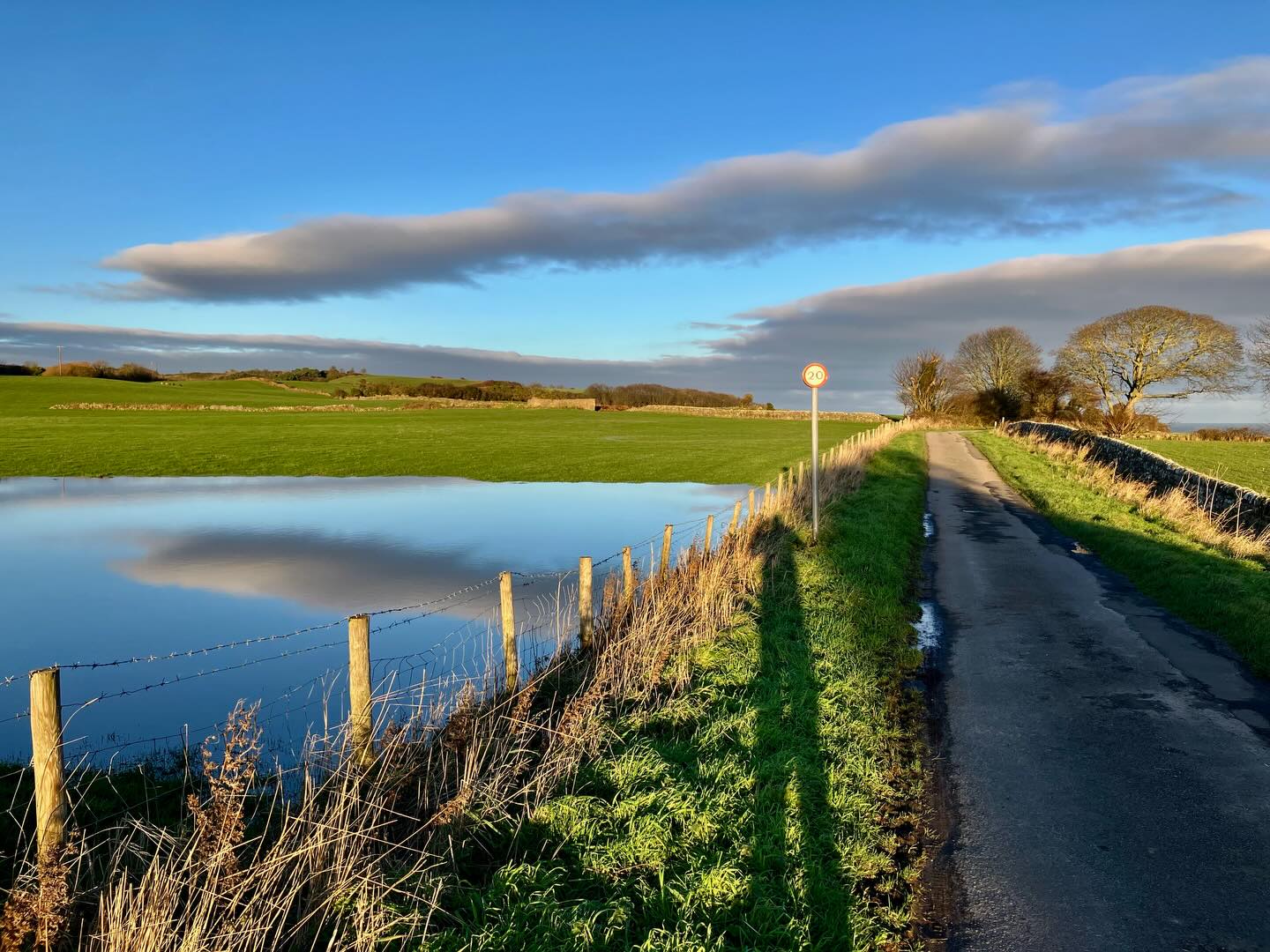
The track to Cloughton Wyke. Although there were intense mornings of drafting poems using prompts, there were also lots of laughs and games, including guess-the-mystery-poets, pool and table tennis, despite the games room (a big shed) being a bit flooded. There was also lots of that great British delicacy, fried bread, at breakfast, which was right up my strasse. I can’t say that I wrote especially well, and sometimes in such weeks the real pleasure to be had is in hearing how well others can draft fully-formed poems in under 10 minutes, and in the conversations at meal-times and in small workshop groups. I very rarely write well from prompts, and usually only if I go off on a tangent, but that’s not necessarily the point; it’s more about getting words down on a page and seeing what might emerge, either immediately or much later when the words are revisited. It is invariably amazing to discover what memories, thoughts and word salads appear.
In between times, I’ve been reading books and journals in a rather unsystematic manner. Here are my thoughts on some of them.
I very much enjoyed Amanda Dalton’s third full collection, Fantastic Voyage (Bloodaxe, 2024, available here), which riffs on the wacky 1966 film of the same name and also includes her moving meditation on grief, the two long poems which make up ‘Notes on Water’ (which I briefly reviewed, here, when it appeared as a Smith | Doorstop pamphlet in 2022), as well as a series of tremendous prose poems which are as funny as they are affecting, as in the opening and ending of this one:
Auntie Irene says that cousin John got a tapeworm from stroking the sheep. [. . .] Every time I see my cousin John I want to ask him if the tapeworm is still growing in his insides and every time he speaks to me I wonder will it come out of his mouth like words he didn’t mean to say.
Alan Buckley’s Still (Blue Diode Publishing, 2025, available here) was for me rather a disappointment after his sublime 2020 debut full collection, Touched (HappenStance Press): every (single-word title) poem consists of six couplets with seven syllables per line, a form which Buckley calls the ‘douzaine’, and most of them are about nature and were written during Covid times, though too many of them seemed like nature notes, inhibited rather than helped by the form, in which the thoughts he conveys aren’t quite brought sufficiently into focus and sometimes lapse into cliché, such as ‘May you burn brightly as long as you can’ (‘Glow’), or the obvious – a magpie described as having ‘piebald simplicity, / disturbed by metalline blue’). The paring-back dictated by the form, which he talks about in the book’s end-matter, lacks the powerful concision of haiku and doesn’t quite leave enough room to develop the plethora of ideas that he evidently has. However, I do, admire Buckley’s determination to try something different and at their best, these poems have a fine simplicity, as one would expect from such a talented poet: ‘As the final transport plane / leaves Kabul, here in Marsh Park // the Afghan boys play cricket. / They made their journeys on foot, // in trucks. Some don’t know if those / they left behind are alive.’ (‘Cricket’) Maybe a re-reading will prove more profitable.
At the age of 80, Peter Jay has collected his poems 1962–2024, as The Last Bright Apple, published by Anthony Howell’s Grey Suit Editions and available here. Jay was the founder and chief editor of Anvil Press Poetry from 1968 until it ceased in 2016, when some of its poets and back-catalogue were taken on by Carcanet. Jay had impeccable taste; as well as perhaps his most lucrative (!) asset, Carol Ann Duffy, I have on my shelves Anvil books by real favourites of mine, like Martina Evans, Michael Hamburger, Anthony Howell himself, Peter Levi, E.A. Markham, Dennis O’Driscoll and Greta Stoddart, and Edmund Keeley and Philip Sherrard’s translations of Elytis, Seferis and others. As is often the case, Jay is better-known as an editor than he is as a poet, and this nicely-titled and beautifully-produced book will go some way to restoring his reputation as a poet. I say some way, because it’s not the most substantial of outputs and includes many translations from a variety of poets and languages. At his best, though, Jay’s poems are warm, attractive and cerebrally ruminative without being esoteric, as in the opening half of ‘Thoughts’:
There are days when the mind grazes,
Circling itself like an answer
Lazily guessing its question.
How fragile they are, thoughts,
How delicately to be hoarded!
When a white thought runs away,
It takes on the colour of air,
Of water. Unguarded thought,
Home thought in search of a heart,
Heartless though in search of a home,
Desert thought thirsting for an oasis,
Pale fractured thought, let me catch you,
Name you and give you a colour.
These lines, perhaps unsurprisingly, remind me of Levi and of the late collections of Hamburger. Elsewhere, Jay is a pleasing observer of what passes for natural wonder in nature-depleted England, e.g. ‘Swans on the tarn / move with the weather, / rain, wind or sun, / drifting together.’ (‘Little Langdale’), and is wryly reflective on his life’s work: ‘What can be done with poets? / Such awkward people. We know / They don’t matter at all; why then / Do they concern us?’ (‘Ars Politica’). In all, this is a collected poems which, despite being comparatively slender at 150 or so pages, contains the sort of fine, philosophising poems which are sadly out of fashion these days.
I’ve also spent time revisiting the metaphysical rococo wordscapes of Lucie Brock-Broido. The four collections published by Alred A. Knopf before her death in 2016 at the age of just 61were and are magnificent. It amazes me that, although Carcanet published a fine selected, Soul Keeping Company, in 2010, the individual collections are yet to be published over here. Maybe they’re waiting for Knopf to publish a definitive collected.
I have more reviews to write before Christmas, and one appearing next week. It has without doubt been my busiest year of poetry, and for that I am very grateful.
-
Reviews of Annie Fisher, Kath McKay and Claire Crowther
Annie Fisher, Missing the Man Next Door, Mariscat Press, £9
Kath McKay, Moving the Elephant, The Garlic Press, £10
Claire Crowther, Real Lear: New & Selected Poems, Shearsman Books, £12.95
Fans of Annie Fisher know that her poetry of the everyday – serious, entertaining, sometimes bordering on outlandish – is handsomely crafted. Even on a first breeze through the 24 poems of her new pamphlet, the variety is evident: of form, length, type and subject matter. There are couplets, tercets, blocks, prose-poems, list-poems, an unrhymed sonnet and more, encompassing, as before, high seriousness, nonsense verse and fantasy. What is constant throughout is Fisher’s voice: droll, mischievously cynical and worldly-wise.
The title-theme is introduced cleverly in a poem entitled ‘The New Neighbour’, whose anonymous character has succeeded ‘John / who died in the pandemic at the age of ninety-four — // John, to whom I never said goodbye, / who’ll always be, for me, the man next door.’ John is elegised at fuller length in the title poem, a list-poem full of delightful closely-observed memories:
I liked that he was there.
I liked the way he sang Italian arias off-key.
I liked how every time he tottered to the corner shop
for bread and beans, he’d ping our metal gate post
with his stick, then nod and smile to hear the note it made
as if was his tuning fork.
Fisher’s use of anaphora here surely bestows extra poignancy to her moving recollections.
Another, pleasurable list-poem, this time verging on nonsense verse (to which it states its debt), itemises what the title, ‘A Few Favourite Things’, indicates, including ‘naked swimming, hugging trees, / Seamus Heaney, Scotsmen’s knees’.
A handful of nature-themed poems include one about the critically-endangered shoebill and a lovely short poem, ‘The Old Beech by the Lychgate’, which deserves to be in every anthology of tree poetry: ‘It’s unembarrassed if we talk out loud. / It’s just as fine with nothing being said.’ That half-rhyme adds to the poem’s four full rhymes. Full rhyme is seemingly scarce nowadays but Fisher is adept at using it to winning effect in light verse which bears comparison to Lear or Nash:
The Parson’s goldfish is godlier than God,
His piranha is pious as well,
But the Parson himself is a wicked old sod,
Who’s probably going to hell.
(‘The Improbable Perfections of the Parson’s Pets’)
The clerical theme continues overleaf (and not, alas, opposite) in one of the pamphlet’s two highpoints, ‘Priests’. Its eight tercets reflectively address the good and the bad in what might be the definitive poem on the subject:
Some were demons. Some were saints.
One (dear Father Clement) was an angel.
They starved for lack of ordinary love.
Here, as throughout, Fisher turns skilfully on a sixpence from the generic to the specific and back again.
The pamphlet ends with the other highpoint, ‘The Old Dancing Woman of Bridgwater Town’, a luscious, celebratory whirl, using ballad meter, of Fisher’s own Somerset roots:
and she’s dancing through Northfield and Springfield and Oakfield,
she’s dancing down East Quay and Westover Green
and on through the back streets, the dark streets, the drunk streets
where only Houdini the alley cat’s been.
Occasionally, Fisher’s flights of fancy – ones involving R.S. Thomas and Jesus for example – feel like filler, but on the whole this is another rich assortment from a poet whose mastery of comic verse shouldn’t blind readers to her ability to write, additionally, and at times simultaneously, profound, re-readable poetry.
Kath McKay’s third full collection, like its predecessors, reflects her life story: a working-class Liverpool-Irish childhood, university in Belfast at the height of the ‘Troubles’, and adulthood, teaching in London, Leeds and Hull, parenting and grandparenting. It runs chronologically, right up to the pandemic and beyond, and the poems are almost always comprised of personal vignettes.
McKay’s style doesn’t set off fireworks; at their best, though, the poems in Moving the Elephant are, well, moving. The staccato clauses of an elegy for her mother, ‘I Know that the Science of Genetics’, say much with little:
[. . .] I fifth in your belly,
one dead at a year, three more to come, and youlapped milk and fed me potatoes and bread, so that
when women go on about chocolate, I say, Give me
potatoes and bread.’
Two successive poems deftly celebrate the optimism of McKay and her Sixties cohort’s aspirations:
In spring, Harold Wilson told our sixth form, ‘You will go far.’
A lad asked about the White Heat of Technology. Next Day
over the law on the conservation of mass, the chemistry teacher
we felt sorry for, in her glasses and bun, curbed our giggles:
‘In the modern world, everyone will need a knowledge of chemistry.’
The Physics teacher had ‘Leaving the Tao’ written on his door.
(‘Leaving the Tao’)
‘Youse girls, says Nelly. ‘Get yourselves an education. Get out of here.’(‘Saturday Job’)
The range of subject matter is diverse, covering: learning Spanish, Catholicism, political activism, working in a jam factory (‘How to switch my mind off, but keep enough residual attention / in case something untoward like a dead spider or a decapitated mouse / ended up in the jam’), secondhand clothing, Captain Webb, moving house (the title poem), a 77-year-old milkman, a visit to a chiropodist, soup-making, strong women and much else; but it is the poems about family which are arguably the most captivating. ‘The Other Room’, second-person tercets presumably about the death of McKay’s mother, contains the tenderest of moments, ‘you note / that your mother is growing colder, but still, you want to cuddle her / in case something of her is still floating round, lost.’ Somehow, the punctuating repetition of ‘still’, albeit used in differing ways, heightens the emotion.
The collection feels over-stuffed; 61 poems is excessive, given their lack of formal variety. In particular, six successive travelogues (set in Russia, Australia x 2, Italy and Spain x 2) midway through the book feels like a few too many, like that old trope of the neighbours showing you their holiday snaps with an implicit ‘you had to be there’ hanging in the air. The best is ‘Black Tea and Lemon’, because its tale is the quirkiest: ‘All night on the train between Moscow and Krasnodar, / Michael cracked the shells of boiled eggs and popped in thirteen.’
Heartfelt though all the poems in the book are, they don’t quite often enough include surprising lines or metaphors/similes, or portray incidents out of leftfield – a poem resulting from donation of her late brother’s eyes is a notable exception and shows exactly what McKay is capable of.
I was left with an abiding memory of two consecutive poems, both of which stand out precise because of their formal difference and (appear to) concern the death of McKay’s partner at just 56: ‘Unremarkable’, a very much remarkable list poem in which the condition of his body parts is itemised – ‘Liver shows evidence of nutmeg congestion’ – and ‘The Other Side’, seven couplets, but not a sonnet, which unflashily and touchingly convey the zombie-like autopilot nature of bereavement – ‘I boiled a kettle I’d forgotten to fill. Left the toast // to burn. Told the kids, their faces stricken, I was going shopping.’
Claire Crowther’s poetry is considerably more complex than Fisher’s or McKay’s. This retrospective drawn from her five collections from 2007 to 2022, plus 23 new poems, therefore demands patience on the reader’s part. In a 2009 interview, in response to the question of how closely Crowther drew on her own experiences, she said:
In a way I always do but only as a starting point. I have always felt what I write about – that’s the genesis of a poem. But the detail varies from my own experience – it could be that I observe other families interacting and freely bring in their details. I never feel I have to stick to any one set of facts – I mingle and match facts I’ve observed to serve the poem which becomes something different. In the end, there is rarely any autobiography at all – the poem has taken over completely.[1]The innate questions of this mix’n’match approach are whether the effort required to try to locate the emotional heart, and the point, of each poem justifies the time spent. I confess that my first read-through was challenging and that the poems – or, rather, some of them – only came alive on a second reading. Perhaps that is a good thing – like music whose depths only reveal themselves over several listenings.
The first poem, has a forbidding, if not off-putting, title, ‘Reconstructive Fortress’, but concerns one of those life-changing events: the process of selling a property, a flat in central London, and the feelings it evokes. The short sentences of the poem’s middle stanza follow each other in an almost disassociative, dark-humoured manner:
I’ve been wearing this flat for too long.
It’s dark though I’ve accessorised it in turquoise.
It works best when my skin is palest in winter.
In summer, it makes me look tacky. I am ready
to invest in a house as well-fitted as a bra.
None of that faux leopard skin, no balconettes.
A later, charming companion piece of sorts, ‘Fennel’ takes a strange turn: ‘The new owners may scrape the taste of my house / off its surface, but her fennel seeds cranny in fissures / and plan a dynasty of yellow tang.’
The subject-matter of the early poems is as happily varied as Crowther’s syntax is elegant. ‘Lost Child’, one of several poems set in Solihull, unspools its curious tale over six couplets, ending beautifully: ‘Pearl was playing quietly alone. / My ear is like a shell the wind swept.’ ‘Nudists’ opens with a killer line, ‘In the home of the naked, glass is queen’; as does ‘Foreigners in Lecce’: ‘Home is rind-hard’. The 23 five-line stanzas of ‘Against the Evidence’ unfold a short story largely also set in and around Lecce, and the phrases of which needs to be slowly savoured:
Saturday. Lemon of winter. Damp charcoal
bramble. Grey quilts of cloud. Wind tumbles
the wrapping from our ciabatta as if future
is the rim of a beaten country
and we’ve reached it. [. . .]
‘Once Troublesome’ begins as a fine Twixmas poem – ‘It isn’t New Year yet so Happy What? / Till then, it’s Boxing Day every morning.’ – then veers off with Crowther’s trademark odd turns. ‘Live Grenade in Sack of Potatoes Story’ is weighed down by its title’s promise.
A number of poems revolve around ‘thikes’, creatures imagined by Crowther, again in Hob’s Moat, Solihull: ‘The number of thikes / casually shot is high. / Celebrities on Channel Five News / have endorsed the policing of thike-baiters.’ (‘The Thike). Whether it’s a metaphor for marginalised groups, or even the position of women, within British society isn’t entirely clear, but it gives Crowther licence to play:It’s not because I’m dirty
It’s not because I’m clean
It’s not because I kissed a thike
inside a space machine
(‘Sleeping on a Trampoline’)
That playfulness is evident elsewhere, such as a punning riff on her forename in the whackily entitled ‘Self-Portrait as Windscreen’:
Do you think I’m clear on every issue
just because I’m glass?
Have you heard yourself calling ‘Claire,
Claire, Claire, Claire’ when you’re confused?
A name is lulling
when you aren’t clear on every issue.
It’s tempting to intuit that that last line is a knowing, self-aware thought that her poetry is not of the transparent kind.
The difficulty quotient is ratcheted up further in Crowther’s fourth collection, Solar Cruise, which explores, via the metaphor of a cruise ship, the world of solar physics inhabited by her partner, Keith Barnham. Yet, among the scientific jargon, these poems are among the book’s most enjoyable, largely because we find Crowther at play again: ‘A sheen of fog curtains our balcony / and into that the captain sends a throaty // ohhhhm // ohhhhm // ohhhhm’ (‘Foghorn with Solar Harvester’). She satirises the domineering men of that world and celebrates the women whose achievements ought to be better known. One poem, ‘Electricity Generation in Germany in a Typical April week’, incorporates a graph showing the relative amounts of solar, wind and conventional power generated. There are further physics-related poems in her fifth collection, and curious others, including a love poem and a (cod?) metaphysical one:
Now we are over, death
has nuanced our model of dead worlds.
Indeed, as some poet mentioned,
pearl is mere pavement here
and no one dead mourns.
(‘Heaven is Nothing If Not Resolution’)
The final section, Real Lear, reimagines Lear as a woman, and includes some delicious gobbledygook, in particular in the nature poem, ‘Gabbery’:
every dry battletwig
scuttles under tubbans
a dunnock in the hedgeskips
sings to her nestling:
cuculus cuculus
gowk in my hidland
gabber in my hidland
o fierce cuculus
This intriguing seam has also recently been mined to great effect by Geraldine Clarkson, in her collection Medlars. Poetry to be enjoyed purely for its soundscape reaches an apogee for Crowther in the book’s final poem, ‘Soundsunder’:
[. . .] I hear inside my silence
that it is the sussuround of us
we other:
sounds that shushhush the our of self
In reading such a generous selection of Crowther’s poetry, it becomes a struggle to know when she is making serious points and what they are. The density of her writing, albeit often exquisitely crafted in musical lines, inhibits simple, or simplistic, exegesis and therefore prohibits much in the way of an emotional reaction other than a degree of frustration and, inasmuch as one can judge the tone, a wry smile at the fun Crowther appears to be having, as if one isn’t quite allowed in on the joke. Surely, though, kernels of clarity are gradually revealed over multiple re-readings.
[1] Interview with Andrew Philip, https://tonguefire.blogspot.com/2009/07/open-plan-otherness-interview-with.html, accessed 23 November 2024.
-
On Mary Mulholland’s ‘Stilling Time’
Mary Mulholland has been steadily building up an impressive body of work over the last decade and more: her latest publication, the elimination game, published by Broken Sleep Books and available here, is her second solo pamphlet, following her 2022 Live Canon debut What the sheep taught me, in addition to her two Nine Pens collaborations with Vasiliki Albedo and Simon Maddrell. Mary is also the founder of the Red Door Poets (details here), of whom I was an original member; I can testify to Mary’s deep poetic intuition and generosity.
With intelligence, humour and carefully contained ire, the elimination game tackles the stereotypes, pitfalls and apparent invisibility of older women in contemporary British society. As a late-middle-aged man in the same society, I can’t, and don’t, pretend to know what it feels like to be an older woman in Britain today, but Mary’s poems provide a good idea.
The content contains a plethora of memorable lines and images, such as the eponymous hero of ‘The General’s Widow’ who, once ‘The funeral’s over’ finds ‘it’s such a relief, / she’ll spend the night making paper planes, / hurl them at his eyes, nose and brains’, and the title-poem in which a litany of misogynist and agist insulting terms for older women are rebuffed in no uncertain terms (‘kindly wait while i /find a bucket to list & puke in’) and then refuted by another, much more positive litany of achievements: ‘last year I swam in the / arctic trekked the sahara then / mastered roller-blading next up / i’m starting classes in mandarin’.
There are heartfelt poems from the perspective of both motherhood and grandmotherhood (both subjective and objective, and in ‘The Grandmothers, both), celebrating the passing on of the torch of female fearlessness; and of the incredible family memories and history which need to be handed down through the generations before it’s too late (the vivid ‘Fallen Tree’); and, in ‘Reading the Silence’, the quiet, uneasy moments of a later-years (heterosexual) relationship, in which the man’s apparently dominant voice and ‘exploits’ are quietly undercut by the woman’s unsaid response:
Once in Africa, with rain like steel drums
on the tin roof, he said whisky was saferthan water, and the grey parrot, once owned
by a bronchial old man, coughed.
She pauses her knitting, replays her thoughts,
plain, purl, clacketing needles, perhaps time,
to cast off. She glances. He raises an eyebrow,
she half-smiles.
There are poems, too, about the perils of older sexual attraction and perfunctory, unfulfilling sex, surely underexplored topics in contemporary British poetry, and, most poignant of all, a rueful list-poem, ‘The Regretting Room’.
There is a degree of interplay and echoing between the poems, not in a way which duplicates ideas, but, rather, augments them with different facets of the same sub-themes. This helps to make this pamphlet unusually well unified. I, for one, would like to see a full collection from Mary, in which she can bring her skills and life-experience to bear on the larger canvas.
The 25 poems in the pamphlet are varied in form: blocks, 5; bullet-points, 1; columns, 1; couplets, 6; haiku, 1; irregular stanzas, 4; quatrains, 2; sestets, 1; tercets, 4. Such variety remains, I think, an under-rated aspect of collecting poems into a coherent whole. Unless a collection is themed by form (e.g. a collection of sonnets), reading poem after poem in the same or similar forms, whether block poems or in couplets, will never be the most enjoyable experience, however excellent the content maybe.
11 of the poems are in standard upper- and lower-case; the others, though, are in lower-case only – first-person singular, names, other proper nouns and all. I presume the decision as which case to use when was made on an intuitive, poem-by-poem basis, rather than with any preconception. I can’t be the only reader who finds the lower-case-for-everything format to be unnerving to the point of mild irritation, because I can’t quite see the point of it, other than as a needless layer of further variety, but I’m endeavouring to get over myself. (For years, there has been a sizeable minority of English-language haiku poets who have deployed the lower-case for each and every word, and within three lines – or just one – that approach looks a trifle pretentious. Often the ‘i’ instead of ‘I’ was/is used to indicate an absence of ego by Zen-infused poets, but to my mind it has had the opposite, self-defeating effect on the reader, of drawing attention to itself.)
You may wonder, then, why I’ve chosen the poem below rather than one of those in standard upper- and lower-case. The answer is simply that I like the content very much. So it seems that I’m succeeding in getting over myself, which must be a good thing.
Mary has kindly given me permission to quote the whole of the following poem.
*
Stilling Time
when she turned eighty my aunt refused to go
to bed, because that’s where most people die.
at eighty eleanor of aquitaine rode on horseback
like a man when she went to visit the king of spain.
a woman even older circumnavigated the world,
another ran marathons, one wrote racy books.
when i’m eighty i’m going to retrace my steps
to the grand canyon, breathe again the air
where i first encountered the majesty of creation.
i will touch a black stone ninety million years old
and feel young. i’ll bump into a family elk
at dawn, we will hold each other’s gaze.
I’ll tell them I come in peace, leave my shadow
falling over the canyon edge, sinking into earth.
*
I’ll be straightforward for once and start with the title. A play-on-words on ‘stealing time’ is intentional, I assume; at least, that allusion came immediately to mind. The idea of stilling time is attractive: of enabling a pausing, even a thwarting, of its sly progress. It’s a fine title with which to end the pamphlet, because the passage of time is the underlying stratum of all the poems within it.
Do seven couplets always make a sonnet? Not necessarily, but there’s a definite turn in this one, after the third couplet, so it’s fair to call ‘Stilling Time’ a reversed sonnet, like Elizabeth Bishop’s ‘Sonnet’ (the 1979 one).
The opening line contains arguably the pamphlet’s finest line-break: I admire how it leads the reader to think that ‘to go’ indicates that death was imminent for her aunt, and then the second line, showing her resilience, intelligence and wit, reveals that she wasn’t quite near the brink yet. Poets nowadays seem more adept at that kind of double-meaning line-break in which the reader is lulled into one interpretation before being directed elsewhere. Here it is all about how much time the reprieve will provide.
That opening couplet leads very nicely into the second, with the precise age of eighty neatly linking the two verses. Eleanor of Aquitaine lived one of the most remarkable lives of anyone of ‘high’ birth in the early Middle Ages: married three times, including to King Louis VII of France and Henry II of England, with both of whom she ruled jointly, she outlived each of them, and even survived imprisonment by Henry. She also outlived her son Richard the Lionheart, for whom she acted as regent during his almost perpetual absences from England, and enabled the succession of her younger son, John, in face of much baronial and other resistance. I’m scarcely doing justice to her full biography here. Suffice it to say that in the cut and thrust of male-dominated diplomatic shenanigans between England and France, she was a central figure for well over half a century. Eleanor’s journey which this couplet refers to was across the Pyrenees to fetch her granddaughter Blanche of Castile to marry Louis VIII of France and in so doing consolidate John’s shaky hold on the English throne. She was, and is, an example of a hugely successful and important long-lived woman, indomitably defied her advanced years. She’s an excellent example in another way too: being equally at home in England and France, like Mary and her family, as shown in several of the poems.
The third couplet, in almost throwaway style, is less specific in its old-age-resistant examples but is precisely-worded to sound salubrious to the ear.Although they link and shift like the verses of a renga, each of the first three stanzas is discrete, content-wise. From the fourth couplet onwards, however, they flow into one another, despite the full stops in the fifth and sixth, thereby giving the heart of the poem a lovely impetus after the somewhat stately, though no less well-made, opening trio of couplets.
At this point, the defiantly adventurous tone becomes reminiscent of Jenny Joseph’s very well-known poem ‘Warning’, available to read here, with its much-quoted opening,
When I am an old woman I shall wear purple
With a red hat which doesn’t go, and doesn’t suit me.
And I shall spend my pension on brandy and summer gloves
And satin sandals, and say we’ve no money for butter.
I shall sit down on the pavement when I’m tired
And gobble up samples in shops and press alarm bells
And run my stick along the public railings
And make up for the sobriety of my youth.
I shall go out in my slippers in the rain
And pick the flowers in other people’s gardens
And learn to spit.
There the comparison ends, though: the ambition in Mary’s poem is much bolder and more outlandish (in a good way). Note that it’s not ‘retrace my steps at the grand canyon’ but ‘to’, as if the poet–persona will take a longer and slower route, like Eleanor of Aquitaine. The segue into the fifth couplet is elegantly managed, with that pause on ‘breathe again that air’. To make the syntax here work to its optimum maybe either a semi-colon is needed after ‘creation’ or ‘touching’ should replace ‘i will touch’, but that’s quibbling. The elk encounter in the sixth couplet is utterly delightful and reminiscent, for me, of the similarly close encounter with elks in Dorianne Laux’s superb poem ‘The Crossing’. The unravelling of the clauses towards the void at the end is beautifully achieved and delivers a delicate and most noteworthy note on which to close the pamphlet.
-
July reading
You might think it invidious at the moment to be reading books by anyone called Donald, so it’s strangely coincidental that I’ve just read two in a row. I’ve mentioned before that Lyn and I have read several books recommended by the excellent Jacqui’s Wine Journal website, and Mr Bowling Buys a Newspaper by Donald Henderson is the latest of them. Jacqui reviewed it here, and her verdict is as dependably spot-on as ever. It’s very much a period piece as many older crime novels are, but that’s its joy.
Toy Fights, Faber 2023, Don Paterson’s memoir of the first 20 years of his life, is full of the rich details and meta-commentary that readers of his poetry would expect. His recall of memories is phenomenal, as if he’s channelling Ray Bradbury, who said, on Wogan in the Eighties, that he could remember everything that had happened in his life, even back into the womb. Paterson says, though, that, after three years of age,
the memories are vivid, but they still can’t be trusted. I am wont to confuse memory and photographs, other folks’ memories with my own, and things I saw on television with things that happened to me.
Paterson writes well about his jobbing musician father, at whose club gigs Paterson joined him as a side guitarist from the age of 15, though his mother, still alive at the time the book was written, is less of a presence. The biggest character, aside from Paterson himself, is the city of his birth and upbringing, Dundee. As a fan of the joyously daft BBC4 sitcom Bob Servant – written by Neil Forsyth who also wrote the fantastically well-plotted The Gold among other things – I was pre-programmed to like the colourful characters, community spirit and language of Dundee which Paterson brilliantly and often hilariously conjures. He’s very good, too, about the painful years of his adolescence, including two or so years as a devout Christian in a cult-like group, and his subsequent musical education, as listener, player and part of the local music scene, which at that time encompassed The Associates, led by much-missed Billy Mackenzie. The most memorable section concerns a breakdown he had aged 19, chiefly caused by drugs, and his subsequent four-month stay in Ninewells (psychiatric) Hospital. The book ends with Paterson setting off for a job in a band in London. Poetry barely gets a mention. Paterson’s ability to self-analyse with candour and honesty is extraordinary and provides many of the book’s funniest moments.
I’ve written before, here and here, of my admiration for the writing and performing of Philip Hoare, and it was about time that I got stuck into his book Spike Island (Fourth Estate, 2001), subtitled ‘The Memory of a Military Hospital’. Ostensibly, it’s concerned with the history of the humungous hospital built from 1856, opened in 1863 and mostly demolished in 1966, at Netley, near Southampton; but it’s much more than that, suffused as it is with Hoare’s memories of growing up a stone’s throw away in Sholing, his family history in general, aspects of British social history from mid-Victorian times and much else. It’s the most Sebaldian of his books, I think, with photographs interspersed throughout, and was in fact one of the last books which Sebald himself endorsed, in the Sunday Telegraph books of the year, before his death in December 2001: ‘A book that has everything a passionate reader could want – a subject that far transcends the trivial pursuits of contemporary writing, concerns both public and private, astonishing details, stylistic precision, a unique sense of time and place, and a great depth of vision.’ Hardly unique, though, as those words could’ve been applied to any of Sebald’s own books. Thanks to its proximity to the port of Southampton where the troopships docked, all British soldiers injured in the nation’s colonial wars were initially treated there, including those suffering from shell-shock inflicted on the Western Front, who were sectioned off in ‘D Block’, where the dreadful treatment was very much based on the notion of using military discipline to bully the inmates back to some kind of ‘normality’. I thought of James Goose, my great-grandfather, who was sent to South Africa in 1899 as part of a Norfolk militia regiment, got shot in the face by a Boer sniper (the wound turned cancerous and killed him years later) and came home on a ship named Roslin Castle, pictured here: he was so relieved to be home that he and my great-grandmother Agnes (née Riches) named their son Roslin, though maybe sensibly he was known as Rossie.
On the poetry front, I much admired Richard Scott’s second collection, That Broke into Shining Crystals, Faber, published earlier this year. As in several of Pascale Petit’s collections, this contains work which very skilfully, and with a marvellous ear for musical cadence , transforms the pain of sexual abuse into beautiful poetry. Each of the 21 poems in the first section, Still Lifes, responds to a different still life painting by painters from the 1600s onwards to Bonnard. The second part, a response to Marvell’s ‘To his Coy Mistress’ felt less successful, as it employs Seventeenth Century language in a manner verging on parody. The third section contains 22 poems after types of crystals and gemstones, as refracted through Rimbaud’s Illuminations as translated by Wyatt Mason, and are, for me, the most successful in the book, because the prose-poem form allows Scott to give fuller vent to his gift for articulating emotion through vivid and sensuous imagery and language, as in this extract from ‘Emerald’:
The field is a body. Wild grass rippling over breasts and muscles, the jut of a hipbone. Some of the grass is trampled down into mud like a battlefield – screams catch the air. Some of the grass is spread over little hillocks like shallow graves. Some of the grass is cut into a bit, desire lines and goat paths, leading to all the places you ever dreamed of going but didn’t.
As I discovered from listening to his interview with Peter Kenny in Series 5, Episode 10 of the ever-excellent Planet Poetry podcast, here, Scott talks very thoughtfully and eloquently about his craft.
I’ve also been knee-deep in the poems of Wisława Szymborska, as translated by Clare Cavanagh and collected in Map, Houghton Miflin Harcourt, 2015, for the poetry book club I’m part of. My jury is still out thus far, but then it’s a heftily daunting tome.
I’m also about halfway through Diane Seuss’s Modern Poetry, published last year in the USA by Graywolf and in the UK by Fitzcarraldo Editions. Her telling-it-as-it-is style might not be everyone’s cup of tea, but I really like the way she throws it all in and takes disjunctive leaps in her poems. I adore her poem ‘An Aria’, 23 irregular quatrains which are propelled with a fearsome energy. I found myself getting funny looks on the Tram Train to Sheffield last Thursday as I read out sotto voce. If poetry can make me do that, it has to be good.
-
May and June reading
Due in large part to preparing for my book launch events, my reading became much less systematic in the last two months, which is probably no bad thing.
I read four of Henning Mankell’s Wallander novels back-to-back: The White Lioness, The Man Who Smiled, Sidetracked, The Fifth Woman, respectively the third, fourth, fifth and sixth in the series. Having watched the BBC Kenneth Branagh adaptations several times, over the years and the Swedish one also, it’s very interesting to see how much television omitted, presumably to increase the pace. I prefer the books, with the intricate, methodical unfolding of the plots and the laying bare of Wallander’s desultory lifestyle beyond his policing. Well ahead of his time, Mankell put geopolitical inequalities at the heart of his books. I admire his offbeat, serious wit, too, such as this, from The Fifth Woman:
Linda poured herself some tea and suddenly asked him why it was so difficult to live in Sweden.
“Sometimes I think it’s because we’ve stopped darning our socks,” Wallander said.
She gave him a perplexed look.
I was very late to A Crime in the Neighborhood by Suzanne Berne, first published in the UK by Penguin in 1998 and winner of the Orange Prize for Fiction in 1999. It’s a beautifully written novel written in the voice of Marsha, a nine-year-old girl living with her mother and teenage twin siblings in Washington D.C. at the time of Watergate. Her father has left the home to be with her mother’s youngest sister. Against that backdrop a terrible crime happens, but this isn’t a crime novel, but one which memorably depicts Marsha’s thoughts and actions, and their consequences, and how a family unravels.
I can’t remember the last time I read and enjoyed a book of short stories as much as I did Jonathan Taylor’s Scablands and Other Stories, published a few months ago by Salt and available here. Its 20 stories aren’t long – they range in length from one page to 33 pages – but Taylor is highly adept at squeezing maximum value from his prose. Even in stories which ostensibly entail time-travelling, the tales and characters are believable, as are the varied narrative voices. My favourites were ‘Heat Death’, involving the whereabouts of a lottery ticket, and the title-story, about a bullied pupil and a teacher at the end of his career, but they all earn their place. These are contemporary stories, unafraid to explore the impact of deprivation and other complex social situations. I’m very glad that it won this year’s Arnold Bennett Prize – our household contains more fiction by Bennett than any other writer.
On the poetry front, I’ve been reading a couple of books for reviewing, plus others. I bought – again belatedly – a copy of Julia Copus’s most recent (2019) collection, Girlhood, as I always like her poetry. The first poem ‘The Grievers’, available here, is an absolute belter, which beautifully conveys how grief shape-shifts. I love these lines: ‘We steady our own like an egg in the dip of a spoon, / as far as the dark of the hallway, the closing door.’ This and the other 11 poems – including a trademark specular (the form Copus invented) – which constitute the book’s first section are all excellent, showcasing her knack for choosing surprising, just-so words and for making sharp, but not daft, line-breaks. The book’s second and larger section inventively dramatises the interactions between Jacques Lacan, the psychoanalyst and philosopher, and Marguerite Pantaine, perhaps his most famous case study. It’s a sequence which needs to be read at least twice, I think, to yield its treasures. It hints at the possibility of Copus, having also written a biography of Charlotte Mew, writing a novel. Coincidentally no doubt, the last poem in the sequence, ‘How to Eat an Ortolan’ is remarkably close in tone as well as content to Pascale Petit’s ‘Ortolan’ in Fauverie, her brilliant 2014 Seren collection (my favourite of her first eight collections – I haven’t read the new one yet). Compare:[. . .] He bends to the dish,
hears the juices sizzle and subside,
then picks the bird up whole by its crisp-skinned skull,
burning his fingers, and is stirred for a moment
by its frailty (it is light as a box of matches);
places it into his mouth, but does not chew.
[. . .]
(Copus)[. . .] Eight minutes he waits
while the bunting roasts, then it’s rushed sizzling
to his lips, a white napkin draped over his head
to envelop him in vapours – the whole singer
in his mouth, every hot note. The crispy fat melts,
the bones are crunchy as hazelnuts. When
the bitter organs burst on his tongue in a bouquet
of ambrosia he can taste his entire life [. . .]
(Petit)
Even as a vegan, I can appreciate the extravagant verbal dexterity of both poems.
-
On The Last Corinthians
It’s taken 10 years and a whole lifetime to bring my new collection to fruition. As with my previous books, there have been false starts and a great many changes as this one has evolved. I’ve needed the help of feedback on drafts of poems – by Red Door Poets, an in-person workshopping group, of whom I was a member from its founding until 2020; South Ken. Stanza, a fortnightly email workshopping group; and, above all, the Collective, a fortnightly Zoom group, whose comments and support have been invaluable. But then again, writing poems is almost always a solitary activity, so first and foremost I’ve had to trust my instincts and have faith in whatever ability I have. By the end of collating the collection, 56 of its 62 poems had been previously published in journals.

Back cover of The Last Corinthians As a fairly regular reviewer of collections, I’ve often read books which don’t have an overtly coherent sense of what the poet is trying to say, other than within individual poems. That’s not to say that there’s anything intrinsically wrong with that, but most poets write poems which speak to, or echo, one another – either directly or indirectly – thus it seems appropriate to make that at least partially explicit through the poems’ ordering. In my case, I gradually took care to carve my manuscript into thematic sections. The drawback with that was that some previously published poems which I think are still not bad didn’t make the cut, because I couldn’t make them fit with the collection’s overall arc.
I was also at pains, as I was with my first collection, to ensure that there were notes at the back. I know that many poets prefer not to do this, in the spirit of ‘never explain’; I, though, don’t see notes as being explanatory but, rather, as helpful to the reader: as a White English, middle-aged male, I can’t expect every reader either to know or understand, at first glance, all of my cultural references; neither do I expect them to look them up online (or even in an encyclopædia!). Assembling notes at the back of the book seems to me to be a sensible thing. There is, of course, a fine balance to be struck between stating who a particular person, painting, TV programme or whatever is, or was, and (in my case) mansplaining in a manner which tells the reader what the poem is about – I like to think that my book, its three sections and the individual poems by and large speak for themselves. I’m not the kind of person who likes to write, or read, cryptic poems. Again, though, I would add the disclaimer that neither would I want to write poems which could be so easily understood at face value that they had no resonance.
As an inveterate tinkerer with poems, some – perhaps as many as half of them – took at least a year, and in some cases more than five years, to be settled. You might therefore not be surprised to hear that the title of the book has also changed lots of times in the last decade. In fact, I only plumped for The Last Corinthians less than two months before the manuscript went to the printer. I should say here that I’m very glad that Crooked Spire Press used a local printer, because supporting the local economy sits squarely with the book’s values. I should also say how grateful I am to work with a publisher who ‘gets’ my poems and what I have tried to achieve with the book.
So why did I choose this title? Well, it derives from the title of the longest poem in the book. That poem was largely concerned with the now long-gone phenomenon of the footballer–cricketer, who excelled enough to play at the highest levels at both sports. Beyond that though, is a sense that the phrase the last Corinthians alludes to how England, Britain, the UK and beyond has changed, mostly for the better, during my, and my immediate antecedents’ lives. I don’t have the slightest hint of rose-tinted hankering for the past, in which imperialism and discrimination very openly thrived; yet, the world before the internet and social media naturally had some pluses as well as technological and societal limitations.
My parents’ generation were born during the desperately tough times of the 1930s, experienced the trauma of war on the home front, and came of age in the Fifties, a decade when rationing was still in force for half of it, opportunities for young women were still extremely limited and young men, including my father, were called up to do National Service, some of whom ended up fighting in Korea or against independence movements in Kenya and Cyprus. Others were even exposed to the fall-out of atomic bomb tests in Australian deserts. Class and other forms of social exclusion were endemic. Roy Jenkins’s and others’ work in the Labour governments of the Sixties and Seventies to improve society through legislation – the Race Relations Act, the decriminalisation of male homosexuality and of abortion, the Sex Discrimination Act, etc. – was crucial, as was further legislation, most notably the Disability Discrimination Act 1995 and the overarching Equality Act 2010.
As is obvious, though, improvement was, and is, wrought not just by the law, but much more so through changes or reinforcements of individual and collective behaviours and moral values. Despite the Farage riots last August, Reform’s recent local government successes, and many inequalities which our current government is yet to address (and in some instances has worsened, e.g. the assault on people with disabilities and support for Israel’s genocide of the Palestinians), and despite the influence of despots on the wider world stage, this country remains one in which the overwhelming majority of people seem to act in accordance with a sense of community and compassion for most of their time. Throughout my career in local government, I was motivated by a sense of moral purpose, of wanting to help to improve the lives of children, young people and their families.
So, I hope that readers of The Last Corinthians will be able to discern some or all of that in the poems and themes which it contains. On the back cover (photo above), it says, that the book, ‘veers psychedelically through history, pausing for quieter moments’ and my inkling of what ‘psychedelic’ means is a nostalgia, in the present, for a past which never quite existed in the way I remember it. Is it absurd to self-identify as a psychedelic poet? Answers on a postcard from the future, please.
-
April reading
I read about Boot Sale Harvest by Adrian May, Dunlin Press 2023, available here, on the Caught by the River website and had to buy it. Ostensibly, it recounts a year’s worth of May’s hauls from car-boot sales near his home in North Essex, but May’s riffs on a variety of themes – Essex itself, literature (good and bad), religion, all manner of objects (practical and otherwise), the highs and lows of his love life, and, above all, music (he’s been a folkie for many years) – are engagingly idiosyncratic and off-piste. He frequently rambles, but don’t we all. As Ken Worpole says in his foreword, ‘There are in Boot Sale Harvest similar elements of the delight which millions found in the critically acclaimed television series, Detectorists.’ The locales in the book are reminiscent of the fictional Danebury of the series, the characters are equally quirky, and May subtly chews over the mostly male obsession with collecting, in a way which reminded me of an anecdote of Lance’s in Detectorists in which he talks about a bloke who ended up collecting collections. May intersperses the book with some of his song lyrics and poems, the former being rather more palatable and entertaining than the latter. It’s one of those chatty books which makes for amusing, melancholy and thoroughly amiable company.
Talking of Ken Worpole, he is the guest on the latest edition of Justin Hopper’s excellent ‘Uncanny Landscapes’ podcasts, here. At one point Ken starts talking about how annoyed he was when John Major’s government brought in the idea of people as ‘customers’ when they interacted with local government and other public services. Personally, it never bothered me, because ‘customer’ was also followed by ‘care’ where I worked, and I always made sure that my teams went out of their way to provide the best possible customer care. For me, what Major’s government was and remains sadly responsible for is introducing the hideously Tory notion of ‘choice’ in public services, since choice was invariably an illusion (the choice to have no choice, if you like it) for those people who needed the most help, e.g. those living in social housing were often the least likely to have a good choice of schools – if you believed the school league tables which Major brought in – to which their children might gain admission, whereas those with the money to move near or next door to the ‘best’ schools definitely did have choice, and even more so if they could also afford to send their kids to private schools if they wanted to be even more selfish. I spent years trying to make school admissions fairer in the areas in which I worked, but I digress.
I also very much enjoyed, and admired, PJ Kavanagh’s The Perfect Stranger (originally published in 1966 and reissued by September Publishing in 2015, available here), a memoir covering his childhood, adolescence, a spell as a Butlin’s redcoat, a sojourn aged 18 in Paris in 1949, National Service (including being wounded in Korea), studies in Oxford, love of and marriage to Sally Lehmann, daughter of Rosamund, and her tragic death from polio in 1958. It’s beautifully written, with enviable self-reflection, and absolutely full of the joys of being young and at large in the world. I’ve never read much of his poetry or any of his novels and must remedy those omissions. I do, though, have a copy of the fine job he did in editing his 1982 edition of the collected poems of Ivor Gurney.
As far as I know there are three biographies of Philip Larkin: Motion’s, the far superior one by James Booth and the one, entitled First Boredom Then Fear, by Richard Bradford. I hadn’t read the latter until the other week, having bought it at Sheffield’s best secondhand bookshop, Kelham Island Books and Music. It’s much shorter than the other two, but contains much more information on Larkin’s childhood and is far and away the best in how it relates Larkin’s character and life to many of his most well-known poems and to some which remained unpublished.
Rebecca Goss is a poet whose work I have hitherto been unfamiliar. Regular readers may recall that I wrote a brief post, here, commending the podcast Goss recorded last year with Heidi Williamson about poetry of place. Like Adrian May, she lives in the middle of East Anglia, in Suffolk. I suggested her most recent (2023) collection, Latch, published by Carcanet and available here, as the book for next month’s poetry book club. It concerns her return, with her husband and young daughter, to the area she was raised in, after living for a long while in Liverpool, and the memories it sparked. At times, it felt like the rural feel had transported me back to the prose of Ronald Blythe in his unclassifiable classic Akenfield. (Though when I think of Suffolk and writers, Roger Deakin, Michael Hamburger and WG Sebald, all of whom I’ve written about on here, also come to mind, as does George Crabbe.) Three poems from Latch were first published in Bad Lilies in 2021, here. As you can see, Goss writes beautifully about a country upbringing. I’ve also now read – in one sitting – her very moving and transfixing second collection Her Birth, about, principally the birth and death of her first daughter Ella.
I really got stuck into Patrick McGuinness and Stephen Romer’s translations of selected poems by Gilles Ortlieb, published in 2023, in a dual-language edition, as The Day’s Ration, by Arc Publications, available here. With a fine but arguably superfluous introduction by Sean O’Brien, Ortlieb’s poems invariably consist of small observations and his thoughts about them. He is from, and still lives in, an industrial part of Lorraine, in north-east France, next to Luxembourg and, of course, Germany. ‘Sleeper Gravel’ (‘Ballast Courant’) will serve as an example of Ortlieb’s style:
A trail of stones reddened this evening
by the last sun that covers the rarely lit
back wall of a bedroom, glimpsed
on the upper floor of a villa
in Uckange, or a frontier suburb:
fragile goldwork, inlaid already
with the spreading gloom, that interval,
before the coloured gems of TV sets
light the house fronts further on.
Small distracted thoughts, in a swarm,
see us over the gulf of every evening.
Having read a few collections and a novel by McGuinness in the last year, I can very easily see why he likes Ortlieb’s poetry, with its quietly sardonic phrasing, its in-between and otherwise overlooked environments and Existentialist attitude. (I can’t vouch for Romer, having not – yet – read his poetry en masse.) As far as I can tell, with my rusty A-level French, the translations aim to convey Ortlieb’s general rather than literal sense. Often, they take liberties with his lineation, but on others they try their best to match the dense slabs of Ortlieb’s poems. It’s my favourite book of ‘new’ poems this year, albeit that they cover the length of Ortlieb’s fifty-year career.
Now I’m working my way deliberately slowly through Jane Hirshfield’s amazing set of essays, Nine Gates, subtitled ‘Entering the Mind of Poetry’, published by Harper Collins back in 1997. As you’d expect from Hirshfield, it’s immesely thought-provoking; the best book I’ve read about poetry in a long time. It would be very difficult to try and summarise Hirshfield’s ideas. If I were the sort of person who defaces books by using a highlighter pen to mark the best bits, then my copy of Nine Gates would look like an Acid House night had been held within it. This sentence is typical of Hirshfield’s Zen-infused (cliché alert, sorry) insights: ‘Originality lives at the crossroads, at the point where world and self open to each other in transparence in the night rain.’
-
Review of Sue Hubbard’s God’s Little Artist
In contemplating writing creatively about the life and death of a real person, famous or otherwise, one has (a minimum of) six key decisions to make, the last four of which are dependent on the first and second.
First and foremost is whether to write poetry or prose. With five poetry collections and four novels already published, I imagine the decision Sue Hubbard made to plump for poetry to address her subject, Gwen John (1876–1939), wasn’t an easy one to make; however, the notes at the back indicate that Hubbard had previously written (at least) one poem about a moment in John’s life so perhaps that had left an itch that needed to be scratched. I admire Hubbard for even taking on such a large and complex project.
The second decision, perhaps a subconscious one, is how much of the subject’s life needs to be recounted to do justice to their main events, relationships, successes, failures and emotions. Despite some artistic success, John, as is widely known now, had only one solo exhibition in her lifetime and lived in the shadow of both her two-years-younger brother, Augustus, who became the most celebrated British painter of their day, and Rodin, 35 years her senior, with whom John had an unequal relationship for a decade from 1904 (and whose forename was, by coincidence, the French equivalent of her brother’s). The 34 poems in this collection run chronologically from John’s childhood and adolescence in North Wales to her death in Dieppe, two weeks after the outbreak of the Second World War. As we’ll see, they aren’t ‘Wiki poems’, i.e. they don’t clunkily include facts for the sake of it; rather, they tend more towards impressionistic sketches, pleasingly in keeping with John’s style of painting. Neither do they amount to a full-blown biography (her mother’s death when John was eight isn’t mentioned for instance, though her absence can be inferred), but that doesn’t necessarily make them any less meritorious or successful than had Hubbard written a fuller account in prose.
Thirdly, should the poet use the same voice – first, second or third person – throughout, and if so which; or should they vary it from poem to poem? Hubbard, I think wisely, has opted for the third person and stuck with it. The benefit of it is, of course, that it provides a certain objectivity, irrespective of how sympathetically the poems are cast. By contrast, writing in the second person almost always reads like a half-baked fudge. It might, though, have been tempting for Hubbard to use the first person; indeed, the notes tell us that the poem about John she’d had published previously was in John’s voice, so she has changed it for inclusion here. Maybe using the first person en bloc would have felt presumptuous.
And fourth, what tense should be used, past or present, and, again, should that be consistent or varied? Hubbard has sensibly chosen to employ the present tense in all the poems, bestowing immediacy, timelessness and a sense of the life’s moments being never ending. Again, this choice surely aligns with the spirit of John’s paintings, and also with her Catholic belief in the life eternal.
The fifth decision pertains to what form(s) the poems should take. Hubbard mixes them up, in a comparatively limited way: 16 are in couplets; five in tercets; six in quatrains; six in narrow-ish blocks; and one has four octaves. Really, though, the tone in all of them is the same, so the variation of the forms only succeeds visually, albeit that that helps to offset the tonal sameness. Whatever their length, Hubbard’s stanzas are rarely self-contained, and her block poems are always composed of several sentences.
The sixth decision may, but needn’t, be subconscious: which narrative tone should be struck? As I say, Hubbard’s tone is consistent throughout: the broadly omniscient voice which enables depiction not just of what John does and what happens to her, but also, where appropriate, her thoughts and feelings. (Hubbard appears instinctively able to judge when to describe John’s emotional reactions and when to let events simply imply reactions.) That narrative consistency also drives the language Hubbard deploys: in echoes of how John’s palette was often muted (as Hubbard considers in a couple of poems), and how her adult life was lived in poverty, austerity and a lack of loving fulfilment, Hubbard’s writing is spare and purposely low-key, usually in short, frequently compressed sentences, though that means that when she uses adjectives their effectiveness is heightened, occasionally quite beautifully: in the poem ‘Teapot’ for instance, ‘a curdy light spills / into her china breakfast bowl.’
Hubbard’s four-page introduction does not explain any of those decisions; instead, it gives a potted prose summary of John’s life, with a psychoanalytic slant. While that may be generous to the general reader who knows little of John’s biography, to others it may be superfluous. On balance, if read before the poems, it might well detract from them. Had it been included as an afterword, that would arguably have been more prudent, and I would advise potential readers of this book to approach it in that manner.
Nevertheless, the poetry is engrossing from the start. ‘Luncheon in Tenby’ opens with a solid metaphor for the oppressiveness of the Victorian values perpetuated by John’s father towards her and her siblings, her mother having died when she was eight:
The mahogany sideboard reclines
against the wall like the chief mourner
at a funeral. [. . .]
[. . .]
Her father demands quiet, so she
and Winifred speak in signs. [. . .]
Soon, Hubbard pictures John on her way to art school in ‘London— / leaving her stern father / with his taxidermy and law tomes, / his shelves of devotional works— / to embrace anatomy, perspective, / and the history of art’ (‘Slade’). There, ‘she learns from Tonks / a new freedom of line. / How to evoke round objects / on flat paper. Three dimensions / whilst working in two.’ This writing has a pleasing brevity to it, with just enough information conveyed for the reader to fill in the rest of the scene. In the life classes, we’re told that, ‘the women are strictly / segregated, the male nudes never / completely nude’ (‘Glaze’), with nice emphases at the line-ends to reinforce the prohibition. ‘Walking with Dorelia’ is a lively, humorous rendering of John’s 1903 walking tour in France with Dorelia McNeill, whom she met at Westminster School of Art and who was later to become her brother’s main, lifelong partner, and hints at their supposed mutual sexual attraction:
[. . .]
sleeping under haystacks and icy stars,
lying on top of each other to stay warm.
They wake to astonished farmers,
gathered gendarmes peering curiously
at les jeunes anglaises déshabillées
huddled under a pagoda of portfolios,
straw woven in their tangled hair.
Hubbard captures well John’s hand-to-mouth subsistence in Paris from 1904 and the city’s colour and grime:
[. . .] On the street corner,
crippled in her sooty blacks
la petite fleuriste hawks bunches
of muguet and yellow mimosa.
Across Sunday streets
bells drift above junk shops
and cheap bars where des maudits
nurse glasses of cloudy absinthe.
Far from Tenby
this, now, is home.
To eat, she knocks on studio doors,
poses, if she can, for women.
(‘Montmartre’)
As that poem’s next stanza attests, the male artists were all too free with their hands, and it’s no coincidence, presumably, that the facing poem is the first of seven consecutive poems concerning John’s relationship with Rodin. It’s here that the collection truly hits its stride. ‘Modelling for Rodin’ (‘Naked before him, / she finds a new peace’) becomes something more: ‘the weight of him, // his tongue in her mouth / like something feral.’ Hubbard adroitly conjures the complexities of John’s relationship with the ‘Maȋtre’; how she can’t just make do with being one of his many model–mistresses, particularly in the vividly heart-rending poem ‘Love is Lonelier than Solitude’:
She thinks of him all the time,
an anchorite in her quiet cell
waiting for his booted step on the stair,
reluctant to go out in case he comes.
All is clean and polished. Her hair washed,
bluebells in a jar on the mantle,
a bow around Tiger’s neck.
The tangible sense of unrequited love that Hubbard conveys here continues in the poems that follow – ‘Fire’, ‘Hands’ and ‘Drawing the Cat’ – in which John’s longing approaches madness, not helped by being forced sometimes into a threesome with Rodin’s (female) ‘Finnish assistant— // the one who thinks she’s ugly’. John wrote hundreds of fervent letters to Rodin without receiving replies, and Hubbard supplies a moving portrait of John with pen in hand, ending with an intriguing, apposite metaphor of liquidity for the futility of her passionate task:
A flood of moonshine spills
onto the round table,
the blank white sheet,
a millrace of words pulling
her under, soaking her wet.
(‘Letter to Rodin’)
The post-Rodin poems are equally interesting. In ‘Suitors’, we see John’s attractiveness to a succession of other women. ‘The Poetry of Things’ and ‘Communion’ show John at work, drawing, in both her room and outside: ‘There is poetry in ordinary things, / her blue jug, the basket of kittens, // that line of busy ants’; ‘she takes her notebook / to Gare Montparnasse, sketches travellers with carpet bags // and furled umbrellas, though her chilblained fingers are freezing.’ Hubbard delves into John’s increasingly nun-like piety in a number of poems, not least the title poem, the precious thinness of which, almost as much as John’s art, is delicately crafted:
Her God is a God of quietness,
so she must be quiet.
His love is constant.
It does not despise,
or rebuff like carnal love.
She would live without
a body, now. Its fleshy needs,
its urgent desires [. . .]
What has crystallised for me through reading and re-reading God’s Little Artist is an appreciation of how well Hubbard inhabits John’s world, with all its disappointments, and draws out her character. Like Letters to Gwen John (Jonathan Cape, 2022) by the painter Celia Paul (no relation of mine), this is an important creative contribution to the ongoing reappraisal of John; but, more than that, its poems provide a fine match of uncomplicated forms and lucid writing to John’s ascetic life and exquisite art.
God’s Little Artist by Sue Hubbard (Seren, 2023), £9.99, available to buy here.