Lyn and I seem to have spent a large chunk of our Christmas evenings this year in the north of Ireland, Belfast to be precise, courtesy of watching Say Nothing (Netflix), the film Good Vibrations (2013, on BBC iPlayer) and Trespasses (Channel 4). All three are set during the Troubles; the series both star the brilliant Lola Petticrew; and Good Vibrations is a biopic of Terri Hooley, who founded the legendary Belfast record shop of the same name, starring the equally brilliant Richard Dormer, who was also so impressively fine in the first series of Blue Lights. It seems as though after years of neglect by television and film drama, aside from Kenneth Branagh’s dreadful Belfast, the Troubles have at last become a subject worthy of dramatic portrayal, and of exploring the question of whether all, or any, of that killing was actually worth it. Novelists, notably Anna Burns and Paul McVeigh, and poets got there first, of course.
Anyhow, all this got me thinking about – or, rather, even more about – my years, from 1985 to 1991, living in Portrush and latterly Coleraine. My first published poem, in Poetry Ireland Review in 1987 (I have eternal gratitude to the late, great Dennis O’ Driscoll), was set in Dundonald. My first collection included five poems directly, and two indirectly, about those times, and The Last Corinthians included three more. Of those 10 poems, one, ‘Pietà’, first published in Magma, dealt head-on with the killing of two RUC men in Portrush in April 1987. I’ve written others but never submitted them. I’ve got plenty more to say, if I ever bother to turn the tap back on – a visit over there would no doubt do the trick.
Perhaps the worst time, Troubles-wise, in those years was that fortnight in March 1988 when the SAS shot three IRA in Gibraltar, then Michael Stone, the UDA man, killed three and injured 60-plus mourners at the Milltown Cemetery funerals of the Gibraltar victims, and then, three days later, two off-duty army corporals were killed by mourners on the route of the funeral cortege of one of Stone’s victims. Thankfully, that cycle did stop, though there were countless other such reprisal attacks.
I found out about 10 years ago that my professor of Philosophy at university, Terry O’Keeffe, was one of the Catholic priests who tried to help and give last rites to some of the 13 victims of the Paras’ shootings in Derry on Bloody Sunday on 30 January 1972. Terry gave evidence to the Widgery Tribunal whitewash about his arrest, beating and torture at the hands of the Paras at Fort George, and, years later, did so over again to the Saville Inquiry, who praised him for his courage and honesty. He died aged 79 in 2020, during Covid.
I’ve written elsewhere about the poet James Simmons, who taught at my university (before my time) and was the headliner at the first reading I gave, in 1987, in the Anchor Bar, Portstewart. He was the eldest of the great generation of Heaney, Longley and Mahon and is the most neglected, understandably, as much of his poetry hasn’t aged especially well; but the best has a poignancy and power which resonates across the decades. Heaney was a little uncharitable about Simmons in Stepping Stones. Simmons set to music and sang, here, his poem ‘Claudy’, about the IRA bombing in 1972 of the village of that name, coincidentally the home of one of my best friends at university, with whom (plus her sister) I spent the summer of 1987 in Berlin. Personally, I prefer Simmons’ heartfelt poetry to that of Longley, though both surely pale in comparison with Heaney and Mahon.
But I’ll close this brief bit of reminiscing with part of a poem by James (Jim) Caruth. I mentioned on here in the summer my admiration for Jim’s collection Speechless at Inch, available here. Jim hails from Belfast but has lived on the edge of Sheffield for many years. One of the many fine poems set in his homeland is ‘Milltown Sequence’ about the cemetery I referred to above. The last four of its six sections are as follows:
IV
Once, we heard a corncrake
in the meadows, watched
and waited for some sign of it,
the slightest movement in the long grass.
But only that intermittent ratchet call
as it sounded its own name.
V
Here is where we bury our Republican dead,
squeezed into this attended plot.
The killed-in-action,
the tit-for-tats and reprisals;
so many names we must remember.
Enough songs to last a lifetime.
VI
The poor ground,
three small fields of indigent grass,
few pennies to weight their eyes.
Over this shamed earth Divis broods,
its dark spine a horizon. A last frontier
before heather, bracken, bog.
For me these lines have a nobility worthy of Robert Lowell at his most serious.
My final, though far from original, thought is that it really is time that Ireland was united. Britain, or rather Norman England, began its imperial aggression by ravaging Ireland nine centuries ago and it’s high time that all vestiges of its empire in Ireland and elsewhere were removed.
Thank you to everyone who has read my ramblings on here this year and a very happy New Year to you when it arrives in your time zone.
Tag: history
-
A Twixmas meditation
-
On the Walker Mausoleum, Rotherham
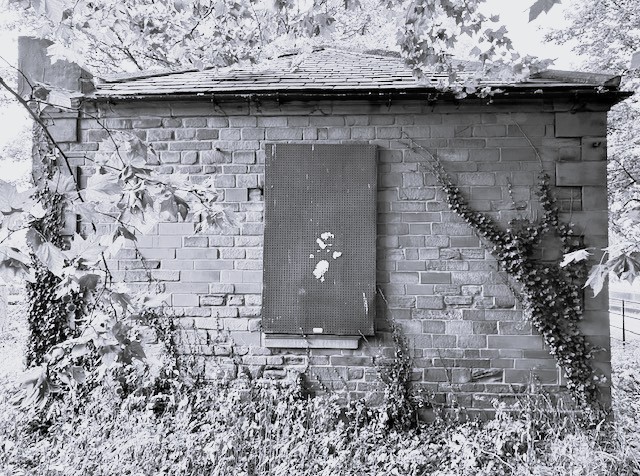
On my usual Sunday run – along the canal, the Sheffield and South Yorkshire Navigation, to Meadowhall, then up the long steep hill to Kimberworth church and back down, and up again and down, to Rotherham – on a rare cooler day, a cloudy August morning, in the third heatwave of an endless summer, I stop briefly in Masbrough, beside Rotherham’s ring road, to part the head-high branches of a water-deprived London plane, and find the unassuming brick box that is the Walker Mausoleum.
Resembling in its size the Hampton Court ice house in Home Park, it was made of red bricks in the Flemish bond pattern, with quoins of ashlar sandstone, though not of the local soft-pink Rotherham Red variety out of which many of the town’s finest buildings, including its forbidding minster, were built. It contains the remains of 23 members of Samuel Walker’s family, including the man himself who died in 1782, with the last internment dated to 1855. With his customary certainty, Pevsner wrote that Samuel ‘died in 1783 [sic], but the architecture of the austere little building is too Grecian for so early a date’.
The Walker Mausoleum, from College Road The Walker brothers – Jonathan, Samuel and Aaron – were sons of a nail-maker from Grenoside, a village whose curious name means ‘quarried hill’ in Anglo-Saxon, six miles to the west in what is now north-east Sheffield. As they surfed the waves of the Industrial Revolution, they made their fortunes as ironmasters. A schoolmaster who moonlighted as a surveyor and sundial maker, Samuel gave up teaching and threw in his lot with his brothers to manufacture furnaces and other premises and equipment for the iron and steel industry, including, in 1746, a major works, powered by the Don, a little upstream at Holmes.
Hand in glove with their moneymaking enterprise went their Methodism. Samuel and Aaron were early converts to the Great Awakening of the 1730s and ’40s, the Christian revival promoted by, inter alia, the Wesleys and George Whitfield. Whitfield’s more Calvinist branch of Methodism was more to their taste than the Wesleys’ Arminianism: predestination rather than free will. In 1763, they built the now vanished Masborough Independent Chapel in whose grounds the mausoleum stands. Functioning as a place of worship until almost the end of the last millennium, it became a carpet warehouse before fire damage led to its demolition in 2012. It had a close connection with Rotherham Independent Academy, a Congregationalist seminary founded in 1795, which moved in 1876 to the Gothic fort-like building on Moorgate Road that now houses a well-regarded sixth-form and adult education centre, Thomas Rotherham College, named after a late-15th Century Archbishop of York and Lord Chancellor of England.
At the top of one of the many hills overlooking the town, Samuel’s son Joshua built Clifton House – designed by John Carr, architect of Buxton Crescent, Harewood House, racecourse grandstands, prisons and much else – in the year his father died. Within this modest Georgian pile Rotherham’s excellent museum, gallery and archival study room are accommodated. Pevsner called it the ‘most ambitious’ of several such houses built locally in that period. The grounds which surround the house are a fine example of civic park landscaping, designed by upstanding Victorian aldermen to provide leisure activity for the town’s workers and their families as an alternative to drinking. It still admirably fulfils that function, with a recently upgraded watersplash play area, a magnet for children throughout this drought summer, plus crazy golf, rides, a sandpit and a splendid 1928 bandstand that is criminally underused. In three weeks’ time, the annual Rotherham Show will fill the park for a weekend celebrating the diversity and identity of the town through music, circus, other performance, stalls aplenty and, best of all, the fruit and veg produce display, prizes awarded in categories galore.

A ruined grave in the burial ground The mausoleum has been rendered even less prepossessing than Pevsner’s description, by the covering-up of the windows with boards painted racing-green, which, despite the building’s listed status, lend it an air not so much of abandonment as wilful apathy on the part of its supposèd protectors. What’s left of the adjacent burial ground of the erstwhile chapel is more desperate still: gravestones are overgrown, illegible and, in some cases, smashed. On the pedestal of the last remaining obelisk these words from the King James version of 1 Corinthians 15:52 are written in capitals, ‘for the trumpet shall sound and the dead shall be raised incorruptible and we shall be changed’. Among such waste land, it is the dead who will more likely be changed; turned to despondency, if not justifiable fury, at the rack and ruin into which their graves have fallen.
I take a few photos with my phone and resume my run, the overcast skies as sombre as the plight of the mausoleum and burial ground.
Later, on typing into the search engine, here, of the UCL database of British slavers and investors in slavery the names of the Walker clan, I find, to my pleasant surprise and relief, that none of them are listed there.

 Matthew Paul: Poetry & Stuff