On Sunday, I read for a lively crowd at poetry Performance in the Adelaide pub in Teddington. It was a very enjoyable evening, hosted impeccably by Del Bowen and with a diverse set of open mic readers, including the inimitable Heather Moulson. My thanks to Heather and Anne Warrington for inviting me. Here’s a picture, taken by Heather, of me in action:
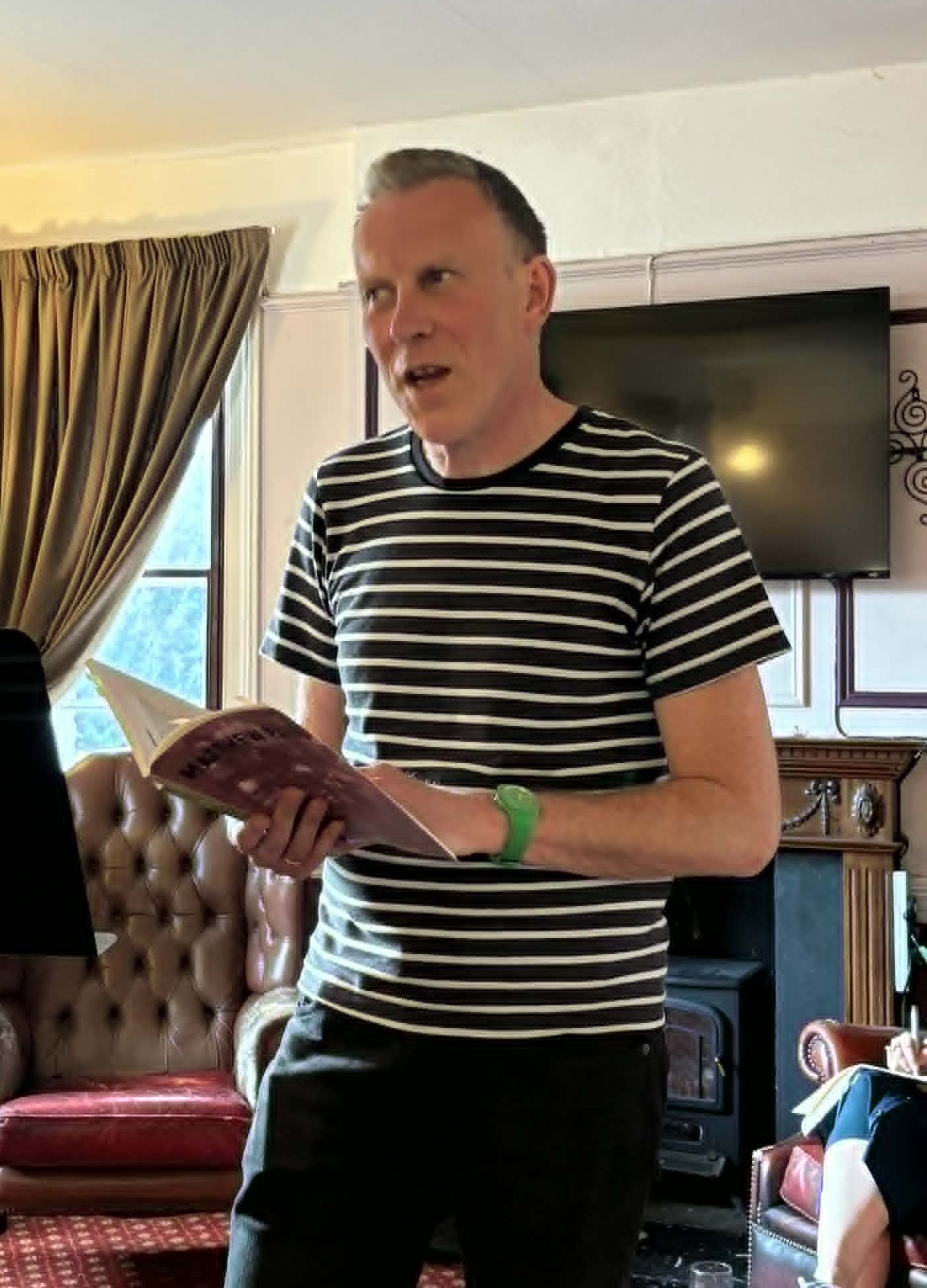
On Wednesday, I was one of the three guest readers for the York Launch of Andrew Neilson’s excellent collection, Little Griefs (Blue Diode Press), alongside Andrew’s wife, the brilliant Seren poet Kathryn Gray, and Katy Mahon, fine poet continuing her father Derek’s trade. It was held at the new branch of the Poetry Pharmacy, which looked splendid. I’m grateful to Andrew for inviting me.
On Sunday 21st June, I’ll be one of four readers at the Poetry Showcase of the Griffin Books Literary Festival in Penarth, alongside Bethany Handley, Tracey Rhys and Hilary Watson. My thanks go to Stephen Payne and Katherine Stansfield for their invitation. Details and tickets are available here.
I’ve read a lot of poetry lately, mostly books which have sat on my TBR pile for a good while. I enjoyed Mona Arshi’s latest Mouth (Chatto and Windus, 2025), or should I say I enjoyed two-thirds of it, as the poems based on Greek mythology left me cold as all poems about Greek (or Roman) mythology do, even when they were dealing with the most important of subjects, like the terrible ordeal and immense bravery of Gisèle Pericot. I realise that sounds rather Philistine, and that I ought to take the trouble to read the original stories which underpin such poems, but I just have an untreatable blind spot. (It might’ve been reading and studying Racine’s Andromaque for French A-level that caused it.) On a positive note, though, there were many lovely, lyrical poems that I liked and admired, not least ‘Driving’, the final four lines of which are these:
How carefully I drive now, so like my father,
into those powder-light memories where there’s
a sharp smell of foxes and a beetle is busy
in the twig-crotch scratching out its wretched sound.
I liked reading new poems by John Montague back when I subscribed to Poetry Ireland Review in the Eighties, so I was pleased last year to come across a copy of his 1999 collection Smashing the Piano (Gallery Books). There’s an argument to be made that he was almost as fine an Ulster poet as any of the famous ones, but, because he was a generation older than Heaney, Mahon and Longley, and left his native Tyrone long before the 1969-onwards Troubles, he somehow didn’t get mentioned in the same breath as them, except perhaps in the Republic. Smashing the Piano contains many reminiscing poems about his upbringing, translations of poems in Irish, poems of travel, and a sequence, ‘Civil Wars’ addressing the Troubles (and the years of IRA campaigns beforehand):
A RESPONSE TO OMAGH
All I can do is curse, complain.
Who can endorse such violent men?
As history creaks on its bloody hinge
and the unspeakable is done again.
One poem in the book leapt out at me as eminently anthologisable: ‘There are Days’, which begins thus:
There are days when
one should be able
to pluck off one’s head
like a dented or worn
helmet, straight from
the nape and collarbone
(those crackling branches!)
and place it firmly down
in the bed of a flowing stream.
I can empathise with that!
Having worked my way some while ago through the slab of a book which is C.K. Williams’s Collected Poems and much enjoyed the long-snaking-line style which he adopted in the mid-Seventies, I got round to reading his last collection, Falling Ill (Bloodaxe, 2017), published two years after his death. Each of the 52 poems was written in five, unpunctuated tercets. Alas, though, Williams wrote them throughout his cancer treatment, so the shadow of death understandably hangs over them to such an extent that they make for a grim, all but unbearable reading experience.
Much more enjoyable and intriguing was Lydia Macpherson’s new, highly-recommended collection The Heights (Calder Valley Poetry), available to buy here. It’s rooted in history, mainly of the area of West Yorkshire in which Lydia grew up and now lives again, near Haworth and the wuthering heights of Top Withens; encompassing the Cragg Vale Coiners, enclosure, domestic service and other issues of class and ownership which still resonate in our landscapes and society today. One poem I particularly liked was a partially-rhymed sonnet ‘Windows in Snow’, consisting of three elegantly-turned sentences, the middle of which is this:
Sometimes, a hint of a fly caught
like those in Baltic amber, or a tilt
across the diagonal, where some apprentice
knocked the frame in surprise
when they brought the news
of the death of the French queen.
Leontia Flynn’s Selected Poems (Carcanet, 2026) draws from all five of her collections and her book of translations of Catullus. I found many of the poems less engaging than I had anticipated and much less than the extravagant praise on the cover. That feeling reached its apogee when I (re-)read ‘Letter to Friends’ the rambling 11-page lowlight of Profit and Loss. I most enjoyed the seven sonnets from Drives concerning Casablanca, Beckett, Baudelaire’s mother, F. Scott Fitzgerald, Hitchcock, Bishop and Orwell; subjects which somehow suit her good-humoured style. A sucker for poems about swimming, I also enjoyed ‘Saturday at the Pool’ and ‘In the Municipal Pool’; the former opens with an arresting image:
The boy pauses at the end of the diving-board
then dives: a broad sword
cleaving the water – there is parting! And rejoining!
Catching the Light (Fairfield Books, 2026), the anthology of cricket poetry edited by Nicholas Hogg and Tim Beard, contains, as it should, several poems by the doyen of cricket poets, Alan Ross, including ‘Watching Benaud Bowl’: ‘Leg-spinners pose problems much like love, / Requiring commitment, the taking of a chance.’ But among the great and the good (Agard, Arlott, Dabydeen, Hughes, Brian Jones, Kunial, McMillan, O’Brien, Rollinson, Selby, etc.), there are many individual poems which leap out, especially those by S.J. Litherland – one of only nine female contributors – and Matt Merritt; the latter’s poignant pair of portraits ‘Two Orthodox Left-armers’ celebrates two Yorkshire and England greats, Wilfred Rhodes (‘Every ball an interrogation, / every over a conspiracy of art and science’), and Hedley Verity, who died in an Italian hospital of wounds sustained from fighting the Germans in Sicily (‘Shell-bursts, a net of tracers closing fast, / but as upright among blazing Sicilian corn / as on any Scarborough dog day.)
Another of the fine contributors to Catching the Light, Rishi Distidar, has just had his fourth collection published: Cherry Blossom at Nightbreak (Nine Arches Press, 2026). In it, his trademark quirky wordplay and use of form gets full rein – just a scan of the titles gives you the idea. At times, his wish to entertain occasionally spills into silliness, but that’s no bad thing in my book, and there are precious few other UK poets around – Selima Hill and Mark Waldron come to mind – who seem to remember that poetry can be something to enjoy as well as be moved by. Those familiar with Rishi’s oeuvre will know that he also writes poems on the most important subjects, like ‘On board the ‘Tynesider’’, concerning Martin Luther King’s visit to Newcastle in 1967, which ends with these beautiful lines:
But actually he was at his best
when he was harried, harassed –
by time as well as the times –
at 1am on a slow train to somewhere
he would never go again, minting
coin as easily as he breathed, currency
we still spend in the realm of hope.
It feels apposite that Rishi’s books should sit on my shelves between the Dickman brothers and Michael Donaghy. (Curiously, for me, one of the three dedicatees of the collection is the brother of a very sadly deceased schoolfriend of mine whom I mentioned in the title-poem of The Last Corinthians.)
*
In other news, my elder son, Conor, got 459 votes for the Greens in the ward (Surbiton Hill, in Kingston) he was standing in – the party went from nowhere to come second, in terms of votes, to the Lib Dems, meaning, obviously, that they beat the Tories, Labour and Reform (in that order). A win was never likely against a party who won almost every seat in the 2022 election, but still a good and encouraging effort. Under a PR system, the Greens would be the opposition; under first past the post, there is no opposition, which is very unhealthy for democracy. Anyway, well done, Conor; I’m very proud of him for standing and proud of his result.





Leave a Reply