Summer daze

I’ve always found the summer to be the only season in which I struggle to write poetry. Of course, an extraordinary heatwave like the current all-but-unbearable one inhibits doing very much except lounging about in whatever shade there is. Jackie Wills’s brilliant new collection aside, I’m also struggling to concentrate on reading; or doing anything else of consequence for that matter, though I enjoyed watching Ecuador win last night. If only all the World Cup games were on in the afternoon and evening . . .

That said, I finished a rare political-ish poem last week and sent it off to the Morning Star, who have since said they’ll publish it in August. As a lifelong leftie, it does my heart good to help to support a publication with values broadly similar to my own. I never quite understand why poets might, instead, want to place poems in right-wing rags, like The Spectator, which gives platforms to some truly odious far-right ‘thinkers’, such as very far-right Douglas Murray (its associate editor) and Max Klinger, and is edited by Michael Gove for pity’s sake. It also happens to be owned by Paul Marshall, the hedge-funder who set up GB News. I like its poetry editor Hugo Williams and most of his corpus of poetry as much as anybody does, but, to me, The Spectator’s values aren’t in the slightest bit compatible with the inclusivity of poetry.

I don’t buy the argument that getting poems published in journals and papers which don’t specialise in poetry must be a good thing per se; or that putting poetry in front of the sort of people who like to read very right-wing tripe might broaden, perhaps even change, their minds. I suspect that is very unlikely. In the same way that publications are necessarily picky about the poems they publish, poets surely have a moral responsibility to be picky about where they attempt to place their poems.

A counter-argument is that placing left-leaning political poems in left-leaning publications like the Morning Star and the New Statesman will only preach to the converted, but how likely is it that a right-wing publication would publish a left-leaning poem or even one that, say, even tangentially alerted the reader to the horrendous adverse impacts of climate change?

In other news, I thoroughly enjoyed my trip to Penarth, at the weekend just gone, to read at the literary festival organised by the fabulous Griffin Books. Not just my reading itself – alongside Bethany Handley, Hilary Watson and Tracey Rhys, each of whom read an excellent set of poems – but the whole weekend. The amazing poets Stephen Payne and Katherine Stansfield co-hosted the event, and Stephen even wrote and read out a clerihew for each of us four readers.
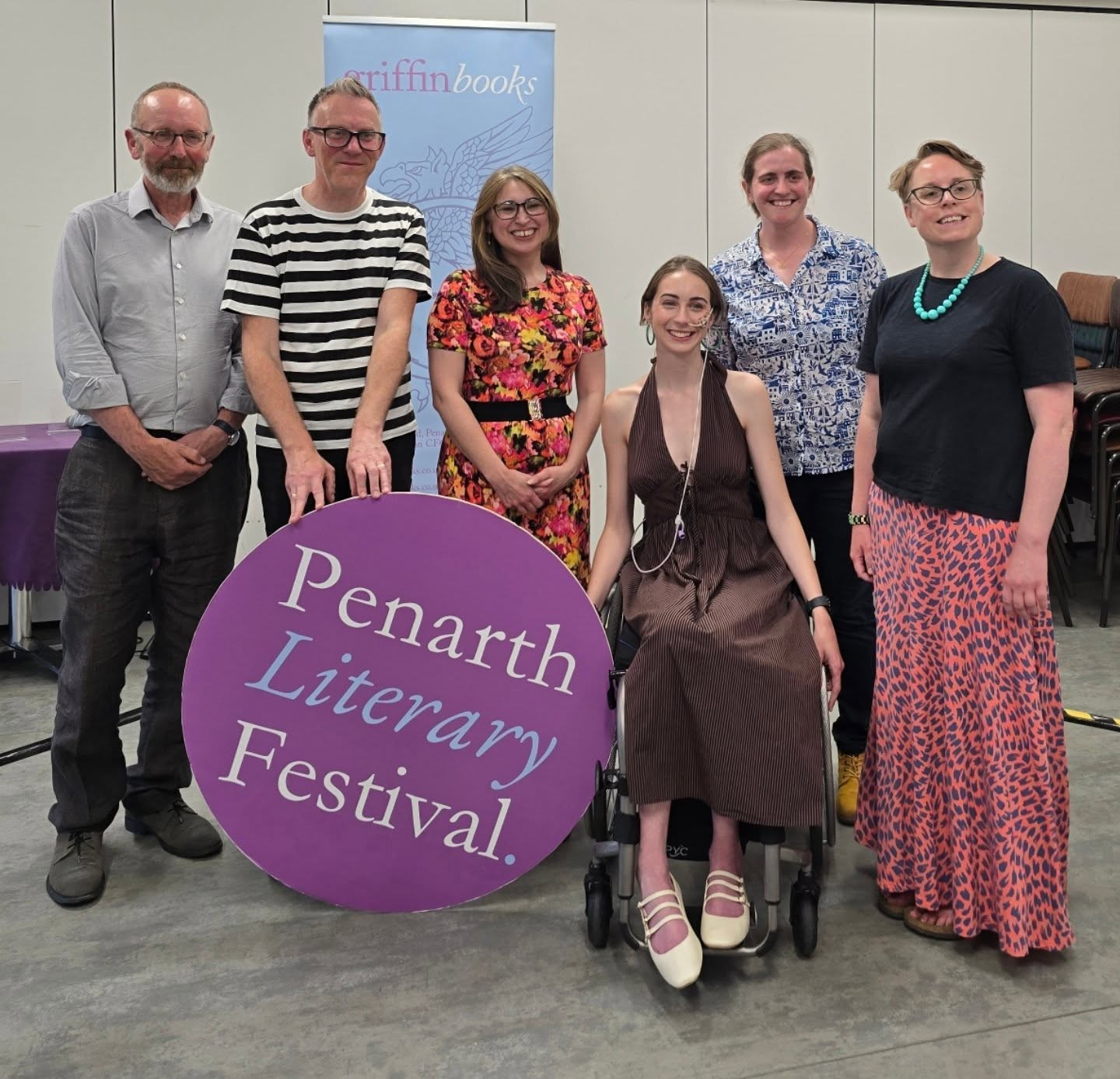
L to R: Stephen Payne, me, Tracey Rhys, Bethany Handley, Hilary Watson and Katherine Stansfield

Stephen and I also met up with about half of our fellow poetry book club members for a curry on Saturday night, and some of us went to see the ace Gwen John exhibition in Cardiff on Sunday afternoon. It served to remind me that it’s lovely to be part of different poetry communities, all of which are part of a wider, overarching one. I must mention that Stephen’s next collection will be published by Parthian Books this autumn. Parthian – website here – make beautiful books, including Tracey Rhys’s, with excellent covers and end-flaps and all.

Published by


Responses

  1. Claire Booker Avatar
    Claire Booker

    Matthew, you really have pricked my conscience here. I’m a huge fan of Hugo Williams, and he’s kindly taken a number of my poems for The Spectator, which most definitely doesn’t reflect my politics. I’ve had poems in The Morning Star too, which is closer to where I stand, though not unreservedly. What I would say, is that none of my Spectator poems were remotely right wing, and a number of them were of a distinct humanitarian nature, including poems on refugees, Nazi survivors, Bangladesh independence, and Northern Ireland after the Troubles. It may well be that they use their generous poetry slots (how many other mainstream publications carry up to four poems per issue?) to balance out their more luridly right wing content. I don’t think poems make the Spectator more saleable, but possibly they open up an alternative view for some who take it for the arts pages. Preaching to the converted certainly feels a happier choice, but in the end, isn’t poetry there to touch people, whoever they are?

    1. Matthew Paul Avatar
      Matthew Paul

      Hi Claire,

      Thanks for this. I’m glad to hear that that was the case; I wouldn’t for a moment suspect that your beliefs were in any way right-wing – I guess Gove and his deputy editors don’t read the poetry acceptances before they’re published. However, the relatively new ownership, under Marshall, is clearly more right-wing than the previous regime, and I can’t see what publishing poems there is likely to gain. Each to their own, but I wouldn’t want to be associated with it in any way, given that they also publish ‘opinion pieces’ by Gaza-genocide-deniers and other racists, lest anyone think I might share the publication’s general ethos. I accept that it’s an individual choice though. All the best, Matthew

  2. Claire Booker Avatar
    Claire Booker

    Yes, you’ve convinced me.

    1. Matthew Paul Avatar
      Matthew Paul

      I know it’s tricky, Claire, especially as Hugo is so lovely and a brilliant poet of course. Moral dilemmas, eh!

  3. quercuscommunity Avatar
    quercuscommunity

    My drive to be published is strong and if Satan announced he had a submission window opening next month I’d be there. And if he finds that it “raises some interesting questions but doesn’t quite fit the shape of the current edition in preparation”, I might resubmit it to Michael Gove.

    I have enough to worry about with writing, so don’t need the additional burden of making a moral judgement.

    1. Matthew Paul Avatar
      Matthew Paul

      Why is it an ‘additional burden’? Surely making moral judgements, either actively or passively, is an intrinsic part of writing poetry (or any art form) – for example, in what we choose to write about and not – so why would it not be part of deciding where to submit poems for publication? I presume you must draw a line somewhere, or are you just being mischievous?

  4. quercuscommunity Avatar
    quercuscommunity

    Sorry, I shouldn’t really have got involved in this, as any full answer I make is likely to be tedious. I’ll try to be brief.

    I’m not convinced that all poetry requires moral judgement. Mine doesn’t.

    I’m not really equipped to make such judgements anyway, and not sure it’s up to me to judge.

    Picking on safe targets like Michael Gove is more like bullying than making a moral judgement. How do we know that some of the others aren’t even worse?

    And then we have the poets – Byron, Graves, D’Annunzio and Pound as simple examples – incest, wife beating, fascism and so much else. I wouldn’t want any of them as a neighbour. Should we be reading them?

  5. Matthew Paul Avatar
    Matthew Paul

    Implicitly all poetry involves moral judgements, either by design or subconsciously, and I’m surprised that you suggest otherwise: e.g. the fact that most poets don’t write about their sex lives; in what they choose to write, or not, about family and friends; about what they disclose and what they don’t; the language which they use, whether and when to use swear-words, etc., etc. – unless all you write are observations of nature, but even then a poet can choose whether or not to be explicitly critical of mankind’s failings.

    I don’t quite get what you mean by ‘picking on’ Gove, and anyway as I said, it wasn’t so much as him as Marshall and some of the very far-right people they employ as columnists, essayists, etc.

    There has to be a line in the sand, otherwise poets would be publishing in some modern-day equivalent of Der Sturmer, so to say that you haven’t got one is very worrying indeed. I sincerely hope that isn’t the case.

    As for those poets you mention, I wouldn’t read D’Annunzio, no; Pound’s poetry bores me stupid; Graves is fine; Byron is fine. I wasn’t talking about poets who wrote in different times with different ethical values, but about the situation today, at a point in time when the far-right here and all across Europe, the USA, Australia and elsewhere, have more support at any time since Nazism and Mussolini’s fascism were defeated. I know which side of the moral fence I sit on that one and I would hope you do too.

    Anyway, thanks for commenting.

Leave a comment