Matthew Paul: Poetry & Stuff

  • About
  • Books
  • Contact
  • Haiku
  • Links
  • Poems, essays and reviews
  • Readings

  • February reading

    Another book which has been sitting on my TBR shelf has at last, and happily, pushed its way into my hands: Don Paterson’s Smith, sub-titled ‘A Reader’s Guide to the Poetry of Michael Donaghy’, Picador, 2014. As well as providing an enlightening exegesis of fifty key poems, it’s also interspersed with Paterson’s affectionate recollections of Donaghy, most notably in how he delivered poems and emphasised particular words. Paterson is especially good value on Donaghy’s sly evasions and ambiguities, born of extensive immersion in the Metaphysicals, Bishop and the New Formalists. As in his fine 101 Sonnets anthology, Paterson wears his erudition lightly and often amusingly.

    Cover of Smith

    One Language (SmithǀDoorstop, 2022, available here), the debut collection by the photojournalist Anastasia Taylor-Lind, intermittently dazzles with its poems from far-flung warzones, as in ‘Welcome to Donetsk’:

    You teach me this wartime trick –
    to look for living pot plants
    in the windows in Kievska Avenue.
    Most are crisped and brown.

    But one green geranium
    and a succulent spider plant
    offer proof of life
    for the person who waters them.


    It’s interesting that she writes ‘for the person’ and not ‘of’, and in so doing shifts the perspective from the external observer to the unseen person inside.

    Despite their most serious subject-matter, some of the poems feel inconsequential and fragmentary, like a diary haphazardly moulded into poetry. The most affecting highlight is a 12-part sequence, ‘Stories No One Wants to Hear’, recounting, in perhaps necessarily prosaic poetry, key incidents where, for better or worse, violence played a part in her life. I was left feeling that where she does tell her important stories well, Taylor-Lind might have rendered them more successfully still as a prose memoir, in the manner of Lara Pawson’s This is the Place to Be, because it feels like she has a lot more to say, e.g. regarding her position as one of the few females in her profession.

    Among other poetry, I’ve read two collections, her third and fourth, by Lavinia Greenlaw: Minsk (2003) and The Casual Perfect (2011), both published by Faber. Greenlaw’s voice is invariably very precise and coolly formal, even when she recounts memories of childhood and adolescence, so the poems which stood out for me are those where she lets her writing go a bit wilder, as in ‘Essex Rag’ from Minsk:

    The piano years . . . Too young to drive
    I played pedal to the metal,
    full reverb, wah-wah and fuzz,
    a collision course bending Chopsticks

    into hairpins, trilling the hell
    out of cheesy Für Elise.


    Minsk also includes the seven-part sequence ‘A Strange Barn’ in which each poem is about one of the buildings or enclosures in Regent’s Park Zoo. As the zoo is one of my favourite places in the world, I was pre-programmed to like these poems:

    His ancestor arrived in London at the dawn
    of transcendentalism and acetylene.
    Walking from the dock to Regent’s Park,
    he freaked at the sight of a cow in Commercial Road.

    (‘Spin’ – The Giraffe House, 1836)

    Taking its title from Lowell’s description of Bishop’s seemingly offhand descriptive prowess, The Casual Perfect begins with another poem implicitly concerning her teen years, ‘Essex Kiss’, which opens with a swagger (and a nod to MacNeice’s ‘Bagpipe Music’ maybe):

    A handbrake turn on a hair-pin bend.
    Merry-go-round? No, the waltzer.
    A touch as bold as  rum and peppermint.
    Chewing gum and whelks, a whiff
    of diesel, crocus, cuckoo spit.


    A similarly joyful spirit pervades ‘Saturday Night’:

    And young girls shall gather
    to dance on the highway
    under petals of light
    that float from their shoulders
    and dip into lotioned shadows.
    They shall coil their salty hair
    and tug at their lapsed muslins
    as they fall like cushions, and spill.


    Greenlaw’s poems are usually quite short, though no doubt they are chiselled out of much larger blocks. Her poem about the eponymous bird ‘Indigo Bunting’ exemplifies her delicately perfect phrasing: ‘A bird that can sing itself to earth as sky mirror / as if to prove there is no fall that is not reflection.’ Both collections made me want to read them again once I’d finished their last poems. As the successor to Matthew Hollis and his illustrious predecessors as Poetry Editor at Faber, Greenlaw occupies a position of considerable influence and authority. She’s published seven collections of her own poetry (plus novels, memoir and non-fiction, etc.) since (and including) her debut in 1991, her most recent being The Built Moment in 2019. Let’s hope her position at Faber doesn’t hinder her own poetic output in the way that it seemed to with Hollis.

    I’ve also re-read Still Life with a Bridle (translated by John and Bogdana Carpenter, Vintage, 1994) a book of ‘essays and apocryphas’ by Zbigniew Herbert, addressing various matters from the Golden Age of Dutch cultural and military might, including the now well-known folly of ‘tulip fever’. Like his poetry, Herbert’s prose mixes the profound with acerbic black humour. My favourite piece from the book is one of the shortest, ‘Spinoza’s Bed’, in which Baruch, aged 24, took his step-relatives to court in order to claim his inheritance two years after his father’s death in 1654, won the case but then claimed only his mother’s bed for himself.

    I’m now halfway through Paula Byrne’s excellent biography The Adventures of Miss Barbara Pym (William Collins, 2021), which I bought in an excellent Oxfam bookshop in Beverley last week. It’s as diverting as Pym’s novels, which is high praise indeed, I reckon. But Pym, despite an outwardly ebullient character, had melancholy times too; her and her sister Hilary’s lives had similarities with those of Jane Austen, one of Pym’s chief models, and her sister, Cassandra, a relationship which has just been dramatised in the excellent BBCTV series, Miss Austen, based on Gill Hornby’s novel of the same name.

    February 23, 2025
    anastasia-taylor-lind, barbara-pym, don-paterson, lavinia-greenlaw, literature, michael-donaghy, paula-byrne, poem, poems, poetry, writing, zbigniew-herbert

  • Review of Sue Hubbard’s God’s Little Artist

    In contemplating writing creatively about the life and death of a real person, famous or otherwise, one has (a minimum of) six key decisions to make, the last four of which are dependent on the first and second.

    First and foremost is whether to write poetry or prose. With five poetry collections and four novels already published, I imagine the decision Sue Hubbard made to plump for poetry to address her subject, Gwen John (1876–1939), wasn’t an easy one to make; however, the notes at the back indicate that Hubbard had previously written (at least) one poem about a moment in John’s life so perhaps that had left an itch that needed to be scratched. I admire Hubbard for even taking on such a large and complex project.

    The second decision, perhaps a subconscious one, is how much of the subject’s life needs to be recounted to do justice to their main events, relationships, successes, failures and emotions. Despite some artistic success, John, as is widely known now, had only one solo exhibition in her lifetime and lived in the shadow of both her two-years-younger brother, Augustus, who became the most celebrated British painter of their day, and Rodin, 35 years her senior, with whom John had an unequal relationship for a decade from 1904 (and whose forename was, by coincidence, the French equivalent of her brother’s). The 34 poems in this collection run chronologically from John’s childhood and adolescence in North Wales to her death in Dieppe, two weeks after the outbreak of the Second World War. As we’ll see, they aren’t ‘Wiki poems’, i.e. they don’t clunkily include facts for the sake of it; rather, they tend more towards impressionistic sketches, pleasingly in keeping with John’s style of painting. Neither do they amount to a full-blown biography (her mother’s death when John was eight isn’t mentioned for instance, though her absence can be inferred), but that doesn’t necessarily make them any less meritorious or successful than had Hubbard written a fuller account in prose.

    Thirdly, should the poet use the same voice – first, second or third person – throughout, and if so which; or should they vary it from poem to poem? Hubbard, I think wisely, has opted for the third person and stuck with it. The benefit of it is, of course, that it provides a certain objectivity, irrespective of how sympathetically the poems are cast. By contrast, writing in the second person almost always reads like a half-baked fudge. It might, though, have been tempting for Hubbard to use the first person; indeed, the notes tell us that the poem about John she’d had published previously was in John’s voice, so she has changed it for inclusion here. Maybe using the first person en bloc would have felt presumptuous.

    And fourth, what tense should be used, past or present, and, again, should that be consistent or varied? Hubbard has sensibly chosen to employ the present tense in all the poems, bestowing immediacy, timelessness and a sense of the life’s moments being never ending. Again, this choice surely aligns with the spirit of John’s paintings, and also with her Catholic belief in the life eternal.

    The fifth decision pertains to what form(s) the poems should take. Hubbard mixes them up, in a comparatively limited way: 16 are in couplets; five in tercets; six in quatrains; six in narrow-ish blocks; and one has four octaves. Really, though, the tone in all of them is the same, so the variation of the forms only succeeds visually, albeit that that helps to offset the tonal sameness. Whatever their length, Hubbard’s stanzas are rarely self-contained, and her block poems are always composed of several sentences.

    The sixth decision may, but needn’t, be subconscious: which narrative tone should be struck? As I say, Hubbard’s tone is consistent throughout: the broadly omniscient voice which enables depiction not just of what John does and what happens to her, but also, where appropriate, her thoughts and feelings. (Hubbard appears instinctively able to judge when to describe John’s emotional reactions and when to let events simply imply reactions.) That narrative consistency also drives the language Hubbard deploys: in echoes of how John’s palette was often muted (as Hubbard considers in a couple of poems), and how her adult life was lived in poverty, austerity and a lack of loving fulfilment, Hubbard’s writing is spare and purposely low-key, usually in short, frequently compressed sentences, though that means that when she uses adjectives their effectiveness is heightened, occasionally quite beautifully: in the poem ‘Teapot’ for instance, ‘a curdy light spills / into her china breakfast bowl.’

    Hubbard’s four-page introduction does not explain any of those decisions; instead, it gives a potted prose summary of John’s life, with a psychoanalytic slant. While that may be generous to the general reader who knows little of John’s biography, to others it may be superfluous. On balance, if read before the poems, it might well detract from them. Had it been included as an afterword, that would arguably have been more prudent, and I would advise potential readers of this book to approach it in that manner.

    Nevertheless, the poetry is engrossing from the start. ‘Luncheon in Tenby’ opens with a solid metaphor for the oppressiveness of the Victorian values perpetuated by John’s father towards her and her siblings, her mother having died when she was eight:

    The mahogany sideboard reclines
    against the wall like the chief mourner
    at a funeral.
    [. . .]

    [. . .]

    Her father demands quiet, so she
    and Winifred speak in signs.
    [. . .]

    Soon, Hubbard pictures John on her way to art school in ‘London— / leaving her stern father / with his taxidermy and law tomes, / his shelves of devotional works— / to embrace anatomy, perspective, / and the history of art’ (‘Slade’). There, ‘she learns from Tonks / a new freedom of line. / How to evoke round objects / on flat paper. Three dimensions / whilst working in two.’ This writing has a pleasing brevity to it, with just enough information conveyed for the reader to fill in the rest of the scene. In the life classes, we’re told that, ‘the women are strictly / segregated, the male nudes never / completely nude’ (‘Glaze’), with nice emphases at the line-ends to reinforce the prohibition. ‘Walking with Dorelia’ is a lively, humorous rendering of John’s 1903 walking tour in France with Dorelia McNeill, whom she met at Westminster School of Art and who was later to become her brother’s main, lifelong partner, and hints at their supposed mutual sexual attraction:

    [. . .]
    sleeping under haystacks and icy stars,

    lying on top of each other to stay warm.
    They wake to astonished farmers,

    gathered gendarmes peering curiously
    at les jeunes anglaises déshabillées

    huddled under a pagoda of portfolios,
    straw woven in their tangled hair.


    Hubbard captures well John’s hand-to-mouth subsistence in Paris from 1904 and the city’s colour and grime:

             [. . .] On the street corner,
          crippled in her sooty blacks
    la petite fleuriste hawks bunches
          of muguet and yellow mimosa.

    Across Sunday streets
          bells drift above junk shops
    and cheap bars where des maudits
          nurse glasses of cloudy absinthe.

    Far from Tenby
          this, now, is home.
    To eat, she knocks on studio doors,
          poses, if she can, for women.


    (‘Montmartre’)

    As that poem’s next stanza attests, the male artists were all too free with their hands, and it’s no coincidence, presumably, that the facing poem is the first of seven consecutive poems concerning John’s relationship with Rodin. It’s here that the collection truly hits its stride. ‘Modelling for Rodin’ (‘Naked before him, / she finds a new peace’) becomes something more: ‘the weight of him, // his tongue in her mouth / like something feral.’ Hubbard adroitly conjures the complexities of John’s relationship with the ‘Maȋtre’; how she can’t just make do with being one of his many model–mistresses, particularly in the vividly heart-rending poem ‘Love is Lonelier than Solitude’:

           She thinks of him all the time,
    an anchorite in her quiet cell
          waiting for his booted step on the stair,

           reluctant to go out in case he comes.
    All is clean and polished. Her hair washed,
            bluebells in a jar on the mantle,

          a bow around Tiger’s neck.


    The tangible sense of unrequited love that Hubbard conveys here continues in the poems that follow – ‘Fire’, ‘Hands’ and ‘Drawing the Cat’ –  in which John’s longing approaches madness, not helped by being forced sometimes into a threesome with Rodin’s (female) ‘Finnish assistant— // the one who thinks she’s ugly’. John wrote hundreds of fervent letters to Rodin without receiving replies, and Hubbard supplies a moving portrait of John with pen in hand, ending with an intriguing, apposite metaphor of liquidity for the futility of her passionate task:

    A flood of moonshine spills
    onto the round table,
    the blank white sheet,
    a millrace of words pulling
    her under, soaking her wet.


    (‘Letter to Rodin’)

    The post-Rodin poems are equally interesting. In ‘Suitors’, we see John’s attractiveness to a succession of other women. ‘The Poetry of Things’ and ‘Communion’ show John at work, drawing, in both her room and outside: ‘There is poetry in ordinary things, / her blue jug, the basket of kittens, // that line of busy ants’; ‘she takes her notebook / to Gare Montparnasse, sketches travellers with carpet bags // and furled umbrellas, though her chilblained fingers are freezing.’ Hubbard delves into John’s increasingly nun-like piety in a number of poems, not least the title poem, the precious thinness of which, almost as much as John’s art, is delicately crafted:

    Her God is a God of quietness,
    so she must be quiet.

    His love is constant.
    It does not despise,

    or rebuff like carnal love.
    She would live without

    a body, now. Its fleshy needs,
    its urgent desires
    [. . .]  

    What has crystallised for me through reading and re-reading God’s Little Artist is an appreciation of how well Hubbard inhabits John’s world, with all its disappointments, and draws out her character. Like Letters to Gwen John (Jonathan Cape, 2022) by the painter Celia Paul (no relation of mine), this is an important creative contribution to the ongoing reappraisal of John; but, more than that, its poems provide a fine match of uncomplicated forms and lucid writing to John’s ascetic life and exquisite art.


    God’s Little Artist by Sue Hubbard (Seren, 2023), £9.99, available to buy here.
    February 6, 2025
    art, books, gwen-john, literature, poems, poetry, writing

  • January reading (2)

    My further exploration of Dorianne Laux’s oeuvre has continued with Only as the Day is Long, her 2019 ‘New and Selected Poems’ (Norton). I’m surprised that no British publisher has brought out an edition of her poems, as I’m sure they would be very well received over here. They’re largely autobiographical, at times uncompromisingly frank – like many of those of one of her key influences, Sharon Olds – in how they address love and sexual love, mental health and sexual abuse. Like both Olds and Philip Levine, who was her mentor of sorts, Laux is over-reliant on the block-poem form, or at least, the selection in Only as the Day is Long makes it seem so. When read en bloc, block poems can resemble brain-dump splurges, in which stream-of-consciousness digressions and occasional non sequiturs are given free rein to run ahead of thought. The effect of this, without any Elizabeth Bishop-like periodic pauses, hesitations and tentative self-questioning, can therefore be a little wearying. However, when this mode succeeds, as in many of the poems from Smoke, e.g. ‘Fast Gas’, available to read and hear here, Laux is a dynamic, marvellous poet.

    That’s not to say that Laux can’t slow her poems down, by using other forms; ‘The Crossing’, for example, from her fourth collection, Facts About the Moon (2005), consists of nine couplets. Courageously, it unravels an encounter with ‘The elk of Orick’, in northern California. I say courageously, because it takes an extra-large dollop of chutzpah to risk comparison with Bishop’s great poem ‘The Moose’, which can be read here. Unlike ‘The Moose’, Laux’s poem didn’t take 26 years to write and doesn’t first have stanza after stanza of (wonderful) ‘dreamy divagation’ (a scene-setting  hymn to smalltown Nova Scotia) before the animal(s) finally appears; instead, it gets straight to the encounter, with wit and charm:

    The elk of Orick wait patiently to cross the road
    and my husband of six months, who thinks

    he’s St Francis, climbs out of the car to assist.


    As this opening indicates, the poem is effectively a love-poem. The description of the elks, one intuits, could equally apply to Laux’s new husband: ‘heads lifted, nostrils flared, each footfall // a testament to stalled momentum, gracefully / hesitant’. The mid-poem capture in words of the elks’ procession is magisterial and breathtaking:

                                            [. . .] They cross the four-lane
    like a coronation, slow as a Greek frieze, river

    wind riffling the wheat grass of their rumps.

    As in ‘The Moose’ the poem’s finale depicts a showdown with a female animal:

    Go on, he beseeches, Get going, but the lone elk
    stands her ground, their noses less than a yard apart.

    One stubborn creature staring down another.
    This is how I know the marriage will last.

    What a fabulous chink of poetry this is, as lovely in its way as Bishop’s:

    A moose has come out of
    the impenetrable wood
    and stands there, looms, rather,  
    in the middle of the road.
    It approaches; it sniffs at
    the bus’s hot hood.

    Towering, antlerless,  
    high as a church,
    homely as a house
    (or, safe as houses).

    In its briefer, but no less compelling manner, ‘The Crossing’ is as much of a classic poem as ‘The Moose’.

    There are several interviews with Laux online, including one, here, which includes this fascinating paragraph:

    Poetry is a slippery beast, a shape changer, a beast with wings, a bird/dog, a hermaphrodite, a water bearer and light bringer, the life force rendered through language, a sieve, a chute, a cone of darkness, an aggregate stone. It’s changed me by reading it, though not in a way I can speak of. It’s a feeling inside a thought inside an image.  It hunts me down. It haunts what haunts me. It changes me while I write it in that I lose myself inside it, making me weightless and colorless, fragile and fearless.  It’s always been with me, even before I knew what it was, it ran ahead of me as I walked through the world, making me look around and take it in through my senses, stop and stare, or listen, or smell or touch or taste until the object of my attention no longer possessed a name, and then poetry dared me to name it.

    That ‘It hunts me down’ is chilling but any obsessive poet can surely identify with it, and with the wider sentiments expressed in these sentences.

    Why Elizabeth Bishop has been on my mind is because I’ve also been re-reading her Collected Poems and a 2002 book of essays, Elizabeth Bishop: Poet of the Periphery (Bloodaxe), edited by Linda Anderson and Jo Shapcott. What’s intriguing about the essays is that most of them are written by esteemed poets – Nichola Deane, Michael Donaghy, Vicki Feaver, Deryn Rees-Jones, Jamie McKendrick, Peter Robinson, Anne Stevenson and Shapcott herself – some of whom are, or were, academics also, rather than by academics who aren’t also known as poets, so they are more personal, readable and less dry than might otherwise have been the case. That said, though, the essay I liked the best and got the most from was by Barbara Page, at that time Professor of English at Bishop’s alma mater, Vassar College, in which she analyses some of Bishop’s draft to see how the poems were sharpened by changes of emphasis, especially in the last few stanzas of ‘The Moose’.  Donaghy’s contribution, the briefest in the book, considers the influence of Auden. Feaver slightly overstates the case that ‘Bishop reclaims not just the female psychic space from which she was ejected at birth, but the psychic female space lost to her in early childhood through her mother’s severe mental illness and subsequent incarceration in an asylum’ (and death). Rees-Jones’s highly idiosyncratic piece starts with admissions that she had come to Bishop’s poems ‘reluctantly’ and hadn’t read all of them, and she doesn’t really add much from then on. Despite, and maybe because of, these and other flaws, it’s an engaging assortment and well worth tracking down.

    I have at last read Kathy Pimlott’s third pamphlet, After the Rites and Sandwiches (2024), available to buy here, from The Emma Press. Longstanding readers of this blog will know that I am a huge fan of Pimlott’s poetry, but I knew that the subject-matter of this pamphlet – the accidental death of her husband and the aftermath – wouldn’t be an easy read. ‘No Shock Advised’, the second poem – after the lovely ‘Prologue: First Date’, the dreamy surrealism of which makes the shocks of ‘No Shock advised’ even more shocking – reimagines the tragic hopelessness of the scene: ‘It’s cruel work /to kneel down / and hunch over / a so-familiar body at the foot of the stairs [. . .]’; that ‘there’s nothing / to be done // [. . .] but how still the sweet mad hopeful brain insists / it will be ok ok ok’. Over the course of its 12 tercets, the next, outstanding and, in its precise unfolding, very Pimlottian, poem, ‘How to be a Widow’, floats through the grief-addled labyrinth: what was happening immediately before and after the accident; what ‘experts’ advise the newly-bereaved to do to keep busy; how other people might shy away from death and, moreover, from the partner who is bereaved; even into a synaesthetic recounting:

    Who wants to hear about the colours? Normal, then purple
    then grey in a moment like the sea changing as light
    shifts with the clouds. No-one. Colonies are collapsing.


    The sonic and visual similarities here, between ‘colours’, ‘clouds’, colonies’ and ‘collapsing’, augment the strangeness.

    The rest of the pamphlet takes in, inter alia, the difficulties innate in navigating post-death bureaucracy, the first Christmas after the event (‘no-one contesting the way to ignite brandy’) and the anxiety that bereavement causes; and also reflects on the relationship Pimlott and her husband shared, not always sweetness and light, and how and where to scatter his ashes. Fine poetry about the complexities of bereavement is rare – Hardy, Dunn and Reid, all men curiously, spring to mind – but the skilful poems in Pimlott’s After the Rites and Sandwiches are exemplary in their objectivising of this most subjective of subjects.

    January 26, 2025
    elizabeth-bishop, kathy-pimlott, poem, poems, poetry, writing

  • Review of Gerry Cambridge’s The Ayrshire Nestling

    With thanks, as ever, to Hilary Menos and Andy Brodie, and also to Helena Nelson for a helpful point of clarification, my first review of the year is up at The Friday Poem – of Gerry Cambridge’s superbly written memoir. The review is here.

    January 17, 2025

  • January reading (1)

    I’ve started my reading in this new year where I left it in the old, with the American poet Dorianne Laux. I’d first encountered Laux’s poetry back in September, when ‘The Shipfitter’s Wife’ was one of many poems I enjoyed in the Seren anthology Women’s Work, edited by Eva Salzman and Amy Wack, and soon after bought a secondhand copy of her 2000 collection, Smoke, published by BOA Editions., which coincidentally includes that poem (It’s available to buy on their website, here.) Laux’s poems are plain-speaking, but far from plain. Here’s the opening sentence of ‘Pearl’, a 38-line, block poem about Janis Joplin:

    She was nothing much, this plain-faced girl from Texas,
    this moonfaced child who opened her mouth
    to the gravel pit churning in her belly, acne-faced
    daughter of Leadbelly, Bessie, Optis, and the booze-
    filled moon, child of the honky-tonk bar-talk crowd
    who cackled like a bird of prey, velvet cape blown
    open in the Monterey wind, ringed fingers fisted
    at her throat, howling the slagheap up and out
    into the sawdusted air.

    I especially like that ‘gravel pit churning in her belly’, and the repetitions of ‘faced’, ‘moon’ and ‘belly’. Laux would’ve been 15 when Joplin fronted Big Brother and the Holding Company at the Monterey Festival, and she must’ve been inspired by Joplin’s example of a young woman putting herself and her soul right out there. The poem is both a paean and an elegy for ‘this little white girl / who showed us what it was like to die / for love’; but beyond that, it is, like many of the poems in the book, an elegy for the wilder times of the late ’60s and the ’70s.

    I also loved Invisible Dog (Carcanet, 2024), available to buy here, a generous selection from the oeuvre of the Mexican poet Fabio Morábito, translated brilliantly from Spanish into English by the Welsh poet Richard Gwyn. In an interesting ‘translator’s note’ afterword, Gwyn notes that Morábito’s first language is actually Italian and that he didn’t live in Mexico until he was 15. Gwyn evidently worked very closely with him on the translations. One thing I like is that Gwyn more often than not plumps for the direct translations of words, rather than sometimes not-especially-close synonyms, the approach which blighted the last translated poetry published by Carcanet that I read, It Must be a Misunderstanding, Forrest Gander’s translation of another major ’50s-born Mexican poet, Coral Bracho. Morábito’s poems are always set out in narrow-ish blocks, and the tone is invariably one of someone just matter-of-factly and often wryly pointing out how things are. In ‘Unidentified’, for example, he shows us the poignancy of anonymity:

    In the last photo
    we find him once again,
    this time in the middle of the group portrait,
    embracing the others,
    and they are all smiling and embracing him in turn,
    all with a first and last name except for him,
    who was not identified.


    Another very enjoyable read was the SmithǀDoorstop anthology, 5, a bargain-buy available here, showcasing five new, or, rather, new-ish, poets who are all members of the Writing Squad, whose website is here: Helen Bowell, Prerana Kumar, Eva Lewis, Laura Potts and Ruth Yates. Each contributes six poems except Lewis with three. Kumar’s explorations of her Indian heritage and use of language stand out:

    Let us believe her bones remain bird-hollow
    in this wind that smells of rosemilk,
    let her hear the grinding of cardamom,
    a sparrowed lullaby humming the weeds

    (‘I rewind the Second My Mother’s Girlhood Breaks’)

    Potts’s poems are also linguistically rich – ‘Yesterday’s Child’ begins, ‘The sun slid like a knife through the April night / and bled like an egg, like a budburst head’ – but also have an appealing, melancholy tone to them. Yates’s poems are quirky and funny (haha), like those of her father Cliff and brother Luke, with an engaging unexpectedness: one poem begins with an ‘Oh!’; and my favourite poem in the anthology, the utterly marvellous ‘Otter’ opens thus:

    They used to swim in Nye Bevan pool,
    just before chips. Nicknamed Otter
    for their ability to stay at the bottom of the pool
    and crawl along it, way before their Taekwondo
    years: this was self-control, perseverance,
    indomitable spirit. [. . .]

    I admire any poet who can chuck in big abstract nouns like that and make them count.

    So far this month, I’ve also read two prose books and started a book of letters. The first was a book I bought and read 30 years ago: Kellow Chesney’s The Victorian Underworld, first published in 1970 and now, it seems, out of print, which is a shame because it’s a genuine classic. Chesney scoured through the archives, newspaper accounts, correspondence and many other sources to give a full flavour of the sub-strata of British society in the middle decades of the 19th Century. In passing, Chesney considers the worlds of itinerant workers, e.g. ‘navvies’ and circus and other show folk, plus beggars, and criminals and their networks of all kinds, and how these worlds symbiotically interacted. The details are at times unbearable, especially the descriptions of the appalling living and working conditions in the ‘rookeries’ of London and other cities. Chesney employs the slang vocabulary of the times, summarising them in a glossary, which includes such gems as ‘beak-hunting’ (poultry-stealing), ‘choker’ (clergyman), ‘crabshells’ (shoes), ‘crusher’ (policeman), ‘flying the blue pigeon’ (stealing roof lead) and some which are too prurient to repeat.

    Having loved its predecessors, I was naturally predisposed to liking Barbara Pym’s third novel, Jane and Prudence (1953), in a Virago edition with a lively and perceptive introduction by Jilly Cooper, who claims it is Pym’s finest novel. Fine and witty though it was, for me it didn’t quite reach the heights of Excellent Women. One of the joys of Pym’s writing lies in how she could turn a crisp and delightful simile:

    Miss Trapnell went to the filing-cabinet and put some pieces of paper into a file, and Miss Clothier drew a small card index towards her and began moving the cards here and there with her fingers, as if she was coaxing music from some delicate instrument.

    The letters are in Words in Air, the collected correspondence between Elizabeth Bishop and Robert Lowell – even in its paperback form, it’s a slab of a book, due in part to over-scholarly and therefore over-fussy editorial annotations. A treat nevertheless and I’m only about a tenth of the way through so far.

    January 14, 2025
    poem, poems, poet, poetry, writing

  • December reading

    What reading I have done this month has principally been on buses, trains and trams. Bus journeys – to and from Doncaster or Sheffield – in particular are ideal for reading poetry collections. Derek Mahon’s final collection, Washing Up (Gallery Press, 2020), available here, was some way to bow out.

    Cover of Washing Up

    Understandably, aging and awareness of mortality, which the punning title implies, are much to the fore, not just in self-portraits, but in portraits and remembrances of others too:

    Not even holidaymakers really bother
    Joseph the beachcomber, who spends his days
    sitting among the rocks and the rock pools
    absorbed in his own thoughts, his own schedules,
    like a bōdhisāttva or a Desert Father
    for whom this life is only a glum phase.

    (‘Among the Rocks’)

    Candlelight in Portstewart,
    forty-odd years ago now,
    and your tin whistle starts
    the tots jigging as though
    instinctively they know
    just what to dance and how.


    (‘A True Note’, i.m. Ciaran Carson)

    Mahon’s mastery of forms – including Lowellesque sonnets – and rhyme, the quality of his translations, and his poetic gifts in toto were undiminished to the end. ‘Another Cold Spring’, nodding to Elizabeth Bishop, contains a lovely, gracefully controlled discursiveness:

    Another cold spring —
    the same as last year,
    the previous year also,
    a late storm papering
    the daffodils with snow
    and leaving the sky clear.

    We can’t depend upon
    the meteorology from one
    month to the next, the seasonal
    graph of established weather
    having been since revised
    or scrapped altogether;

    but when could we ever?


    I read another book by Ruth Fainlight who, at 93, is surely Britain’s oldest excellent poet: Burning Wire (Bloodaxe, 2002) and enjoyed it so much that I’m reading it again. Why I like her poems, I think, is because she notices things so acutely and lets the spotlight on her observations do most of her work. Take the simmering swelter of ‘Sunday Afternoon’ for example:

    A Sunday afternoon in late July:
    the leaves look tired, the sky is clouding up,
    pressure falling. The couple
    in the next apartment are arguing
    about how much he does or doesn’t help.
    Eavesdropping from my terrace.
    I am jealous of how it’s bound to end:
    the stuffy bedroom. Moans and love-cries muffled
    so the baby won’t wake.
    I remember every detail of
    the misery there is in marriage –
    and then making up.


    Elsewhere Fainlight considers her (and her parents’) place within English society with a surprising degree of otherness, but not, surely, without a note of humour:

    A Jewish poet in an English village:
    incongruous and inappropriate
    as a Hindu in an igloo, a Dayak in
    Chicago, a giraffe at the South Pole.


    (’The English Country Cottage’)

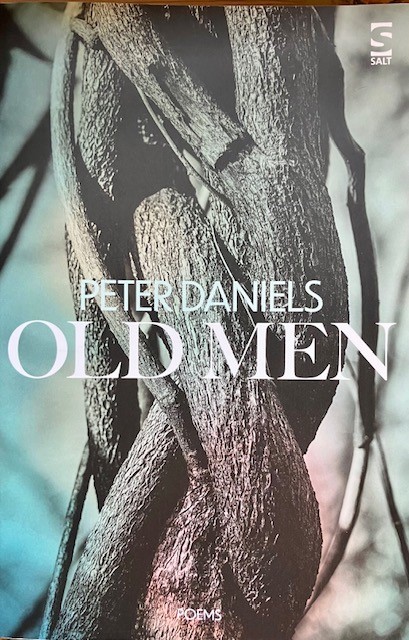
    Otherness is one theme in Peter Daniels’s latest, superb collection, Old Men (Salt, 2023), available here.

    Cover of Old Men

    Many of the poems concern being a gay man of a certain age in Britain, such as the wittily allusive ‘Old Keys’:

    Old keys open strange doors where the dark
    dwells in the lock. Entering the front brings you
    through to the back where the furniture is
    older and stranger. There’s a thick brown varnish
    chipped, you might imagine, by spurs of cavalrymen
    waiting to be undone, away from truth or whatever
    they fought for. Their own bodies asked to be
    betrayed, but they faced any soul unburdened
    behind those doors, overcome by the frantic power
    with its affront to virtue passing unchallenged.


    As exemplified here, Daniels’s syntax is old-school (i.e. without irritating contrivances), elegant and satisfying. The book also contains several memorable and moving poems about objects and stuff which transcend the immediate matter at hand e.g. ‘Royal Worcester’ (‘Its chime resounds / in time and space and is real.) and ‘Empty Boxes:

    I have many lovely boxes, too lovely to fill,
    like these nifty cigar boxes, some plain wood,
    some fancy ones. The man who gave me them
    forty years ago, he’s been dead for thirty-five:
    they screwed his box down tight, afraid
    of what they had to put away inside it.


    The title poem is a microcosm, a masterpiece representing a whole collection of masterpieces, with a nod towards Larkin’s ‘Annus Mirablis’:

    It all began too late for us, but what we hold
    offers this lifetime more than making do:
    we make each other real enough to touch,
    with time to spend where we complete each other.

    And talking of Larkin . . . in February 1952, he offered some words of advice in one of his very regular letters to his mother, Eva, who was suffering from depression, almost four years after the death of her husband, Sydney:

    Do not worry about the past: it is, after all, past, and fades daily in our memory & in the memories of everyone else. Further, it can’t touch the future unless we let it. Every day comes to us like a newly cellophaned present, a chance for an entirely fresh start. Finally, do remember that we are not very important. Hundreds of living people have never heard of us: those who died in previous years & those who will be born in the next century have no chance to, and in consequence we are silly if we do not amble easily in the sun while we can, before time elbows us into everlasting night & frost.

    Excellent advice, I’d say, and exquisitely written. It comes from Letters Home, 1936–1977, edited by James Booth, Faber 2018, p.201.

    I’m off to amble in what’s left of today’s thin sun, if I can find it in the fog which has hung about for two days now. Thank you for reading any of my posts this year, dear reader, and happy new year when it comes.

    December 27, 2024

  • My year in haiku

    I’ve had a grand total of nine haiku and senryu published this year, which is pitifully few compared to my heyday, but nonetheless represents an increase on last year. I write them so seldom that it’s a wonder that any are publishable, so I’m very grateful to Ian Storr and Tanya McDonald, the editors of Presence and Kingfisher respectively, for finding merit in them. The four poems below aren’t necessarily the best of the nine, but represent each of the batches I submitted.


    exit interview:
    the nice fella from HR
    chats about himself


    *

    the echoing mews
    of clear-sky buzzards . . .
    greenness of moss

    *

    on a notepad
    in the stonemason’s yard:
    names to be carved


    *

    a tight peloton
    easing up Reservoir Road
    back-gliding kestrel


    *

    1 Presence 78
    2 Presence 79
    3 Kingfisher 10
    4 Presence 80

    December 18, 2024

  • Back to Michael Hamburger

    It would be remiss of me not to revisit Hamburger before his centenary year ends. I wonder who else has marked it; not even PN Review as far as I can see, a surprising omission given that Carcanet ‘inherited’ Hamburger when they absorbed Anvil’s list and then published A Michael Hamburger Reader, available here, ten years after Hamburger’s death (and five after its editor, Dennis O’Driscoll’s).

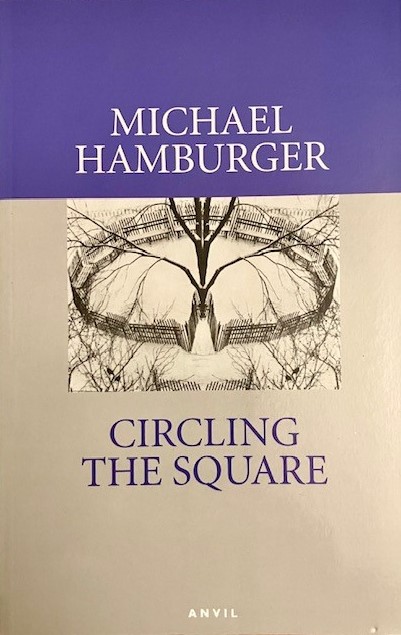
    His final collection, Circling the Square (Anvil Press Poetry, 2007), was published not long before he died, in June of that year.

    Cover of Circling the Square

    His love of nature, particularly in his adopted home county, shone forth to the end, none more so in the poem below, suffused with colour and light, fading to darkness at its close. As ever, his syntax was slightly, but likeably, awry, here within the penultimate stanza.


    Winter Evenings, East Suffolk

    The sun’s and our days are shortening
    While before solstice the visible moon fills out,
    What on these lowland wide horizons lingers
    As though to reiterate, recall, is dusk:
    On the south-western from flame to glimmer
    Slowly the glow subsides
    From scarlet to roseate, amber drifts and shifts
    Or else to a strip of blue
    Deeper than any a summer noon sustained.
    If a black cloud hangs there it shines
    Rimmed with departing light.

    December’s last leafage responds:
    A red so dark on this maple
    It’s nightfall too, detained,
    Wisps of pale yellow to ochre
    On the rugosa stems wilting
    As on those with buds for another year.

    Then, moon not yet full, whole skies
    Whether clouded or clear
    And silver tarnishing.

    Never a night is total
    Until our vision, dimmed,
    Disowns the shapes, the shadows,
    All colours mixed on palettes too far away.

    December 14, 2024

  • Poem at Atrium – ‘Entertaining’

    With thanks to editors Claire Walker and Holly Magill, I’m very pleased to have a poem up at Atrium today, here.

    December 6, 2024

  • November reading

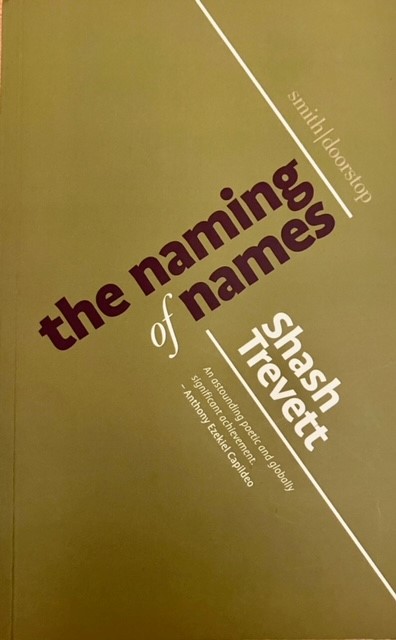
    Shash Trevett’s debut full collection, The Naming of Names, published by the Poetry Business and available to buy here, follows on from her 2021 pamphlet From a Borrowed Land, with more poems relating aspects of the Tamil experience of the civil war in Sri Lanka between 1983 and 2009 and some on other, ancillary matters: British colonialism and racism (including that of the UK government’s immigration policies). Readers may also know that Trevett was one of the three co-editors of the exemplary and acclaimed Out of Sri Lanka anthology, published by Bloodaxe last year.

    Cover of The Naming of Names

    Estimates, disputed by the state’s Sinhalese majority, suggest that more than 100,000 Tamil civilians died during the conflict, many as victims of brutal violence, including sexual violence, bombings, massacres and/or dismemberments. As the title indicates, Trevett’s collection aims to put names to some of those victims, to reanimate them as real people, so that they aren’t just statistics. As a refugee from the war herself, Trevett writes with understandable passion, though in spare language which allows the individual and collective stories and incidents to speak for themselves without embellishment. It’s necessarily a difficult read, as any bearing of witness to war crimes is, as in ‘And on the Ceiling, a Lizard’:

    When he rested his gun against the wall
    and told me to lie down.
    When he placed a grenade by the pillow
    and unbuckled his belt

    I watched the dust motes hang
    in the air and the lizard freeze
    on the ceiling, and knew that words
    had never had the power to save me.

    This almost matter-of-fact recounting magnifies the terror far more than any liberal sprinkling of adjectives could do. It’s hard in reading this fine collection not to think of Gaza, Sudan and other places where State-inflicted warfare inevitably kills thousand of civilians as collateral damage. Above all, though, it shines a light on what very specifically happened to the Tamil people, the ramifications of which are naturally still being felt. (When I worked for Kingston Council, in the Student Awards team, in the early 1990s, I saw a good number of customers who were Tamils living in exile in Tolworth and some of whom revealed the circumstances of what they’d seen. That Tamil community is still going strong.) This brave, elegantly crafted collection doesn’t flinch from the horrors, yet somehow also finds a sense of beauty among them:

                     [. . .] The last mango tree
    waits, remembering those years when children
    clung to its branches, women picked its fruit –
    green for pickling, honeyed orange for eating.
    The last mango tree knows that its branches
    hold the secrets of a lost people.
    It stands guarding memories, surrounded
    by abandoned and derelict life.


    (‘The Last Mango Tree’)

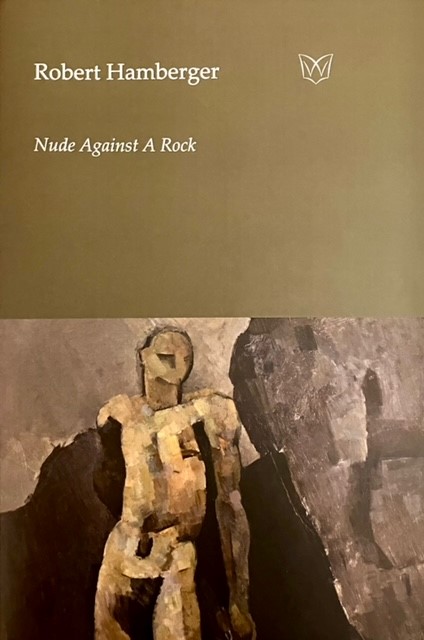
    I’ve written about Robert Hamberger’s poetry before, in a review for The North of his 2019 collection, Blue Wallpaper; I concluded by saying that, ‘It’s high time that Hamberger becomes widely acknowledged as the marvellous poet he is.’ His new, fifth collection, Nude Against a Rock, published by Waterloo Press and available to buy here, amply justifies my belief that Hamberger is a highly gifted poet.

    Cover of Nude Against a Rock

    It’s a bumper collection, stretching to 100 pages, yet it doesn’t feel over-stuffed. That may in part be because most of Hamberger’s poems are fairly short, including lots of his trademark exceptional sonnets, which he always turns with a naturalness belying the constraints of the form; but more, though, because they always have a discernible point to them. The first section contains 17 poems about his husband, such as the terrifically-titled and tender ‘Love Song for a Bigot’:

    If whatever I do tonight
    makes you shudder you don’t need
    to watch. When I kiss his eyebrow
    his shoulder his dick it’s none
    of your business. I claim sanctuary
    in his arms. My door is bolted.
    I’m an eel and he’s my river.


    The middle section, of 46 poems, is more miscellaneous: here we find, inter alia, poems for and about his children and grandchildren; recollections of his father and mother and of old, departed friends, including Mark Hollis of Talk Talk, and his aunts who so memorably featured in Blue Wallpaper also. There’s also a sonnet called ‘Street Song’ – presumably a nod to Thom Gunn’s poem of the same name, though the two poems’ subjects are very different – which seems to be in the voice of a homeless person: ‘Who owns me? Who chose / to call me mister when time’s harder / than ten pavements and I need no sparrows / whistling for my crumbs?’

    The final section has the same name as the book’s title, deriving from a painting by the gay artist Keith Vaughan, 1912–1977. Its 28 poems respond to selected journal entries of Vaughan’s, from August 1939 up to his suicide by an overdose after two years of living with cancer, and/or other writings and artworks. Sequences can often feel too forced in places, but this doesn’t, as Hamberger fully inhabits Vaughan’s voice and creative mind, at times thrillingly:

    You leap into paint:
    its scuffs and strokes and splashes –
    gouache seems a caress on paper,
    oils a sticky glut, ink and wash
    thunder and cloud. They make a man
    of you, this body of contradictions
    standing barefoot by the easel.
    You leap over naysayers, the obstructers,
    your damned neurosis, foggy doubt.
    You leap over courts of justice,
    steeples in autumn villages,
    your mother’s grip, your lover’s smothering.

    (‘Leaping Figure’)

    He also convincingly ventriloquises Vaughan’s despair towards the end:

                 Shall I drink now from the yellow cup,
    let rainfall soak a broken lip
                                      a parchment tongue –
              stream into my hands until
    I’m overflowing? Look how this slate
                                   edge balances green,
               how empty my hours have become –
    like a jug loses purpose when the pouring’s done.


    (‘Still Life with Greengages and Yellow Cup’)

    As I noted four years ago, Waterloo Press’s production values are superb, perhaps the best of any poetry publisher in the UK, and in this case they perfectly augment the satisfaction which the reader gains from the tremendous contents.

    I’ve also read two more Rupert Thomson novels: The Book of Revelation (2000) and Never Anyone But You (2018). The more I read Thomson’s books, the more he reminds me of Brian Moore, whose novels spanned a vast range of subjects, narrative voices and styles, but never less than compellingly; and like Moore knew, Thomson also knows how to write proper page-turners. Given that my attention span for prose is much lower than it used to be, that fact is increasingly important!

    To give a flavour of the plot of The Book of Revelation would be to ruin it, so suffice to say that its plot twists and first-person psychological insights are engaging throughout.

    Never Anyone But You is also written in the first person, in the voice of Suzanne Malherbe, AKA Marcel Moore, and recounts the lives and deaths of Moore and her lifelong partner, Lucy Schwob, AKA Claude Cahun. As is increasingly well-known, both Moore and Cahun were avant garde, multi-talented creatives who chose to live their unorthodox, gay lives openly. I loved this line:

    The longer you’re with someone, the more mysterious they become.

    Moore and Cahun’s finest moments arguably came during the war when, living on Jersey, they defied the Nazis for four years by spreading  propaganda leaflets designed to demoralise the occupying forces, until they were betrayed to the Gestapo. Thomson’s version of their story is really quite beautiful and evidently painstakingly researched. Thomson’s output is yet to garner any literary prizes whatsoever, which is mystifying. Hey ho.

    November 30, 2024

  • Review of Victoria Gatehouse’s The Hawthorn Bride

    With thanks to the editor, Hilary Menos, for commissioning it, my review of Victoria Gatehouse’s excellent debut full collection, The Hawthorn Bride, is at The Friday Poem today, here.

    The collection, published by Indigo Dreams, is available to buy here.

    November 29, 2024

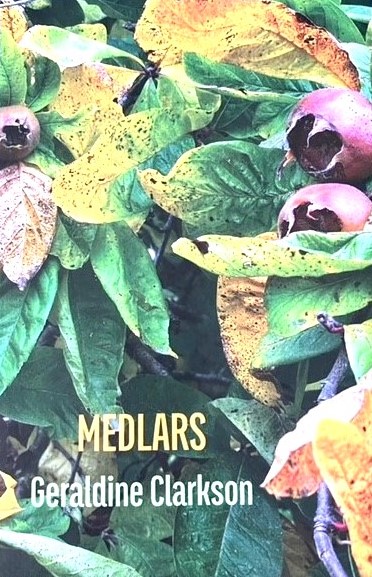
  • On Geraldine Clarkson’s Medlars

    It’s been a while since I read Chris Edgoose’s admirable and enticing review for The Friday Poem, here, of Geraldine Clarkson’s second full collection, Medlars, available to buy from its publisher Shearsman Books here (with free p&p, might I add); and therefore about time I bought and read a copy. That I have now done, and what a deferred pleasure it was and is!

    Cover of Medlars

    Mystifyingly overlooked for the major prize shortlists, Medlars is simultaneously both a state-of-England-post-Brexit collection and one which explores the nation’s folklore and psychogeography. It does so in rich, often tongue-twisting language; the wordsmithery of Shakespeare by way of Raymond Queneau and even, perhaps, ‘Professor’ Stanley Unwin. Consider, for example the second part (‘oulipo yew engenders TT strop’), a sonnet of sorts, of ‘golden opportunity, wet streets’, which I find it difficult not to read in Unwin’s voice:

    oily graveside glove shunted. Motto pops.
    Cone shape sings, mining tissue
    of hay – vie
    a dapple, a coin, a thorny no.

    In pop tryout, a doter overeaten (why?)
    a hotdog mound, phone nite,
    curdle of slow – nearer – eyes, hoof, nose;
    glib moon, dew nines; anatomy hefted.

    And, if egoists speak no cot, they
    hover, chattered, or – alembic wren-rug –
    retrain tweets: the raw iota dots,
    forced sons, idle lies. Faeces pour

    canapé sighs, gene-slimy, semi-nosing.
    Limned owls will leach, ruin Midi sow’s icy tit.


    Yes, poetry like this is demanding for the reader, but it isn’t just ‘nonsense poetry’; it’s hugely satisfying, on the ear, the eye and in how it forces the reader to savour each clause and think deeply.

    A three-part sequence of ‘Rivariations’ concerning three rivers, the Leam, Ouse and Derwent, begins thus:

    Lovely the Leam and her sisters
    milling through Midlands
    watermeadows. Broadbacked
    and elegant, halving the Spa town.

    There was a story in childhood
    of three daughters of one family,
    adrift in a boat, lost. Leam lowered
    her gaze and mourned. Hypocrite river.

    For me, this is delightful, magical writing by a poet not content merely to write anecdotal poetry, but to stretch herself by extending the limits of her language and control, and to follow her own vision. Her poem on the Derwent and its ‘brown surge’ is one I can easily relate to, having walked many miles alongside it in Derbyshire one extraordinarily muddy Christmas Eve a few years ago, as illustrated here.

    I much enjoyed Clarkson’s first collection Monica’s Overcoat of Flesh (Nine Arches, 2020) also, and I’m eagerly anticipating her third collection, due from Verve Poetry soon.

    November 15, 2024

  • October reading

    I read Kathleen Jamie’s first two collections of nature and travel essays – Findings (2005) and Sightlines (2012) – when they appeared and loved them both. But they weren’t so much nature or travel essays as uncategorisable, touching on humankind’s relationship with nature, both mutual and destructive,  rather than aspects of nature itself. You might say that they were as anthropological as anything. Her third essay collection, Surfacing (Sort of Books, available here), was published in 2020 but I’ve only just got round to reading it. What a deferred pleasure it was. Passing into middle age had evidently deepened Jamie’s already considerable philosophical grasp of time, ancestry and rootedness, as she wrote about places and peoples at what ‘civilisation’ might regard as the edge of things:

    Transformation is possible. A bear can become a bird. A sea can vanish, rivers change course. The past can spill out of the earth, become the present.
    (‘In Quinhagak’)

    But Jamie is no wide-eyed truth-seeker ready to swallow other cultures’ wisdom unconditionally, and puts enough distance to enable the reader to intuit her strength of feeling. As one might expect from such a first-rate poet, Jamie’s writing is often beautiful. It’s now 32 years since her first non-poetry book, The Golden Peak was published (reissued in 2002 as Among Muslims, subtitled ‘Meetings at the Frontiers of Pakistan’), so a rate of one every eight years seems to me to be just about right.

    I’ve recently read another prose work by a poet, although one better known for his prose than his poetry: Common Ground by Rob Cowen (Hutchinson, 2015, reissued by Windmill Books, 2016). I started it a year ago, then stopped because I couldn’t get into it. A blurb on the back by Alan Bennett no less – ‘[A] cracking book and having finished I now feel deprived’ – eventually drew me back in. It’s essentially the story of Cowen’s return to a village near Harrogate and his exploration of the edgelands thereabouts, with a background ‘plot’ of his partner’s pregnancy and birth. His prose is at times as dense as the thickets and brambles which crowd those edgelands. I was particularly impressed by one sub-chapter, part II of ‘The Union of Opposites’, in which he takes on the first-person persona of one John Joseph Longthorne, to tell his imagined life-story as

    the youngest of four brothers but the only one blessed with cheiloschisis. People tell me that the preferred term nowadays is ‘cleft lip’, but back then even facial surgeons called it a harelip. In the end it doesn’t matter how you dress it up, it’s the same thing: a fissure, a rift in the tissue of my labium superius oris that happened before I was even born, a non-union that occurred in the womb.

    That brief, 19-page story leads me to think that if and when Cowen ever writes a novel it will be tremendous.

    I can’t pretend that I didn’t find some of the edgelands descriptions a bit hard-going and I didn’t emerge from the book with the same sense that Little Alan did. Neither did I feel that it deserves its status as one of the best ‘new nature’ books yet to be written; nevertheless, I could see why people liked it.

    I had the same sort of feeling when at last I finished Spent Light by Lara Pawson, which has been sitting on my bedside table since I started reading it back in May. Somewhat oddly, it’s been nominated for the 2024 Goldsmiths Prize, whose statement of intent is as follows:

    The Goldsmiths Prize was established in 2013 to celebrate the qualities of creative daring associated with the University and to reward fiction that breaks the mould or extends the possibilities of the novel form. The annual prize of £10,000 is awarded to a book that is deemed genuinely novel and which embodies the spirit of invention that characterises the genre at its best.

    Although the publisher, the estimable CB Editions, categorised it as ‘fiction / memoir / history’ on the back cover, Spent Light felt more like a series of reminiscences and vignettes rather than mould-breaking fiction. It had its moments; somehow though it wasn’t for me. One benefit of reading it was that Pawson raved about White Egrets by Derek Walcott, a collection which has been sitting on my shelves unread for a few years, so I’ve now started reading it.

    When Fleur Adcock died the other week, there were many comments about how she was the last UK-based poet of her generation and every time I saw words to that effect, I wanted to shout, What about Ruth Fainlight?’ Fainlight was born in 1931, three years before Adcock, and is still with us. A few weeks ago, I bought and read a copy of her 1976 collection Another Full Moon and enjoyed it immensely. Her poem ‘Ghosts’ begins:

    Old men, women, ancients, old crones,
    Jealous and interfering ghosts;
    Ancestors with their accusations,
    Who know best where to place each wound,
    Who, fierce and unforgiving, lap my tears,
    Thicken the cries in my throat.


    I was bound to be predisposed towards her given the fact that she was married to Alan Sillitoe, the first writer for adults I ever read; however, I wasn’t expecting to like her poetry as much as I did. I think I may have heard her read back in the 1980s, possibly on the bill for the all-day extravaganza at the Royal Albert Hall in 1984. One of her most well-known poems ‘Handbag’ is one of her four poems on the Poetry Archive website, here.

    I re-read Sean O’Brien’s The Drowned Book (Picador, 2007), which won both the Eliot and the Forward, and loved again its wit and erudition, and admired especially two elegies, a sonnet for (and named for) Thom Gunn and a longer poem for Ken Smith. That was by way of a warm-up for the pleasure of reading his 2015 collection (also from Picador), the drily-titled The Beautiful Librarians. It includes such gems as the marvellous title poem, about ‘The ice-queens in their realms of gold’; ‘Nobody’s Uncle’, in which the eponymous anti-hero ‘might be taken for a fisherman / Who sets out more from habit than belief’; ‘At the Solstice’, with its killer line ’As daylight turns to cinema once more’; and the arcane strangeness of ‘Grey Rose’, which ends thus:

    The grey rose is and cannot be.
    It neither toils nor spins. It waits.
    A truth that will not set you free,
    Grey rose that’s nothing but a rose
    That flowers here where nothing grows.

    Last Wednesday, I attended an Off the Shelf Festival event in Sheffield’s Millennium Gallery: readings from the new SmithǀDoorstop anthology, Coal, edited, though not credited as such, by Ann and Peter Sansom and Sarah Wimbush, to mark the fortieth anniversary of the 1984–5 NUM strike. Peter Sansom, Wimbush and Ian Parks read poems, as did a few other contributors, including Alan Payne, Sue Riley (pictured below), Laura Strickland, and Tracy Dawson, whom I’ve got to know through Parks’s Read to Write group in Doncaster. It was a super event and the book – available here – is even better, containing as it does not just brilliant poems, but also prose, and photographs from the strike.

    Sue Riley

    Now I’m immersed in reading books which I’m due to review. As chores go, I can’t think of anything finer.

    October 29, 2024

  • Review of Sarah Wimbush’s STRIKE

    With thanks, as ever, to Hilary Menos and Andy Brodie of The Friday Poem, my review of Sarah Wimbush’s excellent STRIKE, which was nominated for the Forward Best Collection Prize, is here.

    October 11, 2024

  • ‘Writing through place’ podcast

    I’ve been listening to a National Centre for Writing podcast on ‘Writing through place’, a conversation between two fantastic poets, Rebecca Goss and Heidi Williamson. It’s available here and is really lovely and inspiring.

    October 7, 2024

  • September reading

    Another miscellany, which is how I like it.

    I tried my best to get to grips with Kay Ryan’s Odd Blocks – Selected and New Poems (Carcanet, 2011), and liked her quirky, playful poetry to start with; but as the book wore on, it felt like I was reading a weird mixture of Lorine Niedecker, Anglo-Saxon riddles, the Martian Poets, Dr Seuss and the utterances of Chauncey Gardiner in Being There.

    Ryan was one of the poets new to me in the truly excellent anthology, Women’s Work, subtitled ‘Modern Women Poets Writing in English’, edited by Eva Salzman and Amy Wack, published by Seren in 2016 and available here. It’s a chunky book, divided up by (loose) themes, and is as readable and enjoyable as any anthology I’ve ever read. Come to think of it, I’ve rarely read an anthology all the way through like I did with this one. Other poets featured whom I was aware of but had never really read before include Dorianne Lux, Ruth Fainlight, Sarah Hannah and Olive Senior. I’ve since bought collections by some of them to add to my TBR pile. It reminded me that the purpose of an anthology should never be an attempt to be fully representative of a cohort or period, because that would be impossible; but rather to shine spotlights, however brief, on poets and poems as little known as some of the others are well-known. It’s that rubbing of shoulders which provides the delights for seasoned readers. That’s not to say, though, that Women’s Work wouldn’t make an excellent introduction for readers who haven’t read much contemporary poetry because it most certainly would.

    For the Finding Poetry Book Club of which I’m a member, we read Abigail’s parry’s 2023 collection, I Think We’re Alone Now. On first reading, though I admired Parry’s craft, I didn’t care for the book at all, and thought it was trying too hard to be clever at the expense of feeling. I struggled to puck a poem I liked enough to read when the group of us met online, and then fundamentally misread the poem. However, by the end of the evening, I had a better understanding of, and liking for some of the poems in the collection, which, I suppose, is precisely why book clubs are a good idea.

    I also started reading the Selected Poems of Denise Levertov, in a NDP edition from 2002, just three years after she died. I first read some of Levertov’s poems in my teens, but this is the first time I’ve read her in any depth. Like Gunn, Levertov was born and brought up in England and emigrated to America in her early Twenties; this, together with her mixed religious heritage and her own beliefs and values, made for a background which infuses her poetry. I’m not usually a great one for religious poetry of any kind, but her six-part poem ‘The Showings: Lady Julian of Norwich, 1342–1416’ has an appealing clarity and tone. Levertov had had deep friendships with William Carlos Williams and Kenneth Rexroth, and was also associated with both the Black Mountain Poets and New York School, and all of those can be discerned in her poems; yet she was most definitely her own woman:

    Julian laughing aloud, glad
    with a most high inward happiness,

    Julian open calmly to dismissive judgements
    flung backward down the centuries—
    ‘delirium’
    , ‘hallucination’;

    Julian walking under-water
    on the green hills of moss, the detailed sand and seaweed.
    pilgrim of the depths, unfearing;

    twenty years later carefully retelling
    each unfading vision, each
    pondered understanding


    How much this is a self-identification with Julian is hard to tell, but I find it more moving and memorable than, say, her poems of the Blitz, during which she worked as a nurse, and those protesting against the Vietnam War. The same goes for her incredible poems ‘The Change’ and ‘Enduring Love’, both as good as any poem about the dead that I’ve ever read. It seems that, again like Gunn, she suffered from being thought of as ‘English’ in America and ‘American’ in Britain, i.e. that she somehow remained neither one nor the other, and therefore much less significance was attached to her than she deserved. It’s good that Gunn is now belatedly getting more critical attention over here, but Levertov may well still be unjustly under-read and under-appreciated.

    Thanks to the library, I read two memoirs in September: Eileen Atkins’s marvellous Will She Do?, which she wrote during the Covid lockdowns when acting was next to impossible, and Janice Galloway’s All Made Up (2012). Atkins’s descriptions of her working-class childhood in Tottenham and her circuitous route into her profession are brilliantly recalled and often very funny. Galloway’s book, detailing her hard early life in Ardrossan in the Sixties and Seventies, is largely memorable for the superb portrait painted of her (16 years older) sister, Cora, whose attitude to life seemed to invoke in Galloway both revulsion and admiration, and for Galloway’s own determination to make her way in the world.

    The best novel I read in September was the black comedy Sheep’s Clothing by Celia Dale, originally published in 1988 and reissued by Daunt Books. It’s another book recommended in a review by the excellent Jacqui’s Wine Journal, here. Dale was 75 when it was published, yet it’s as fresh, masterful and richly funny as if it was the work of a current contemporary, especially in the wonderful dialogue. It’s as fine as any British novel of the 1980s that I can recall.

    October 5, 2024

  • Poem in The Honest Ulsterman – ‘The Walrus Club’

    Having recently taken up swimming again for the first time in years, I’m delighted to have a poem about that pastime (and other stuff) in the latest issue of The Honest Ulsterman, here. I’m grateful to the editor, Greg McCartney.

    The full issue can be accessed here.

    October 1, 2024

  • Poem at Black Nore Review – ‘Reversing the Charges’

    Getting poems published surely is like waiting for buses. With my thanks to editor Ben Banyard, I’m delighted to be back on the Black Nore Review site today, here.

    September 5, 2024

  • Featured poet in The Fig Tree #4

    I’m delighted and honoured to be the featured poet in the new issue of The Fig Tree, here.

    I am grateful to its editor and fine poet and reviewer, Tim Fellows. Although it’s based in Derbyshire and has thus far predominantly featured poetry from writers based in the North of England, it’s open to submissions from anywhere – details are here.

    September 2, 2024

  • Poem in London Grip – ‘Picasso in England’

    My thanks to editor Michael Bartholomew-Biggs for publishing a poem of mine, in good company, in the autumn issue of London Grip, here.

    August 31, 2024

Previous Page Next Page

Blog at WordPress.com.


Loading Comments...
 

    • Subscribe Subscribed
      • Matthew Paul: Poetry & Stuff
      • Join 145 other subscribers
      • Already have a WordPress.com account? Log in now.
      • Matthew Paul: Poetry & Stuff
      • Subscribe Subscribed
      • Sign up
      • Log in
      • Report this content
      • View site in Reader
      • Manage subscriptions
      • Collapse this bar